Asset Sales and Financial Distress
| Peter Klein |
“What is prudence in the conduct of every private family can scarce be folly in that of a great kingdom,” Adam Smith famously observed. I noted in an earlier post on raising the debt ceiling that restructuring US government securities is hardly the “nuclear” option it’s portrayed in the pundit world; bankrupt firms, like bankrupt families and firms, restructure their debt obligations all the time. The notion of T-Bills as a sort of sacred relic, to be once and forever “risk-free,” seems more like religion than economics to me.
But, more important, there is another option for entities struggling to make their interest payments: asset sales. Just in the last couple days Bob Murphy, David Friedman, and Steve Horwitz have made this point. Public discussion on the US debt crisis assumes that the only options for meeting US debt obligations are increasing taxes, cutting spending, or both. But asset sales are another viable option. There’s a huge literature on this in corporate finance (e.g., Shleifer and Vishny, 1992; Brown, James, and Mooradian, 1994; John and Ofek, 1995), exploring the benefits and costs of asset sales as a source of liquidity for financially distressed firms. Of course, selling assets under dire circumstances, at fire-sale prices, is far from a first-best option but, as this literature points out, often better than bankruptcy or liquidation. (One of the best-known results, from John and Ofek, is that asset sales tend to increase firm value when they result in an increase in focus. Would it really be so bad if the US government sold off some foreign treasuries and currency, the strategic petroleum reserve, its vast holdings of commercial land, and other elements of a highly diversified, and unaccountably bloated, portfolio?)
Productivity: The Mother of (Nearly) All Good Things
| Lasse Lien |
The mother of all good (material) things is productivity growth. Competitive advantage, firm level growth and survival, profits, economy-wide economic growth, job creation, and destruction, etc. are all outcomes that depend critically on relative productivity and productivity changes. So if you understood productivity really well, you would understand a lot about (material) outcomes across firms, industries and countries, too.
Also, if one wants to advance “the human condition” it is presumably better to advance the understanding of productivity than profits, since profits are contaminated by market power. Profit maximization is good because – or to the degree – it tends to raise productivity. So while profit maximization and competition are means, productivity growth is the goal.
Though few would argue against the fundamental importance of productivity, productivity is nevertheless quite rarely used as a dependent (or independent) variable in strategy, organizational economics, organization theory, leadership, innovation, etc. The reason is probably that the considerable problems associated with measuring productivity has scared us into focusing on more easily observable variables, such as accounting profits, Tobin’s Q, EVA, sales growth, survival, etc.
However, there is a large literature in economics that attacks productivity head on, and tries to elucidate its determinants. Though there is an unfortunate bias towards manufacturing in this literature (due to measurement issues), the findings from this research stream still makes extremely interesting reading (IMHO). Here is a recent review of the key findings from the past decade:
Economists have shown that large and persistent differences in productivity levels across businesses are ubiquitous. This finding has shaped research agendas in a number of fields, including (but not limited to) macroeconomics, industrial organization, labor, and trade. This paper surveys and evaluates recent empirical work addressing the question of why businesses differ in their measured productivity levels. The causes are manifold, and differ depending on the particular setting. They include elements sourced in production practices — and therefore over which producers have some direct control, at least in theory — as well as from producers’ external operating environments. After evaluating the current state of knowledge, I lay out what I see are the major questions that research in the area should address going forward. (JEL D24, G31, L11, M10, O30, O47)
Syverson, Chad. 2011. “What Determines Productivity?” Journal of Economic Literature 49(2): 326–65.
Institutions and Political Economy Group
| Peter Klein |
The Institutions and Political Economy Group (IPEG) is a new research group at the University of the Witwatersrand that “promotes the study of the relationship among institutions, organizations and markets through the simple principles of economic reasoning.” Sounds good to me! IPEG is directed by O&M friend Giampaolo Garzarelli.
AoM PDW on Austrian Economics
| Peter Klein |
 Four years ago I helped organize an Academy of Management pre-conference workshop on Austrian economics featuring Nicolai, me, Joe Mahoney, Yasemin Kor, Dick Langlois, and Elaine Mosakowski. It was well attended and very well received and we are doing something similar this year. Henrik Berglund, Todd Chiles, Steffen Korsgaard, and I have put together a Professional Development Workshop (PDW) on “Austrian Economics and Entrepreneurship Research.” Full details below. The conference home page is here. Hope to see many O&Mers at the workshop!
Austrian Economics and Entrepreneurship Research
Please join us Saturday, August 13, from 12:30 to 2:30pm in the San Antonio Convention Center, Room 212A, for a PDW on the Austrian school of economics and its implications for entrepreneurship studies (Program Session #281).
The Austrian school is increasingly well-known in the entrepreneurship field and is typically associated with Joseph Schumpeter’s idea of “creative destruction” and Israel Kirzner’s concept of “entrepreneurial alertness.” But Austrian economics features a number of additional themes, constructs, and emphases — resource heterogeneity, subjectivity of beliefs and expectations, processes of organizational emergence under complexity, and more — that are particularly relevant to research in entrepreneurship, organization, and strategy. Austrian economics is also receiving increasing attention in the broader economics and policy communities, as witnessed by the revival of interest in Austrian business cycle theory as an explanation for the financial crisis and subsequent economic downturn.
This PDW features a panel discussion and interactive table discussions designed to explore Austrian themes in greater detail and examine their applications to research in entrepreneurship and related areas of management studies. The organizers also hope to encourage and help develop the growing community of management scholars interested in the Austrian school.
The program begins with an introduction and overview by session organizers Henrik Berglund (Chalmers University of Technology), Todd Chiles (University of Missouri), Peter Klein (University of Missouri), and Steffen Korsgaard (Aarhus University), followed by breakout sessions organized around particular themes such as alertness and opportunity discovery, heterogeneity of the entrepreneurial imagination, resource heterogeneity and Austrian capital theory, entrepreneurship and equilibration, entrepreneurship and punctuated disequilibrium. Other distinctively Austrian (e.g., opportunities and action, the role of individuals, the individual-opportunity nexus, the market process, methodological individualism) and related (e.g., effectuation and bricolage) ideas will also figure prominently in the discussions.
The groups will then reassemble to share findings and results with the larger group. Ample time will be allowed for informal discussion and networking.
Please contact Henrik Berglund (henrik.berglund@chalmers.se) with any questions.
Weird Economics Dissertation of the Day
| Peter Klein |
John Nash’s 1950 Princeton dissertation is odd, though brilliant. Khieu Samphan’s 1959 University of Paris dissertation, “Cambodia’s Economy and Problems of Industrialization,” is frightening, as it foreshadows the genocidal policies Samphan implemented as a top Khmer Rouge official in the 1970s. A NYT story excerpts key passages like this one, arguing that white-collar workers
add no value to the society from the perspective of the economy as a whole. They simply profit from a transfer of value issuing from other productive activities within society (agriculture, crafts, small industry). And the transfer of produce within society does not enlarge the total value of production obtained by society in any way. The distinction made by the Scottish economist Adam Smith between productive and unproductive work deserves to be carefully considered here.
This is far from saying, for example, that a civil servant or a soldier would be useless to society. However, the greater the reduction in numbers of individuals concerned with general social organization, the greater the number who can contribute to production and the faster the enrichment of the nation.
Presumably this was in Samphan’s mind when he had office workers marched at gunpoint to the fields, where many starved and where millions were later executed.
New Issue of Business History Review
| Peter Klein |
The March 2011 issue of Business History Review, just now online, contains several excellent papers, including “The Origin and Development of Markets: A Business History Perspective” by Mark Casson and John Lee, “Economics, History, and Causation” by Randall Morck and Bernard Yeung, “Globalization, Development, and History in the Work of Edith Penrose” by Christos Pitelis, and “Economic Theory and the Rise of Big Business in America, 1870–1910” by Jack High.
Morck and Yeung take the (perhaps surprising, almost Misesian) position that “[i]nstrumental variables can lose value with repeated use because of an econometric tragedy of the commons: each successful use of an instrument creates an additional latent variable problem for all other uses of that instrument,” and that “[e]conomists should therefore”consider historians’ approach to inferring causality from detailed context, the plausibility of alternative narratives, external consistency, and recognition that free will makes human decisions intrinsically exogenous.”
High notes that “by 1910, the entrepreneur was an important figure in American economics. He appeared regularly in textbooks written by American economists and his influence in the economy, especially in large firms, was generally recognized.” Entrepreneurship at that time was not about startups, but coordination more generally: J. R. Commons called the entrepreneur “the speculating, progressive, organizing, inventive, economizing agent of industry.”
2011 Spengler Prize
| Peter Klein |
Congratulations to Robert Leonard for winning the 2011 Joseph J. Spengler Prize for the best book in the history of economics for Von Neumann, Morgenstern and the Creation of Game Theory: From Chess to Social Science 1900-1960 (Cambridge University Press, 2010). I’ve only skimmed the book but it looks exceptionally well done. Required reading for O&Mers interested in intellectual history, methodology, Austrian economics, strategy, and/or game theory. . . . (That’s pretty much all of you.)
Decentralization and the Walmart Decision
| Peter Klein |
On Monday the US Supreme Court turned refused to hear the class-action discrimination suit against Walmart (technically, the Court denied to certify the plaintiffs as a single class for purposes of a class-action suit). I haven’t followed the case closely enough to have an opinion on the merits (or the role of sociologists). But a main legal issue in the case — whether Walmart’s policy of delegating hiring and promotion decisions to local managers makes the firm itself liable for illegal personnel behavior — raises important questions for organization theory.
According to the decision (no, I didn’t try to read all 42 pages):
Pay and promotion decisions at Wal-Mart are generally committed to local managers’ broad discretion, which is exercised “in a largely subjective manner.” . . . Local store managers may increase the wages of hourly employees (within limits) with only limited corporate oversight. As for salaried employees, such as store managers and their deputies, higher corporate authorities have discretion to set their pay within preestablished ranges.
Promotions work in a similar fashion. Wal-Mart permits store managers to apply their own subjective criteria when selecting candidates as “support managers,” which is the first step on the path to management. Admission to Wal-Mart’s management training program, however, does require that a candidate meet certain objective criteria,including an above-average performance rating, at least one year’s tenure in the applicant’s current position, and a willingness to relocate. But except for those requirements, regional and district managers have discretion to use their own judgment when selecting candidates for management training. Promotion to higher office — e.g., assistant manager, co-manager, or store manager — is similarly at the discretion of the employee’s superiors after prescribed objective factors are satisfied. (more…)
ISNIE Conference Papers
| Peter Klein |
ISNIE held its fifteenth annual meeting last week in lovely Palo Alto, California. President-Elect Barry Weingast put together a terrific program, which you can view here. Many of the papers are also available for public viewing here. A few highlights:
Private Entrepreneurs in Public Services: a Longitudinal Examination of Outsourcing and Statization of Prisons – abstract and paper
Sandro Cabral, (Federal University of Bahia)
Sergio Lazzarini, (Insper)
Paulo Furquim de Azevedo, (FGV-SP)What is Law? a Coordination Account of the Characteristics of Legal Order – abstract and paper
Gillian K. Hadfield, (University of Southern California)
Barry R. Weingast, (Stanford University)Law As Byproduct: Theories of Private Law Production – abstract and paper
Bruce H. Kobayashi, (George Mason Univeristy School of Law)
Larry E. Ribstein, (University of Illinois College of Law)On the Evolution of Collective Enforcement Institutions: Communities and Courts – abstract and paper
Scott E. Masten, (University of Michigan)
Jens Prüfer, (Tilburg University)The ‘Fundamental Transformation’ Reconsidered: Dixit Vs. Williamson – abstract and paper
Antonio Nicita, (University of Siena, and EUI)
Massimiliano Vatiero, (University of Lugano)In the Shadow of Violence: the Problem of Development in Limited Access Societies – abstract and paper
Douglass North, (Washington University (St Louis))
John Wallis, (University of Maryland)
Steven Webb, (World Bank)
Barry Weingast, (Stanford University)
Alberto Diaz-Cayeros, (University of California San Diego)
Gabriella Montinola, (University of Californa Davis)
Jong-Sung You, (University of California San Diego)Entrepreneurial Finance and Performance: a Transaction Cost Economics Approach – abstract and paper
Alicia Robb, (Ewing Marion Kauffman Foundation)
Robert Seamans, (NYU Stern School of Business)Expanding the Concept of Bounded Rationality in TCE: Incorporating Interpretive Uncertainty in Governance Choice – abstract
Libby Weber, (UC Irvine)
Kyle J. Mayer, (University of Southern California)
See the complete list for many more excellent papers.
Bonus (via Lynne Kiesling): the program for a Festschrift conference at Northwestern in honor of Joel Mokyr.
Update: More on the Mokyr conference from Lynne.
What Do Resource- and Capability-Based Theories Propose?
| Peter Klein |
Check out Michael Leiblein’s Guest Editorial in the new Journal of Management:
What Do Resource- and Capability-Based Theories Propose?
Michael J. Leiblein
The Ohio State UniversityThe purpose of this editorial is to review the basic definitions, assumptions, and propositions offered by the resource-based, strategic factor market, and dynamic capability literature streams. Considering the underlying definitions and assumptions associated with these approaches leads directly to a set of refutable propositions that highlight the distinct insights offered by each of these literatures. It is hoped that accentuating these distinctions may stimulate dialogue regarding the underlying causal mechanisms associated with these approaches and foster future empirical work testing these related perspectives.
A very useful reference, both for specialists and those new to the RBV and capabilities approaches. Highly recommended! (And not just because the author’s name ends in “-lein.”)
Against (Karl) Polanyi
| Peter Klein |
 I mentioned Karl Polanyi (not to be confused with Michael) in yesterday’s post on anonymity. Gavin Kennedy points us today to Mark Pennington, who writes that Polanyi’s claims “are either historically inaccurate or based on a crude misrepresentation of classical liberalism.” Specifically,
classical liberalism has never claimed that narrowly selfish behaviour is all that is required to sustain the social fabric. Of course markets are always “embedded” in a broader nexus of institutions, but the question we need to ask is precisely what sort of institutional and social norms are required to facilitate social cooperation on the widest possible scale. Polanyi and his followers prefer to rely on hackneyed accounts of the Wealth of Nations rather than recognise that Smith’s support for markets and “self interest” constituted part of a broader ethical system set out in the Theory of Moral Sentiments. Specifically, Smith was concerned to elucidate the balance between the social norms appropriate to contexts of commercial exchange and those appropriate in more intimate environments. From Smith’s point of view feelings of sympathy which include love, friendship and reciprocity are reserved for people of whom we have detailed personal knowledge. The morals expected in commercial relations which are often between relative strangers, however, tend to be more impersonal, focussed on principles such as the observance of contracts and are oriented more towards the “self interest” of the parties involved rather than the direct benefit of “others.” The great mistake is to suppose that the type of ethos that pervades family life or that in tight knit communities can operate on a much wider scale. The development of inclusive markets requires a more impersonal ethos which enables people to engage with diverse actors who may not share the same moral outlook. If people deal only with those who share the same moral outlook or trade only with “locals” rather than engage in transactions with “foreigners” then the sphere of potentially cooperative relationships will be reduced. The alternative to self-interest is not solidarity, but suspicion if not outright conflict.
Mahoney and Pitelis Talk Public Entrepreneurship
| Peter Klein |
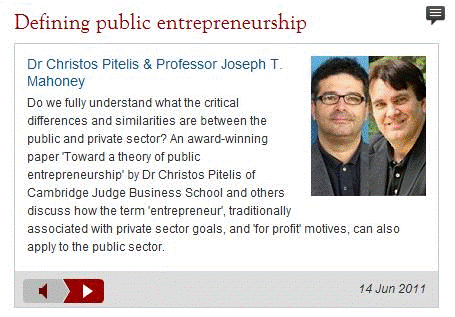
Here’s a podcast with my colleagues and good friends Joe Mahoney and Christos Pitelis on public entrepreneurship, part of an ongoing research project on public-private boundaries. Check it out!
Blessed Anonymity
| Peter Klein |
Critics of the market, from Marx and Karl Polanyi to Alasdair MacIntyre, John Gray, Robert Putnam, and some contemporary sociologists, decry the anonymity of commercial relations. Strong, local, community ties, they complain, are being displaced by long-distance, ad hoc, impersonal, weak ties. “Increasingly,” writes anthropologist Stephen Gudeman, “we commoditize things, leisure, body parts, reproductive capacities, DNA, and social relationships. As people flock to cities, sell their hardwood trees, change clothing styles, and watch television, community . . . shrinks.” (Thanks to Virgil Storr for this and many other good references.)
One response is to invoke Mises’s idea that social cooperation under the division of labor is actually the foundation of community. “The fundamental facts that brought about cooperation, society, and civilization . . . are the facts that work performed under the division of labor is more productive than isolated work and that man’s reason is capable of recognizing this truth” (Human Action, p. 144). Writers like Thomas Sowell and Walter Williams argue, for example, that the growth of the market stymies racism and other forms of prejudice.
Last week’s Economist had an interesting piece on supermarkets that brought these arguments to light:
The nostalgics don’t even have their history right. A big research project at the universities of Surrey and Exeter is currently studying shopping in post-war England. For one thing, high streets were not as quaint as politicians think. As far back as 1939, chain stores and co-operative (ie, mutual) retail societies already controlled about half of the grocery market. It was middle class matrons, the sort who dressed up to go shopping, who missed the deference shown by traditional grocers. Supermarkets were often welcomed by younger and working-class women. A retired secretary interviewed by the project recalled, as a young bride, asking the butcher for a tiny amount of mince. “Oh, having a dinner party, madam?” he sneered. A woman who bought anything expensive or unusual risked disapproving gossip, spread by shop assistants. The project
found press advertisements promoting the anonymity of supermarkets, as well as their convenience.
Some of you will remember a scene from Woody Allen’s Bananas, which also illustrates this point nicely.
Do Senior Managers Make Better Decisions Than Students?
| Nicolai Foss |
Even management students may occasionally suffer from confidence and self-esteem problems. I have had many students confide that they were more than a little scared at the prospect of landing a real job where their decision-making skills would be compared to older, wiser, smarter, etc. colleagues. Rather than directing them to this site, in the future I am going to give such students a copy of Gary E. Bolton, Axel Ockenfels and Ulrich Thonemann’s “Who Is the Best at Making Decisions? Managers or Students?” They set up a simple experiment based on a simple profit maximizing problem, and find that practitioner performance isn’t as good as graduate business students’. Moreover, the learning curve of the latter is steeper than that of practicioners. (more…)
More on Free Speech
| Nicolai Foss |
We have blogged a number of times in the past on (the economics of) free speech. John Stuart Mill is, of course, the towering figure when it comes to philosophical defenses of free speech. Here is a recent working paper, “Speech, Truth, and Freedom: An Examination of John Stuart Mill’s and Justice Oliver Wendell Holmes’s Free Speech Defenses,” that compares Mill with Holmes’ views, undertakes a dehomogenization exercise, and argues that their different free speech positions are rooted in different underlying views of liberty. For free speech afficionados, perhaps, but still recommended.
Upcoming Conferences
| Peter Klein |
- ISNIE, 16-18 June in Palo Alto. Registrations are closed but latecomers could try lobbying the Treasurer to accept a late payment — never mind, that’s me, don’t bother.
- “Open Source, Innovation, and New Organizational Forms,” 1 August in Johannesburg. “This first IPEG conference intends to explore new theoretical and empirical advances in open source organization: the interest is not just on voluntary Open Source Software production and its potential innovation implications, but also on such related ‘open source’ phenomena as collective invention, online collaboration (e.g., Wikipedia), online social networking (e.g., Facebook), open innovation, open science, open source biology, and open standards.” The conference website is not live as of this posting, but organizer Giampaolo Garzarelli can provide details. O&M’s Dick Langlois is a keynote speaker. 500-word abstracts are due 24 June.
- “Achieving Coexistence of Biotech, Conventional & Organic Foods in the Marketplace,” 26-28 October in Vancouver. Speakers include FAO Deputy Director General Ann Tutweiler and Canadian Ag Minister Gerry Ritz. Coexistence conferences have been held every other year since 2003; the first 3 conferences came out of EU Commission efforts, the next was in Australia, and this one is the first to be held in North America. A co-organizer tells me “we hope to bring a more ‘practical’ view of coexistence than is commonly held in Europe.”
Incomplete Contracts and the Theory of the Firm
| Peter Klein |
 A very useful survey article from the Spring 2011 Journal of Economic Perspectives: “Incomplete Contracts and the Theory of the Firm: What Have We Learned over the Past 25 Years?” by Philippe Aghion and Richard Holden. From the introduction:
In the first section of this paper, we spell out Grossman and Hart’s argument using a simple numerical example, then then we show how the incomplete contracts approach can be extended beyond the firms’ boundaries issue to analyze firms’ internal organization; firms’ financial decisions; the costs and benefits from privatization; and the organization of international trade between inter- and intrafirm trade. In the second section, we discuss several criticisms of the incomplete contracts/property rights methodology, especially what we call the “implementation criticism,” and then we briefly review some recent developments of the incomplete contracts approach.
I plan to use it in “Economics of Institutions and Organizations” this fall.
Update: Thanks to Stéphane Saussier for the pointer to the upcoming conference, Grossman and Hart at 25, June 24-26 in Brussels.
An Ancient Rejection Letter
| Peter Klein |
Via Josh Gans, here’s the response from Geometrika: A Most Prestigious Journal with Really Special Referees to poor Ptolemaeus, regarding his submitted paper, “An Argument that the Earth Is Round, and a Method to Determine its Circumference.” Sadly, the reviewers were not impressed, one feeling that “the idea that the Earth is round is both (i) too simple and well known to be really surprising and worth of publication, and (ii) utterly deceptive, misleading and wrong.” The editor’s skillful close:
I am sorry to bring you what must be disappointing news. Please keep in mind that we can only publish less than 8 percent of submissions. I also hope that the brilliant comments of the referees will help you to revise this paper for a submission to a more appropriate eld journal, such as Forms of Miscellaneous Objects or Maritime Inquiries.
On the bright side, I feel that you must now be in the mood of refereeing a few papers for our great journal. I will not tell you, which, if any, of the attached papers is authored by referees 1 to 3, but you can of course guess. I would have liked to receive your reports on these papers by yesterday, so you can also consider this letter as your rst reminder notice for these reports.
HRM in Film
| Peter Klein |
It isn’t every day you can blog about a film called The Human Resources Manager so, well, here it is:
A touching black comedy with a heart of gold, The Human Resources Manager is the story of a jaded and grumpy HR Manager stuck with the duty of delivering the corpse of a former employee to her estranged Eastern European family for burial. . . .
The film is part road trip journey, but it’s mostly a character study of the unnamed worker bee who works as the HR Manager at a large bakery in Israel. When an employee turns up dead in a car bomb explosion, the media links the worker to the bakery. After a defamatory article against the treatment of the deceased employee breaks, the company assigns our reluctant hero, the HR Manager, to band-aid the situation. This means setting the record straight with the press, a particularly suspect tabloid reporter, and making his company look thoughtful and decent. Soon the man finds himself lugging the corpse and coffin around town looking for a next of kin to relieve him of his duty.
I’m putting it on my Netflix list, and considering it for classroom use!
Anti-Williamson
| Peter Klein |
Thanks to Per for reminding me of this 2004 paper by Daniel Ankarloo and Giulio Palermo, “Anti-Williamson: A Marxian Critique of New Institutional Economics” (Cambridge Journal of Economics 28, no. 3). It’s one thing to question Williamson’s behavioral assumptions and to complain about their implications for education and business practice. But apparently “Williamson’s categories, his method and conception are themselves products of bourgeois ideology.” Who knew?
Bonus: Here’s Doug North getting the same treatment. And if anyone thinks I don’t take Marx seriously, let me say that I once mitigated a contractual hazard in my pajamas — how it got in my pajamas I’ll never know.





 Organizations and Markets
Recent Comments