ISNIE Annual Conference, Stanford University, June 16–18
| Scott Masten |
The 15th Annual Conference of the International Society for New Institutional Economics will be held this year at Stanford University on June 16-18. The conference is being organized by President-Elect Barry Weingast, and my inside, not-yet-public information is that the conference will have two very interesting keynotes. The ISNIE website has the just-released Call for Papers.


Organizing for Synergies
| Peter Klein |
Thanks for Mike S. for the pointer to this paper (published version here, ungated version here):
Organizing for Synergies
Wouter Dessein, Luis Garicano, and Robert GertnerLarge companies are usually organized into business units, yet some activities are almost always centralized in a company-wide functional unit. We first show that organizations endogenously create an incentive conflict between functional managers (who desire excessive standardization) and business-unit managers (who desire excessive local adaptation). We then study how the allocation of authority and tasks to functional and business-unit managers interacts with this endogenous incentive conflict. Our analysis generates testable implications for the likely success of mergers and for the organizational structure and incentives inside multidivisional firms.
This is an understudied topic in organizational design, I think. The large literature on the M-form, going back to Chandler and Williamson and flourishing in the 1970s and 1980s, compared functional to business-unit managers across organizations, but said much less about mixing them within organizations. The modern internal capital markets literature focuses on information problems between division heads and the central office, and conflicts over resources among division heads, but not the issues raised here by Dessein, Garicano, and Gertner. The vertical integration literature, as well, tends to treat firm-wide support services as peripheral to the incentive conflicts between vertically related divisions.
Economic Growth Quote of the Day
| Peter Klein |
The path of economic progress is strewn with the wreckage of failures. Every business man knows this, but few economists seem to have taken note of it. In most of the theories currently in fashion economic progress is apparently regarded as the more or less automatic outcome of capital investment, “autonomous” or otherwise. Perhaps we should not be surprised at this fact: mechanistic theories are bound to produce results which look automatic.
— Ludwig Lachmann, Capital and Its Structure (1956), pp. 36-37.
Famous Figure Omission
| Scott Masten |
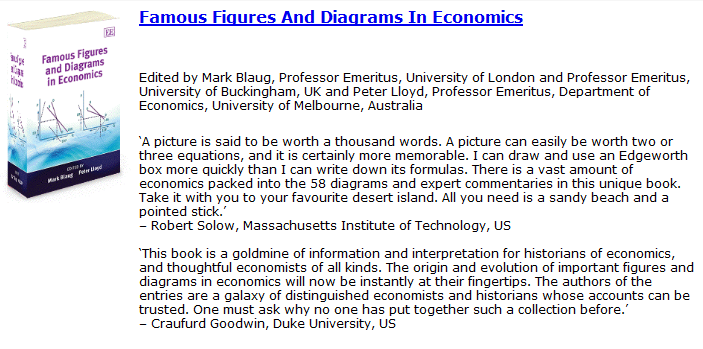
My inbox today contained an advertisement for a new Elgar publication: Famous Figures and Diagrams in Economics:
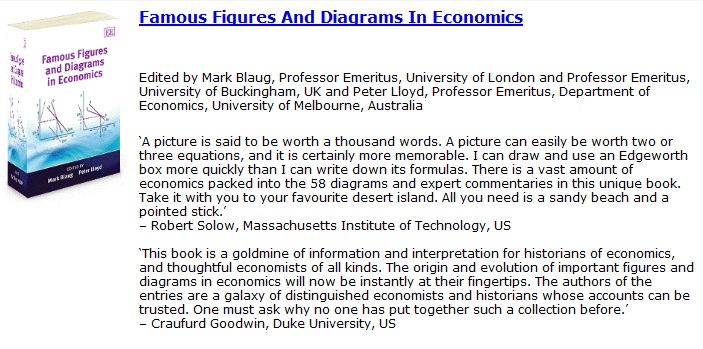
I’m sure that everyone in the O&M-isphere will agree that such a volume is incomplete without (more…)
Unrelated Diversification, circa 1971
| Peter Klein |
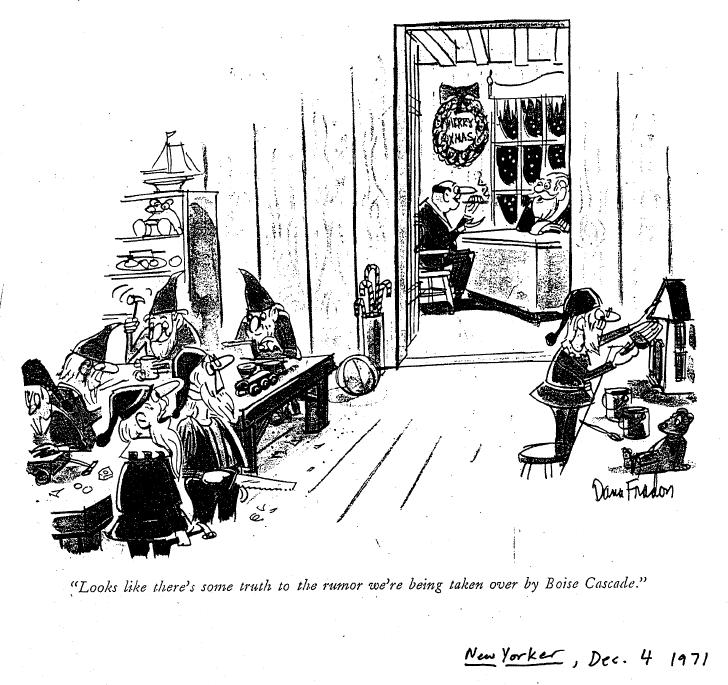
A funny (to me) New Yorker cartoon about diversification, appearing at the height of the conglomerate merger wave of the late 1960s and early 1970s. Click to enlarge. (I’ve been looking for this for a while; found it when cleaning out an old file cabinet.)
The Value of Steve Jobs
| Peter Klein |
As you have likely heard, Steve Jobs is taking an indeterminate leave of absence from Apple to deal with his continuing health problems. How will this affect Apple? How important is one person — albeit the founder and CEO — to a diversified multinational company with tens of thousands of employees? Apple’s stock slipped slightly on the news of Jobs’ leave (down 2.3 percent today, the first trading day after the announcement), but Jobs’s health problems are well known and Apple’s stock price presumably already included a discount reflecting the possibility he’d step down. To estimate the value of a particular employee to the firm in this way, we need an unanticipated departure, one that isn’t a response to poor performance and isn’t expected in advance.
Sure, enough, there’s an app for that — I mean, there’s a literature on that. An influential 1985 paper by Bruce Johnson, Robert Magee, Nandu Nagarajan, and Harry Newman looked at stock-price reactions to CEO deaths by plane crash, finding positive announcement effects for founders and negative announcement effects for professional managers. (One way to handle the founder-succession problem!) Macabre, I know, but nonetheless a clever way to deal with endogeneity. Naturally, this paper spawned a follow-up literature. Rather than cite the papers myself, I’ll just block quote a paper by Bang Dang Nguyen and Kasper Meisner Nielsen presented at last week’s AEA meeting, “What Death Can Tell: Are Executives Paid for Their Contributions to Firm Value?” and you can chase down the references on your own: (more…)
Guilt by Association?
| Peter Klein |
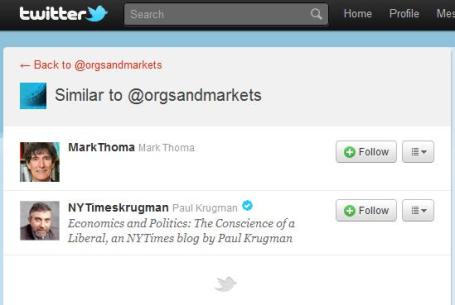
You may know that we have a Twitter feed, @orgsandmarkets. Twitter recently added a recommendation feature, “Similar to,” showing feeds its software judges similar to a given feed. See below what Twitter deems similar to O&M. I don’t mind being associated with Mark Thoma, who seems like a good guy even though I usually disagree with him, but that other one? I’m offended!
University Restructuring, Agricultural Economics Edition
| Peter Klein |
The current issue of AAEA Exchange, the newsletter of the Agricultural and Applied Economics Association (formerly American Agricultural Economics Association), features three perspectives on the long-term viability of maintaining separate departments of economics and agricultural economics. (Much of the discussion would apply to business economics departments too.) Ron Mittelhammer of Washington State argues for consolidation, Ken Foster of Purdue for keeping separate departments, and Rob King of Minnesota for the transformation of agricultural economics departments to applied economics departments.
The issues are organizational and strategic and familiar to O&M readers. Mittelhammer emphasizes tangible resources and a shared intellectual heritage and downplays accumulated routines and capabilities, organizational culture, etc.:
Arguably above all other rationale, mergers are also warranted because, fundamentally, economics is economics. Agricultural economics is a field of economics, not some other paradigm of economics, and is no more distinct from its parent discipline than other fields such as labor economics, international economics, health economics. . . .
Too often of late, it appears that the last ditch attempt at justifying the separation of economic units degenerates to the issue of faculty personalities, the correlated issue of seemingly unbridgeable differences in “professional cultures,” and the fear of open faculty warfare that might be ignited by a merger, rather than the existence of truly distinct and defensible differences in the methodologies used to do economic analysis in agricultural and applied, versus the “other” economics disciplines. (more…)
Economics of Wikipedia
| Peter Klein |
 Wikipedia turns ten today, as you’ve no doubt heard. Most Wikipedia content is recycled, so let me honor the subject by recycling an old O&M post: “Hayek and Wikipedia.” The relationship between the Wikipedia model and Hayek’s concept of dispersed, tacit knowledge, exploited through decentralized decision-making, is perhaps to obvious to note, but consider it noted. See also this Reason piece which emphasizes the Hayek connection. (Of course, in Hayek’s model, information is communicated and actions coordinated through changes in market prices, a feature absent from systems like Wikipedia.) You may also amuse yourself with other old O&M posts about tacit knowledge.
The Internet, circa 1972
| Peter Klein |
Very cool 1972 ARPANET diagram, via Gizmodo, which notes: “It’s pretty amazing to think that this smattering of cables turned into the bizarre, twisted, incredibly complex nebula of porn, parody, knowledge hatred, joy, and cat videos we now adore.”

I imagine the network effects (or, if you like, network externalities) were substantial, despite the small number of nodes. (But these guys were way behind the Victorians.)
For semi-informed musings about the origins of the Internet, and what this implies for organizations and markets, look here.
Remediableness Quote* of the Day
| Scott Masten |
In the matter of reforming things, as distinct from deforming them, there is one plain and simple principle; a principle which will probably be called a paradox. There exists in such a case a certain institution or law; let us say, for the sake of simplicity, a fence or gate erected across a road. The more modern type of reformer goes gaily up to it and says, “I don’t see the use of this; let us clear it away.” To which the more intelligent type of reformer will do well to answer: “If you don’t see the use of it, I certainly won’t let you clear it away. Go away and think. Then, when you can come back and tell me that you do see the use of it, I may allow you to destroy it.”
— G.K. Chesterton, The Thing (1929)
*Shouldn’t it be quotation of the day?
New Coase Interview
| Peter Klein |
In conjunction with Ronald Coase’s new book on China, he’s given a new interview to his co-author Ning Wang. (HT: Paul Walker via Mike Giberson.) Excerpt:
WN: You mentioned many times that you do not like the term, “Coasean economics,” and prefer to call it simply the “right economics” or “good economics.” What separates the good from bad, the right from wrong?
RC: The bad or wrong economics is what I called the “blackboard economics.” It does not study the real world economy. Instead, its efforts are on an imaginary world that exists only in the mind of economists, for example, the zero-transaction cost world.
Ideas and imaginations are terribly important in economic research or any pursuit of science. But the subject of study has to be real.
I’m sympathetic to this, but with some methodological reservations, expressed at the end of this post. Anyway, the interview focuses on China, its future economic prospects and likely influence, and the newly formed Coase China Society. Coase is bullish on China: “In the past, economics was once mainly a British subject. Now it is a subject dominated by the Americans. It will be a Chinese subject if the Chinese economists adopt the right attitude.” (more…)
CFP: Hayek and Behavioral Economics
| Peter Klein |
Forwarded on behalf of Roger Frantz:
CALLL FOR PAPERS
“Hayek and Behavioural Economics” (2011). Palgrave Macmillan. Vol 4 of Archival Insights into the Evolution of Economics. Robert Leeson Series Editor. Vol 4 editors, Roger Frantz and Robert Leeson.
Papers on all aspects of Hayek’s work as it relates to behavioral economics defined broadly which includes but not limited to economics and psychology, neuroeconomics, and topics in the history of economic thought.
Papers will be due by the summer of 2011. Send inquiries and an abstract to Roger Frantz (rfrantz@mail.sdsu.edu) or Robert Leeson (rleeson@stanford.edu).
History of Economic Thought Revival?
| Peter Klein |
More on the AEA meetings: I didn’t attend enough sessions to get a feel for overall directions and trends, but David Warsh (via Lynne) detected a revival of interest in the history of economic thought:
Interesting, too, was the undercurrent to be found in many conversations of interest in the history of economics itself. History of economic thought — or history of science, if you prefer — is a subject that has all but disappeared in the last thirty years as a topic of major research interest or as a subject of courses in top graduate schools — precisely the period of economic triumphalism.
I certainly can’t prove a resurgence of interest in economics past as it bears upon the present, or even document it beyond a few suggestive facts. The history of thought sessions in the meetings proceeded in their customary grooves — a retrospective on the rational expectations assumption fifty years after it was introduced, Irving Fisher’s The Purchasing Power of Money at one hundred.
But there were portents of change in at least one session on “rethinking the core” of graduate education. James Heckman, of the University of Chicago, endorsed the possibility of restoring to the graduate curriculum high-level elective courses in the history of economic thought. “People in the past were smart and they made mistakes and had insights,” he said afterwards. “We have sometimes forgotten the insights and we have sometimes repeated the same mistakes.”
An interesting challenge to what Murray Rothbard called the “Whig theory” of science, the view that dominates contemporary research in most of the social sciences.
Entrepreneurship Lives!
| Scott Masten |
At the ASSA meetings in Denver this weekend, O&M impresario Peter Klein gave a typically (for him) enlightening and entertaining presentation on “Institutions and Entrepreneurial Opportunities: A New Approach.” (An audience member gushed afterward that it was one of the best presentations she had ever seen. Perhaps Peter can provide a link to the paper.) To illustrate one of his points, Peter used images of ruins from once-glorious buildings in Detroit such as this one:

Peter’s point was that, though on its face, such abandoned structures would appear to present unrealized entrepreneurial opportunities, such opportunities were probably illusory in light of Detroit’s decline.
In fact, Peter, in a rare lapse, simply failed to look deeply enough into the question. Entrepreneurship is alive and well even in Detroit! (more…)
Impressive Lunch Bunch
| Peter Klein |
Whenever the economics Nobel goes to an American, the AEA has a luncheon at the next (year+1) annual meeting, and this year the 2009 recipients were honored. Elinor Ostrom was unable to attend, so Oliver Williamson was the lone honoree. Avinash Dixit gave a nice talk summarizing Ostrom’s and Williamson’s achievements and Williamson offered some informal, personal remarks.
The head table, pictured below — sorry for the poor picture quality, my phone is megapixel-challenged, but you can click to enlarge — seated an impressive bunch: Bengt Holmström, Bob Hall, David Teece, Paul Joskow, Carl Shapiro, Steve Tadelis, Pablo Spiller, Orley Ashenfelter (behind podium), Avinash Dixit (at podium), Williamson, Gérard Roland, John Morgan, Dale Mortensen, Jackson Nickerson, Scott Masten, and David Kreps.
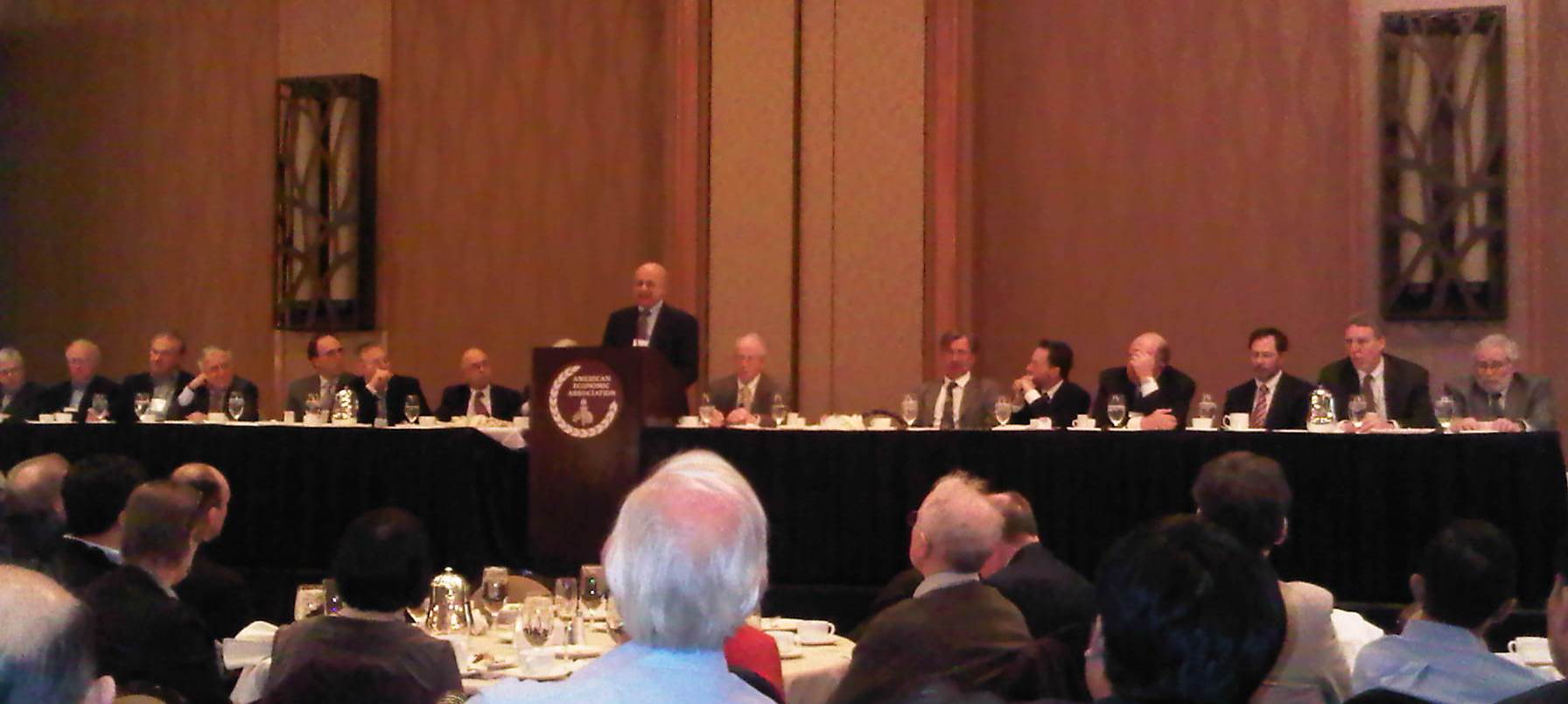
To my knowledge the only blogger among that group is our own Scott Masten, making O&M the sole blog represented on the panel. Take that, self-styled rivals!
AEA Papers on Organizations, Institutions, and Entrepreneurship
| Peter Klein |
O&M readers attending the American Economic Association annual meeting in Denver may find these papers of particular interest:
Industrial Policy, Entrepreneurship, and Growth
PHILIPPE AGHION (Harvard University)Does Management Matter: Evidence from India
NICHOLAS BLOOM (Stanford University)
BENN EIFERT (University of California-Berkeley)
APRAJIT MAHAJAN (Stanford University)
DAVID MCKENZIE (World Bank)
JOHN ROBERTS (Stanford University)Efficiency and Adaptation in Organizations and Institutions
PETER G. KLEIN (University of Missouri-Columbia)
JOSEPH T. MAHONEY (University of Illinois)
ANITA M. MCGAHAN (University of Toronto)
CHRISTOS N. PITELIS (University of Cambridge)The Coevolution of Culture and Institutions in Seventeenth Century England
PETER MURRELL (University of Maryland) (more…)
The Future of Managerial Economics
| Peter Klein |
The December 2010 issue of Managerial and Decision Economics features an editorial by Paul Rubin and Tony Dnes on the state of the field, “Managerial Economics: A Forward Looking Assessment.” As they note, the “traditional approach” — basically applied neoclassical microeconomics, production theory in particular — has been augmented by new developments,
particularly in areas such as globalization, the economics of organization, information economics, strategic behavior, the learning organization, risk management, business ethics, and behavioral economics. All of these topics are hot in modern managerial economics and are slowly feeding through into MBA and similar courses.
The modern trends are often referred to as “the new managerial economics.” Some modern texts even use the term explicitly (Boyes, 2008) and focus on questions of “organizational architecture” including areas such as incentive structures in personnel economics. There are increasing numbers of specialist works emerging in these areas, which are coming to feature in influential handbooks (Lazear, 2009). Personnel economics, for example, applies economics to human resources topics, including information interactions, problems of team coordination, morale, and seniority systems. . . . In managerial terms, this field is a natural development of the economics of organization and of labor economics, and we hope to see much future research coming through. (more…)
Why Do Bad Ideas Spread? Luzzetti and Ohanian on the Rise and Fall of Keynesianism
| Peter Klein |
O&M generally takes a dim view of Keynesian economics. And yet Keynesianism triumphed after WWII and, while mostly dormant among academics from the 1970s to the 2000s, made a sweeping comeback over the last 2-3 years. If we anti-Keynesians are so smart, why is Keynesianism so popular?
This is an important question for the history, philosophy, and sociology of science, and we’ve addressed it before. Keynesianism appeals to fine-tuners, is easily formalized, appeared to “work” during and after WWII, has a “progressive” and “scientific” veneer, and justifies policies that governments have long championed (but all serious economists opposed).
Matthew Luzzetti and Lee Ohanian propose a similar narrative in their new NBER paper, “The General Theory of Employment, Interest, and Money After 75 Years: The Importance of Being in the Right Place at the Right Time.” In a nutshell, Keynesianism told people what they wanted to hear, gave them hope that the “new” economics could cure the Depression and bring long-term prosperity, worked well with the new empirical methods appearing in the 1940s and 1950s, and seemed consistent with observation. By the 1970s, however, the situation became almost reversed, and Keynesianism was dumped by the research community. Here’s an excerpt from the introduction: (more…)
Top Posts of 2010
| Peter Klein |
 Our most popular post published in 2010:
- Summary of Dodd-Frank Act
- Management Journal Impact Factors 2009
- Intellectual Steam
- How to Read an Academic Article
- The Era of Laissez-Faire?
- Does Behavioral Economics Offer Anything New and True?
- Pomo Periscope XX: Thomas Basbøll vs. Karl Weick
- Political and Methodological Individualism
- The Role of Assumptions in Management Research
- Ig Nobel Economics and Management Prizes
- Assessing the Critiques of the RBV
- PowerPoint Version of “I Have a Dream”
- Teaching Analytical Writing
- Ronald Coase’s New Book
- Isomorphism in Higher Education
Thanks to all our readers, commenters, linkers, lurkers, secret admirers, public admirers, etc. for a great 2010!





 Organizations and Markets
Recent Comments