Blogs About Organizations
| Peter Klein |
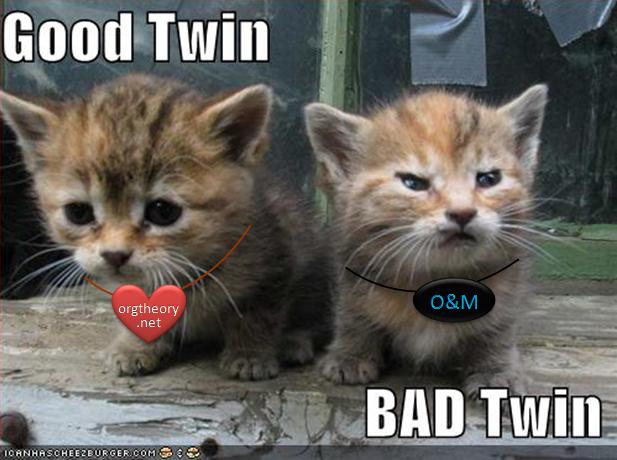
Who’s more fun? Good Spock or Evil Spock? Bedford Falls or Pottersville? The Narrator or Tyler Durden? Orgtheory.net or Organizations and Markets? As Dick Vitale would say, “Are you serious?” (Thanks to SL for the image.)
The Modern University
| Peter Klein |
[I]f you were starting a top university today, what would it look like? You would start by gathering the very best minds from around the world, from every discipline. Since we’re living in an age of abundant, not scarce, information, you’d curate the lectures carefully, with a focus on the new and original, rather than offer a course on every possible topic. You’d create a sustainable economic model by focusing on technological rather than physical infrastructure, and by getting people of means to pay for a specialized experience. You’d also construct a robust network so people could access resources whenever and from wherever they like, and you’d give them the tools to collaborate beyond the lecture hall. Why not fulfill the university’s millennium-old mission by sharing ideas as freely and as widely as possible?
What would this modern university look like? It certainly wouldn’t resemble Harvard or Swarthmore or Michigan or Texas A&M. It would look like TED, profiled in this month’s Fast Company. Or Wikiversity or the Mises Academy or some nonprofit or for-profit alternative we haven’t heard of yet.
See also: “Are Universities Worth It?”
Analyzing the WikiLeaks Data
| Peter Klein |
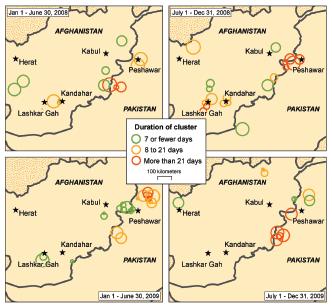
Once more on WikiLeaks: A team of University of Colorado researchers has already produced a geospatial analysis of the incident reports contained in the dataset. “By mapping the violence and examining its temporal dimensions, the authors explain its diffusion from traditional foci along the border between the two countries. While violence is still overwhelmingly concentrated in the Pashtun regions in both countries, recent policy shifts by the American and Pakistani governments in the conduct of the war are reflected in a sizeable increase in overall violence and its geographic spread to key cities. . . .” This is exactly the kind of analysis the military intelligence agencies are not doing, or at least not sharing.
Economists, geographers, entrepreneurship and innovation researchers, and other social scientists have a lot of expertise in network and cluster analysis. Why not turn them loose on these kinds of raw data? It’s also cheap: as Karen Kwiatkowski notes, “[t]he study was honestly, scientifically, and nimbly completed and published at no direct cost to the intelligence community. It was made possible by the decentralization, fluidity, and constant sharing and shifting of roles and responsibilities that comprise the Internet.”
Law School for Economists
| Peter Klein |
Via Josh Wright, here’s an announcement for the Levy Fellowship at George Mason University School of Law. It’s a program to support PhD economists (and ABDs) pursuing law degrees. These days, a JD and a PhD are pretty much required for an academic post at a good law school, so check it out if you’re interested in teaching. After all, the world clearly needs more economists and more lawyers. . . .
Bruce Caldwell on The Road from Mont Pèlerin
| Peter Klein |
 Don’t miss Bruce Caldwell’s review of Philip Mirowski and Dieter Plehwe, eds., The Road from Mont Pèlerin: The Making of the Neoliberal Thought Collective (Harvard, 2009). “Mont Pèlerin” refers, of course, to the Mont Pèlerin Society, the association of classical liberal academics and journalists founded by Hayek in 1947. Bruce finds the volume informative, despite its frequently disdainful tone toward its subjects. He also raises an important general point, one that I’ve wrestled with a lot since the financial crisis: does anybody listen to us?
The second question [raised by the book] has to do with the potency of intellectuals to shape world events or, more narrowly, even economic and social policy. It is evident that members of the Mont Pèlerin Society, for all of their diversity, still preferred some form of liberalism . . . to other ways of organizing economic and political affairs. But how important were they in the emerging global consensus that began in the 1980s in favor of trade liberalization and privatization? Were not, for example, the dismal performance of Keynesian demand management policies in the United States, Britain, and elsewhere in the 1970s; the heavy-handed actions of the trade unions in Britain during the “Winter of Discontent”; the sclerotic performance of countries like India who had embraced a modified version of the planning model for their own; and, of course, the patent economic and political failures of the East Bloc, far more important in turning the tide, however briefly, towards globalization? Was not George Stigler (himself a founding member of the Society) right in his comment about economists that “our influence appears to be powerful only when we support policies ripe for adoption” (Stigler 1987, p. 11)?
ScienceCodex
| Nicolai Foss |
ScienceCodex is the name of a great resource for serious procrastination, amusement, and — sometimes — useful inputs to research and teaching. Signing up for the feed will result in about 20 daily pieces of science news, and, at least for me, a couple of them are usually great fun and potentially useful for teaching. For example, those who teach OB or HRM may find this piece, “Over 50? You probably prefer negative stories about young people,” useful for classroom discussion. There are also potentially offensive stories (e.g., “You Kick Like a Girl“), so be forewarned ;-)
Chris Coyne’s Austrian Course
| Peter Klein |
Earlier I shared the reading list for my graduate course in the Austrian school of economics. Chris Coyne is teaching a similar class and has posted his syllabus here. Chris’s course is laid out differently than mine, with a different mix among types of readings, but I like what he’s done. As Pete Boettke and Joe Salerno have noted, the diversity and variety of course offerings and educational programs in Austrian economics is a sign of the health and vitality of the school.
How to Read an Academic Article
| Peter Klein |
This fall I’m teaching “Economics of Institutions and Organizations” to first-year graduate students. The reading list is rather heavy, compared to what most students are used to from their undergraduate courses and their first-year courses in microeconomics, econometrics, etc. I explain that they need to become not only avid readers, but also efficient readers, able to extract the maximum information from an academic article with the least effort. They need to learn, in other words, the art of the skim.
When I’ve explained this in the past, students have responded that they don’t know how to skim. So a couple years back I put together a little handout, “How to Read an Academic Article,” with a few tips and tricks. I emphasize that I don’t mean to be patronizing, and that they should ignore the handout if its contents seem painfully obvious. But students have told me they really appreciate having this information. So, I reproduce the handout below. Any comments and suggestions for improvement?
How to Read an Academic Article
- Caveat: no single style works for everyone!
- Klein’s basic steps for skimming, scanning, processing…
- Read the abstract (if provided)
- Read the introduction.
- Read the conclusion.
- Skim the middle, looking at section titles, tables, figures, etc.—try to get a feel for the style and flow of the article.
- Is it methodological, conceptual, theoretical (verbal or mathematical), empirical, or something else?
- Is it primarily a survey, a novel theoretical contribution, an empirical application of an existing theory or technique, a critique, or something else?
- Go back and read the whole thing quickly, skipping equations, most figures and tables.
- Go back and read the whole thing carefully, focusing on the sections or areas that seem most important.
- Once you’ve grasped the basic argument the author is trying to make, critique it!
- Ask if the argument makes sense. Is it internally consistent? Well supported by argument or evidence? (This skill takes some experience to develop!)
- Compare the article to others you’ve read on the same or a closely related subject. (If this is the first paper you’ve read in a particular subject area, find some more and skim them. Introductions and conclusions are key.) Compare and contrast. Are the arguments consistent, contradictory, orthogonal?
- Use Google Scholar, the Social Sciences Citation Index, publisher web pages, and other resources to find articles that cite the article you’re reading. See what they say about it. See if it’s mentioned on blogs, groups, etc.
- Check out a reference work, e.g. a survey article from the Journal of Economic Literature, a Handbook or Encyclopedia article, or a similar source, to see how this article fits in the broader context of its subject area.
Two Economics Papers About Culture
| Peter Klein |
The New Institutional Economics focuses mainly on formal rules, both “macro” (constitutions, legal systems, written languages) and “micro” (firms, contracts, other formal agreements). But there are many studies of informal or semi-formal constraints — norms, conventions, religion, belief systems, and other aspects of culture, broadly conceived. Given their commitment to methodological individualism, New Institutional Economists tend to explain the emergence and stability of these phenomena as the consequences — typically unintended — of purposeful individual choices (which distinguishes us from our colleagues on the other side of the aisle). (Culture is important within organizations, as well as between them, though attempts to explain organizational culture in this manner have been less successful.)
Does Culture Matter?
Raquel FernándezThis paper reviews the literature on culture and economics, focusing primarily on the epidemiological approach. The epidemiological approach studies the variation in outcomes across different immigrant groups residing in the same country. Immigrants presumably differ in their cultures but share a common institutional and economic environment. This allows one to separate the effect of culture from the original economic and institutional environment. This approach has been used to study a variety of issues, including female labor force participaiton, fertility, labor market regulation, redistribution, growth, and financial development among others.
Do Social Connections Reduce Moral Hazard? Evidence from the New York City Taxi Industry
C. Kirabo Jackson, Henry S. SchneiderThis study investigates the role of social networks in aligning the incentives of economic agents in settings with incomplete contracts. We study the New York City taxi industry where taxis are often leased and lessee-drivers have worse driving outcomes than owner-drivers as a result of a moral hazard associated with incomplete leasing contracts. Using instrumental variables and fixed-effects analyses, we find that: (1) drivers leasing from members of their country-of-birth community exhibit significantly reduced effects of moral hazard; (2) network effects appear to operate primarily via social sanctions; and (3) network benefits can help to explain the organization of the industry in terms of which drivers and owners form business relationships.
Department of “Duh”
| Peter Klein |
It must be acknowledged, however, that a researcher’s political ideology or vested interest in a particular theory can still enter even ostensibly descriptive analysis by the data set chosen for the research; the mathematical transformations of raw data and the exclusion of so-called outlier data; the specific form of the mathematical equations posited for estimation; the estimation method used; the number of retrials in estimation to get what strikes the researcher as “plausible” results, and the manner in which final research findings are presented.
That’s Uwe Reinhardt, writing a NY Times op-ed that could have been titled “A Mainstream Economist Tries to Come to Grips with Kaldor-Hicks Efficiency.” It’s actually a pretty thoughtful and informative discussion that exposes some of the fatal — to my mind, anyway — flaws of the Kaldor-Hicks concept. But Reinhardt implies, unfortunately, that virtually every economist accepts the Kaldor-Hicks principle as a normative standard. There is actually a fair amount of dissent, not only from Austrians but also from people like Jon Elster and John Roemer. As Gary Lawson notes in an excellent survey of welfare economics concepts, the Kaldor-Hicks criterion, in practice, is
as useless as Pareto superiority. Kaldor-Hicks efficiency purchases its coherence by requiring that compensation be hypothetically possible in such a way as to guarantee that each person, by her own standards, does not come away a loser, just as strict Paretianism requires that each person judge herself to be as well off or better off than before. All it takes to make the universe of Kaldor-Hicks-efficient transactions an empty set is one person who sincerely cannot be bought-that is, a person who values autonomy, either his own or that of others, so highly that no amount of after-the-fact compensation could possibly leave him as well off as he would have been had the loss never been inflicted. (without consent) in the first place. In a large population, no legal rule [or other reallocation of resources] will ever satisfy the Kaldor-Hicks efficiency criterion.
An Industry Study for the Beautiful People
| Peter Klein |
It’s Beauty Imagined: A History of the Global Beauty Industry by Geoffrey Jones (Oxford University Press, 2010). From the blurb:
This book provides the first authoritative history of the global beauty industry from its emergence in the nineteenth century to the present day, exploring how today’s global giants grew. It shows how successive generations of entrepreneurs built brands which shaped perceptions of beauty, and the business organizations needed to market them. They democratized access to beauty products, once the privilege of elites, but they also defined the gender and ethnic borders of beauty, and its association with a handful of cities, notably Paris and later New York. The result was a homogenization of beauty ideals throughout the world.
Sounds like a great study of entrepreneurship, industry dynamics, clustering and network effects, and the relationship between business and culture. Reviewer Ingrid Giertz-Mårtenson says it’s “one of the more fascinating stories in modern business history,” the journey of an industry once seen as “fickle, superficial, and feminine” to a “brand-driven global power house.” The book should make a beautiful addition to your collection!
Texting Victorians
| Peter Klein |
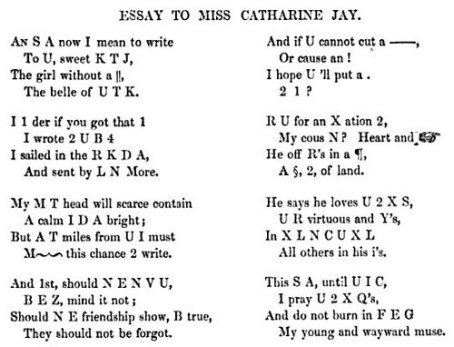
I knew that the Victorians had their own Internet, that information goods and open innovation are old hat, and that S-curves go back a hundred years. But apparently the Victorians used texting language too! We instruct our students to avoid it, but apparently Victorian poets thought writing I “love U 2 X S” or “U R virtuous and Y’s” was exceedingly clever. LOL! (Discovery! via Gizmodo.)
Austrian Economics PhD Course
| Peter Klein |
This semester I am teaching a PhD course in the Austrian school of economics. Here’s a preview. Visitors to Columbia, Missouri are welcome to sit in!
Excerpt from the syllabus:
It is difficult to cover an entire school of thought in one semester. Austrian economics, after all, is not an applied field like development economics or international trade policy or biotechnology but an alternative approach to all fields of economics. The course objective is not to provide a comprehensive review and critique of the entire Austrian tradition, but to give students a sampler of high-quality Austrian writings, classic and modern, on a variety of issues and topics. One goal is to show that while Austrian economists share a common conceptual framework, theoretical core, and historical context, the Austrian literature contains tremendous variety, both stylistic and substantive. Like any living, breathing tradition the Austrian literature continues to expand and diversify, often at a dizzying pace.
Add to: Facebook | Digg | Del.icio.us | Stumbleupon | Reddit | Blinklist | Twitter | Technorati
The Corporate Hierarchy Dies, Again
| Peter Klein |
Ronald Coase described his 1937 paper on the firm as “much cited, but little used.” He was referring to the academic literature, but these days it seems to apply to the popular press as well. Almost every week brings a new article on the death of the corporate hierarchy: you know, firms only exist to deal with transaction costs, and the Internet has reduced them to almost zero, so who needs firms? This argument shows up again and again. But it’s wrong. Of course there are transaction costs between firms (search, bargaining, enforcement). But there are also transaction costs inside firms (agency and information costs, the Misesian calculation problem). The firm straddles these margins. Both sets of transaction costs matter, and both can be reduced through technological change. Coase was not as clear on this point as he could have been, but Williamson has been explaining it for decades, in terms of “comparative contracting costs.” You have to compare both sets of costs, not just look at one. Why is it so hard to see?
Saturday’s WSJ gives us the latest version of the bogus argument, this time from Alan Murray. Same old story: Internet, transaction costs, Tapscott and Williams, wikipedia, yada yada yada. “Mr. Coase received his Nobel Prize in 1991 — the very dawn of the Internet age. Since then, the ability of human beings on different continents and with vastly different skills and interests to work together and coordinate complex tasks has taken quantum leaps. Complicated enterprises, like maintaining Wikipedia or building a Linux operating system, now can be accomplished with little or no corporate management structure at all.” Yawn. “[T]he trends here are big and undeniable. Change is rapidly accelerating. Transaction costs are rapidly diminishing. And as a result, everything we learned in the last century about managing large corporations is in need of a serious rethink.” Zzzzzzzzzzzzzzz. Mr. Murray, please read The Victorian Internet three times fast and have a report on my desk first thing in the morning. “The new model will have to be more like the marketplace, and less like corporations of the past. It will need to be flexible, agile, able to quickly adjust to market developments, and ruthless in reallocating resources to new opportunities.” Right, no corporations of the past ever tried to do this.
Add to: Facebook | Digg | Del.icio.us | Stumbleupon | Reddit | Blinklist | Twitter | Technorati
Note on Anonymous Comments
| Peter Klein |
 We interrupt our regular programming for a note from the site administrators: When you comment here at O&M, the server asks you for a name, email address, and (optionally) a URL. The email address is hidden (to protect your privacy), while the name and URL (if provided) are published with the comment. Rest assured that we keep your private information private — we don’t sell your email address to spammers, laugh about your funny username, or otherwise violate your dignity. But the server knows the email address you entered and the IP address whence you came, and provides this information to the site administrators and/or post author. In other words, even if you don’t use your real name, we probably know who you are!
Of course, anonymous comments are welcome (though the spam filter may hold them if they contain bad words or other stuff it doesn’t like). We understand that you may wish to use a pseudonym and keep your identity hidden from the wider world, and that’s fine. But I recently discovered that some commenters thought they were anonymous from us too, and that isn’t the case.
Add to: Facebook | Digg | Del.icio.us | Stumbleupon | Reddit | Blinklist | Twitter | Technorati
The Economics of Freedom of Speech
| Nicolai Foss |
Recent, uhhmm, debate here on O&M has made me wonder why we don’t have an economics of freedom of speech. Freedom of speech has been hailed as the fundamental hallmark of free, open societies and a fundamental human right. It is also clear that freedom of speech is under attack, not just by its traditional enemies within various fundamentalist factions of established religions and authoritarian, populist, and socialist/communist regimes, but also by the tendency to turn political disagreements into moral disagreements (in Europe, most prevalent among lefties who just don’t disagree with you but think you are downright evil in case you defend free markets, nuclear power, etc.).
Related to the latter point, increasingly individuals, groups, and nations define certain opinions, political positions, moral judgments, etc. as “hatecrimes.” This position seems increasingly influential in the EU. Proponents of the right to freedom of speech has countered that part of living in a free and open society is that there is simply no right to avoid insults, hurt feelings, and the like. For example, such arguments have been invoked here in Denmark in the aftermath of the Mohammed cartoon crisis, and are currently being leveled against DK legislation regulating blasphemous utterances. However, even the most ardent defenders of freedom of speech draw the line at the explicit verbal promotion of violence against others. And most defenders of freedom of speech would also argue that organizations and associations have the rights to regulate their members’ freedom of speech.
These are clearly externality and property rights issues, and would therefore seem to fall directly within the orbit of economic arguments. And yet, economists have had very little to say about freedom of speech. Specifically, negative or positive externalities are not conventionally seen as including the untraded effects of utterances. One of the few papers that have dealt with these issues, Coase’s “The Market for Goods and the Market for Ideas,” basically argues that if there is a case for regulating the market for goods, there is also a case for regulating the market for ideas (specifically, politicians — which admittedly adds to the attraction of the idea). (more…)
Experimental Philosophy
| Peter Klein |
 Experimental economics is mainstream, and is increasingly popular in management (as well as sociology, political science, criminology, etc.). Laboratory and natural experiments seem to fill more journal pages every year. Esther Duflo took home this year’s Clark Medal for her work on randomized controlled trials. Identification is all the rage in empirical social science, and who needs instrumental variables or fixed effects if you can force ceteris to be paribus through experimental design?
But wait a minute: philosophy? Apparently philosophers are getting into the game, via a new experimental philosophy movement (“X-Phi,” to the cool kids). The NYT Magazine surveyed the field a few years back, and this week’s this week’s “Room for Debate” asks important philosophers what they think. Note the wide range of opinions. My initial reaction was similar to Brian Leiter’s, namely that X-Phi is about being trendy, attracting funding, and keeping philosophy departments from being shredded by budget-conscious administrators. Academia, after all, is among the most faddish of the professions. But who knows. (Thanks to MLC for the link.)
Add to: Facebook | Digg | Del.icio.us | Stumbleupon | Reddit | Blinklist | Twitter | Technorati
One-Size-Fits-All Higher Ed?
| Peter Klein |
Alternative title: “An Economist Tries Talking to an English Professor, and Gives Up.” Perhaps one of you wants to take up the mantle over at UD?
The point, which I’ve raised in previous posts (e.g., here and here), is that higher education isn’t one, well-defined thing, but a variety of things, and we should welcome experimentation, innovation, and — well — diversity. Blockquoting myself:
“Diversity” is the primary mantra of higher-education institutions. So why not have some diversity in organizational forms? “Education,” after all, is not a homogenous good. As with healthcare, one size doesn’t fit all. Shouldn’t we encourage entry, and applaud entrants who experiment with alternative curricula, teaching methods, incentive structures, sizes, and shapes? Let a thousand pedagogic flowers bloom, I say!
Add to: Facebook | Digg | Del.icio.us | Stumbleupon | Reddit | Blinklist | Twitter | Technorati
Students: Do It for the Panda
| Peter Klein |
Words — and pictures — of wisdom for the new academic year:

An epic win, courtesy of FAIL Blog.
Add to: Facebook | Digg | Del.icio.us | Stumbleupon | Reddit | Blinklist | Twitter | Technorati





 Organizations and Markets
Recent Comments