Management Journal Impact Factors 2008
| Nicolai Foss |
The new ISI impact factors for 2008 have just been released. There are lots of surprises this time. The biggest one is arguably that Organization Science is now out of the top 10 range, a long drop from its #4 status in 2006 (this sucks when you got two recent papers, one forthcoming and one R&R, at this journal :-( ). The second surprise, at least to me, is that the Journal of Management has made it to #5. One possible explanation is its rather influential yearly review issues. Another surprise is that Organization Studies, which was among the top 10 in 2006, has now moved down a lot to close to #30. The Journal of Management Studies, while not among the top 10 this year, has not been harmed as badly, dropping to #14. ASQ, once the undisputed top-management journal, is now #9. Less surprising is Academy of Management Review’s #1 position (it is usually among the top 3), and that the Strategic Management Journal is #4.
The rank order down to LRP at # 36 is: AMR – AMJ – MIS Q – SMJ – JoM – ORM – JIBS – AMLE – ASQ – OBHD – RP – JPIM – Org. Sci. – JMS – RoB – JoM – JOperationsM – IMA – JMIS – Man Sci -DS – IRS – LQ – Omega – R&D Man – GOM – JIT – Techno. – Org. Stud. – Brit. JoM – Adv. Strat Man. – HBR – Int Small Bus. J – Int. J. Oper. Prod. M. – Int. J. Man. Rev. – Int. J of Forec. – LRP
A new feature of the list is the inclusion of a five-year impact factor which, given the rather turbulent movements from year to year, makes a lot of sense (and which produces a rather different rank order from the above!).
Show Us Some Love
| Peter Klein |
Thanks to Randy for these pictures of science-related tatoos. The phrase “beyond awesome” comes to mind. Who among you will be the first to get an O&M-themed body decoration?
Does Capitalism Suffer Cycles of Statism?
| Benito Arruñada |
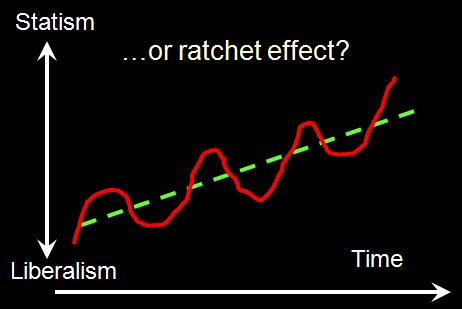
Does the current expansion of the State reverse a previous reduction, to be reduced once again in the future? Or, alternatively, is there a sort of ratchet effect, with a trend towards greater statism disguised by cycles along such increasing trend?
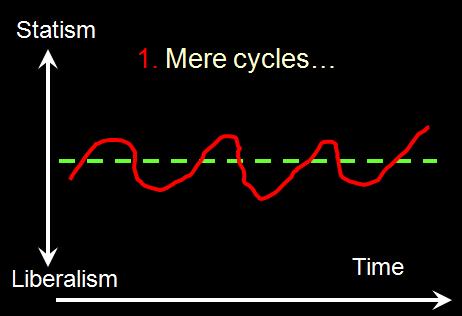 I am inclined to think that cycling has not taken place around a stationary average but around an increasing tendency (see the figures). But perhaps a better way of facing these questions would be to disaggregate in different dimensions. For instance, in several papers with Veneta Andonova we argue that freedom
  of contract has been in decline for more than a century in Western Law, both in civil- and common-law countries. Something similar could probably be said about trade, but in the opposite direction. However, in both freedom of contract and trade, it might be the case that exchange opportunities have expanded mainly as a result of technological change (e.g., cheaper transportation and communications), whatever the legal constraints. In terms of research, how could these trends be measured?
These thoughts were triggered by a timely and extremely suggestive paper by Witold J. Henisz presented at the Workshop on “Manufacturing Markets” organized last week in Villa Finaly, Florence, by Eric Brousseau and Jean-Michel Glachant. My next few blogs will address other aspects of Henisz’s views on the broader challenges facing capitalism.
Sameulson on the Crisis
| Peter Klein |
Is it wrong to pick on a 94-year-old? Mario Rizzo doesn’t think so, and neither do I — if it’s Paul Samuelson, perhaps the most influential economist of the twentieth century and bête noire to Austrians, libertarians, and many other types I hold near and dear. Samuelson, champion of “scientific” economics (i.e., the nineteenth-century physics model so effectively skewered by Phil Mirowski), the neo-Keynesian synthesis, and the everything-but-the-kitchen-sink approach to economics textbooks, now says prediction is impossible and deficit spending unsustainable. What’s next, a startling pronouncement that, contrary to what Samuelson wrote in the pre-1991 editions of his textbook, the Soviet Union was not actually more productive than the US?
Bonus Keynesian material (via Ross Emmett): Did Keynes die of a bad tooth?
Events @CBS
| Peter Klein |
I’ve just arrived in Copenhagen, where I’m spending a month as a visiting professor at the SMG. Copenhagen Business School has become one of the most intellectually exciting places in Europe. This week alone the school is hosting the DRUID summer conference which features people like Anita McGahan, Sid Winter, Will Mitchell, Russ Coff, Mike Ryall, and many others, along with a workshop on corporate governance with keynotes by Mark Roe, Randall Morck, Annette Poulsen, and Florencio Lopez-de-Silanes Molina. Of course these are only appetizers for the next week’s main course, the PhD seminar on The Theory of the Firm and Its Applications in Management Research conducted by Professors F. and K. Truly an embarrassment of riches!
If You’re So Smart …
| Nicolai Foss |
… that it makes sense to delegate a lot of decision-making authority to you when you perform as an agent for a principal, you may also be so smart that you can game the incentive plan. In “Ability and Agency Costs: Evidence From Polish Banking,” Douglas Frank and Tomasz Obloj, both INSEAD, argue (rightly, IMO) that the link between cognitive ability and agency costs has not yet been studied in agency theory. (more…)
Campello and Fluck
| Lasse Lien |
Here is a paper from 2006 by Maurillo Campello and Zsuzsanna Fluck that is even more interesting now than it was in 2006. If you are interested in the micro-implications of the current crisis, you’ll surely like this one.
Abstract: We model the interaction of product market competition and firms’ financing decision when firms face capital market imperfections and consumers face switching costs. In our model, consumers anticipate that capital market frictions may drive their supplier out of business and account for welfare losses that firm bankruptcy imposes upon them. Likewise, managers, when investing in long-term market share building, take into account the possibility of business failure and the residual value they may capture from the firm’s liquidation process. Our theory yields four central implications. In response to a negative shock to demand: (1) more leveraged firms will experience significant market share losses; (2) the market share losses of more leveraged firms will be more pronounced in industries where low debt usage is the norm; (3) the market share losses of more leveraged firms will be more pronounced in industries where consumers face higher switching costs; and (4) the market share losses of more leveraged firms will be magnified in industries where asset liquidation is less efficient. Using detailed firm- and industry-level data from U.S. manufacturers over the 1990-91 recession, we present empirical evidence supporting our model’s predictions. We later expand our empirical analysis, studying a large panel of firms over the various phases of the full business cycles contained in the 1976-96 period. Results from these broader tests provide additional evidence in support of our theory.
Factor-Biased Technological Change
| Dick Langlois |
Back in October, I blogged about Daron Acemoglu’s presentation at the Economic History Association meeting. There now seems to be an NBER working paper version of that talk, called “When Does Labor Scarcity Encourage Innovation?” Here is the abstract.
This paper studies the conditions under which the scarcity of a factor (in particular, labor) encourages technological progress and technology adoption. In standard endogenous growth models, which feature a strong scale effect, an increase in the supply of labor encourages technological progress. In contrast, the famous Habakkuk hypothesis in economic history claims that technological progress was more rapid in 19th-century United States than in Britain because of labor scarcity in the former country. Similar ideas are often suggested as possible reasons for why high wages might have encouraged rapid adoption of certain technologies in continental Europe over the past several decades, and as a potential reason for why environmental regulations can spur more rapid innovation. I present a general framework for the analysis of these questions. I define technology as strongly labor saving if the aggregate production function of the economy exhibits decreasing differences in the appropriate index of technology, theta, and labor. Conversely, technology is strongly labor complementary if the production function exhibits increasing differences in theta and labor. The main result of the paper shows that labor scarcity will encourage technological advances if technology is strongly labor saving. In contrast, labor scarcity will discourage technological advances if technology is strongly labor complementary. I provide examples of environments in which technology can be strongly labor saving and also show that such a result is not possible in certain canonical macroeconomic models. These results clarify the conditions under which labor scarcity and high wages encourage technological advances and the reason why such results were obtained or conjectured in certain settings, but do not always apply in many models used in the growth literature.
Peter L. Bernstein (1919-2009)
| Peter Klein |
I was saddened to learn (from Kenneth Anderson) that Peter L. Bernstein, author of Against the Gods: The Remarkable Story of Risk and other popular works, died June 5. Bernstein was a terrific writer and a clear and provocative thinker with a gift for making difficult concepts accessible. I was greatly influenced by an earlier book, Capital Ideas: The Improbable Origins of Modern Wall Street, which I came across in graduate school while searching for a dissertation topic. Bertstein’s characterization of the brokerage industry in the 1960s and early 1970s, before the deregulation of brokerage fees — an Old Boys Club, lacking competition and innovation — inspired me to examine the role of corporate internal capital markets in replicating the resource-allocation function normally performed by external capital markets, and how the growth and development of financial markets following liberalization contributed to the end of the conglomerate period.
Here are obituaries in the WSJ and NYT and here is Bernstein’s wiki.
Men of Few Words
| Peter Klein |
Those of you into Flesch-Kincaid scores and similar metrics probably appreciate men who can say a lot with a few words. The Bud Light “Dude” guy — whose Fog index, if my calculations are correct, is 1 — may be the best-known modern example:
He’s good, but before him there was Donnie Brasco:
Can your favorite academic writers be that parsimonious?
Fughetaboudit.
Mises and Hayek in Progress in Human Geography
| Nicolai Foss |
It is surprising, even bizarre, to see Mises and Hayek, as well as other luminaries of 20th-century classical liberalism, being extensively cited, quoted, and discussed in one of the leading geography journals, Progress in Human Geography (here is the wiki on the field of “human geography”), specifically in the form of the printed version of an invited lecture by Jamie Peck. (more…)
Sid Winter and Alice Rivlin on the Current Crisis
| Nicolai Foss |
Sidney G. Winter is a towering figure in management research, essentially being the current thought leader in the strategic management field as it pertains to issues of capabilities, routines, knowledge assets, etc. Most of his work in strategic management is founded on his earlier work in evolutionary economics (notably this seminal volume). Winter is married to Alice Rivlin, a long-time critic of Reagan-era economic policies and a high-ranking bureaucrat under Johnson and Clinton.
Here is Winter and Rivlin on “fixing the global financial system.” Winter thinks that business schools are partly to blame, but is not very concrete in his critique (at least he doesn’t blame agency theory). And here is Winter answering the question, “Is capitalism dead?” Note his comments about “people on the extreme right.” Neither Winter nor Rivlin leave much doubt about where they stand politically.
UPDATE: There is more Winter on YouTube: “Inflation or Deflation,” “Economic Cassandras,” and “The Price of Oil.” They are all very recent and done under the auspices of the Australian School of Business.
Is the Future in Contract Manufacturing?
| Benito Arruñada |
The purchase of Opel by Magna shows the strength of contract manufacturers and their strategies, which I discussed with Xosé H. Vázquez in our 2006 article in the Harvard Business Review. Once thought of as a lifebelt for the decreasing margins of large-brand owners, contract manufacturing has now become a major source of competition. Shanghai Automotive Industry Corporation (SAIC), which learned the business by producing initially for Volkswagen and GM, has actually started to sell its own cars in Europe and North America. It has even bought R&D knowledge, acquiring from bankrupt MG Rover the drawings needed to build the Rover 25, Rover 45, and Rover 75.
The economic crisis is accelerating this process. The need to liberate assets to increase ROI has been facilitated by technological and organizational change. This is stimulating business practices at the corporate level that are pushing outsourcing practices to dangerous limits. The wrong management of contract manufacturing will thus increasingly provoke knowledge leaks to direct competitors and the loss of internal manufacturing knowledge; more importantly, it will continue to eliminate barriers to entry, allowing large distributors and contract manufacturers themselves to market their own brands much more easily.
De Figueiredo on Political Strategy
| Peter Klein |
We’ve previously mentioned the chapters by Nicolai and Nils Stieglitz and by Lasse and me in the forthcoming Advances in Strategic Management volume titled Economic Institutions of Strategy. John de Figueiredo’s chapter, “Integrated Political Strategy,” is now available as an NBER Working Paper. John is a leader of this emerging field, which studies how firms attempt to influence the legal and political environment to achieve competitive advantage. As he points out:
Legal and acceptable competitive behavior is determined endogenously by legislators, regulators and judges who are influenced, positively and negatively, by the very same firms the regulations are designed to control. By understanding the theories of how firms affect politics, one can better determine how to gain competitive advantage through political institutions. This is a natural extension of the traditional tools of strategic management. Moreover, for young scholars, this is an area in which the lines of investigation are clear and the openings for serious research opportunities available. In this sense, it is robust area for future research and major contributions to understanding firm performance.
2009 SES Boot Camp
| Peter Klein |
Just received the Call for Papers for the 2009 edition of the Society for Entrepreneurship Scholars Manuscript Boot Camp, this year at Johns Hopkins University right before the SMS Conference in October. I participated last year and had a terrific experience (OK, it was at a ski resort, but that has nothing to do with it). Submissions due 4 August 2009. Details below the fold. (more…)
A Reason To Keep Laptops Out of the Classroom
| Peter Klein |
I missed this Doonesbury strip when it came out in 2007 (click to enlarge). Made me cringe. (HT: John Drobak)

Thanks to Mike Sykuta
| Peter Klein |
Thanks to Mike Sykuta for a great series of guest posts on contracting, transaction cost theory, and the crazy political and regulatory world around us. We look forward to Mike’s continued participation in the O&M comment threads and elsewhere in the blogosphere. If you need Mike you can reach him through the usual virtual channels or, if you prefer something meatier, let me know and I’ll walk the 10 feet to his office and bop him over the head.
The MBA Oath
| Peter Klein |
As a manager, my purpose is to serve the greater good by bringing people and resources together to create value that no single individual can create alone. Therefore I will seek a course that enhances the value my enterprise can create for society over the long term. I recognize my decisions can have far-reaching consequences that affect the well-being of individuals inside and outside my enterprise, today and in the future. As I reconcile the interests of different constituencies, I will face choices that are not easy for me and others.
Therefore I promise:
- I will act with utmost integrity and pursue my work in an ethical manner.
- I will safeguard the interests of my shareholders, co-workers, customers and the society in which we operate.
- I will manage my enterprise in good faith, guarding against decisions and behavior that advance my own narrow ambitions but harm the enterprise and the societies it serves.
- I will understand and uphold, both in letter and in spirit, the laws and contracts governing my own conduct and that of my enterprise.
- I will take responsibility for my actions, and I will represent the performance and risks of my enterprise accurately and honestly.
- I will develop both myself and other managers under my supervision so that the profession continues to grow and contribute to the well-being of society.
- I will strive to create sustainable economic, social, and environmental prosperity worldwide.
- I will be accountable to my peers and they will be accountable to me for living by this oath.
This oath I make freely, and upon my honor.
This comes from a group of second-year Harvard MBAs and was featured in last Friday’s New York Times (HT: MGK). Here’s their blog. I eagerly await the analysis of the O&M commentariat.
Seat-of-the-Pants Sports Management
| Peter Klein |
The WSJ recently ran a sort of anti-Moneyball piece on the NBA’s Denver Nuggets that belongs in our “by the numbers” series. Love the title: “Textbook Management? Hardly. — Assembled Largely by Instinct, the Denver Nuggets Keep Winning; Mastering a ‘Curious Business.'” Here’s the central passage:
[The Nuggets] don’t describe their success as the inevitable result of a carefully designed strategy. Rather, in an era when sports executives like to play themselves off as masters of mathematical analysis and risk management — and in a year when most NBA teams chose fiscal prudence over expensive superstars — the Nuggets are an anomaly. They owe their success to a bizarre combination of luck, good health, opportunism and a management strategy that is more six-shooter than Six Sigma.
The story caught my eye partly because it profiles Nuggest owner Stan Kroenke, a real estate developer who lives here in Columbia, Missouri and whose son Josh was Mizzou’s starting shooting guard from 2000 to 2003. (Stan’s wife also happens to be Ann Walton Kroenke, one of Sam Walton’s two nieces; it’s nice to have connections!)
World Bank’s “Doing Business” Changing Course
| Benito Arruñada |
Thanks to O&M for the opportunity to join the conversation. I plan to be blogging about some issues discussed in my book.
One of my recent research areas is the cost of business formalization. In particular, I have criticized the World Bank’s Doing Business project for the narrow focus of its “Starting a Business” indicator on reducing the initial costs of incorporating companies (Arruñada, 2007, 2009), which disregards the more important role of business registers as a source of reliable information for judges, which is essential for reducing transaction costs in future business dealings. In many developing countries, registers produce documents that judges do not trust and, therefore, registration does not facilitate impersonal transactions that it should be supporting. Reducing the explicit cost of registers and speeding production of useless paperwork will not help. The priorities of reform policies should therefore be thoroughly reviewed, aiming first for registers to achieve a minimum reliability. (See this discussion).
In April, following continuing pressure by Barney Frank, chairman of the US House Financial Services Committee, the World Bank decided to drop Doing Business’s “Employing Workers Indicator” and develop a new “Worker Protection Indicator” after concluding that the first indicator “does not represent World Bank policy and should not be used as a basis for policy advice or in any country programme documents that outline or evaluate the development strategy or assistance programme for a recipient country” (Aslam, 2009).
In line with my argument about registration, meaningful indicators of institutional quality should be comprehensive of costs and values. Therefore, an indicator of the quality of employment regulation should consider not only workers’ protection but other aspects, such as, most prominently, unemployment rates.





 Organizations and Markets

Recent Comments