Mundane Austrian Economics
| Peter Klein |
The “Austrian” school of economics gets frequent mention on this blog. It even comes up in mainstream discussions of the financial crisis. But what exactly is it? Why do I care so much about the economy of Austria (or, I’m sometimes asked, Australia)?
The label “Austrian” describes a particular tradition in economic analysis, one that dates back to Viennese economist Carl Menger’s 1871 Principles of Economics (hence the geographic identifier). The Austrian approach is usually associated, particularly in applied fields like organization and strategy, with Hayek’s ideas about dispersed, tacit knowledge, Kirzner’s theory of entrepreneurial discovery, and an emphasis on time, subjectivity, process, and disequilibrium. Even Lachmann’s “radical subjectivism” is getting some play. Various Fosses and Kleins have also argued that Austrian capital theory has some implications for entrepreneurship.
Despite this renewed interest in the Mengerian tradition, the Austrian approach to “basic” economic analysis — value, production, exchange, price, money, capital, and intervention — hasn’t gotten much attention at all. Indeed, it’s widely believed that the Austrian approach to mundane topics such as factor productivity, the substitution effect of a price change, the effects of rent control or the minimum wage, etc. is basically the same as the mainstream approach, just without math or with a few buzzwords about “subjectivism” or the “market process” thrown in. Even many contemporary Austrians hold this view.
In a new paper, “The Mundane Economics of the Austrian School,” I suggest instead that the Austrians offer a distinct and valuable approach to basic economic questions, an approach that should be central to research by Austrians on theoretical and applied topics in economics and business administration. (more…)
Revenge of the Aggregates
| Peter Klein |
I first studied macroeconomics back in the dark days before the microfoundations revolution had filtered down into the undergraduate curriculum. We learned Y = C + I + G and that was about it. Fluctuations in aggregate demand cause fluctuations in aggregate output, Hayek be damned. Relative price changes — between markets at the same place in the time-structure of production, or between higher- and lower-order sectors — were completely ignored.
Supposedly mainstream macroeconomics has moved beyond this crude level of aggregation. But you’d never know if from the discussions of the last few weeks. “Banks” aren’t “lending” enough. “Businesses” and “consumers” can’t get “loans.” “Firms” have too many “bad assets” on their books. The key question, though, is which ones? Which banks aren’t lending to which customers? Which firms have made poor investments? Newsflash: a loan isn’t a loan isn’t a loan. I hate to break it to the Chattering Class, but not every borrower should get a loan. The relevant question, in analyzing the current mess, is which loans aren’t being made, to whom, and why? The critical issues revolve around the composition of lending, not the aggregate amount. Focusing on total lending, total liquidity, average equity prices, and the like merely obscures the key questions about how resources are being allocated across sectors, firms, and individuals, whether bad investments are being liquidated, and so on. (more…)
Humorous Headline of the Day
| Peter Klein |
OK, it’s bailout related, so the humor is macabre, but here goes, courtesy of the Financial Times:
Iceland in emergency talks to prevent bank meltdown
When even the ice is melting, it’s getting serious.
Political Origins of the Financial Crisis
| Dick Langlois |
Okay, so maybe I’ll write about the financial crisis after all.
Stan Liebowitz has been pointing for a long time to the political origins of lowered lending standards — pressure on Fannie Mae to increase “affordable housing” — and to the role of those lowered standards in the mortgage bubble. “[I]n an attempt to increase homeownership, particularly by minorities and the less affluent, an attack on underwriting standards was undertaken by virtually every branch of the government since the early 1990s. The decline in mortgage underwriting standards was universally praised as an ‘innovation’ in mortgage lending by regulators, academic specialists, GSEs, and housing activists. This weakening of underwriting standards succeeded in increasing home ownership and also the price of housing, helping to lead to a housing price bubble.”
Today the AEI has posted a nice piece by Peter Wallison and Charles Calomiris saying much the same thing. Even more interesting, however, is a long article in Saturday’s New York Times that chronicles the process in great detail.
Capitol Hill bore down on Mr. Mudd as well. The same year he took the top position, regulators sharply increased Fannie’s affordable-housing goals. Democratic lawmakers demanded that the company buy more loans that had been made to low-income and minority homebuyers.
“When homes are doubling in price in every six years and incomes are increasing by a mere one percent per year, Fannie’s mission is of paramount importance,” Senator Jack Reed, a Rhode Island Democrat, lectured Mr. Mudd at a Congressional hearing in 2006. “In fact, Fannie and Freddie can do more, a lot more.” (more…)
Amethyst and Public Choice
| Dick Langlois |
Many of you have heard of the Amethyst Initiative, a petition signed (at this writing) by 130 American college and university presidents in favor of lowering the drinking age from 21 back down to 18. As the website puts it, prohibition is not working. The college presidents are hoping that, by removing the black-market character of college drinking in the U.S., lowering the drinking age might be part of a solution to the problem of binge drinking on campus. (Although American 18-year-olds may not buy alcohol because such an activity is unsafe and unhealthy, it is quite alright for the same 18-year-olds to join the military and be posted to Iraq or Afghanistan.) Needless to say, this proposal has generated an enormous amount of controversy, and is vociferously opposed by politically powerful groups like Mothers Against Drunk Driving. The authoritarian response, typified by this column in Slate, is to point to the many studies that show that a higher drinking age reduces driving fatalities, although the Slate article does come around at the very end to the point that economists would make: taxes are more efficient at regulating behavior than is prohibition. (This would also include binge drinking. A student of mine, recently returned from a semester abroad, reports that there is no binge drinking at the National University of Singapore despite a drinking age of 18 — not because of that government’s well-known authoritarianism but because alcohol is highly taxed.) Not, of course, that I would personally like to see higher taxes on my pinot grigio.
My point here is not to engage the debate but to raise a Public Choice point I haven’t seen raised elsewhere. A quick reading of the list of university presidents who have signed suggests that many of them are from private schools. Among the most prominent of these are Dartmouth, Duke, and Johns Hopkins. Public Choice theory might suggest that presidents of state universities are much less likely to sign, since they depend on politicians for funding, and are much less willing to take positions that groups like MADD would oppose. The president of my university is certainly not about to sign it. The six Connecticut schools that have signed are all private, including Trinity College but not including Connecticut College, Wesleyan, or Yale. (Of course, Rick Levin at Yale may be just as reluctant to take unpopular positions given the hungry eye the government has been casting at his endowment.) On the other hand, there are a number of public colleges among the signatories, notably Maryland, UMass, and Ohio State. Are the signatories really biased in favor of private schools? Or are people actually taking moral positions despite possible consequences? That would be interesting. Do we have enough data to tell? Might be an good project for someone talented in the relevant econometrics.
I hesitated at first to post this, since I didn’t see its relevance to the current financial crisis. On reflection, however, it occurred to me that there is an important connection, since the best possible response to the financial crisis might well be binge drinking.
Protesting Against and Sanctioning Bad Reviewers
| Nicolai Foss |
Keynes famously complained (whined) that Hayek, in his review of A Treatise of Money, hadn’t treated the book with the measure of relative goodwill that an author is entitled to expect from a reviewer. He also equally famously informed Hayek that he (Keynes) had changed his mind, so that Hayek’s two-part, article-length review was irrelevant anyway. Hayek later explained that this was the main reason why he had chosen not to review Keynes’ General Theory (the story is a bit more complex, see this paper).
While Keynes was no doubt whining — those who care can check Hayek’s very careful and balanced review — he does have a point: Aren’t authors entitled to a certain measure of goodwill in the sense that they can reasonably expect that the reviewer has tried to understand what the author is talking about, doesn’t misinterpret and misrepresent him too badly, doesn’t kill a paper because of very minor problems, etc. etc.? While I trust that most people would agree with this, we also know that we may occasionally get reviewers (whether anonymous or, in the case, of published reviews, usually non-anonymous) who are not at all inclined to show such goodwill. (more…)
Call for Papers: Org Economics and Org Capabilities
| Nicolai Foss |
The relation between organizational economics (agency theory, TCE, property rights theory, team theory) and the organizational capabilities view has often been debated on O&M. Perhaps not surprising, as at least three out of the four current O&M bloggers have frequently covered this theme in their research, Dick Langlois writing about the relation between these ideas at least as early as 1984 (here), my first publication on the subject appearing in 1993 (here), and Peter’s first paper on it appearing in 1996 (here). I think we hold different views on the nature of the relation between organizational economics and capabilities ideas. I increasingly think of ideas on transaction costs, property rights etc. as primary to, and more fundamental than, notions of capabilities (e.g., see this paper, forthcoming in Strategic Entrepreneurship Journal). Dick, on the other hand, seems to hold the opposite view.
Such differences are even more pronounced in the strategy and organization fields. Some scholars reject organizational economic altogether (Sid Winter seems close to that position). Others argue that organizational economics and the organizational economics view are complementary in an additive sense: They deal with different, yet complementary issues, so that, for example, the organizational capabilities view tells us which assets/resources we need, organizational economics providing insight in the actual organization of those assets/resources (this seems to be the current mainstream view). Some scholars go further, and argue that there is a real scope for integrating, for example, ideas on localized knowledge and learning from the capabilities view with transaction cost economics (e.g., this paper). In fact, overall there seems to have been some movement from the i initial polarized positions of 10-15 years to today’s more integrative stance.
In order to report advances in research on the relation between organizational economics and the organizational capabilities view, Nick Argyres, Teppo Felin, Todd Zenger and I will edit a special issue of Organization Science on “Organizational Economics and Organizational Capabilities: From Opposition and Complementarity to Real Integration.” Papers which can be both theoretical (or, for the US audience, “conceptual”) and empirical, must be submitted between Oct. 1 and Oct. 30 2009. The Call for Papers is here (scroll down a bit). The Call contains a long list of possible themes for papers, but feel free to mail me at njf.smg@cbs.dk (or any of the other editors) if you are in doubt whether your paper may make a fit with the SI.
Nobel Pickin’ Time
| Peter Klein |
The econommics Nobel chatter has already begun (1, 2, 3, probably many more). I’ll just borrow from last year’s post for those who follow such things:
How about a prize for organizational economics? Coase, of course, whose 1937 paper is foundational to the field, has already won, as have Akerlof, Spence, Stiglitz, Mirrlees, Vickrey, Hayek, and others whose work has greatly informed the study of organizations. But, for a prize recognizing organizational economics per se, whom would you pick? Williamson, Holmström, Milgrom, Roberts, Hart, Tirole, Aghion? Perhaps Alchian, Demsetz, or Jensen. Maybe a personnel economist (Lazear) or someone in corporate finance or accounting (Bill Schwert, Stewart Myers, René Stulz, Raghuram Rajan, Cliff Smith, Milton Harris, Artur Raviv)? Suggestions?
An entrepreneurship Nobel for, say, Baumol and Kirzner isn’t out of the question, but seems unlikely. What do you think?
Self-Fulfilling Prophecy?
| Peter Klein |
 Commentators seem to take it for granted that this week’s crazy stock-market performance, particularly Monday’s 700-point drop in the Dow, proves the reality of the financial crisis. But in today’s Fed-watching age, in which even the most cryptic pronouncements of Federal Reserve officials send traders rushing to their keyboards, do you think the repeated statements by the Fed chair, Treasury secretary, and other insiders that the economy is on the verge of total collapse might just have a teensy, weensy effect on financial markets?
“Henry, banks are still lending. Hurry, say ‘credit crunch’ again and maybe we can scare ’em off!”
BTW isn’t it interesting that the phrase “not lending” has become a synonym for “lending less”? The Paulson plan “could channel enough money to enough banks to get them to resume lending,” says Knowledge@Wharton. So banks are currently making zero loans? Wow. I sense a profit opportunity. Hmmm, Don Boudreaux points to a Christian Science Monitor piece revealing that “only 63 percent of consumers applying for a car loan are being approved compared with 83 percent a year ago.” Yep, sounds like zero lending to me.
More Bailout Humor
| Peter Klein |
In dark times, sometimes all you can do is laugh.
StrategeryCapital Management LLC
“Putting your money where our mouth is.”About Strategery
Strategery is a unique hedge fund.
It is the largest in the world, with expected initial capital of $700 billion. It has a free and unlimited credit line should it need more. It has no fixed mandate, though it is expected to initially focus on mortgage-backed securities. And it is the only fund backed by the full faith and credit of the U.S. Government.
Strategery is a way for you to be more patriotic. Supporting this fund is an American duty. Many people have already taken to wearing a green, red, and blue ribbon to symbolize and broadcast their support for this newest American institution.
Ig Nobel
| Lasse Lien |
The Ig Nobel for economics has been awarded for 2008. The winners are:
Geoffrey Miller, Joshua Tybur, and Brent Jordan of the University of New Mexico, USA, for discovering that a professional lap dancer’s ovulatory cycle affects her tip earnings.
It’s tempting to pose the classic question: Could the direction of causality be an issure here?
Reference: “Ovulatory Cycle Effects on Tip Earnings by Lap Dancers: Economic Evidence for Human Estrus?” Geoffrey Miller, Joshua M. Tybur, Brent D. Jordan, Evolution and Human Behavior, vol. 28, 2007, pp. 375-81.
Strange Bedfellows
| Peter Klein |
One of the interesting aspects of this week’s House vote on the Paulson plan was the coalitions it generated. The Treasury Secretary, the Fed Chair, and leaders of both the Democratic and Republican sides stood hand-in-hand to urge lawmakers to support the bailout. Conservative Republican and liberal Democratic members joined forces to defeat it. What gives? Larry White points to ideology: “Republicans who voted no didn’t like the fact that $700 billion would be taken from taxpayers. . . . Democrats who voted no didn’t like the fact that it would be going to Wall Street.” Maybe, but I prefer Gordon Smith’s suggestion:
Anthony Ha uses the data at MapLight.org (a website dedicated to “illuminating the connection” between money and politics) to tell another familiar political story. Looking at this page, Anthony observes:
Overall, bailout supporters received an average of 54 percent more in campaign contributions from banks and securities than bailout opponents over the last five years. The disparity also held true if you look at individual parties. In fact, the 140 Democrats who voted for the bailout received almost twice as much money from banks and securities as the 95 Democrats who voted against it. (The difference was closer to 50 percent for Republicans.)
Does anybody have data that would permit some quick-and-dirty analysis, say a logistic regression of the House votes as a function of legislator and district characteristics, contributions from the commercial and investment banking industries, and other interest-group variables?
I’m From the Government, and I’m Here to Make You Some Money
| Peter Klein |
I’ve noted before how most commentators on the financial crisis are ignoring political economy. Virtually everyone, with the exception of the good folks at Mises.org, The Beacon, and a few other sites, treats Paulson, Bernanke, bank regulators, members of Congress, and other principals as the benevolent dictators of neoclassical welfare economics. (This is true even of people you’d think might know something about public choice.) But it’s impossible to analyze the current situation without reference to special interests — not only those whose actions are responsible for the current mess, but also those taking advantage of the situation to rewrite the rules and increase their authority.
One example: A particularly foolish (and dangerous) meme working its way through Washington and the surrounding punditocracy is the idea that the Paulson or modified Paulson plan isn’t really a $700 billion bailout. It’s an asset purchase, the argument goes, not a transfer payment; the Treasury buys $700 billion of bad securities, holds them, and sells them later, once market conditions improve. Maybe the Treasury can sell these assets for, say, $500 billion, so the net cost to the taxpayer is only $200 billion. Heck, if prices rise enough, taxpayers may even make money on the deal! (That’s what the junior senator from Missouri said today. Plenty of clever-silly people are saying this kind of thing too.)
The scenario is pure fantasy. Think of it this way. Treasury gets the $700 billion by borrowing (say, from the Chinese) or through increased tax revenue. Suppose the value of these assets really does rise to $500 billion, and the Treasury sells them back to investors. What will the US government do then — return the 500 billion to taxpayers? Does anyone seriously think Congress would cut taxes or offer rebates to give that money back? Not on your life. Congress will simply take that $500 billion and spend it on new programs. The Paulson plan represents an increase in government expenditures of $700 billion, period. Joe and Jane taxpayer will never get a penny of that $700 billion back, no matter what happens to asset prices.
Teaching Economics through Cinema
| Peter Klein |
 I wrote something a while back on the entrepreneur in film. Here’s a working paper on the use of cinema in economics education more generally. Gherardo Girardi experiments with movies in the clasroom and reports the results, summarized by this (perhaps unintentionally) droll remark: “The results from the student surveys show that the students strongly wish to see the proposed module introduced.” No kidding.
Girardi’s recommendions include some surprises along with familiar items:
- Death of a Salesman (Arthur Miller, 1949, US) – Choice of profession, sense of self worth based on economic performance;
- Grapes of Wrath (John Steinbeck, 1939, US) – Property rights, migration, trade unions;
- Oliver Twist (Charles Dickens, 1838, UK) – Economics of crime, economics of charities;
- Rogue Trader (James Dearden, 1999, US) / Wall Street (Oliver Stone, 1987, US; C) – Psychology of financial markets, business ethics;
- Balkanizateur (Sotiris Goritsas, 1998, Greece; C) – Efficiency of capital markets;
- La Terra Trema (Luchino Visconti, 1948, Italy) – Poverty and the risks of entrepreneurship;
- St. Francis (Michele Soavi, 2002, Italy) / Francis, God’s Jester (Rossellini, 1950, Italy) – Choice between wealth and poverty
- Mother India (Mehboob Khan, 1957, India; C) – Rural financial markets in poor countries;
- Pride and Prejudice (Jane Austin, 1813, UK) – Dowries, economics of inheritance;
- Ashani Sanket (a.k.a. Distant Thunder, Satyajit Ray, 1973, India) – Economics of famines;
- Robin Hood (author unknown, 1973 Walt Disney production recommended) – Morality of stealing from the rich/the state
See also From ABBA to Zeppelin, Led: Using Music to Teach Economics.
Karl’s Revenge
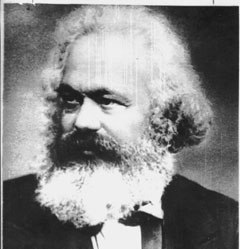 | Peter Klein |
I closed my first post on the bailout mess with “Capitalism, requiescat in pace.” Here’s Martin Masse with the details. (Thanks to Mark Thornton.)
Paulson, Bernanke, Congress: We Need Your Help!
| Peter Klein |
With our economy in crisis, the US Government is scrambling to rescue our banks by purchasing their “distressed assets”, i.e., assets that no one else wants to buy from them. We figured that instead of protesting this plan, we’d give regular Americans the same opportunity to sell their bad assets to the government. We need your help and you need the Government’s help!
Use the form below to submit bad assets you’d like the government to take off your hands. And remember, when estimating the value of your 1997 limited edition Hanson single CD “MMMbop”, it’s not what you can sell these items for that matters, it’s what you think they are worth. The fact that you think they are worth more than anyone will buy them for is what makes them bad assets.
Here’s the link (via Sean Corrigan, and please excuse the language). Remember, if people can’t get rid of their bad assets, they will have to cut back their spending, hurting local businesses, which will then be unable to spend, hurting other businesses, and so on, generating a “consumption crunch” that will cause the next Great Depression. Please, somebody, break some windows!
Best of “On the Economy”
| Peter Klein |
 Tom Keane’s greatest (interview) hits, featuring Nassim Taleb, Bill Gross, Robert Lord Skidelsky, Mohamed El-Erian, Eugene Fama, Peter Peterson, James MacGregor Burns, Peter Bernstein, Allan Meltzer, Martin Feldstein, James Poterba, Peter Fisher, David Malpass, Milton Friedman, Thomas Schelling, Myron Scholes, William Sharpe, Edmund Phelps, Gary Becker, Robert Mundell, Robert Solow, Amartya Sen, Robert Lucas, Kenneth Arrow, and Paul Samuelson.
30 September 2008 at 11:08 am Peter G. Klein Leave a comment
A Critique of Modern Law and Economics Research
| Peter Klein |
From Eric Engle. How can I not link to a paper with “Theoretical Puffery” in the title? (Thanks to Mark Thornton for the pointer.)
Law and Economics: Theoretical Puffery, Exaggerated Claims and Counterfactual Models
Eric Engle
Universität Bremen; Harvard University – Berkman Center for Internet & SocietySeptember 15, 2008
Economic analyses of law predominate in the United States because they can claim to be objective and scientific thus verifiable and the basis of predictions and reproducible experiments. However, several of the claims of economic analysis of law go too far and are entirely unrealistic. This explains why economic analysis of law has not been taken up outside of the U.S. to the extent it has in the U.S. This article points out the unrealistic presumptions within law and economics theory (homo economicus and efficient markets, mostly) and the unrealistic claims of law and economics (that the law is and should be a mirror of the economy). Economic analysis of law cannot and should not serve as a general basis of legal decision making. However, as a special theory applicable as a method for determining certain issues economic methods can well inform legal decision making helping judges to shape justice correctly. This article exposes the competing schools within law and economics and presents a defensible version of economic methodology applied within legal discourse.
Nationalization of US Credit Markets: Where Is the Analysis?
| Peter Klein |
Over and over during the last week we’ve been told that unless Congress, the Treasury, and the Fed take “bold action,” credit markets will freeze, equity values will plummet, small businesses and homeowners will be wiped out, and, ultimately, the entire economy will crash. Such pronouncements are issued boldly, with a sort of Gnostic certainty, a little sadness for dramatic effect, and only minor caveats and qualifications.
And yet, details are never provided. The analysis is conducted entirely at a superficial, almost literary, level. “If the government doesn’t act then banks will be afraid to lend, and people can’t get credit to buy a house or expand their business, and the economy will tank.” Unless we rescue these particular financial institution, in other words, a massive contagion effect will swamp the entire economy. But how do we know this? We don’t. First, we don’t even know if there is a “credit crunch.” Nobody has bothered to provide any empirical evidence. Second, even if credit markets are tight, does it matter? Any predictions about the long-term effects are, of course, purely speculative. Sure, borrowers like cheap and easy credit and tighter credit markets will leave some borrowers worse off. But what are the magnitudes? What are the likely effects on the economy as a whole? (Possibly zero.) What are the possible scenarios, what is the likelihood of each, and how large are the expected effects? Where is the cost-benefit analysis? After all, the seizure of Fannie and Freddie, the takeovers of AIG and WaMu, the modified Paulson plan — the effective nationalization of the US financial sector, in other words — ain’t exactly costless. There are direct costs, of course, to be borne by taxpayers, but the possible long-term effects brought about by increased moral hazard, regime and policy uncertainty, and the like are enormous. Even on purely utilitarian grounds, the arguments offered so far are tissue-paper thin.
Perhaps the dopiest remark I heard today was from Jamie Galbraith on the Diane Rehm show. “I’m a risk-averse person, and the risk of doing nothing is too great.” Huh? Um, shouldn’t a risk-averse person compare the risk of doing nothing with, well, the risk of doing something? Jamie, are the provisions of the bill making its way through Congress this morning risk free?
Government Funding and the Economic Organization of Scienctific Research
| Peter Klein |
A prominent climate scientist, Richard Lindzen of MIT, argues that the politicization of climate science over the last decade is but a symptom of a larger, more general problem caused by government science funding: namely an emphasis on demonstrable results that satisfy the public and have “practical” implications, rather than the pursuit of scientific truth (via Sean Corrigan).
For a variety of inter-related cultural, organizational, and political reasons, progress in climate science and the actual solution of scientific problems in this field have moved at a much slower rate than would normally be possible. Not all these factors are unique to climate science, but the heavy influence of politics has served to amplify the role of the other factors. By cultural factors, I primarily refer to the change in the scientific paradigm from a dialectic opposition between theory and observation to an emphasis on simulation and observational programs. The latter serves to almost eliminate the dialectical focus of the former. Whereas the former had the potential for convergence, the latter is much less effective. The institutional factor has many components. One is the inordinate growth of administration in universities and the consequent increase in importance of grant overhead. This leads to an emphasis on large programs that never end. Another is the hierarchical nature of formal scientific organizations whereby a small executive council can speak on behalf of thousands of scientists as well as govern the distribution of ‘carrots and sticks’ whereby reputations are made and broken. The above factors are all amplified by the need for government funding. When an issue becomes a vital part of a political agenda, as is the case with climate, then the politically desired position becomes a goal rather than a consequence of scientific research. This paper will deal with the origin of the cultural changes and with specific examples of the operation and interaction of these factors. In particular, we will show how political bodies act to control scientific institutions, how scientists adjust both data and even theory to accommodate politically correct positions, and how opposition to these positions is disposed of.
The paper is well worth reading by social scientists and organization theorists. Business-school faculty will recognize the parallels with the call for “relevance” in management education (see the links in Teppo’s recent post). And there are important connections to the arts and humanities; recent scholarship, for example, challenges the notion that public funding produces better art (painting, music, literature, drama) than patronage or commercial funding (Cantor, Cowen, Scherer). Some readers may respond, with Pilate, “What is truth?” Somebody has to pay the bills, in other words, and that party will want something in return. (more…)
29 September 2008 at 10:17 am Peter G. Klein Leave a comment





 Organizations and Markets

Recent Comments