Archive for 2007
“What Does Austrian Economics Predict?”
| Nicolai Foss |
At the professional development workshop on “The Austrian School of Economics: Applications to Organization, Strategy and Entrepreneurship,” arranged by my co-blogger for this year’s Academy of Management Meetings, the first question raised from the audience after the presentations was the one in the heading to this post. (Fabio at orgtheory.net has also made related, ehhh, provocations, which we will deal with later here at O&M).
It wasn’t entirely clear what the person who asked the question meant, the acoustics in the room were terrible (he had to repeat the question twice), and I am sure that complex issues like the symmetry thesis were popping up in the minds of my co-panelists, so there was some hesitation in the panel to address the question. (Afterwards I learned that unfortunately this was taken by some audience members as an implicit admission that AE isn’t predictive).
The question was unclear because it could mean any of this: (more…)
Economic Darwinism During Recessions
| Peter Klein |
Some version of the survivor principle, or “economic Darwinism,” underlies much economics and strategy research. While the term “survivor principle” was coined by Stigler (1968), the idea is usually attributed to Alchian (1950) and Friedman (1953). Alchian argued that even though theories about rational decision makers making “optimal” choices are clearly unrealistic, the predictions of such theories need not be. The quest for profit, combined with competitive selection forces, ensures that the average firm will tend to behave like those described by theories of rational behavior (Alchian, 1950). Friedman (1953: 22), defending the profit-maximization hypothesis, puts it this way:
[U]nless the behavior of businessmen in some way or other approximated behavior consistent with the maximization of returns, it seems unlikely that they would remain in business for long. Let the apparent immediate determinant of business behavior be anything at all — habitual reaction, random choice, or whatnot. Whenever this determinant happens to lead to behavior consistent with rational and informed maximization of returns, the business will prosper and acquire resources with which to expand; whenever it does not, the business will tend to lose resources and can be kept in existence only by the addition of resources from outside. The process of “natural selection” thus helps to validate the [maximization] hypothesis or, rather, given natural selection, acceptance of the hypothesis can be based largely on the judgment that it summarizes appropriately the conditions for survival.
The problem with Friedman’s strong version of the survivor principle is that we know little about how such competitive selection processes actually work. (more…)
Fun Activities for B-School Geeks
| Peter Klein |
Found these in Wired 15.09 (October 2007):
- Pecha-kucha: a sort of PowerPoint haiku in which presentations of exactly 20 slides, displayed for 20 seconds each, compete for honor and glory.
- Miss Management, a simulation game that let’s you play middle manager. “You’ll have to juggle incoming work tasks, keep everyone from getting stressed out, and help the coworkers achieve their goals, from flirting at the watercooler to getting more work done than anyone else!” Oh boy.
- And by the way, here are some social networking sites to avoid. Example: Trek Passions. “What it is: Sci-fi personals for Star Trek fans. Who you’ll meet: Men — sad, lonely men.”
Papers for São Paulo Workshop
| Peter Klein |
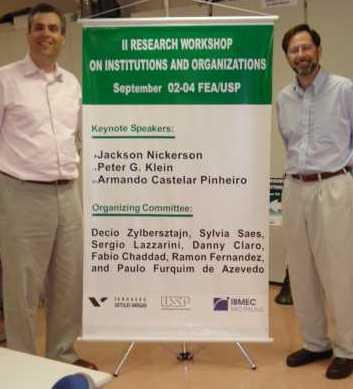
Papers for the II Research Workshop on Institutions and Organizations in São Paulo are now available here.
Keynote speakers Jackson Nickerson and I are headed to Brazil today. If I have time this morning I’ll post “My Favorite Things St. Louis Airport.”
Update (1 September): Here we are at PENSA, in a somewhat narcissistic pose, shortly after arrival.
Teaching Game Theory
| Nicolai Foss |
Game theory is fun to teach because the real world applications, exemplifations, etc. are legion, and the theory so often does more than merely redescribe the situation, but actually brings new insight. If, however, you are out of good examples, you may want to check out Game Theory.net’s list of game theory in film, music and fiction.
The Anti-Blog
| Nicolai Foss |
One consequence of the expansion of the blogosphere is, in accordance with the basic Hegelian scheme, the emergence of the anti-blog. Here is the Anti-Becker-Posner-blog dedicated to smashing, well, you guessed it (and here is an alternative conception of what an anti-blog entails).
O&M has been accused of doing “right-wing craponomics,” Peter’s economics has been attacked by Sraffian Robert Viennau, and my comments about pomo and sociologists have often provoked angry reactions. I wonder when the Anti-O&M-Blog will appear? (Hmm, perhaps we shouldn’t play with fire; remember the Corsair Affair involving Søren Kierkegaard? (Tyler will know what I mean)).
Thoughts on Capabilities From the Interesting Sutton
| Nicolai Foss |
We have spent too much time on this blog discussing Bob Sutton. A much more interesting Sutton is John Sutton, the Sir John Hicks Professor of Economics as the London School of Economics. Sutton is the author of numerous papers and books (e.g., the highly influential Sunk Costs and Market Structure). He has had some influence on strategic management thinking, mainly (obviously) among those who base strategic management on industrial economics. (more…)
Reports of My Assistant’s Death Are Greatly Exaggerated
| Peter Klein |
Received this email today from Harvard Business Online:
One of your course planning assistants, Mary E____, will be expiring on 09/12/2007.
Was she told? Does her husband know? Does the insurance company know?
Oh, wait: “This means that your assistant will no longer have access to your courses or be able to assist you with course planning in any way.” Whew!
New material for those funny lists you see from time to time.
SDAE Sessions
| Peter Klein |
Sessions from the SDAE section of the upcoming Southern Economic Association annual meeting (New Orleans, 18-20 2007) that may interest our readers:
- Peter Lewin (University of Texas at Dallas) and Howard Baetjer Jr. (Towson University),“Can Ideas be Capital? Can Capital Be Anything Else?”
- Per-Olof Bjuggren and Johanna Palmberg (Jönköpings International Business School), “Swedish Listed Family Firms and Entrepreneurial Spirit”
- Joseph T. Salerno (Pace University), “The Entrepreneur: Real and Imagined” (more…)
Pomo Periscope XIII: The Theology of Relativism
| Nicolai Foss |
OK, time to revitalize our successful Pomo Periscope series (seriously, the PP posts are among the most read O&M posts). I am reading Roger Scruton’s recent brilliant A Political Philosophy: Arguments for Conservatism at the moment. The book is an extremely articulate expression of true Burkean conservatism, and very far indeed from both neoconservatism and libertarianism. Anyway, these days Scruton seems unable to write anything without lashing out at pomo. Luckily, because what he says is correct and it must be said. (more…)
How Would You Know Him from Any Other French Professor?
| Peter Klein |
Phantom French Professor Claims Salary for 15 Years
PARIS (Reuters) — A French tax official cheated the government out of 600,000 euros (407,000 pounds) by creating a phantom identity as a university professor and claiming a salary for some 15 years, the government said on Monday.
Sorry, I couldn’t resist. But I’m excused.
Corporate Asset Purchases and Sales
| Peter Klein |
There’s a huge literature on mergers and sell-offs (see this excellent, if slightly dated, survey) but less work on the purchase and sale of corporate assets short of full acquisition or divestiture. Studying asset purchases and sales is a good way to learn about firms’ growth and retrenchment strategies because these transactions are not complicated by issues of corporate control.
Missaka Warusawitharana, a recent Wharton PhD now at the Federal Reserve Board, is doing interesting work in this area. In a forthcoming Journal of Finance paper he finds strong evidence that efficiency, not agency, considerations drive most asset purchases and sales. This contrasts with the M&A literature, in which the evidence on investment efficiency is mixed. A companion paper (with Sugata Ray) compares the sensitivity of acquisition returns to transaction value for both asset purchases and full acquisitions, finding evidence for value creation when corporate assets are purchased but not when an entire firm is acquired.
Write Like a Management Consultant
| Peter Klein |
With Mike Shor’s MBA Sentence Generator you can craft fine prose like this: “To proactively manage profit, our frictionless infrastructure parallels our world-class thought leadership.” You don’t even need an MBA!
HT to Luke Froeb, who also recommends Fred Kahn’s “My War Against Bureaucratese.”
Think Globally, Drink Locally
| Peter Klein |
Railing against corporate dictatorship, delocator.net helps consumers find locally-owned cafes, bookstores, and movie theatres in their area — alternatives to the “invasion” of Starbucks, Borders, and their ilk. The site itself is actually quite an interesting capitalist idea in its freshness and creativity, and people certainly should eat or drink or shop where they are most comfortable. That’s the beauty of competition! And the kind of community-building that often takes place at familiar, time-tested, local shops is to be encouraged.
But to say local businesses possess some kind of moral magic simply by virtue of being family-owned and homey is preposterous.
That’s Brooke Levitske, writing on the Acton PowerBlog. Recently a friend asked what I thought of Wendell Berry and his agrarian, anti-industrial philosophy. My response was similar: If people wish to live according to these principles, more power to them. I object only when materialist urbanites are forbidden by law from pursuing their own path to enlightenment.
Incidentally, does anyone remember the WSJ article a few years back suggesting that local cafes benefit when Starbucks moves to town? The theory is that the presence of a Starbucks increases local demand for premium coffee, providing spillover benefits to local stores. I haven’t seen any systematic evidence on this, however.
Summary of Kirzner’s Contributions
| Peter Klein |
Israel Kirzner received the 2006 International Award for Entrepreneurship and Small Business Research. Here is an article by Robin Douhan, Gunnar Eliasson, and Magnus Henrekson from the current issue of Small Business Economics summarizing Kirzner’s contributions to entrepreneurship theory.
Investor Protection and Firm Governance: Substitutes or Complements?
| Peter Klein |
The new institutional economics often treats the institutional environment and institutional arrangements as substitutes. In countries with stable legal institutions, relatively efficient courts, and reasonable default rules for contract terms, for example, contracts tend to be less complete. If contracting parties can trust the courts to fill in the gaps, why bother to write out every contingency? Likewise, if a country has an efficient external capital market, firms can be small and specialized, relying on the capital markets to allocate resources among business units, but if the external capital market performs poorly, diversified business groups may arise to exploit their internal capital markets.
It is thus surprising to learn, from a new paper by Reena Aggarwal, Isil Erel, René Stulz, and Rohan Williamson, that firms tend to establish better mechanisms for corporate governance in countries that already have strong rules for investor protection. “[O]ur evidence suggests that firm-level governance attributes are complementary to rather than substitutes for country-level investor protection, so that better country-level investor protection makes it optimal for firms to invest more in internal governance.” The better the institutional environment, in this case, the more effort agents put into designing efficient institutional arrangements.
Clearly more work is needed to understand the interactions between “macro” and “micro” institutions. What are some other good papers in this area?
Does Management Research Need to Become More Empirical?
| Nicolai Foss |
Or, to put it more precisely, does management research (i.e., the journals) need to become more empirical in the specific sense of allowing for research that is pre-theoretic, but addresses an issue of relevance or detects a pattern to organizational stakeholders, that is, identifies a potentially important stylized fact? (more…)
Me in Chinese
| Peter Klein |
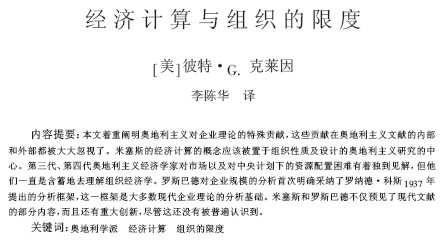
Here is a Chinese translation of my 1996 article “Economic Calculation and the Limits of Organization,” one of my favorites. It appears in Comparative Economic and Social Systems 116, no. 6 (2004): 70-78. The journal is edited by Wu Jinglian, an important Chinese economist specializing in economic reform. (Thanks to Chenhua Li for the translation and Kuo-Yang Tang for background information.)
Outsourcing Bleg
| Peter Klein |
A friend asks for good examples of companies outsourcing core functions or selling core technology and brands. Suggestions?
Knightian Financial Markets
| Peter Klein |
Frank Knight knew in 1921 what the world’s most sophisticated mathematical models could not capture today. That is, there is a fine line between risk with mathematical probabilities and uncertainty that cannot be measured. Although investors have no difficulty in pricing all sorts of risks, the “immeasurable” uncertainty and information asymmetries make them shy away from all forms of risk, especially in times of global anxiety. In our view, this is exactly what has happened in the past couple of weeks in financial markets, as credit risks linked to the US subprime-mortgage market spread out (through highly leveraged derivatives and structured instruments) and triggered a volatility wave across the world.
That’s Morgan Stanley’s Serhan Cevik and Katerina Kalcheva, writing in yesterday’s Global Economic Forum. Kudos to Cevik and Kalcheva for reminding investors (or, more likely, economists) that some risks cannot be measured and priced. But keep in mind that Knight treated uncertainty as ubiquitous, not some parameter that rises and falls with market conditions. “Profit arises out of the inherent, absolute unpredictability of things, out of the sheer brute fact that the results of human activity cannot be anticipated and then only in so far as even a probability calculation in regard to them is impossible and meaningless,” as he famously put it. (BTW you can get the full text of Risk, Uncertainty, and Profit online, courtesy of EconLib.)





 Organizations and Markets
Recent Comments