Our Recent Books

Nicolai J. Foss and Peter G. Klein,
Organizing Entrepreneurial Judgment: A New Approach to the Firm (Cambridge University Press, 2012).

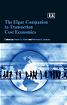
Peter G. Klein and Micheal E. Sykuta, eds.,
The Elgar Companion to Transaction Cost Economics (Edward Elgar, 2010).

Peter G. Klein,
The Capitalist and the Entrepreneur: Essays on Organizations and Markets (Mises Institute, 2010).

Richard N. Langlois,
The Dynamics of Industrial Capitalism: Schumpeter, Chandler, and the New Economy (Routledge, 2007).

Nicolai J. Foss,
Strategy, Economic Organization, and the Knowledge Economy: The Coordination of Firms and Resources (Oxford University Press, 2005).

Raghu Garud, Arun Kumaraswamy, and Richard N. Langlois, eds.,
Managing in the Modular Age: Architectures, Networks and Organizations (Blackwell, 2003).

Nicolai J. Foss and Peter G. Klein, eds.,
Entrepreneurship and the Firm: Austrian Perspectives on Economic Organization (Elgar, 2002).
Nicolai J. Foss and Volker Mahnke, eds.,
Competence, Governance, and Entrepreneurship: Advances in Economic Strategy Research
(Oxford, 2000).
Nicolai J. Foss and Paul L. Robertson, eds.,
Resources, Technology, and Strategy: Explorations in the Resource-based Perspective (Routledge, 2000).


1. Henri | 27 August 2011 at 4:40 pm
When I read Shane & Venkataraman AMR article as a PhD student I thought it was flawed because its arguments supposed the future to be predetermined (this seems a clearly unacceptable basis for building arguments). Their discussion of opportunities seemed to be a metaphysical speculation that would offer nothing to anyone (well, legimacy maybe). The authors even themselves note that the paper may have logical contradictions (how many other AMR articles state that!). Anyhow, 3.2k citations!
This is not really my domain, but looking at the slides, Klein (2008) seems to have gotten this ‘right’. I also liked reading Baker & Nelson (2005) paper on bricolage, which elaborates the ‘imagination’ of opportunities (in part) as social construction of resource environments.
Obviously a lot of stuff has been done on opportunities and a lot of it must be really good. As an occasional reader, I sometimes ponder if it would be even clearer if entrepreneurial opportunities would be simply called ‘business plans’ (I think Gartner proposed this?). I don’t fully understand how Austrian economics clarifies Shane’s 2000 orgsci finding that the prior knowledge people have influences the content of business plans they come up with.
2. Peter Klein | 28 August 2011 at 10:36 pm
Well, I certainly can’t diagree with you on Klein (2008). :) I agree that the term “business plan” is more straightforward than “opportunity,” because it highlights the conjectural nature of entrepreneurial visions; as you point out, “opportunity” seems to make sense only ex post, after profits were realized. I also like Mark Casson’s notion of “projects,” which are business plans backed up by tangible investment.
3. Rafe’s Roundup August 29 at Catallaxy Files | 29 August 2011 at 6:59 am
[…] Peter Klein at Organizations & Markets , some sets of slides from a recent conference: key figures in the Austrian School, Israel […]