Author Archive
AOM 2011
| Peter Klein |
The Academy of Management conference in San Antonio is in full swing, with lots of interesting activities for O&Mers. Friday I co-facilitated the theory workshop for the Entrepreneurship Division Doctoral Consortium (slides here), and Peter Lewin and I participated yesterday in a great Professional Development Workshop on the role of Austrian economics in entrepreneurship research. Today O&M friend Joe Mahoney will receive the Irwin Outstanding Educator Award. And there are paper sessions, roundtables, keynotes, and other events dealing with organizational design, entrepreneurship, strategy, innovation, regulation, and other topics near and dear to our collective hearts. A good time is being had by all!
Renegotiation
| Peter Klein |
The idea of a renegotiation-proof equilibrium — a situation in which all commitments are credible such that no party has an incentive to alter the arrangement — became popular in the game-theoretic contract literature in the 1980s. A recent paper by Michael Roberts shows that renegotiation is much more common in bank lending than is commonly recognized (by academics), suggesting that in many cases, formal financial contracting arrangements should be seen as starting points for future negotiation, not equilibrium agreements.
The Role of Dynamic Renegotiation and Asymmetric Information in Financial Contracting
Michael R. RobertsWe show that bank loans are repeatedly renegotiated by the borrower in an effort to loosen contractual constraints designed to mitigate information asymmetry. The typical loan is renegotiated every eight months, or four times during the life of the contract. The frequency of renegotiation is closely linked to the restrictiveness of the initial contact and the degree of information asymmetry between borrower and lender. In addition to significantly altering the terms of the contract, renegotiation reduces the speed of information revelation – more anticipated renegotiation rounds lead to longer durations between those renegotiations as information evolves more slowly. Consequently, later renegotiation rounds are more sensitive to new information regarding the borrower and their outside options than early rounds. An important by-product of our study is to show that many of the observations in the Dealscan database correspond to renegotiations of the same credit agreement, as opposed to originations of new loans.
Warning to My Future Biographers
| Peter Klein |
Daniele Besomi, writing at the SHOE list (and shared with permission):
[N]ot only memory is treacherous and selective, but even archival sources are not always fully reliable. In my work on the papers of Roy Harrod I have found examples of self-selection of documents to be preserved for posterity. Already aged 30 he annotated some documents as witnessing his position on some university matters; at 32 he preserved his own side of the correspondence he entertained with some politicians apparently because he deemed it important to keep a trace of it (he normally never kept copies of his outgoing correspondence, almost all handwritten); at 45 he started going through his own archives, annotating some correspondence for the benefit of “future historians of thought.”
At some (probably later) point in life he organized his own archives for the benefit of future readers, and he is likely to have manipulated some contents (besides rearranging the correspondence: annoyingly, the archivists undid some of Harrod’s work and moved some papers to different folders …).
It is in fact very strange that one who preserved tailor’s bills and bus tickets had kept no documents relating to his activities with the New Fabian Research Bureau in the early 1930s: he didn’t keep any of the memoranda he wrote (two at least survive in the NFRB’s archives) nor the correspondence he received about it (but the outgoing letters are in the recipients’ archives), except for a letter from James Meade dealing with theoretical matters and mentioning the NFRB in a postscript — perhaps (I am speculating here) Sir Roy turned conservative was embarrassed of the left-wing tendencies of his younger self.
Look below the fold for some annotations and sources (via Daniele). (more…)
Rogoff on Leverage
| Peter Klein |
An important point from Ken Rogoff:
Many commentators have argued that fiscal stimulus has largely failed not because it was misguided, but because it was not large enough to fight a “Great Recession.” But, in a “Great Contraction,” problem number one is too much debt. If governments that retain strong credit ratings are to spend scarce resources effectively, the most effective approach is to catalyze debt workouts and reductions.
For example, governments could facilitate the write-down of mortgages in exchange for a share of any future home-price appreciation. An analogous approach can be done for countries. For example, rich countries’ voters in Europe could perhaps be persuaded to engage in a much larger bailout for Greece (one that is actually big enough to work), in exchange for higher payments in ten to fifteen years if Greek growth outperforms.
I don’t agree with all of the discussion, for example Rogoff’s call for price inflation to mitigate the burden on debtors, but this is a big advance over the vulgar Keynesianism that passes for analysis at the New York Times. (See also Peter L.’s post on Rumelt.) The main point is that a recession like the present one is structural, and has nothing do with shibboleths like “insufficient aggregate demand.” I wish Rogoff (here or in his important book with Carmen Reinhart) talked about credit expansion as the source of structural, sectoral imbalances that generate macroeconomic crises.
A Krugmanian Slasher Flick
 | Peter Klein |
Paul Krugman is furious about the deficit-reduction plan reportedly agreed to yesterday, which Krugman says will “slash government spending,” introducing “big spending cuts” that “will depress the economy even further.” And yet, the deal apparently does not cut one penny of government expenditures, but simply increases them at a slower pace (over ten years) than originally projected by the CBO. Remember, in Washington-speak, “cut” means “reduction in the planned rate of increase.”
Imagine a scene from a Krugman-style slasher flick: the villain approaches the victim, and gives him a smaller hug than the victim was expecting! The audience gasps as the victim screams in terror and flees from the vicious attack.
The Downside of Case Studies
| Peter Klein |
As Herbert Simon once noted, while a case study is only a sample of one, a sample of one is infinitely more informative than a sample of none. This is surely true, but cases must be used with caution, particularly when more systematic evidence is available.
A couple months back I saw a Huffington Post piece claiming that, because Lincoln Electric retains workers even during recessions, and Lincoln Electric is a profitable company, firms should not fire workers when the demand for their products declines. QED. The author laments that business schools don’t teach the virtues of a “no-layoffs” policy more generally. As evidence that business schools are corrupt or incompetent, the author shows that management experts do not, in fact, believe that such a policy is desirable.
A more troubling reason is that many professors at Harvard and other MBA schools are deeply skeptical of offering workers such a bargain.
“It’s a terribly non-optimal and inefficient policy,” says George P. Baker, the co-chair of the HBS doctoral program. “Lincoln Electric is a special case. Unless there is some other reason for having it, as part of an incentive system, you would be wrong to recommend it.”
“I’m not unsympathetic to guaranteed employment and the long-term social strengths it builds,” says James Rebitzer, Chair of the Business Policy Department at Boston University’ School of Management, “But I think there are only a very few special circumstances where a commitment to no-layoffs actually improves operating efficiency.”
Harvard students such as Corey Crowell (MBA 2009), who read the [Lincoln Electric] case just days before we met, got the message: “I just worry that the sense of a guaranteed job would create complacency . . . look at the auto industry.”
There you have it. Despite a wealth of theory and evidence that guaranteed lifetime employment is generally harmful to firm performance, if one firm follows such a policy and prospers, then all firms should do so. That business schools don’t embrace the non sequitur is “troubling.” Okey dokey.
No Wonder Our Readers Find Us Witty and Clever
| Peter Klein |
Confirmation bias, it appears, affects not only our scientific and political beliefs, but our aesthetic preferences as well. Now I understand why certain people read orgtheory.net!
Another Benefit of Globalization
| Peter Klein |
Better management practice:
The Land that Lean Manufacturing Forgot? Management Practices in Transition Countries
Nicholas Bloom, Helena Schweiger, John Van Reenen
NBER Working Paper No. 17231, July 2011We have conducted the first survey on management practices in transition countries. We found that Central Asian transition countries, such as Uzbekistan and Kazakhstan, have on average very poor management practices. Their average scores are below emerging countries such as Brazil, China and India. In contrast, the central European transition countries such as Poland and Lithuania operate with management practices that are only moderately worse than those of western European countries such as Germany. Since we find these practices are strongly linked to firm performance, this suggests poor management practices may be impeding the development of Central Asian transition countries. We find that competition, multinational ownership, private ownership and human capital are all strongly correlated with better management. This implies that the continued opening of markets to domestic and foreign competition, privatisation of state-owned firms and increased levels of workforce education should promote better management, and ultimately faster economic growth.
2011 Oliver E. Williamson Prize
| Peter Klein |
The Journal of Law, Economics, and Organization, co-founded by Oliver Williamson in 1985, has created a new best article prize in his name. The first winner is “Juvenile Delinquency and Conformism” by Eleonora Patacchini and Yves Zenou. Details about the award and this year’s winner and runners-up are available at Oxford’s JLEO site. Congrats!
Grade Inflation
| Peter Klein |
Via Steve Kates, some data on US grade inflation that may or may not surprise you. I leave discussion of root causes to the discussion thread.
Contemporary data indicate that, on average across a wide range of schools, A’s represent 43% of all letter grades, an increase of 28 percentage points since 1960 and 12 percentage points since 1988. D’s and F’s total typically less than 10% of all letter grades. Private colleges and universities give, on average, significantly more A’s and B’s combined than public institutions with equal student selectivity. Southern schools grade more harshly than those in other regions, and science and engineering-focused schools grade more stringently than those emphasizing the liberal arts. At schools with modest selectivity, grading is as generous as it was in the mid-1980s at highly selective schools. These prestigious schools have, in turn, continued to ramp up their grades. It is likely that at many selective and highly selective schools, undergraduate GPAs are now so saturated at the high end that they have little use as a motivator of students and as an evaluation tool for graduate and professional schools and employers.
Sovereign States Default, Repudiate; Sun Still Rises
| Peter Klein |
Frivolous commentary on the US debt crisis (like this) attributes to opponents of raising the debt ceiling the view that “defaults don’t matter.” Sensible people recognize, of course, that default (and even repudiation) are policy options that have benefits and costs, just as continuing to borrow and increasing the debt have benefits and costs. Reasonable people can disagree about the relevant magnitudes, but comparative institutional analysis is obviously the way to go here. (Unfortunately, most of the academic discussion has focused entirely on the possible short-term costs of default, with almost no attention paid to the almost certain long-term costs of continued borrowing.)
I’m a bit surprised no one has brought up William English’s 1996 AER paper, “Understanding the Costs of Sovereign Default: American State Debts in the 1840’s,” which provides very interesting evidence on US state defaults. It’s not a natural experiment, exactly, but does a nice job exploring the variety of default and repudiation practices among states that were otherwise pretty similar. Here’s the meat:
Between 1841 and 1843 eight states and one territory defaulted on their obligations, and by the end of the decade four states and one territory had repudiated all or part of their debts. These debts are properly seen as sovereign debts both because the United States Constitution precludes suits against states to enforce the payment of debts, and because most of the state debts were held by residents of other states and other countries (primarily Britain). . . .
In spite of the inability of the foreign creditors to impose direct sanctions, most U.S. states repaid their debts. It appears that states repaid in order to maintain their access to international capital markets, much like in reputational models. The states that repaid were able to borrow more in the years leading up to the Civil War. while those that did not repav were, for the most part, unable to do so. States that defaulted temporarily were able to regain access to the credit market by settling their old debts. More surprisingly, two states that repudiated a part of their debt were able to regain access to capital markets after servicing the remainder of their debt for a time.
Amazingly, the earth did not crash into the sun, nor did the citizens of the delinquent states experience locusts, boils, or Nancy Grace. Bond yields of course rose in the repudiating, defaulting, and partially defaulting states, but not to “catastrophic” levels. There were complex restructuring deals and other transactions to try to mitigate harms.
A recent CNBC story on Europe cited “the realization that sovereign risk, and particularly developed market sovereign risk exists, because most developed world sovereign was basically treated as entirely risk free,” quoting a principal at BlackRock Investment Institute. “With hindsight, we can say . . . that they have never been risk free, it’s just that we have been living in a quiet time over the last 20 years.” Doesn’t sound like Apocalypse to me.
Old Economics Test Questions
| Peter Klein |
The University of Missouri’s sprawling new student center recently opened Mort’s, a reproduction of an old campus hangout called The Shack, made famous by Beetle Bailey creator and Mizzou alumnus Mort Walker. I snapped the photos below from the entrance to Mort’s, which is full of old Walker cartoons. I spied a 1950 cartoon featuring an economics test. Click to enlarge the strip.
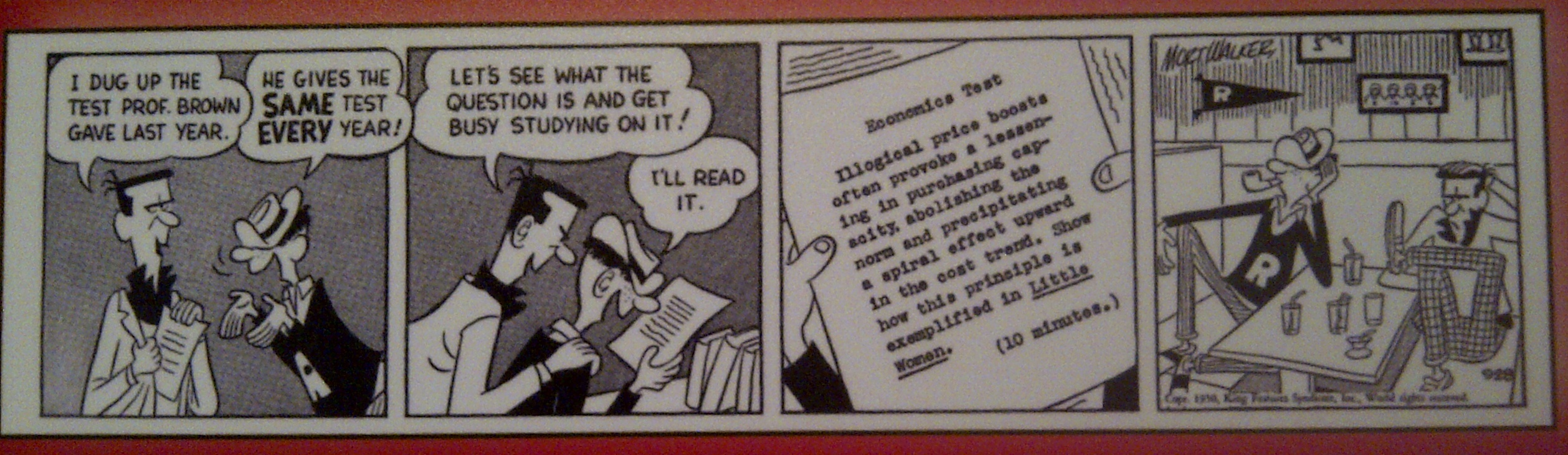
Funny, but what was Professor Brown smoking when he wrote that question? (Maybe he was just a Keynesian, bless his heart.)
Is the Internet “Transforming” Business?
| Peter Klein |
In the 1990s and early 2000s there was a huge debate about the impact of information technology on productivity. Robert Solow famously quipped, “You can see the computer age everywhere but in the productivity statistics.” Robert Gordon, Erik Brynjolfsson, Jack Triplett, and many others participated in this debate, with issues revolving around productivity measurement, workplace incentives, organizational complementarities, and more. (I did some work on this too.) The end result was a rough consensus that IT did increase productivity, but that the effects were modest.
The buzz over “wikified” organizations — open-source communities, highly disaggregated firms, crowdsourced production, and the like — gives me a strong sense of déjà vu. Indeed, we have not been kind to the wikinomics view in these pages. Now Don Tapscott, a leader of this movement, seems to be having second thoughts:
In our 2006 book Wikinomics, Anthony D. Williams and I looked at dozens of companies that have used the Internet to transform their business models and achieve tremendous success.
However, in the five years since the book’s publication, we’ve noticed something striking: the rate of business model innovation has not accelerated. Yes, some individual companies have achieved competitive advantage by exploiting the web and networked business models. But overall the gains have been modest.
The reason, says Tapscott, is that “it’s becoming difficult or even impossible for companies to achieve breakthrough success without changing their entire industry’s modus operandi.” This reminds me of the conclusion from the earlier literature that IT has the biggest effect when combined with complementary organizational practices (e.g., Milgrom and Roberts, 1995), which suggests that change doesn’t occur until all elements of the complementary bundle are in place — maybe a long time after the initial innovation.
Legal Rights of Academics and Journalists
| Peter Klein |
Do academic oral historians have the same legal protections as journalists? No, according to the US Department of Justice:
With the filing, the U.S. government has come down firmly on the side of the British government, which is fighting for access to oral history records at Boston College that authorities in the U.K. say relate to criminal investigations of murder, kidnapping and other violent crimes in Northern Ireland. The college has been trying to quash the British requests, arguing that those interviewed as part of an archive on the unrest in Northern Ireland were promised confidentiality during their lifetimes.
This is from Inside Higher Ed via Zachary Schrag, who notes that the DOJ brief
suggests that the Boston College researchers are mere academics, and seizing information from them should be easier than prying it from reporters “because the Constitution and the courts have long recognized the unique role which news reporters play in our constitutional system. See, e.g., Branzburg, 408 U.S. at 681; New York Times Co. v. Sullivan, 376 U.S. 254, 268-71 (1964). The limited protections afforded news reporters in the context of a grand jury subpoena should be greater than those to be afforded academics engaged in the collection of oral history.”
Lots of interesting stuff above about informed consent, academic freedom, confidentiality, etc.

Introducing Guest Blogger Peter Lewin
| Peter Klein |
 We’re grateful to Scott for his excellent contributions. As we bid him fond farewell, we’re also excited to welcome Peter Lewin as our newest guest blogger.
Peter studied with Ludwig Lachmann at University of the Witwatersrand and earned a PhD in economics at Chicago under Gary Becker. He is currently clinical professor of economics at the University of Texas at Dallas, School of Management, where he has taught since 1979. Peter has published in monetary economics, human capital, the economics of discrimination, and a variety of other subjects but is best known for his work on capital theory, where his teacher Lachmann made seminal contributions. Peter’s work on capital, and its relation to the theory of the firm, has inspired much of my and Nicolai’s thinking on these issues.
Besides his academic work Peter is also an entrepreneur, helping co-found Soft Warehouse in 1984, the firm that became CompUSA.
We’re delighted to have Peter on the team and look forward to his insights.
Asset Sales and Financial Distress
| Peter Klein |
“What is prudence in the conduct of every private family can scarce be folly in that of a great kingdom,” Adam Smith famously observed. I noted in an earlier post on raising the debt ceiling that restructuring US government securities is hardly the “nuclear” option it’s portrayed in the pundit world; bankrupt firms, like bankrupt families and firms, restructure their debt obligations all the time. The notion of T-Bills as a sort of sacred relic, to be once and forever “risk-free,” seems more like religion than economics to me.
But, more important, there is another option for entities struggling to make their interest payments: asset sales. Just in the last couple days Bob Murphy, David Friedman, and Steve Horwitz have made this point. Public discussion on the US debt crisis assumes that the only options for meeting US debt obligations are increasing taxes, cutting spending, or both. But asset sales are another viable option. There’s a huge literature on this in corporate finance (e.g., Shleifer and Vishny, 1992; Brown, James, and Mooradian, 1994; John and Ofek, 1995), exploring the benefits and costs of asset sales as a source of liquidity for financially distressed firms. Of course, selling assets under dire circumstances, at fire-sale prices, is far from a first-best option but, as this literature points out, often better than bankruptcy or liquidation. (One of the best-known results, from John and Ofek, is that asset sales tend to increase firm value when they result in an increase in focus. Would it really be so bad if the US government sold off some foreign treasuries and currency, the strategic petroleum reserve, its vast holdings of commercial land, and other elements of a highly diversified, and unaccountably bloated, portfolio?)
Institutions and Political Economy Group
| Peter Klein |
The Institutions and Political Economy Group (IPEG) is a new research group at the University of the Witwatersrand that “promotes the study of the relationship among institutions, organizations and markets through the simple principles of economic reasoning.” Sounds good to me! IPEG is directed by O&M friend Giampaolo Garzarelli.
AoM PDW on Austrian Economics
| Peter Klein |
 Four years ago I helped organize an Academy of Management pre-conference workshop on Austrian economics featuring Nicolai, me, Joe Mahoney, Yasemin Kor, Dick Langlois, and Elaine Mosakowski. It was well attended and very well received and we are doing something similar this year. Henrik Berglund, Todd Chiles, Steffen Korsgaard, and I have put together a Professional Development Workshop (PDW) on “Austrian Economics and Entrepreneurship Research.” Full details below. The conference home page is here. Hope to see many O&Mers at the workshop!
Austrian Economics and Entrepreneurship Research
Please join us Saturday, August 13, from 12:30 to 2:30pm in the San Antonio Convention Center, Room 212A, for a PDW on the Austrian school of economics and its implications for entrepreneurship studies (Program Session #281).
The Austrian school is increasingly well-known in the entrepreneurship field and is typically associated with Joseph Schumpeter’s idea of “creative destruction” and Israel Kirzner’s concept of “entrepreneurial alertness.” But Austrian economics features a number of additional themes, constructs, and emphases — resource heterogeneity, subjectivity of beliefs and expectations, processes of organizational emergence under complexity, and more — that are particularly relevant to research in entrepreneurship, organization, and strategy. Austrian economics is also receiving increasing attention in the broader economics and policy communities, as witnessed by the revival of interest in Austrian business cycle theory as an explanation for the financial crisis and subsequent economic downturn.
This PDW features a panel discussion and interactive table discussions designed to explore Austrian themes in greater detail and examine their applications to research in entrepreneurship and related areas of management studies. The organizers also hope to encourage and help develop the growing community of management scholars interested in the Austrian school.
The program begins with an introduction and overview by session organizers Henrik Berglund (Chalmers University of Technology), Todd Chiles (University of Missouri), Peter Klein (University of Missouri), and Steffen Korsgaard (Aarhus University), followed by breakout sessions organized around particular themes such as alertness and opportunity discovery, heterogeneity of the entrepreneurial imagination, resource heterogeneity and Austrian capital theory, entrepreneurship and equilibration, entrepreneurship and punctuated disequilibrium. Other distinctively Austrian (e.g., opportunities and action, the role of individuals, the individual-opportunity nexus, the market process, methodological individualism) and related (e.g., effectuation and bricolage) ideas will also figure prominently in the discussions.
The groups will then reassemble to share findings and results with the larger group. Ample time will be allowed for informal discussion and networking.
Please contact Henrik Berglund (henrik.berglund@chalmers.se) with any questions.
Weird Economics Dissertation of the Day
| Peter Klein |
John Nash’s 1950 Princeton dissertation is odd, though brilliant. Khieu Samphan’s 1959 University of Paris dissertation, “Cambodia’s Economy and Problems of Industrialization,” is frightening, as it foreshadows the genocidal policies Samphan implemented as a top Khmer Rouge official in the 1970s. A NYT story excerpts key passages like this one, arguing that white-collar workers
add no value to the society from the perspective of the economy as a whole. They simply profit from a transfer of value issuing from other productive activities within society (agriculture, crafts, small industry). And the transfer of produce within society does not enlarge the total value of production obtained by society in any way. The distinction made by the Scottish economist Adam Smith between productive and unproductive work deserves to be carefully considered here.
This is far from saying, for example, that a civil servant or a soldier would be useless to society. However, the greater the reduction in numbers of individuals concerned with general social organization, the greater the number who can contribute to production and the faster the enrichment of the nation.
Presumably this was in Samphan’s mind when he had office workers marched at gunpoint to the fields, where many starved and where millions were later executed.





 Organizations and Markets
Recent Comments