Author Archive
Scribd Version of Book
| Peter Klein |
I just learned I can embed the full document right here in a blog entry. Very cool!
Add to: Facebook | Digg | Del.icio.us | Stumbleupon | Reddit | Blinklist | Twitter | Technorati
The Capitalist and The Entrepreneur: Available Now!
| Peter Klein |
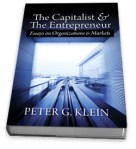 My new book, The Capitalist and the Entrepreneur: Essays on Organizations and Markets (Mises Institute, 2010), is now available. For a limited time, you can get it for just $15 — a bargain at half the price! Actually, the resource-constrained among you can read the Full Monty here, free of charge. A PDF version is also available. A promotional essay appears today on Mises.org.
The editorial and production staff did a terrific job, and I’m thrilled with the volume’s look and feel. The contents aren’t bad either!
Order two or more and I will personally send you a set of Ginsu knives.
Add to: Facebook | Digg | Del.icio.us | Stumbleupon | Reddit | Blinklist | Twitter | Technorati
Personnel Economics Survey
| Peter Klein |
Paul Oyer and Scott Schaefer provide a helpful overview:
Personnel Economics: Hiring and Incentives
Paul Oyer, Scott Schaefer
NBER Working Paper No. 15977We survey the Personnel Economics literature, focusing on how firms establish, maintain, and end employment relationships and on how firms provide incentives to employees. This literature has been very successful in generating models and empirical work about incentive systems. Some of the unanswered questions in this area — for example, the empirical relevance of the risk/incentive tradeoff and the question of whether CEO pay arrangements reflect competitive markets and efficient contracting — are likely to be very difficult to answer due to measurement problems. The literature has been less successful at explaining how firms can find the right employees in the first place. Economists understand the broad economic forces — matching with costly search and bilateral asymmetric information — that firms face in trying to hire. But the main models in this area treat firms as simple black-box production functions. Less work has been done to understand how different firms approach the hiring problem, what determines the firm-level heterogeneity in hiring strategies, and whether these patterns conform to theory. We survey some literature in this area and suggest areas for further research.
Add to: Facebook | Digg | Del.icio.us | Stumbleupon | Reddit | Blinklist | Twitter | Technorati
Transaction Costs and the Virtual Personal Assistant
| Peter Klein |
You can outsource grading, paralegal work, and other services, so why not personal assistance? Some credit cards now feature a concierge service that acts like a crowdsourced, virtual, personal assistant. By exploiting scale economies (a network of specialist assistants that can respond quickly and cheaply to specific client requests) and reducing excess capacity, such ser vices offer dramatically lowered production costs, compared to the conventional model of one dedicated assistant per client (or small group of clients). But the lack of bilateral commitment may make it difficult to encourage relationship-specific investments, so the transaction-cost effects are ambiguous. (Thanks to Chihmao for the pointer.)
If you want to discuss this further, have your people contact my people.
Add to: Facebook | Digg | Del.icio.us | Stumbleupon | Reddit | Blinklist | Twitter | Technorati
Readings for Hayek-Klein Day
| Peter Klein |
Here are some readings to help you celebrate tomorrow’s Hayek-Klein Day:

- Klein’s Biography of Hayek
- Hayek and Entrepreneurship
- Austrian Economics and Strategic Management
- The Use of Knowledge in Firms
- Austrian Economics and the Transaction Cost Approach
- Rothbard and Hayek
- Hayek versus Hayek
Add to: Facebook | Digg | Del.icio.us | Stumbleupon | Reddit | Blinklist | Twitter | Technorati
The Invention of Enterprise: Reviews
| Peter Klein |
If you haven’t yet had a chance to read Landes, Mokyr, and Baumol’s 600-page baby, The Invention of Enterprise: Entrepreneurship from Ancient Mesopotamia to Modern Times, here are reviews by Mansel Blackford and Reuven Brenner. Blackford is impressed; Brenner, not so much. Brenner is worth quoting at length:
[L]arge chunks of the book are more about the topic of inhibitions to enterprise and both the variety of ideas people came up with to rationalize them and the institutions rulers and governments put in place to enforce these ideologies. . . .
Unfortunately most of the chapters dealing with the topic of inhibitions miss the forest from the trees, as not one addresses what is to me the basic issue when examining “the invention of enterprise.” There is nothing more threatening to an established order — any order — than opening up, deepening, democratizing capital markets — accountably, allowing people to leverage their inventive, enterprising spirit. True, this would also disperse power — political power in particular. The deeper capital markets would also threaten established industries and commerce. Entrepreneurs, brilliant and ambitious as they might be, are not a threat. They can be sent to Siberia, forced into complacency by the Maos of this world, and the opportunistic ones will channel their ambition through the established powers.
But entrepreneurs with access to different, independent sources of risk capital — now that’s threatening, be they Brin and Page, Jobs or Milken at the time (quickly taking away much of the banks’ bread and butter of providing loans). Understanding this, even if not wanting to articulate it, provides enough incentives for those in power to subsidize, spread, and promote ideas and institutions inhibiting the deepening of capital markets under a wide variety of jargons, and thus inhibiting the invention and reinvention of enterprises. With time, people get accustomed to these institutions, their origins lost in the mist of time, inhibiting entrepreneurship and business for centuries. Today this may be happening a bit before our eyes. Suddenly, everything becomes a “bubble” — Internet, oil, houses, gold, bonds. Guess what: if everything is — why have capital markets to start with? If pricing no longer offers guidance to allocate capital; if stock and bond markets are not there to help correct mistakes faster — why should they continue to exist? And if they do not exist, who else remains but politicians, bureaucrats and the academics surrounding them — none of whom ever worked in a business even one day in their lives — who would then tax and borrow and subsequently allocate capital and “invent enterprises” based on — well — whatever.
Add to: Facebook | Digg | Del.icio.us | Stumbleupon | Reddit | Blinklist | Twitter | Technorati
Religion and Economic Development
| Peter Klein |
Thanks to Tyler for calling my attention to Davide Cantoni’s job-market paper, “The Economic Effects of the Protestant Reformation: Testing the Weber Hypothesis in the German Lands”:
Many theories, most famously Max Weber’s essay on the ‘Protestant ethic,’ have hypothesized that Protestantism should have favored economic development. With their considerable religious heterogeneity and stability of denominational affiliations until the 19th century, the German Lands of the Holy Roman Empire present an ideal testing ground for this hypothesis. Using population figures in a dataset comprising 276 cities in the years 1300-1900, I find no effects of Protestantism on economic growth. The finding is robust to the inclusion of a variety of controls, and does not appear to depend on data selection or small sample size. In addition, Protestantism has no effect when interacted with other likely determinants of economic development. I also analyze the endogeneity of religious choice; instrumental variables estimates of the effects of Protestantism are similar to the OLS results.
In my AE 8050 class last semester we discussed several papers on religion, and other aspects of culture, as they affect economic development (e.g., Stulz and Williamson, 2003). Cantoni’s paper will go on my reading list next year.
Add to: Facebook | Digg | Del.icio.us | Stumbleupon | Reddit | Blinklist | Twitter | Technorati
Why People Resist Marginal Cost Pricing
| Peter Klein |
Hahn and Passell get it right, I think:
Consumers everywhere seem to like all-you-can-eat/drink/exercise/drive pricing, even if their own consumption is modest and they are net losers in the process. This may simply be irrational. But (as cruise ship lines understand very well) it may also reflect the real psychological benefits of being able to imagine oneself in an environment of no scarcity, in which everything is “free” including calories. By the same token, salad-bar-style blanket pricing may relieve consumers of the very real costs of weighing costs against benefits at every turn of the menu.
One could interpret this in terms of bounded rationality, e.g., Akerlof and Yellen’s concept of near-rationality (1, 2): small deviations from “rational” behavior aren’t too costly, in such cases, so why be fully rational? Alternatively, call these decision-making costs some kind of transaction costs and deem the behavior fully rational, once all relevant costs are taken into consideration. (Some hand-waving required in both cases.) But some kind of cognitive explanation is probably best here.
Add to: Facebook | Digg | Del.icio.us | Stumbleupon | Reddit | Blinklist | Twitter | Technorati
Greenstein on Innovation
| Peter Klein |
One of my regular lectures at the Mises University deals with the economics of networks and information technology, with a particular focus on the history of the internet. A few years ago I wrote up my notes for a Mises.org daily article, which appeared as “Government Did Invent the Internet, But the Market Made It Glorious.” Shane Greensteinn’s new NBER paper could used the same title, though he chose something meatier: “Nurturing the Accumulation of Innovations: Lessons from the Internet.” Okay, the paper is a bit meatier too. Check it out:
The innovations that became the foundation for the Internet originate from two eras that illustrate two distinct models for accumulating innovations over the long haul. The pre-commercial era illustrates the operation of several useful non-market institutional arrangements. It also illustrates a potential drawback to government sponsorship — in this instance, truncation of exploratory activity. The commercial era illustrates a rather different set of lessons. It highlights the extraordinary power of market-oriented and widely distributed investment and adoption, which illustrates the power of market experimentation to foster innovative activity. It also illustrates a few of the conditions necessary to unleash value creation from such accumulated lessons, such as standards development and competition, and nurturing legal and regulatory policies.
Add to: Facebook | Digg | Del.icio.us | Stumbleupon | Reddit | Blinklist | Twitter | Technorati
Nerd Merit Badges
| Peter Klein |
 How many of these could you earn?
My favorite is Inbox Zero (right), perhaps because it’s the least attainable. (And no, I didn’t know what foursquare was either.) Thanks to Wired for the pointers.
The cynical among you may prefer The Onion’s take on merit badges.
Add to: Facebook | Digg | Del.icio.us | Stumbleupon | Reddit | Blinklist | Twitter | Technorati
Quote of the Day, Free Trade and Peace Edition
| Peter Klein |
Go into the London Stock Exchange — a more respectable place than many a court — and you will see representatives of all nations gathered there for the service of mankind. There the Jew, the Mohammedan, and the Christian deal with each other as if they were of the same religion, and give the name of the infidel only to those who go bankrupt. There the Presbyterian trusts the Anabaptist, and the Anglican accepts the Quaker’s promise. . . . If there were just one religion in England, despotism would threaten; if there were two religions, they would cut each other’s throats; but there are thirty religions, and they live together peacefully and happily.
—Voltaire (Letters on England, Letter 6)
Add to: Facebook | Digg | Del.icio.us | Stumbleupon | Reddit | Blinklist | Twitter | Technorati
Lazear on Leadership
| Peter Klein |
Ed Lazear tries his hand at the leadership literature in “Leadership: A Personnel Economics Approach.” The paper fits closely with his earlier work on entrepreneurship (here and here). Intuition:
The view presented [here] is that leaders are individuals who confront new situations often and choose the right direction in a high proportion of cases. Leaders also have the ability to identify situations where their skills will be needed and to do this frequently in a public setting. As a result of their success in choosing direction, and because the success is observable to others, leaders acquire followers who turn to the leaders for guidance in new and ambiguous situations. Individuals follow those who make correct decisions for a variety of reasons, the most direct of which is that they will boost their own probabilities of being correct by mimicking the decisions of the leaders. Thus, a leader is someone who has both vision and wisdom and who attracts a coterie of followers because of displayed superiority of decision making.
Because leaders are confronted with a wide variety of choices and because these choices span many fields, leaders tend to be generalists rather than specialists. Further, the broader the organization that an individual leads, the more general are the skills. . . .
An additional key ingredient is that leaders also possess the skills necessary to convince others that they have leadership ability. Consequently, communication skills are likely to be an important component in the leadership mix.
A formal model generates some testable propositions: “1. Ability and visibility, manifested in number of contacts per period, are complements. The most able seek to be the most visible in decision making settings. 2. The most able leaders are in the highest variance industries. 3. Leaders are generalists.” Survey data from Stanford MBAs are consistent with #2 and #3. Overall, a useful contribution to the small economics-of-leadership literature pioneered by Ben Hermalin.
Update: I neglected to mention this very important paper on leadership.
Add to: Facebook | Digg | Del.icio.us | Stumbleupon | Reddit | Blinklist | Twitter | Technorati
Business Ethics Symposium in Reason Papers
| Peter Klein |
From Reason Papers 31 (Fall 2009):
Articles: Business Ethics Symposium
- Rival Paradigms in Business Ethics —Nicholas Capaldi
- The Need for Realism in Business Ethics —Elaine Sternberg
- The Virtue of Prudence as the Moral Basis of Commerce —Tibor R. Machan
- Hume and Smith on the Moral Psychology of Market Relations, Practical Wisdom, and the Liberal Political Order —Jonathan Jacobs
- Ethics without Profits —Douglas Den Uyl
- Is a Market for Values a Value in Markets? —Alexei Marcoux
- The Sloppiness of Business Ethics —Marianne Jennings
- The Business Ethics of Incarceration: The Moral Implications of Treating Prisons Like Businesses —Daniel D’Amico & Joseph Butt
Add to: Facebook | Digg | Del.icio.us | Stumbleupon | Reddit | Blinklist | Twitter | Technorati
O&M Four-Year Anniversary
| Peter Klein |
 O&M went live April 25, 2006. Our inaugural post said: “Welcome to all readers. (Hopefully the plural is appropriate.)” Since then we’ve spread our message to literally tens of people around the world. Actually, the numbers aren’t bad: over these four years we’ve delivered 2,247 posts and 6,036 comments to 797,965 unique visitors (based on IP address). The comments are of consistently high quality too. Thanks to all current and former guest bloggers, commenters, pingbackers, lurkers, and other friends.
For a blast from the past, why not try our random post link? You never know what you’ll find. . . .
Add to: Facebook | Digg | Del.icio.us | Stumbleupon | Reddit | Blinklist | Twitter | Technorati
Esther Duflo Wins Clark Medal
| Peter Klein |
Congratulations to MIT’s Esther Duflo for winning the John Bates Clark Medal. (NB: Unlike Richard T. Ely, J. B. Clark was actually a great economist.) Duflo is a pioneer in the use of randomized controlled trials (RCTs) which, along with natural experiments, is becoming an increasingly popular alternative to conventional regression models. Interestingly, the WSJ reports that Harvard’s Sendhil Mullainathan, another RCT person, was also on the short list. Given the extreme faddishness of social scientists we can expect a wave of RCT centers, experiments, and papers in the next few years.
Add to: Facebook | Digg | Del.icio.us | Stumbleupon | Reddit | Blinklist | Twitter | Technorati
New Klein Book
| Peter Klein |
The Mises Institute is publishing a collection of my papers as The Capitalist and the Entrepreneur: Essays on Organizations and Markets (love that subtitle!). You can view some promotional materials, the table of contents, and drafts of the introduction and a sample chapter at the link above. Publication is scheduled for May 2010. I’ll post ordering information as soon as I have it. Start saving your pennies today!
Add to: Facebook | Digg | Del.icio.us | Stumbleupon | Reddit | Blinklist | Twitter | Technorati
Raising Rivals’ Costs, Goldman Edition
| Peter Klein |
One could also call this “From the Department of ‘Duh'”:
A powerful alumni network plus bundles of campaign cash mean Goldman will get what it wants — and contrary to the media narrative, what Goldman wants is not laissez-faire.
Politico quoted a Goldman lobbyist Monday saying, “We’re not against regulation. We’re for regulation. We partner with regulators.” At least three times in Goldman’s conference call Tuesday, spokesmen trumpeted the firm’s support for more federal control. . . .
Goldman reported on the conference call that it holds 15 percent “Tier 1 capital,” meaning it is very liquid and not very risky. Goldman can play it safe, you see, without needing a regulation. But regulations prevent smaller competitors from taking the risks needed to compete with Goldman (and every competitor is smaller).
The article is also very good on Obama’s Goldman problem. (Link from Steve Horwitz via Per Bylund.)
Add to: Facebook | Digg | Del.icio.us | Stumbleupon | Reddit | Blinklist | Twitter | Technorati
Melnyk on Flew
| Peter Klein |
My Missouri colleague Andrew Melnyk penned this nice appreciation of Antony Flew, who passed away 8 April 2010. Flew “was for several decades a heroic defender of classically liberal political philosophy and indeed by far the best known professional philosopher in Britain over that period to champion classical liberalism.” As Andrew notes, “in challenging the spirit of the age as sharply and as unapologetically as he did, he was, and must have known that he was, irreparably damaging his reputation among his overwhelmingly left-leaning professional peers.”
Here are remarks on Flew’s political philosophy from David Gordon, David Conway, and Sean Gabb. Here’s a biographical sketch written for Flew’s 2001 Schlaurbaum Prize, and here’s the acceptance speech.
Add to: Facebook | Digg | Del.icio.us | Stumbleupon | Reddit | Blinklist | Twitter | Technorati
C. K. Prahalad (1941-2010)
| Peter Klein |
C. K. Prahalad died Friday at the age of 68. He’s best known for his “guru” work with Gary Hamel, but had turned his attention more recently to economic development , particularly the “bottom-of-the-pyramid” approach to poverty reduction. Here are thoughts and reminiscences from the WSJ, HBR, Ross Emmett, and the Ross School. HBR has already set up a Prahalad page. Here are previous O&M mentions. I last saw him at the 2009 SMS conference in Washington, D.C. where he spoke with Yves Doz on “The Future of Strategy.”
Add to: Facebook | Digg | Del.icio.us | Stumbleupon | Reddit | Blinklist | Twitter | Technorati
Quoted in the WSJ, Kinda Sorta
| Peter Klein |
Earlier this week AFL-CIO president Richard Trumka wrote a predictable WSJ piece blaming private equity for various economic and social ills. PE firms, you see, are “unregulated and shrouded in secrecy, and they extract big profits while the companies, their employees and many of their investors lose.” Um, OK. A few sentences later he says it again: PE firms “function with virtually no oversight. Despite managing trillions of dollars and employing millions of Americans, they operate as a shadow financial system — in secret, free to take on outsized risks, and make huge bets with no outside supervision.” Hmmmm, one might think the limited partners who provide the funds — usually sophisticated, experienced investors holding substantial equity stakes — would exercise a wee bit of supervision, but never mind. Trumka goes on to demand that PE firms be forced to make all their information public, defeating one of the main purposes of private equity. (Hey, Rich, when will the minutes of that last AFL-CIO board meeting show up on your Twitter feed?)
Today’s paper includes several responses, some supplying actual arguments and evidence on the nature and effects of private equity. One letter notes that “[r]esearchers at the University of Missouri found that private equity-backed companies that exited between 1984 and 2006 grew employment by an average of more than 13% a year over the life of the private-equity investment.” The writer is citing my paper with John Chapman, “Value Creation in Middle-Market Buyouts: A Transaction-Level Analysis,” which came out earlier this year in a Wiley finance handbook series. (You can download an SSRN version here.) We report financial, operating, and employment performance for a sample of 288 middle-market transactions collected, through surveys and interviews, from 13 US PE firms. The results suggest that PE firms create substantial economic value. A shout-out by name would have been nice, but it’s nice to be noticed.
Add to: Facebook | Digg | Del.icio.us | Stumbleupon | Reddit | Blinklist | Twitter | Technorati





 Organizations and Markets
Recent Comments