Author Archive
A Ranking We Like
| Peter Klein |
An analysis published in the Eastern Economic Journal ranks O&M the sixth-best economics blog, based on the academic reputation of its authors. As you can see from Table 2, we outpaced such obscure sites as Freakonomics, DeLong’s blog, Marginal Revolution, and The Blog Formerly Known as the Austrian Economists. I wonder how we would fare against our good-twin site, were it included?
Murray N. Rothbard
| Peter Klein |
Jeff Tucker reminds me that Murray Rothbard passed away 15 years ago today. I remember the moment when I heard the news, from Parth Shah at a restaurant in DC, where we were attending the American Economic Association meeting. (This was before smartphones, Twitter, and the like, and news traveled more slowly.) I was stunned — Rothbard was not yet 70 — but my wife reminded us that he hadn’t looked well when we saw him the last time, the previous summer at the Mises Institute instructional conference in Claremont. (He died of congestive heart failure.) Check out the photo montage at Jeff’s post — see if you can identify younger versions of Ralph Raico, Roger Garrison, Bill Evers, George Reisman, Leonard Liggio, and others.
I consider Rothbard one of the great theorists of the twentieth century, and think his contributions to technical economics are greatly undervalued, even by many of his Austrian-school admirers. My own work has been heavily influenced by Rothbard (one of my most-cited papers is basically a gloss on a Rothbardian idea). Joe Salerno and I are working on a price-theory text (based on our lecture series) that builds heavily on Rothbard’s analysis in Man, Economy, and State. We hope it contributes to renewed interest in mundane Austrian economics.
Measuring the Returns to R&D
| Peter Klein |
A new paper by Bronwyn Hall, Jacques Mairesse, and Pierre Mohnen surveys the technical literature on private and aggregate returns to R&D, focusing on econometric issues. A great overview, with the relevant factoids conveniently summarized in tables. The version linked above is gated; I don’t know if there is an ungated one.
Dilbert takes a somewhat different perspective.
Update: an ungated version is available on Bronwyn’s research papers page.
The Collected Works of Henry Manne
 | Peter Klein |
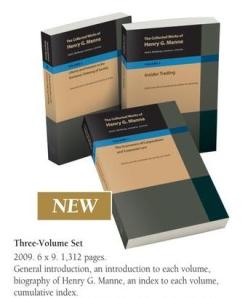
Via Geoff Manne, a description and ordering information for the new Collected Works of Henry Manne, produced by Liberty Fund. A great collection of scholarly articles, reviews, and shorter popular pieces divided into three volumes, “The Economics of Corporations and Corporate Law,” “Insider Trading,” and “Liberty and Freedom in the Economic Ordering of Society.” Order your copy today!
A New Hawthorne Study
| Peter Klein |
Tanjim Hossain and John List have done a Hawthorne-type study on a Chinese high-tech manufacturing company. The paper, “The Behavioralist Visits the Factory: Increasing Productivity Using Simple Framing Manipulations,” is unfortunately gated at NBER. I’m surprised it’s taken this long for someone to take advantage of the current craze for field experiments to do this kind of study. (I wonder if IRB approval is easier when the test subjects are in China?) Check out the abstract:
Recent discoveries in behavioral economics have led to important new insights concerning what can happen in markets. Such gains in knowledge have come primarily via laboratory experiments — a missing piece of the puzzle in many cases is parallel evidence drawn from naturally-occurring field counterparts. We provide a small movement in this direction by taking advantage of a unique opportunity to work with a Chinese high-tech manufacturing facility. Our study revolves around using insights gained from one of the most influential lines of behavioral research — framing manipulations — in an attempt to increase worker productivity in the facility. Using a natural field experiment, we report several insights. For example, conditional incentives framed as both “losses” and “gains” increase productivity for both individuals and teams. In addition, teams more acutely respond to bonuses posed as losses than as comparable bonuses posed as gains. The magnitude of the effect is roughly 1%: that is, total team productivity is enhanced by 1% purely due to the framing manipulation. Importantly, we find that neither the framing nor the incentive effect lose their importance over time; rather the effects are observed over the entire sample period. Moreover, we learn that worker reputation and conditionality of the bonus contract are substitutes for sustenance of incentive effects in the long-run production function.
See also List’s paper with Levitt on the original Hawthorne experiments.
Studying Entrepreneurs
| Peter Klein |
Great opening from Robert Whaples’s EH.Net review of T.J. Stiles, The First Tycoon: The Epic Life of Cornelius Vanderbilt (Knopf, 2009):
Economists have always had a hard time dealing with entrepreneurs — as individuals and in the aggregate. We sort of know what entrepreneurship is and that it can have a profound impact on economic performance, but it’s usually just too difficult to model and measure. What we do not understand, we simply ignore and leave to others. After all, we are firm believers in comparative advantage and studying entrepreneurship — even if it is economically important — doesn’t seem to be our comparative advantage. In the view of most economic historians, it is the rules of the game — the incentives and the institutions — that really matter, not the players. American economic history has been cast as the story of millions of diligent and clever beavers working away and transforming the landscape. Take one of them away and nothing of great importance will really change. (In fact, most of us seem to believe that if you take away an entire technological complex, like the railroads, little of much importance would really change.)
Why, then, should economic historians study the careers of entrepreneurs? Not all of us should. But for some, the study of entrepreneurs will illuminate the past and the present — and put life into our cliometric narrative.
Joe Salerno has a valuable treatment of this problem in his 2008 paper “The Entrepreneur: Real and Imagined.”
Felin and Foss Best Paper Award
| Peter Klein |
Congratulations to Nicolai and Teppo Felin for winning this year’s SO!WHAT Award for Scholarly Contribution for their 2005 paper “Strategic Organization: A Field in Search of Micro-Foundations” (ungated version). These are given by the journal Strategic Organization for the best paper published five years earlier (i.e., after some seasoning, based on impact as well as substance and originality). Look here (about half-way down the page) for praise from Jay Barney and Bruce Kogut. Way to go, guys!
Here are some prior O&M posts on microfoundations.
Finally, a Humanities Book Worth Reading
| Peter Klein |
It’s The Year’s Work in Lebowski Studies, edited by Edward P. Comentale and Aaron Jaffe (Indiana University Press, 2009). Says one dust-jacket endorsement: “There is something here for the slacker as well as the scholar, for all Lebowskis, big and small.” HT to the NYT, which titles its review “Dissertations on His Dudeness.” Look for Cornel West to offer a Princeton course soon on Lebowski Studies.
Call for a Slow-Word Movement
| Peter Klein |
If you like slow food, maybe you’ll like slow words. Forbes columnist Trevor Butterworth (via John Hagel) calls for journalists, educators, parents, and executives to spend time in the information superhighway’s slow lane:
the crisis of journalism is, at this point, sufficiently real to be seen as part of a wider conceptual crisis brought about by new-media technology: a crisis that is located, primarily, in the cognitive effects of acceleration and its cultural backwash. In short, a relentless, endless free diet of fast media is bad for your brain. Generation Google — those who have never known a world without the Internet — it turns out, not only cannot use Google effectively, they don’t even know enough about how to search for information to know they can’t use Google effectively. The idea that the kids are whizzes at multimedia tasking is a platitude confected by middle-aged techno gurus to peddle their expertise as explainers of generational difference. In fact, relentless multitasking erodes executive function. And while the brain may not be overloaded by 34 gigabytes of brute information a day, it appears that too many of these mental quanta are the equivalent of empty calories. PlayStation and texting need to be balanced out by reading novels, handwriting (for old-fashioned digital dexterity) and playing with other live people if you want your child to develop to be an effective, skill-acquiring, empathetic adult.
The tone is a bit curmudgeonly, even for me, and smells like yet another apologia for the Old Media. Some good points, nonetheless. And I’m sure there’s material for a good multitask principal-agent paper in there somewhere.
Here’s wishing you a Curmudgeonly New Year!
Can We Tackle the Big Problems?
| Peter Klein |
Russ Coff, Emory University strategy professor extraordinaire and former O&M guest blogger, sends this special report:
I’m reporting live (but jet lagged) from the Israel Strategy Conference that Peter had mentioned earlier. A theme among the keynote speakers (particularly Jay Barney and Anita McGahan) has been how we can apply our theories to tackle more meaningful problems.
Jay delivered a tearful account of his personal efforts to apply resource based theory to help a small village in Bolivia. (more…)
Happy Birthday, Ronald!
 | Peter Klein |
Happy Birthday to Ronald Coase, 99 years young today. Live long and prosper!
Favorite under-appreciated Coase essay of the day: “Business Organization and the Accountant.”
Update: Oops, Mike Sykuta tells me that the birthday is actually tomorrow, 29 December. (I blame the Coase Institute, which sent out a Facebook message on 28 December saying “Congratulations to Ronald Coase on his 99th birthday today, December 29.” I didn’t catch the goof.)
Update II: A friend asks why new institutional economists live so long. I suggested a keen appreciation of comparative institutional analysis, reflected in a version of the old adage, “Getting old isn’t so bad, once you consider the feasible alternative.”
Entrepreneurship and Action
| Peter Klein |
A few entrepreneurship scholars see action under uncertainty, rather than perception of opportunity, as the essence of the entrepreneurial function. Really, really eminent scholars. Anyway, here’s a little etymological tidbit along these lines from Jesús Huerta de Soto’s book The Austrian School: Market Order and Entrepreneurial Creativity:
Indeed both the Spanish word empresa and the French and English word entrepreneur derive etymologically from the Latin verb in prehendo-endi-ensum, which means “to discover, to see, to perceive, to realize, to capture”; and the Latin term in prehensa clearly implies action and means “to take, to seize.” In short, empresa is synonymous with action. In France, the word entrepreneur has long conveyed this idea — since the High Middle Ages, in fact when it was designated to those in charge of performing important and generally war related deeds or to those entrusted with executing the large cathedral building projects.
Thanks to Dan D’Amico for calling my attention to this passage.
PS: On the more general claim that entrepreneurship should be treated as an abstract function, rather than an employment category, I call to the stand Edith Penrose, who writes in Theory of the Growth of the Firm (chapter 3, footnote 1):
The term “entrepreneur” throughout this study is used in a functional sense to refer to individuals or groups within the firm providing entrepreneurial services, whatever their position or occupational classification may be.
You go, girl!
We Feel Your Pain
| Peter Klein |
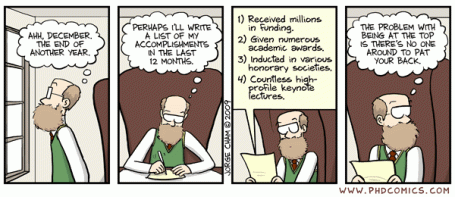
From all of us here at O&M, we hope you have the same problem as the guy below (click to enlarge), and we wish you a happy, healthy, and productive 2010!
Public Entrepreneurship
| Peter Klein |
Joe Mahoney, Anita McGahan, Christos Pitelis, and I have written a paper, “Toward a Theory of Public Entrepreneurship,” exploring the application of concepts, theories, and approaches from the entrepreneurship literature to non-market behavior. We argue that governments, government agencies, social enterprises, charitable organizations, and other “public” actors can be described as being alert to opportunities for value creation and capture, exercising judgment over the deployment of resources under uncertainty, introducing technological and organizational innovations, and so on. These actors are, in a sense, “public entrepreneurs.” This characterization also helps highlight critical differences between private and public actors and organizations, differences relating to the definition and measurement of objectives, the ability to evaluate performance, the nature of external governance, and, of course, the role of coercion. The paper is very much an exploratory effort in this area, and we certainly welcome comments and suggestions.
Here’s the abstract:
This paper explores innovation, experimentation, and creativity in the public domain and in the public interest. Researchers in various disciplines have studied public entrepreneurship, but there is little work in management and economics on the nature, incentives, constraints and boundaries of entrepreneurship directed to public ends. We identify a framework for analyzing public entrepreneurship and its relationship to private entrepreneurial behavior. We submit that public and private entrepreneurship share essential features but differ critically regarding the definition and measurement of objectives, the nature of the selection environment, and the opportunities for rent-seeking. We describe four levels of analysis for studying public entrepreneurship, provide examples, and suggest new research directions.
Today’s Food and Ag Links
| Peter Klein |
- Via LRC, Jim Rogers and Marc Faber are bullish on commodities and agribusiness. “Rogers says that it will be farmers not bankers driving Ferraris in the coming decades. Faber likens investing in agriculture to investing in oil in 2001 or 2002.” Rogers is good on macro, BTW.
- The Illinois Department of Agriculture — bless its heart! — has swooped in to protect high-end Chicago restaurant diners from the evils of unregulated designer sausages. Notes Thom Lambert: “The charcuteries’ sophisticated patrons realize they’re dealing with unlicensed meat-preparing facilities, but they know the sausage makers, are aware of the high-quality products they use and the care they take in making their products, and are willing to purchase the products despite the absence of a commercial license.” No, no, reputation effects cannot, I repeat, cannot, substitute for one-size-fits-all, top-down, government regulation! People might start thinking for themselves, you know.
- Christine Harbin writes on libertarian food paternalism. “If America were serious about reducing the caloric intake of its citizens, then officials would eliminate the subsidies that it pays to corn producers rather than instituting sin taxes.”
- Here’s an updated food chain, with zombies.
Granger Causality in Film Studies
| Peter Klein |
Did Sidney Poitier Granger-cause Denzel Washington? Chris Cagle discusses. Imagine similar questions in management: Did Harold Geneen Granger-cause Jack Welch? Did Schumpeter Granger-cause Nelson and Winter? Who Granger-caused Nicolai Foss? (Answer: he’s sui generis.)
A Boxes-and-Arrows Diagram Even the Academy of Management Review Couldn’t Love
| Peter Klein |
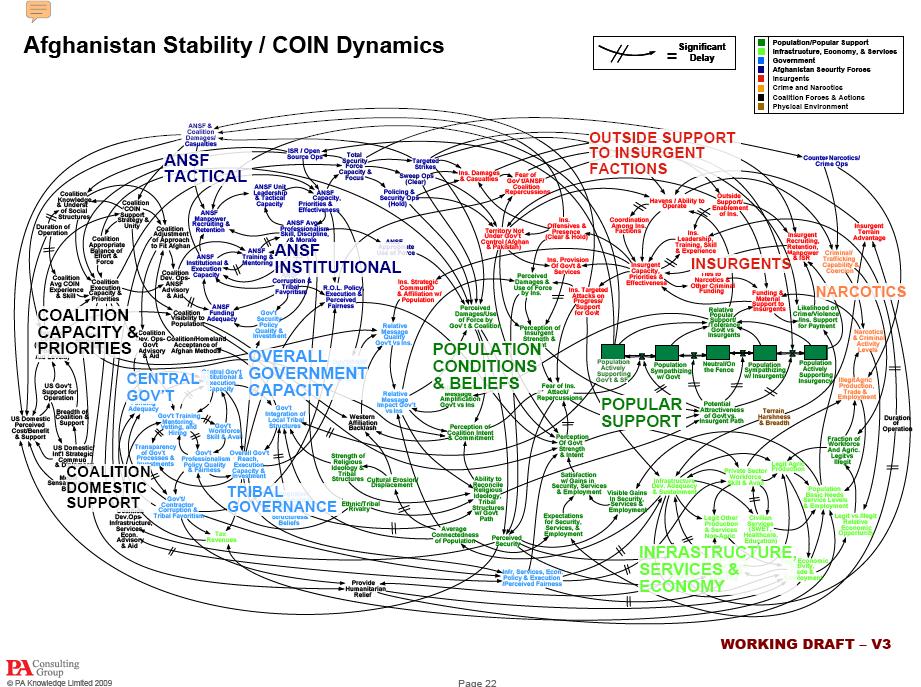
From a stunningly awful slide show (both substantively and aesthetically) on US Afghanistan policy (via Chris Coyne).
Ironies of Avatar
| Peter Klein |
I took the kids to see Avatar this weekend. From a technical standpoint, Jim Cameron’s film is remarkable, a breakthrough, as good as advertised. The alien world Pandora is stunningly realistic, detailed, convincing. The computer-generated characters look and move like real actors. The battle scenes are phenomenal.
But the storyline didn’t grab me. It’s a twist on that familiar Hollywood trope: evil, materialist, capitalist, militarist humans versus nature-loving, low-carbon-footprint, New Agey savages so noble they would have made Rousseau blush. The computer-generated landscapes are dazzlingly three-dimensional, but the characters, both human and alien, are cartoonish and one-dimensional (especially the Head Evil Capitalist, played here by Giovanni Ribisi, essentially reprising Paul Riser’s role from Cameron’s Aliens). The Pandorans are in their own way as clichéd as Peter Jackson’s much-derided Skull Islanders. I appreciate the film’s antiwar, anti-imperialist message, but really, the Earth First! propaganda is way, way over the top. And consider these ironies:
1. Avatar was written and directed by bazillionaire businessman Jim Cameron, is produced and distributed by giant corporation 20th-Century Fox, and will likely gross hundreds of million dollars. Naturally the film’s villain is — you guessed it — a giant corporation! Because, you know, businesspeople and money and corporations are evil and stuff.
2. The film was made possible by Cameron’s highly innovative, beyond-the-state-of-the-art, years-in-the-making technological innovations. Yet one of the film’s main themes is the evils of technology and capital accumulation and the beauty of live-for-today, pre-industrial society. The Pandorans literally worship their planet and don’t just hug their animals and tress, they physically bond with them through some mystical (and anatomically curious) process. The poor humans, one of the characters explains, have destroyed their own “Mother.” Blech.
Update: Peter Suderman beat me to it, calling Avatar
one of the stupidest major movies in recently memory, blithely peddling a message that its entire production process actually undermines. That Avatar’s melodramatic attacks on corporate interests and its defense of simple, natural living come packaged as one of the most expensive, and probably the most technically advanced, corporate films in history would seem to indicate that only quality bigger than the movie’s stupidity is its head-in-the-clouds hypocrisy. Cameron’s made a movie that he intends to be epic and awesome, but the only thing that’s awesome here is his total lack of self-awareness.
Stephan Kinsella sees a libertarian defense of property rights, and so do I, but for me that message was buried beneath the eco-propaganda. Had the earthlings homesteaded some piece of unoccupied Pandoran land, put it to productive use, and then the natives decided they needed the land or that its economic value belonged to “Mother Pandora,” is there any doubt what side Cameron would be on?
The Onion on Industrialization
| Peter Klein |
At year-end the Onion is featuring “Top Ten Stories of the Last 4.5 Billion Years” and some are O&M-themed. A look at child labor is cute, if uninformed (some of them little buggers actually worked before the Industrial Revolution, believe it or not). And I liked these person-on-the-street reflections on Henry Ford:
Ethel Smith, Auto Worker: “It’s satisfying to know I’m helping to build an industry and a future for my grandchildren and great-grandchildren right here in Detroit.”
Walter Booker, Craftsman: “It’s about time. I’ve had enough of those mind-numbingly boring jobs where you have to do different things all day.”
And don’t miss “Four Or Five Guys Pretty Much Carry Whole Renaissance”: “Our research indicates that da Vinci, Michelangelo, Shakespeare, and Galileo basically hoisted the entire intellectual transformation of mankind onto their shoulders while everyone else just sat around being superstitious nimrods.”
Andrew Gelman’s Meta-Lesson
| Peter Klein |
“Microeconomics ain’t easy, and don’t let a regression — or division by a baseline — be a substitute for clear thought.” Steve Levitt is the target. Why does it take a statistics professor to remind economists of such an obvious truth?





 Organizations and Markets

Recent Comments