Author Archive
New McKinsey Videos
| Peter Klein |
Acumen Fund founder and CEO Jacqueline Novogratz shares stories of social-sector entrepreneurship in an excerpt from her new book, The Blue Sweater. A video interview with the author takes you behind the book.
Google’s chief economist says executives in wired organizations need a sharper understanding of how technology empowers innovation.
Tarun Khanna says their common optimistic entrepreneurialism makes them a formidable force.
Watching the Growth of Walmart
| Peter Klein |
This animated map showing the US growth of Walmart from 1965 to 2007 proves the adage that a picture is worth a thousand words. Lots of other cool visualizations at FlowingData, like the Heavy Metal Band Names Flowchart. (Thanks to SKK.)
Change Management Bleg
| Peter Klein |
I am giving some lectures next week at the University of Angers, France, a series on change management and another on globalization. (And hanging out with old friend Guido Hülsmann.) I have some change-management materials prepared but am looking for additional readings, classroom exercises, cases, etc. If you have any teaching materials on change management suitable for MBAs or undergraduates (whose first language isn’t English!), I’d appreciate seeing them.

Ah, Democracy!
| Peter Klein |
I learned this week from Doug French that Dissident Books has published a new edition of H. L. Mencken’s classic and extremely politically incorrect Notes on Democracy. Who but Mencken could write that the common man “is not actually happy when free; he is uncomfortable, a bit alarmed, and intolerably lonely. He longs for the warm, reassuring smell of the herd, and is willing to take the herdsman with it.” As for democratically elected politicians, Mencken reminds us how quickly all those sappy paeans to the people’s will evaporate when a “crisis,” real or imagined, is on the horizon. “All the great tribunes of democracy, on such occasions, convert themselves, by a process as simple as taking a deep breath, into despots of an almost fabulous ferocity. Lincoln, Roosevelt and Wilson come instantly to mind.”
This was on my mind when I read (via Kathryn Muratore) about a new study appearing in Science finding that children looking at pictures of political candidates correctly pick the eventual winner 64% of the time. Apparently we are hard-wired to prefer pretty faces, even when supposedly choosing based on policy views, ideology, “the issues,” etc . So much for the rational voter.
What Does a Trillion Dollars Look Like?
| Peter Klein |
As they say, trillion is the new billion, where bailouts and government debt are concerned (1, 2). Just how much is a trillion dollars anyway? Here it is in pictures (via MGK).
Best Time Waster of the Day
| Peter Klein |
No, not reading these. It’s this online version of wastepaper-basket basketball. I’ve already wasted about 30 minutes today playing. (Via EclectEcon)
Ben Jones on the Burden of Knowledge
| Peter Klein |
Ben Jones, who does very interesting work on innovation and economic growth, has a new paper on the “burden of knowledge,” the idea that as an economy’s knowledge base increases, the amount of education necessary to be an effective innovator increases as well, mitigating the effects of knowledge accumulation on growth. Abstract:
This paper investigates a possibly fundamental aspect of technological progress. If knowledge accumulates as technology advances, then successive generations of innovators may face an increasing educational burden. Innovators can compensate through lengthening educational phases and narrowing expertise, but these responses come at the cost of reducing individual innovative capacities, with implications for the organization of innovative activity – a greater reliance on teamwork – and negative implications for growth. Building on this burden of knowledge mechanism, this paper first presents six facts about innovator behaviour. I show that age at first invention, specialization, and teamwork increase over time in a large micro-data set of inventors. Furthermore, in cross-section, specialization and teamwork appear greater in deeper areas of knowledge, while, surprisingly, age at first invention shows little variation across fields. A model then demonstrates how these facts can emerge in tandem. The theory further develops explicit implications for economic growth, providing an explanation for why productivity growth rates did not accelerate through the 20th century despite an enormous expansion in collective research effort. Upward trends in academic collaboration and lengthening doctorates, which have been noted in other research, can also be explained in this framework. The knowledge burden mechanism suggests that the nature of innovation is changing, with negative implications for long-run economic growth.
Blue Eagle Redux
| Peter Klein |
 Assuming this is not a joke, Obama has unveiled a new stimulus-plan logo. Projects funded by the American Recovery and Reinvestment Act — primarily roads and bridges, I presume — will sport this handsome emblem. It lacks the 1930s-era fascist style of the NRA’s Blue Eagle but is much in the same spirit. Will those who maintain these roads and bridges be fined for failing to display the logo? (Business owners without a Blue Eagle could be fined up to $500 — more than $8,000 in today’s dollars — and get six months in jail.) Will consumers be encouraged to bycott those without the colorful insignia?

 Jason Taylor and I have written that the Blue Eagle may be more important than economic historians have realized. In the early days of the NRA it seems to have played a strong cartel-enforcement role. Eventually business owners and consumers learned that NRA officials were not punishing cartel violations and the Blue Eagle began to disappear from store windows and newspaper advertisements. Our analysis is game-theoretic, but I’m sure our friends from that other discipline would proffer a different explanation based on institutional legitimacy and that stuff.
Mises Quote of the Day
| Peter Klein |
OK, so the great line attributed to George W. Bush — “the problem with the French is they don’t have a word for entrepreneur” — turns out to be apocryphal. But check out this passage from the recent Mises collection, Marxism Unmasked, as noted in David Gordon’s review:
In French, the words “organize” and “organizer” were unknown before the end of the eighteenth century or the beginning of the nineteenth century. With regard to the term “organize,” Balzac observed “This is a new-fangled Napoleonic term. This means you alone are the dictator and you deal with the individual as the builder deals with stones.” (p. 45)
Thanks to Jeff Herbener for the pointer.
Sarasvathy at Missouri
| Peter Klein |
Saras Sarasvathy comes to our campus this Thursday, 5 March, for a seminar on the effectuation approach to entrepreneurship. Details are at the McQuinn Center site. Those of you within driving distance to Columbia should consider coming over. Friday she’s keynoting the Gateway Entrepreneurship Research Conference at St. Louis University.
Saras presented this material last summer at SMG, before Nicolai; here’s another opportunity to brainwash her into adopting the Foss-Klein perspective. Kool-Aid for lunch!
Update: Can she build on the excitement generated by Jimmy John?
Waugh’s House of Wittgenstein
| Peter Klein |
The Saturday Wall Street Journal features Janes Penrose’s review of Alexander Waugh’s House of Wittgenstein, a profile of the prominent Viennese family that produced not only the philosopher Ludwig, considered by many the greatest of the twentieth century, but also pianist Paul. Their father, Karl, was an important Austrian industrialist, and their home, nicknamed Palais Wittgenstein, a Viennese landmark. The WSJ also offers a sample chapter.
Hayek enthusiasts will of course remember that Hayek and Wittgenstein were second cousins, though they did not appear to know each other well (see Hayek’s “Remembering My Cousin Ludwig Wittgenstein” in Hayek, Collected Works, vol. 4, pp. 176-81). My old boss Bill Bartley, founding editor of Hayek’s Collected Works, wrote a controversial Wittgenstein biography in 1973 (Bartley’s book was the first to discuss Wittgenstein’s homosexuality publicly, for which Bartley was condemned by Wittgenstein’s literary executors and outcast by the Wittgenstein establishment). Hayek is also mentioned briefly in the popular book Wittgenstein’s Poker, which we discussed before.
John Gray argues that Hayek’s theory of language, as presented especially in The Sensory Order, was strongly influenced by Wittgenstein (even the numbering system copies that of the Tractatus). There are, writes Gray, “many evidences that Wittgenstein’s work reinforced Hayek’s conviction that the study of language is a necessary precondition of the study of human thought, and an indispensable prophylactic to the principal disorders of the intellect. Examples which may be adduced are Hayek’s studies of the confusion of language in political thought and, most obviously, perhaps, of his emphasis on the role of social rules in the transmission of practical knowledge.”
Archived Version of Hitt Presentation on Strategic Management
| Peter Klein |
Here’s an archived version of Mike Hitt’s presentation, “New Theoretical Developments in Strategic Management,” that Mike Sykuta described before. You can also download the slides.
I watched the presentation yesterday and strongly recommend it, particularly the first part, as a good introduction to the resource-based view of the firm and an overview of some of Mike’s recent work on the institutional environment. It was nice of the AEM folks to set this up.
Skidelsky on Keynes and Hayek
| Peter Klein |
Keynes biographer Robert Skidelsky delivered the Manhattan Institute’s 2006 Hayek Lecture on Keynes and Hayek. The lecture will be broadcast this Sunday, 1 March 2009, 3:00 EST, on C-Span 2’s Book TV series. It will presumably appear later on C-Span’s YouTube channel. (Thanks to Warren for the pointer.)
Top Earners at Private US Colleges and Universities
| Peter Klein |
Some interesting factoids in this Chronicle of Higher Ed. story on compensation at 600 private US colleges and universities (via Gary Peters):
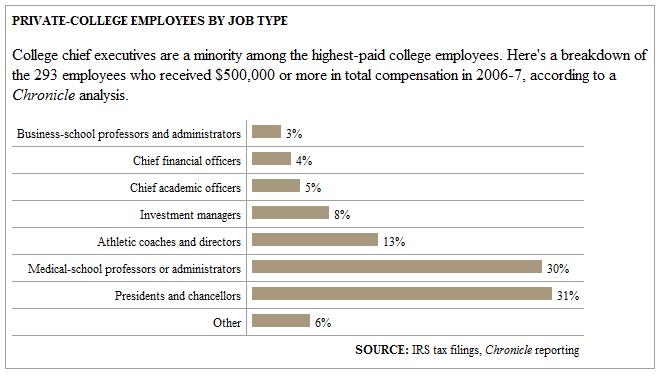
- Of the 88 employees earning more than $1 million in 2006-07, only 11 were chief executives. Most were coaches or medical school faculty.
- Median salary for full professors with MDs in the clinical sciences: $238,000
- Median salary for full professors in all other disciplines: $122,159
- Highest-paid employee: USC football coach Pete Carroll ($4.4 million)
- Second highest-paid employee: Columbia University dermatologist David Silvers ($4.3-million)
- Highest-paid economist: Columbia’s Henry Levin ($302,053)
- Highest-paid film-studies professor: Wesleyan’s Jeanine Basinger ($250,854)
No information given on marginal revenue products. I imagine Pete Carroll’s is at least $4.4 million. Don’t know about the rest.
See also the graphic below (click to enlarge):
Risk, Uncertainty, and Financial Markets
| Peter Klein |
A quick follow-up to Nicolai’s post on the copula function: See also this item on Gary Gorton’s role in the financial crisis, which includes Warren Buffett’s great line: “Beware of geeks . . . bearing formulas.” And items on Knightian uncertainty here and here.
And there’s this passage from Darren Aronofsky’s cult classic Pi:
Restate my assumptions: One, Mathematics is the language of nature. Two, Everything around us can be represented and understood through numbers. Three: If you graph the numbers of any system, patterns emerge. Therefore, there are patterns everywhere in nature. Evidence: The cycling of disease epidemics;the wax and wane of caribou populations; sun spot cycles; the rise and fall of the Nile. So, what about the stock market? The universe of numbers that represents the global economy. Millions of hands at work, billions of minds. A vast network, screaming with life. An organism. A natural organism. My hypothesis: Within the stock market, there is a pattern as well. . . . Right in front of me . . . hiding behind the numbers. Always has been.
This is before the speaker, the mathematician protagonist Max Cohen, goes literally insane. That’s what quantitative financial modeling can do to you.
More on the Evolution of Accounting
| Peter Klein |
For some reason posts dealing with accounting are among our most popular. Perhaps this says something about the Nerd Quotient of the typical O&M reader. Anyway, if you liked the recent post about the evolution of accounting rules, you may enjoy this paper that looks at the problem more systematically.
Accounting is an Evolved Economic Institution
Gregory B. Waymire and Sudipta Basu
We consider accounting from an evolutionary perspective. Accounting encompasses the creation of transactional records, the summarization of records in t-accounts, and the preparation of audited financial statements. Accounting’s history spans at least 10,000 years dating back to the first human settlements in ancient Mesopotamia. Our focus is on the study of accounting history in three ways: providing useful thoughts experiments valuable to researchers interested in the development of modern practices, the use of historical data to test formal hypotheses about the origins of accounting practices, and the development of theories and related empirical evidence that explain accounting based on evolution and ecological rationality. Within this third area, we describe the basis for hypotheses and empirical analyses concerning six issues: (1) the emergence of recordkeeping, (2) the effect of double-entry bookkeeping on the scale and scope of economic organization, (3) the spontaneous emergence of norms of practice in accounting, (4) the impact of law, regulation, and taxation on accounting, (5) the demand for broad principles in evaluating accounting method choices, and (6) the relation between economic crises and major discontinuities in accounting practice.
Slides on “Putting Entrepreneurship into Strategy and Organization”
| Peter Klein |
You’ve read the book. You’ve seen the movie. You attended the seminar. Now download the slides. Or something like that. Anyway, Lasse begged me to post the slides from this morning’s talk at NHH — or maybe he begged me not to post them, I forget which — so here they are. Some of the slides may not make much sense without the animation (and accompanying patter), but sadly the event was not captured on video, where it could have won next year’s Oscar in the “Best Obscure Academic Talk” category.
Why Did the Chicken Cross the Road: Strategic Management Edition
| Peter Klein |
Joe Mahoney and Christos Pitelis have produced their most original, and possibly most enduring, piece of scholarly work, reprinted here by permission:
Why did the chicken cross the road?
“We must first study the chickens in aggregate; once we understand the chicken industry, then we can explain the individual chicken’s conduct.” — Joe Bain
“We must study the potential mobility barriers of a meaningful strategic group of chickens to understand the individual chicken’s conduct.” — Richard Caves
“The reason for the chicken’s behavior is causally ambiguous.” — Richard Rumelt
“The behavior of the chicken is socially embedded.” — Mark Granovetter
“The chicken is merely following its standard operating procedures.” — Richard Cyert and James March
“Walking across the street is a core competence of the chicken.” — Gary Hamel
“Walking across the street is the chicken’s strategic intent.” — C. K. Prahalad
“It is the chicken’s dominant logic.” — Richard Bettis
“It is simply a routine of the chicken.” — Sidney Winter (more…)
An Obamanable Housing Plan
| Peter Klein |
So, let me get this straight. We’re in a major recession triggered by a collapse in the housing market, itself the inevitable result of government policies, led by Fannie Mae and Freddie Mac, to get the wrong loans to the wrong people so they could buy the wrong houses. The Obama Administration’s remedy is not to let Fannie and Freddie die a long-overdue and merciful death, but to prop them up, to give them additional powers, and to subsidize private mortgage lenders who extend yet more credit to more borrowers who can’t pay it back, thus making what might have been a temporary misallocation of the housing stock into a permanent one. Brilliant!
I am bewildered. But, more than that, I am angry. I can’t count how many news accounts I’ve seen about the poor, struggling homeowners who can’t make the monthly mortgage payment, are about to be foreclosed, and risk losing the family home, yard, white picket fence, and piece of the American Dream. But I haven’t heard one word about the poor, struggling renters, the ones who scrimped and saved and put money away each month towards a down payment, who kept the credit cards paid off, stayed out of trouble, and lived modestly, and thought that maybe, just maybe, the fall in housing prices meant that they, finally, could afford a house — maybe one of those foreclosed units down the street. These people are Bastiat’s unseen. For them, Obama’s housing plan is a giant slap in the face. To hell with the prudent. Party on, profligate! Now that’s what I call moral hazard.
Update: Here it is in pictures (from EconomiPicData via Wayne Marr).





 Organizations and Markets

Recent Comments