Author Archive
Halo Alert
 | Peter Klein |
Phil Rosenzweig’s excellent Halo Effect takes to task the typical “guru” book in business, one that picks a few successful companies, describes their business practices, and attributes success to those practies, without any attempt to design a “controlled experiment.” As I wrote last year:
The most common problems are sampling on the dependent variable (i.e., choosing a sample of high-performing companies and explaining what their managers did, ignoring selection bias) and using independent variables based purely on respondents’ ex post subjective assessments of strategy, corporate culture, leadership, and other “soft” characteristics. The latter is the “Halo Effect” of the book’s title. When a company’s financial or operating performance is strong, managers, consultants, journalists, and management professors tend to rate strategy, culture, and leadership highly, while rating the same strategies, cultures, and leadership poorly when a company’s performance is weak. It’s as if the authors of “guru” books have never taken a first-year graduate course on empirical research design. Or, as Rosenzweig puts it (p. 128): “None of these studies is likely to win a blue ribbon at your local high school science fair.” Ouch.
Look for a series of Halo-style analyses of the Presidential contest. Today’s NY Times, for example, contains a lengthy profile of the Obama campaign, “Near-Flawless Run Is Credited in Victory,” which recapitulates the Obama campaign’s hodge-podge of tactics, some good and some bad, without trying to isolate and identify the effects of particular tactics. The writers note that Obama’s chief strategists, David Axelrod and David Plouffe, have never before been involved with a successful campaign, which right away makes you wonder how “flawless” their strategy could have been. Still, the Times describes almost everything the campaign did as exactly right. Had Obama lost, no doubt the same pundits would be calling the same hodge-podge of tactics an obvious failure, placing the blaime on Alexrod and Plouffe and praising the McCain campaign’s own strategy and tactics. Post hoc, ergo propter hoc!
The Emergence of English Commercial Law
 The English system of commercial law or the lex mercatoria has been described as an example of “spontaneous order,” a set of rules that emerged without central direction and yet provided remarkable stability and favorable institutional environment for trade. Harold Berman and Bruce Benson, among others, have written extensively on this. Here’s an interesting paper by Daniel Klerman on the early history of English commercial law, framed as a comparison of the English and Ottoman systems:
Thirteenth-century England was a commercial backwater whose trade was dominated by foreigners. To accommodate and encourage foreign merchants, England modified its legal system by creating legal institutions which were available to both domestic and foreign traders. Among the most important of these institutions were streamlined debt collection procedures and mixed juries composed of both Englishmen and foreigners. By introducing institutions which treated locals and foreigners equally, England created a level playing field which enabled English merchants to become increasingly prominent in the later Middle Ages. England’s ability to modernize its law was facilitated by the secular nature of English law, the representation of merchants in Parliament, and legal pluralism. Medieval England contrasts sharply with the early modern Ottoman Empire. The latter created special institutions for foreign merchants, which eventually put Ottoman Muslims at a competitive disadvantage.
Food Miles
| Peter Klein |
My favorite economic geographer, Pierre Desrochers, has written (along with his better half, Hiroko Shimizu), a critique of the “food-miles” approach to measuring environmental impact.
As modern food production and distribution becomes ever more complex and globalized, a “buy local” food movement has arisen. This movement argues that locally produced food is not only fresher and better tasting, but it is also better for the environment: Because locally produced food does not travel far to reach your table, the production and transport of the food expend less energy overall. The local food movement has even coined a term, “food miles,” to denote the distance food has traveled from production to consumption and uses the food miles concept as a major way to determine the environmental impact of a food.
This Policy Primer examines the origins and validity of the food miles concept. The evidence presented suggests that food miles are, at best, a marketing fad that frequently and severely distorts the environmental impacts of agricultural production. At worst, food miles constitute a dangerous distraction from the very real and serious issues that affect energy consumption and the environmental impact of modern food production and the affordability of food.
See also these comments from Peter Gordon.
Beware of Geeks Bearing Formulas
| Peter Klein |
The entrepreneur, writes Mises in one of my favorite passages, “is a speculator, a man eager to utilize his opinion about the future structure of the market for business operations promising profits.” The entrepreneur relies on his “specific anticipative understanding of the conditions of the uncertain future,” an understanding that “defies any rules and systematization.”
 This passage was in my mind today as I read the WSJ front-pager about the computer models used by AIG to analyze asset risk. Poor Gary Gorton, who designed many of AIG’s models, is put on public display. AIG’s catastrophic failure is likely to fuel skepticism about the use of such models for risk analysis, though Gorton maintains the problem was the application of the models, not their basic design. (His Yale colleague Ian Ayres will likely agree.) Longtime skeptic Warren Buffet has the best line: “Beware of geeks . . . bearing formulas.”
Today’s paper also includes an item on Harry Markowitz, including this:
As with all new information tools at our disposal, applying portfolio theory to investing entails its share of trial and error. Mr. Markowitz admits some people might object to asking him how to repair the credit crisis. “You, Harry Markowitz, brought math into the investment process,” he imagines some people thinking. “It is fancy math that brought on this crisis. What makes you think now that you can solve it?”
He draws a line between his portfolio theory and its later misapplication. “Not all financial engineering is always bad,” he says, “but the layers of financially engineered products of recent years, combined with high levels of leverage, have proved to be too much of a good thing.”
Update (Nov. 5): See this related piece from the Times.
New Issue of Strategic Entrepreneurship Journal
| Peter Klein |
Volume 2, number 3 of the Strategic Entrepreneurship Journal, a special issue edited by Sharon Alvarez and Jay Barney on “Opportunities, Organizations, and Entrepreneurship,” is now out. It features my paper “Opportunity Discovery, Entrepreneurial Action, and Economic Organization,” Nicolai’s paper with Kirsten Foss, “Understanding Opportunity Discovery and Sustainable Advantage: The Role of Transaction Costs and Property Rights,” and several others of interest. The abstracts from my paper and the Foss & Foss paper are below the fold. (more…)
Needed: A Little Cost-Benefit Analysis
| Peter Klein |
Andrew Gelman, Nate Silver, and Aaron Edlin estimate the the probability of any given vote being decisive in Tuesday’s US election is about one in 60 million. Residents of a few states, like New Mexico, Virginia, New Hampshire, and Colorado, are especially important: their chance is one in 10 million. Oh, did I mention that your vote doesn’t matter?
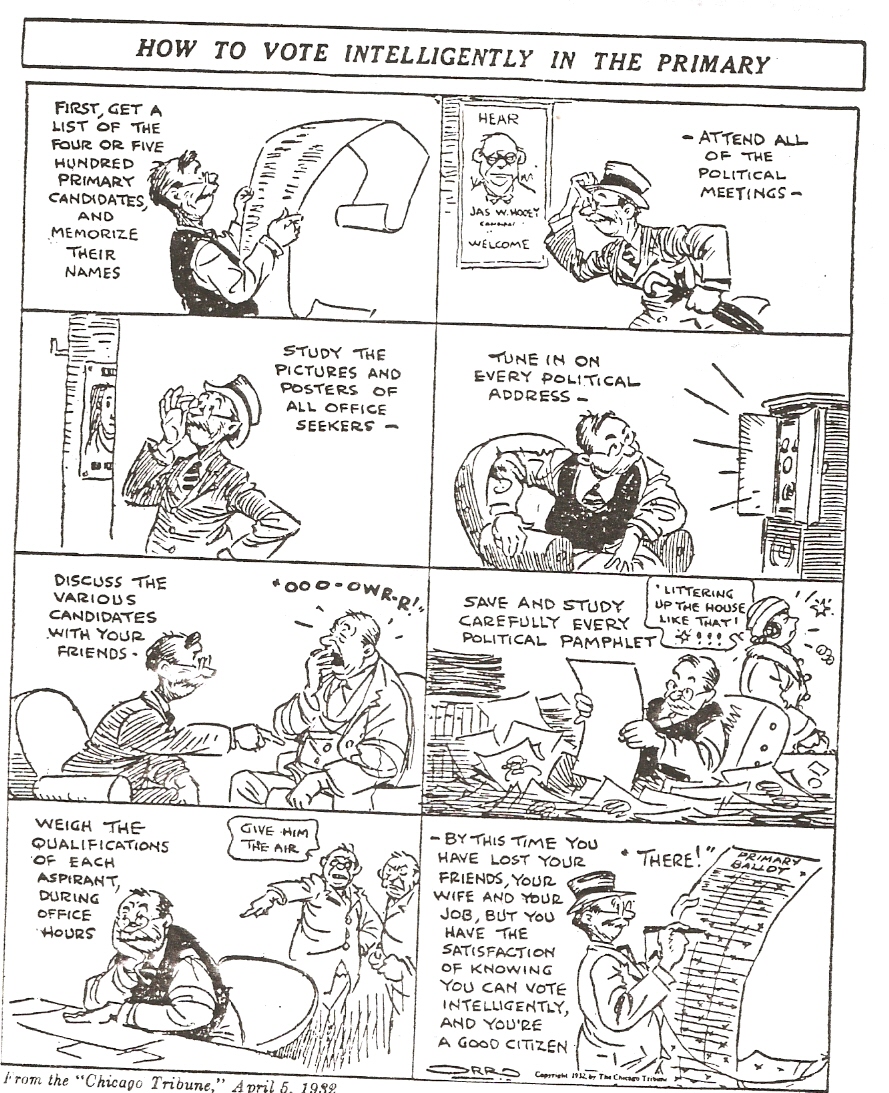 Cliff sent me a couple of amusing items on People Who Don’t Get It. Here’s one on a young Chicago woman who can’t decide between McCain and Obama, and is “probably going to cram the night before the election and really study them both.” Gee, I wonder which candidate is going to win Illinois? And here’s a wonderful cartoon from the 1932 Chicago Tribune, “How to Vote Intelligently in the Primary.” Ah, where are the Colonel McCormicks of today?
Things You Learn from David Gordon
| Peter Klein |
Nicolai has written on great beards in philosophy. From David Gordon’s talk this morning on “Money and Philosophy” I learn that Thomas Aquinas, among his many other distinctions, was also the heaviest of all the great philosophers. Apparently his church had to install a special altar with a large cutout so Aquinas could take communion. According to David, Aquinas’s only possible rival for the title of heaviest great philosopher is David Hume.
Interviews with Alchian, Coase, Kirzner, Manne
| Peter Klein |
 The Liberty Fund has put online several interviews from its Intellectual Portrait Series. Of particular interest to O&M readers:
- Armen Alchian, interviewed by Dan Benjamin
- Ronald Coase, interviewed by Richard Epstein
- Israel Kirzner, interviewed by Tibor Machan
- Henry Manne, interviewed by Fred McChesney
Update (Nov. 2): Manne link fixed.
Mises Quote of the Day
| Peter Klein |
Here is Mises on entrepreneurial “understanding,” a concept distinct from quantitative prediction according to a known model. You could even call it judgment. It’s particularly germane to current economic conditions and the phalanx of economic forecasters attempting to predict how the economy will do in the coming months and years. The source is a 1956 essay, “The Plight of Business Forecasting,” reprinted in Economic Freedom and Interventionism:
Economics can only tell us that a boom engendered by credit expansion will not last. It cannot tell us after what amount of credit expansion the slump will start or when this event will occur. All that economists and other people say about these quantitative and calendar problems partakes of neither economics nor any other science. What they say in the attempt to anticipate future events makes use of specific “understanding,” the same method which is practiced by everybody in all dealings with his fellow man. Specific “understanding” has the same logical character as that which characterizes all anticipations of future events in human affairs — anticipations concerning the course of Russia’s foreign policy, religious and racial conditions in India or Algeria, ladies’ fashions in 1960, the political divisions in the U.S. Senate in 1970; and even such anticipations as the future marital relations between Mr. X and his wife, or the success in life of a boy who has just celebrated his tenth birthday. There are people who assert that psychology may provide some help in such prognostications. However that may be, it is not our task to examine this problem. We have merely to establish the fact that forecasts about the course of economic affairs cannot be considered scientific.
Controynms Redux
| Peter Klein |
Last year’s post on contronymns — words that are their own antonyms — was one of our most popular. Anu Garg of Wordsmith.org ran a contronymns series this week, featuring cleave, continuance, asperse, copemate, and quiddity.
The series intro contained a few more:
When you sanction a project, do you approve of it or disapprove? Should one be commended for oversight (watchful care) or reprimanded for oversight (error or omission)? When you resign from a job, do you leave it or re-join (re-sign) it?
When a proposal gets tabled, is it being brought forward for discussion or being laid aside? Depends on which side of the pond you’re at. If the former, you’re in the UK; if the latter, you’re in the US.
I call them fence-sitters. They sit on fences, ready to say one thing or its opposite depending on which side they appear at. I’m not talking about politicians. These are words, known by many names: autoantonym, contranym, self-antonym, enantiodromic, amphibolous, janus word, and so on.
Sometimes it’s a result of two distinct words evolving into the same form (cleave from Old English cleofian and cleofan) but often a single word develops a split personality and takes on two contradictory senses. All of us have a bit of yin and yang and these words are no exception. The context usually provides a clue to help us understand the right sense in a given place.
Always Two, There Are: A Master, and an Apprentice
| Peter Klein |
 Here are the proceedings of a conference on apprenticeship, the much-maligned, but frequently valuable, practice of learning a trade through experience, rather than formal classroom education.
Paul Ryan notes in his EH.Net review:
Its publication responds to the extensive contemporary interest in apprenticeship — among historians, as part of discussions of the role of guilds, proto-industrialization and social change; and among policy analysts, reflecting the benefits of apprenticeship for school-to-work transitions, notably in Germany. . . .
Most contributors subscribe to a revisionist historical view of apprenticeship, as less monolithic, standardized and guild-regulated, and more determined by economic factors, than in traditional interpretations, notably the ganze Haus perspective of the German historical school. Both individually and collectively, the papers document the heterogeneity of apprenticeship. Thus contract durations and completion rates are shown to have varied considerably, even within particular occupations in particular towns in particular periods, despite clear guild prescriptions.
Today’s Episode of “The Onion or Reality?”
| Peter Klein |
White House to banks: Start lending now
By Jennifer Loven, AP White House CorrespondentWhite House tells banks getting federal aid to quit hoarding money and start lending it
[ . . . ]
“What we’re trying to do is get banks to do what they are supposed to do, which is support the system that we have in America. And banks exist to lend money,” White House press secretary Dana Perino said.
Those silly banks; first they made too many loans, causing the subprime crisis, now they’re making too few! (Via Manuel Lora.)
Let’s review: Some banks made bad loans, and some banks bought securities tied to these loans. When the bad loans went sour, some banks failed. Instead of letting those banks fail, freeing up scarce resources to flow to other banks and financial institutions, the government tried to prop up the entire banking system. Now, when the propped-up banks decide to hoard their taxpayer-provided cash, the government wants to make them lend — to whom, it doesn’t matter. Just lend, baby, lend! A loan, you see, is just like any other loan. All investments are the same. All banks are the same. No need to separate the good ones from the bad ones. We Are the World!
A Billion Here, A Trillion There
| Peter Klein |
How expensive is the bailout? Where will the money come from?
Consider the numbers: $29 billion for the Bear Stearns mess; $700 billion to buy spoiled assets; $200 billion to buy stock in Fannie Mae and Freddie Mac; an $85 billion loan to AIG insurance; another $37.8 billion for AIG; and $250 billion for bank stocks. Hundreds of billions in guarantees to back up money market funds and to guarantee bank deposits. And who knows what expenses are still to come. . . .
How will the U.S. pay for it all? Answer: by borrowing — raising worries about how the country’s ballooning annual budget deficits and aggregating debt will affect the economy and financial markets. Some guidelines, such as interest rates and the ratio of debt and deficits to gross domestic product, suggest the new debt will be digested easily. But some experts think those guidelines are misleading, warning that obligations are piling up like tinder on a forest floor.
“This kind of accounting that the government does — if they did it in the private sector they would go to jail,” says Kent Smetters, a professor of insurance and risk management at Wharton.
From Knowldge@Wharton, which reminds us that there’s plenty more to come — a probable bailout of Chrysler and G.M., for instance. And who knows what else. Of course, the US government now has a $10.5 trillion national debt. “To economists, the most frightening fact is that the enormous cost of today’s financial rescues is just a drop in the bucket.”
Nair, Trendowski, and Judge on Penrose
| Peter Klein |
The October 2008 AMR features an essay by Anil Nair, Joseph Trendowski, and William Judge on Edith Penrose’s seminal Theory of the Growth of the Firm (1959), written in the form of a book review. The essay is gated, but you can get a flavor from the conclusion:
Many economists call the unexplained variance in a regression equation the “Penrose effect.” According to Barney, it was left to strategy scholars to propose that the Penrose effect comprises the intangible resources and capabilities that are the source of sustained competitive advantage, and while these phenomena may be difficult to measure directly, the implications of these phenomena for firms’ operations and performance could be tested. After reviewing the passionate and prolific research that has attributed its intellectual roots to Penrose’s book, it is clear to us that her work was successful in rallying scholars who sought an alternative to the standard structure-conduct-performance model within strategy. However, scholars should be careful that Penrose’s theory (and the book) does not become a Rorschach blot on which they impose their own biases.
Here is a paper that links Penrose to Austrian concepts of subjectivism and capital heterogeneity. Penrose was of course a student of Fritz Machlup, himself a student of Mises. Apparently at one point the book was to be a joint project with Machlup; in Murray Rothbard’s papers is a memo Rothbard wrote for the Volker Fund evaluating a 1953 grant proposal by Machlup and Penrose for a “Growth of the Firm” project. (Rothbard’s assessment was unfavorable; he was, however, a fan of Penrose’s earlier paper on “Biological Analogies in the Theory of the Firm,” which he cites favorably in “The Mantle of Science.”)
Tooth-Fairy Economics
| Peter Klein |
Art Laffer offers this succinct summary of Bernankeconomics:
No one likes to see people lose their homes when housing prices fall and they can’t afford to pay their mortgages; nor does any one of us enjoy watching banks go belly-up for making subprime loans without enough equity. But the taxpayers had nothing to do with either side of the mortgage transaction. If the house’s value had appreciated, believe you me the overleveraged homeowner and the overly aggressive bank would never have shared their gain with taxpayers. Housing price declines and their consequences are signals to the market to stop building so many houses, pure and simple.
But here’s the rub. Now enter the government and the prospects of a kinder and gentler economy. To alleviate the obvious hardships to both homeowners and banks, the government commits to buy mortgages and inject capital into banks, which on the face of it seems like a very nice thing to do. But unfortunately in this world there is no tooth fairy. And the government doesn’t create anything; it just redistributes. Whenever the government bails someone out of trouble, they always put someone into trouble, plus of course a toll for the troll. Every $100 billion in bailout requires at least $130 billion in taxes, where the $30 billion extra is the cost of getting government involved.
If you don’t believe me, just watch how Congress and Barney Frank run the banks. If you thought they did a bad job running the post office, Amtrak, Fannie Mae, Freddie Mac and the military, just wait till you see what they’ll do with Wall Street.
Best-Selling Ivey Cases for 2007-08
| Peter Klein |
-
Starbucks, Mary M. Crossan, Ariff Kachra
-
Ellen Moore (A): Living and Working in Korea, Henry W. Lane, Chantell Nicholls, Gail Ellement
-
Ruth’s Chris: The High Stakes of International Expansion, Ilan Alon, Allen H. Kupetz
-
Eli Lilly in India: Rethinking the Joint Venture Strategy, Charles Dhanaraj, Paul W. Beamish, Nikhil Celly
-
Sabena Belgian World Airlines: Weytjens First Assignment, Mary M. Crossan, Barbara Pierce
-
Swatch and the Global Watch Industry, Allen Morrison, Cyril Bouquet
-
Cola Wars in China: The Future is Here, Niraj Dawar, Nancy Dai
-
Leo Burnett Company Ltd.: Virtual Team Management, Joerg Dietz, Fernando Olivera, Elizabeth O’Neil
-
Toyota: Driving the Mainstream Market to Purchase Hybrid Electric Vehicles, Jeff Saperstein, Jennifer Nelson
- Brand in the Hand: Mobile Marketing at Adidas, Andy Rohm, Fareena Sultan, David T. A. Wesley
The Ivey School, as you probably know, is second only to Harvard in the production of business cases.
Dan and Chip Heath on Presentations
| Peter Klein |
A new entry for our PowerPoint series: Dan and Chip Heath’s “How to Avoid Making a Bad Presentation,” from the current issue of Fast Company. They’re the Made to Stick guys, in case you forgot. (Not, sadly, the people behind my all-time favorite ice cream.)
New NBER Working Papers
| Peter Klein |
Three new NBER papers likely to interest the O&M crowd. (Aggressive Googlers can probably find ungated versions.)
Railroads and the Rise of the Factory: Evidence for the United States, 1850-70 by Jeremy Atack, Michael R. Haines, and Robert A. Margo
Over the course of the nineteenth century manufacturing in the United States shifted from artisan shop to factory production. At the same time United States experienced a transportation revolution, a key component of which was the building of extensive railroad network. Using a newly created data set of manufacturing establishments linked to county level data on rail access from 1850-70, we ask whether the coming of the railroad increased establishment size in manufacturing. Difference-in-difference and instrument variable estimates suggest that the railroad had a positive effect on factory status. In other words, Adam Smith was right – the division of labor in nineteenth century American manufacturing was limited by the extent of the market.
The Limited Partnership in New York, 1822-1853: Partnerships Without Kinship by Eric Hilt and Katharine O’Banion
In 1822, New York became the first common-law state to authorize the formation of limited partnerships, and over the ensuing decades, many other states followed. Most prior research has suggested that these statutes were utilized only rarely, but little is known about their effects. Using newly collected data, this paper analyzes the use of the limited partnership in nineteenth-century New York City. We find that the limited partnership form was adopted by a surprising number of firms, and that limited partnerships had more capital, failed at lower rates, and were less likely to be formed on the basis of kinship ties, compared to ordinary partnerships. The latter differences were not simply due to selection: even though the merchants who invested in limited partnerships were a wealthy and successful elite, their own ordinary partnerships were quite different from their limited partnerships. The results suggest that the limited partnership facilitated investments outside kinship networks, and into the hands of talented young merchants.
Inside the Black of Box of Ability Peer Effects: Evidence from Variation in Low Achievers in the Classroom by Victor Lavy, Daniele Paserman, and Analia Schlosser
In this paper, we estimate the extent of ability peer effects in the classroom and explore the underlying mechanisms through which these peer effects operate. We identify as low ability students those who are enrolled at least one year behind their birth cohort (repeaters). We show that there are marked differences between the academic performance and behavior of repeaters and regular students. The status of repeaters is mostly determined by first grade; therefore, it is unlikely to have been affected by their classroom peers, and our estimates will not suffer from the reflection problem. Using within school variation in the proportion of these low ability students across cohorts of middle and high school students in Israel, we find that the proportion of low achieving peers has a negative effect on the performance of regular students, especially those located at the lower end of the ability distribution. An exploration of the underlying mechanisms of these peer effects shows that, relative to regular students, repeaters report that teachers are better in the individual treatment of students and in the instilment of capacity for individual study. However, a higher proportion of these low achieving students results in a deterioration of teachers’ pedagogical practices, has detrimental effects on the quality of inter-student relationships and the relationships between teachers and students, and increases the level of violence and classroom disruptions.
Kirzner’s Tapestry
 | Peter Klein |
One of the points I make in my forthcoming SEJ paper is that Kirzner’s metaphor of entrepreneurial discovery is, like Freud’s cigar, just a metaphor. It’s invoked by Kirzner to explain the tendency of markets to clear, not to describe a particular behavior or personality type. Applied entrepreneurship studies aimed at identifying what kinds of people really “are” more alert to opportunities, in some sense we can measure with a survey or experiment, misses the point of the metaphor. Likewise, Kirzner does not mean that opportunities literally are given, objectively, in the environment, independent of human creativity. “Discovery” is an analytical construct, an instrumental device, not a description of behavior.
Kirzner explains all this in a 1997 interview:
Q: What do you mean in saying something is “waiting” to be discovered?
A: Philosophically, people have objected to that. I do not mean to convey the idea that the future is a rolled-up tapestry, and we need only to be patient as the picture progressively unrolls itself before our eyes. In fact, the future may be a void. There may be nothing around the corner or in the tapestry. The future has to be created. Philosophically, all this may be so. But it doesn’t matter for the sake of the metaphor I have chosen.
Ex post we have to recognize that when an innovator has discovered something new, that something was metaphorically waiting to be discovered. But from an everyday point-of-view, when a new gadget is invented, we all say, gee, I can see we needed that. It was just waiting to be discovered.
Q: Consumer demand was there, resources were there, and the technology was there. . .
A: Yes, so there was no reason why it wasn’t being done. The entrepreneur is alert to this reality, to the profit opportunity it represents, and responds creatively to it.
Notice the emphasis on opportunities “metaphorically waiting to be discovered,” not literally waiting to be discovered. Kirzner isn’t offering a particular ontology or epistemology, just proposing an analytical device, designed for a specific purpose (to understand market clearing). Some of the literature comparing “discovery” and “creation” as alternative conceptions of the entrepreneurial act seems to me to read too much into Kirzner.
Economic Notes From the Underground
| Peter Klein |
An interesting call for proposals from EconJournalWatch:
Fyodor Dostoevsky’s novella Notes from Underground (1864) is a classic of introspection and confession. The symposium takes its title from Dostoevsky’s work.
The prospective symposium will consist of confessional essays by economists about their existence as economists. Only genuine narrative and sincere reflection are welcome. However, essays may be anonymous.
Here are the kinds of confessions the editors have in mind:
- Building models one does not really believe to be useful or relevant.
- Making simplifications that obscure or omit important things.
- Using data one does not really believe in.
- Focusing on the statistical significance of one’s findings while quietly doubting economic significance.
- Engaging in data mining.
- Drawing “policy implications” that one knows are inappropriate or misleading.
- Keeping the discourse “between the 40 yard lines” so as to avoid being outspoken; knowingly eliding fundamental issues.
- Tilting the flavor of policy judgments to make a paper more acceptable to referees, editors, publishers, or funders.
- Disguising one’s methodological or ideological views, such as by omitting revealing activities or publications from one’s vitae.
- For government, institute, or corporate economists: Having to significantly play along with things one does not believe in.
My reaction: Can a single symposium issue possibly hold them all?





 Organizations and Markets
Recent Comments