Author Archive
Order Yours Today!
| Peter Klein |
It’s great having graduate students with a sense of humor (and a knowledge of German):
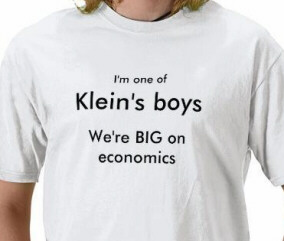
Now, if only they would spend as much time on their dissertations as they spend on their jokes. . . .
Hoselitz’s “Early History of Entrepreneurial Theory”
| Peter Klein |
Thanks to my dedicated assistants Per Bylund and Mario Mondelli we now have an electronic copy of Bert Hoselitz’s hard-to-find 1951 essay, “The Early History of Entrepreneurial Theory” (Explorations in Entrepreneurial History, volme 3, pp. 193-220) and are happy to share it. This is one of the best surveys of the concept of entrepreneurship in pre-classical economics (but also including J. B. Say). (Hébert and Link (1988) think Hoselitz draws too sharp a line between Cantillon and Say.)
Influence of E. A. G. Robinson on Coase
| Peter Klein |
The March 2008 issue of the Journal of the History of Economic Thought features “On Robinson, Coase, and ‘The Nature of the Firm'” by Lowell Jacobsen. Robinson is E. A. G. Robinson, the Cambridge economist and longtime editor of the Economic Journal, now known mainly as the husband of Joan Robinson. Coase was trained by Arnold Plant and has written much about Plant’s influence. Jacobsen argues that Coase was also influenced significantly by Robinson, an influence that has not been widely appreciated. Here’s a bit from the conclusion:
Robinson’s influence on Coase’s writing of ‘‘The Nature of the Firm’’ through his The Structure of Competitive Industry is both obvious and significant. This is understandable, as Robinson and Coase both embraced and looked to extend the Marshallian tradition with these noted works.19 They sought to directly engage the real world of business as they were keenly interested in how firms actually behave, and why. They pursued answers to very fundamental questions: Why do firms exist? and, To what size? In addition, the study of firms and their industries requires a variety of considerations if effective decision-making by the firms’ managers is to be properly understood. In Cairncross’ fine biography of Robinson, he noted the brilliance of Robinson was his ability ‘‘to look at problems from different angles, against an historical background, taking in technology, organisational considerations, political feasibility’’ (Cairncross 1993, p. 164). Much the same could be said about Coase. . . .
[Robinson and Coase] were both interested in applying simple, yet compelling, economic concepts and theory such as scale economies, substitution at the margin and, of course, transaction costs. Further, it was important for them that economic analysis be grounded on realistic assumptions; theory that depended on fabricated assumptions to ensure tractability and even elegance should be largely avoided. Moreover, mathematics should not be the sine qua non of economic theory. Unfortunately, formalism and a priori theorizing emerged in the 1930s (given such influences as Robbins, Pigou, and even Joan Robinson) to dominate, if not define, mainstream economics, including the treatment of the firm. As a result, Coase and Robinson arguably became ‘‘outsiders’’ as Medema (1994), in his equally fine biography, concludes about Coase.
The paper is free, for now at least, on the Cambridge Journals site, so grab it while you can.
Barry Smith Online
| Peter Klein |
I just learned that Barry Smith’s influential book, Austrian Philosophy: The Legacy of Franz Brentano (Open Court, 1994), is available online in its entirety. This is not a book on the Vienna School or logical positivism or Wittgenstein, but on the general philosophical climate in Austria during the late nineteenth and early twentieth centuries, with special emphasis on the influence of this climate on Carl Menger’s economics. Menger, Smith has argued, was steeped in the Catholic, Aristotelian tradition of classical Austrian philosophy and this helps explain how his “causal-realist” approach differs from its Walrasian and Jevonsian counterparts.
Understanding Professors: Graphical Expositions
| Peter Klein |
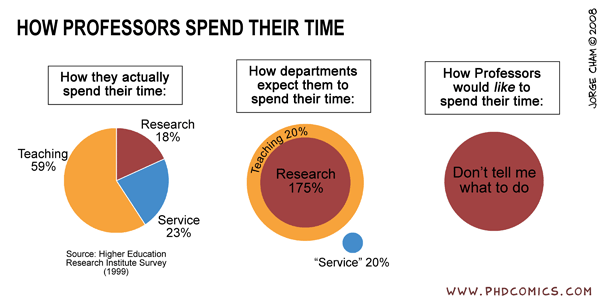
Here are some diagrams to help you understand how professors think. First, how they spend their time, from PhD Comics (via Art Carden). Click to enlarge.
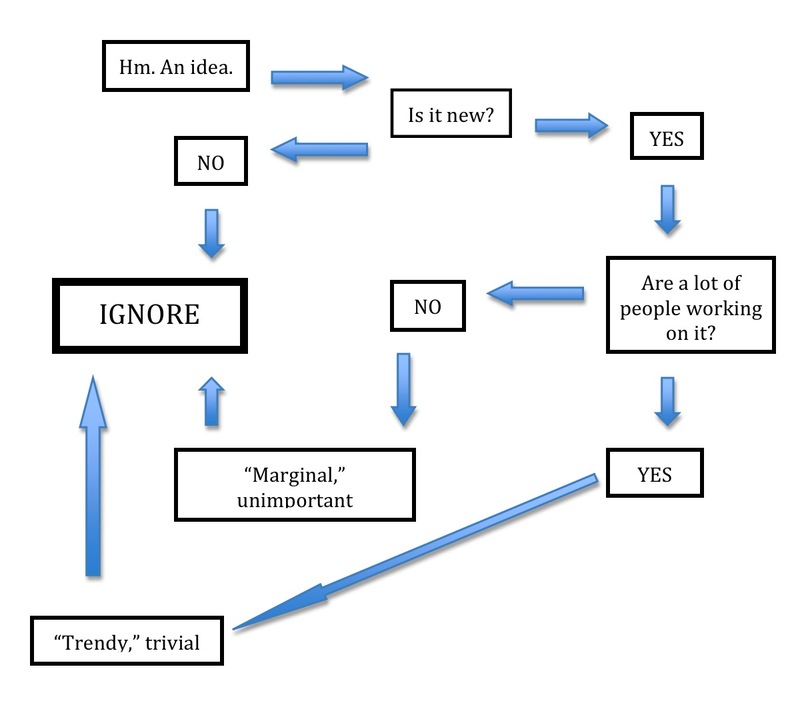
Second, how they choose research topics, from Marc Liberman (via Newmark):
Tullock on the Corporation
| Peter Klein |
Gordon Tullock is retiring this year from George Mason Law School. In the coming weeks you’ll probably be reading a lot of Tullock tributes and Tullock anecdotes (for example, about his famous put-downs). I don’t have much to add on the personal side, but I thought I’d share a remark or two about one of my favorite, and little-known, Tullock articles, “The New Theory of Corporations,” in Erich Streissler, ed., Roads to Freedom: Essays in Honor of Friedrich A. von Hayek (Routledge and Kegan Paul, 1969).
Tullock offers a number of insights into the corporate form and, in particular, the Berle-Means problem, that are well ahead of their time. As Tullock notes in the essay, he draws heavily here on Henry Manne’s work (and, he tells us, many conversations with Manne about these issues). In 1969 the consensus view was that corporations were almost exclusively controlled by salaried managers, running firms in their own interests and largely ignoring the wishes of shareholders. However, Tullock notes:
The theory of management control of corporations, of course, is subject to one very obvious difficulty. It offers no explanation of how managements are changed, and changes of management are an everyday occurrence as any reader of the Wall Street Journal can appreciate. It is true that presidents of large corporations frequently stay in office rather longer than the president of the United States, but they don’t stay in office as long as congressmen and senators, and we would hardly argue that the long tenure of congressmen and senators indicates that we do not have democracy in the United States. Thus, the current orthodoxy that the management actually runs the corporation cannot explain how the management got there or how the everyday occurrence of a change in management occurs. For some reason, this does not seem to disturb the partisans of the . . . Berle and Means theory. (more…)
Save Grandma, Don’t Give Makeup Exams
| Peter Klein |
I quit giving makeup exams years ago because they were Granger-causing the deaths of too many grandmothers. I believe the relationship between makeup exams and grandma mortality is well known among college professors, but I only recently discovered Lee Jussim’s analysis (via Teppo). (He suggests giving only really difficult makeup exams, which has a similar effect.)
Hayek, Read, Mises in the Classroom
| Peter Klein |
Today the University of Missouri welcomes its largest freshman class in history, with 5,680 student expected at their desks for the first day of the semester. (Could the increased enrollment be the result of Mizzou football’s surprising 10-2 record, and Big Twelve North Championship, last season? Not as crazy as you might think.) I am teaching an undergraduate class, “Economics of Managerial Decision Making,” that focuses on organizational and managerial issues. Finding good readings is often a challenge, though the textbook options are much better than a generation ago (Brickley, Besanko, Froeb, Hendrikse, and more.) Here are a couple of classroom resources I discovered today:
- A short paper by Russ Roberts summarizing the (somewhat difficult) argument in Hayek’s “Use of Knowledge in Society” (1945)
- Roger Meiners’s PowerPoint version of Leonard Read’s classic “I, Pencil”
Mises is not usually considered “classroom friendly” but I have found that “Profit and Loss” (1958) works well with undergraduates. And of course Mises emphasizes the entrepreneur as the driving force behind price adjustment, an aspect missing from Hayek’s treatment (in which agents are modeled as responders, not initiators). Section I of Bureaucracy, on “Profit Management,” is also quite good, and only 20 pages.
Best Three Sentences I Read Today
| Peter Klein |
Chris Dillow, wondering why doctors have such a good reputation, and economists such a poor one:
A man who’s been cured by a doctor lives to tell everyone. A man who’s been killed by one stays quiet. Economists’ “victims” — those stupid enough to believe forecasts — don’t keep schtum.
The rest of his reasons are interesting too. I think he focuses too much on economic forecasting, which is not in my view the same as economic analysis. The economy is not, after all, a “patient” to be taken care of and “cured” by the economist.
Don’t Ask Me What This Means
| Peter Klein |
In 1999, a group of researchers including [endocrinologist Erma] Drobnis were working on a study comparing semen quality across major metropolitan areas, suspecting that sperm counts were dropping worldwide. They selected New York, Minneapolis and Los Angeles for their study. But reviewers of the grant application recommended adding add another, more rural town. They selected Columbia [Missouri].
Researchers believed that including Columbia would serve as a baseline by which to judge the other cities. More rural settings, so the theory goes, tend to have fewer toxic pollutants such as smog in the air that impact reproductive health.
So researchers were caught off-guard when the Columbia sperm samples turned out to be significantly lower than samples from three other cities.
Here’s the story from the local paper. I’m eagerly awaiting the witty comments.
Reflections on Cyert and March
| Peter Klein |
The April 2008 issue of JEBO features a symposium on Cyert and March’s 1963 classic, A Behavioral Theory of the Firm (an O&M favorite). The book has been highly influential in organization theory, somewhat influential in behavioral economics, but mostly ignored in the contemporary economics literature on the firm (see here). As Mie Augier and March note in their introduction to the special issue:
As long as the primary focus of the theory of the firm was on the aggregate outcomes of interaction among rational actors, the book’s role in economics was limited. As Cyert and March noted, “Ultimately, a new theory of firm decision making behavior might be used as a basis for a theory of markets, but at least in the short run we should distinguish between a theory of microbehavior, on the one hand, and the micro-assumptions appropriate to a theory of aggregate economic behavior on the other. In the present volume we will argue that we have developed the rudiments of a reasonable theory of firm decision making” (1963, 16).
As interest in economics moved slowly toward greater concern with behavioral micro-assumptions, ideas consistent with Cyert and March (1963) became more prominent ([Kay, 1979], [Day and Sunder, 1996] and [Day, 2002]), although with hesitations and qualifications ([Baumol and Stewart, 1971] and [Williamson and Winter, 1991]). Elements of a behavioral view of the firm can now be found in many modern developments in economics, but especially in transaction cost economics ([Williamson, 1996] and [Williamson, 2002]), evolutionary theory ([Nelson and Winter, 1982], [Nelson and Winter, 2002], [Winter, 1986] and [Dosi, 2004]), and organizational economics (Gibbons, 2003). Behavioral ideas have been elaborated not only in theories of the firm but also in collateral areas of economics, such as strategic management (Rumelt et al., 1991), organization theory (Argote and Greve, 2007), and the psychological foundations of economic choice ([Tversky and Kahneman, 1974], [Kahneman and Tversky, 1979] and [Camerer et al., 2004]). Ideas of bounded rationality, conflict, learning, and routines are now commonplace, as is the general idea that economic behavior is guided by principles of human behavior. Although those ideas have many ancestors, A Behavioral Theory of the Firm probably contributed some modest amount of DNA.
Of particular interest to the O&M crowd are “Outlines of a Behavioral Theory of the Entrepreneurial Firm” by Dew, Read, Sarasvathy, and Wiltbank; “Realism and Comprehension in Economics: A Footnote to an Exchange Between Oliver E. Williamson and Herbert A. Simon” by Augier and March; and “Unpacking Strategic Alliances: The Structure and Purpose of Alliance versus Supplier Relationships” by Mayer and Teece.
Best Sentence I Read Today
| Peter Klein |
Justin Wolfers, on methodological conformity among mainstream economists:
Feel free to insert joke here about two-handed economists; although recognize that even an octopus couldn’t summarize the consensus within, say, sociology.
He’s mainly criticizing economists, however, adding: “Is it really the case that economics has advanced so little that 30 years later we are still having the same old debates?”
An Orthodox Response to Max Weber
| Peter Klein |
“Orthodox” with a capital O, that is. The current issue of the Acton Institute’s flagship journal, the Journal of Markets and Morality, features the first English translation of Sergey Bulgakov’s 1909 essay “The National Economy and the Religious Personality,” described by translator Krassen Stanchev as “the first Orthodox Christian response to Max Weber’s The Protestant Ethic and the Spirit of Capitalism.” Bulgakov, widely regarded as the greatest 20th-century Orthodox theologian, has been attracting increasing interest in recent decades, in both East and West. Writes Stanchev:
Only in the 1906s did scholars turn their attention to business in the Orthodox medieval world. Professors in theological academies in Communist countries carefully avoided the topic while economic historians, at best, studied the relations between religion and business for closed audiences, but most often they pretended the phenomenon did not exist.
Just a few years after Weber, Bulgakov managed to put together similar theoretical arguments and a set of historical evidence that allowed claiming origins of the capitalist spirit from Orthodox Christianity as well. For those who are familiar with the later Russian “scientific” philosophers’ disregard for facts and documents, it will be a surprise as to how rich Russian historiography in the nineteenth century has been.
The article is currently gated but should be available to non-subscribers later this year. Or you can subscribe now and avoid the wait.
Top Ten Signs Your Airline is Cutting Costs
| Peter Klein |
Having done a fair amount of flying this summer I particularly appreciated this recent Letterman top ten list:
Letterman: Top Ten Signs Your Airline is Cutting Costs (August 5)
10. During flight they hit you with additional $200 “landing charge”
9. It’s day 4 of your honeymoon, and you’re still on the tarmac
8. Plane has a “Hyundai” hood ornament
7. When you arrive, Hawaii looks suspiciously like Detroit
6. Inflatable vest replaced with smaller inflatable bow ties
5. Plane can’t take off until you lose 20 pounds
4. In-flight entertainment: watching two fat guys fight for an armrest
3. Flight attendants wearing clothes you packed
2. The pilot — Andy Dick
1. During the captain’s preflight checklist, you hear him say, “close enough”
“El Pulpo”
| Peter Klein |
A few years ago I read, and enjoyed, Stephen Schlesinger and Stephen Kinzer’s Bitter Fruit: The Story of the American Coup in Guatemala. (Kinzer also has a nice book on the CIA’s role in Iran.) So when I saw Peter Chapman’s Bananas!: How The United Fruit Company Shaped the World in a local bookstore — yes, the bright-yellow cover caught my eye — I snapped it up. United Fruit — “El Pulpo” (the Octopus) to its detractors — is a fascinating company, the history of which should be required reading for students of international business. Bananas is a disappointment, unfortunately. I wasn’t expecting a scholarly treatment but, even by journalistic standards, the book is weak, substituting breathy clichés for facts and analysis. And Chapman’s unfamiliarity with even the most basic concepts of economics doesn’t help. (Spend your money on Bananas instead — my favorite Woody Allen movie.)
Today I learned of at least one scholarly treatment of United Fruit, focusing on its Colombian operations: Bananas and Business: The United Fruit Company in Colombia, 1899-2000 by Marcelo Bucheli (New York University Press, 2005). Alan Dye makes some interesting points about knowledge transfer in his review for EH.Net:
One important contribution is the story the book tells of how United Fruit eventually decided to abandon its initial policy of creating barriers to competition and accept fair dealing with rivals to its core business. Although its early history was one of raising barriers to competition and exploiting the weakness of unstable governments to establish its monospony position, he argues that in the long run the presence of this, or another multinational, was necessary for the development of a commercial banana industry in Colombia. United Fruit had pioneered techniques for how to commercialize a fragile and highly perishable product. Regardless of unethical practices when dealing with locals in the producing countries, the importation of the marketing techniques that such pioneers in the industry developed were of substantial value to local industry. (more…)
Please, No More “Preneurs”
| Peter Klein |
The term entrepreneur is well-established in the academic and practitioner literatures, if not always consistently used. (As I note here, the word is typically applied to self-employed individuals or, in adjective form, to new and small ventures, but I prefer the broader, functional notions of innovation, alertness, or judgment found in the classic economics literature on entrepreneurship.) The literal translation of the French entrepreneur, “undertaker,” isn’t quite right, though I’m rather drawn to the older English terms “adventurer” or “projector.”
In any case, there’s no excuse for the seemingly endless proliferations of
“-preneur” words floating around today. An entrepreneurial individual within a large firm is an intrapreneur. With some additional skills and an external perspective she might become an extrapreneur. A good manager can hope to be a manapreneur. You in the tech sector? You’re a technopreneur. Or you might be a minipreneur, actorpreneur, agripreneur, authorpreneur, seniorpreneur, or even a mompreneur. Enough!
Let’s stick to simple ideas, like manurepreneurship.
McNamara on Management
| Peter Klein |
From Abraham Zaleznik in HBS Working Knowledge (via Marshall Jevons):
[Robert S. McNamara] was a brilliant student at the University of California and at Harvard Business School, where he became a member of the HBS faculty. McNamara was a devotee of managerial control, an expertise he applied in his work at the Ford Motor Company and later at the Department of Defense as secretary in President John F. Kennedy’s cabinet.
His mantra was measurement. As secretary of defense, McNamara developed, along with key subordinates, including Robert Anthony of the HBS control faculty, long-range procurement cycles. He even tried to get the U.S. Navy to subscribe to a common aircraft for the three branches of the military. The Navy refused to go along, since this branch was concerned about aircraft operating from carriers.
McNamara urged field commanders in Vietnam to apply measurement to enemy losses, but did not realize until it was too late that the measurements were unreliable to assess enemy losses. The most reliable assessments came from correspondents like Neil Sheehan and David Halberstam. McNamara published a book years after he retired to reassess the Vietnam War and his role in it as secretary of defense. His main theme was the failure to examine critically the assumptions leading to U.S. involvement in this disaster. Editorial writers took no pains to spare McNamara’s feelings.
The moral I took away from his story is to avoid the perils of the fox and its reliance on a single belief, in this case measurement, and the technology of control.
For more on McNamara’s management philosophy and experiences, Deborah Shapley’s 1992 biography Promise and Power is pretty good. I also recommend The Whiz Kids: Ten Founding Fathers of American Business — and the Legacy They Left Us by John Byrne. As these books point out, McNamara was not a pioneer in this area but a follower of Tex Thornton, head of the US Army’s Statistical Control Group in WWII and later CEO of Litton Industries. It was Thornton who brought McNamara and the rest of his “Whiz Kids,” as a group, to Ford in 1945. Harold Geneen, the most famous “management-by-the-numbers” guy, was not part of this group but shared much of Thornton’s philosophy. (See Robert Sobel’s Rise and Fall of the Conglomerate Kings.)
Public Choice and Austrian Economics
| Peter Klein |
The Austrian school and the Public Choice or Virginia school of economics are often tightly linked, both among the lay public and within academic circles. The connection isn’t obvious, however. While members of both schools tend to have classical-liberal views on political economy, the Virginia school emerged from the Chicago public finance tradition (Buchanan, after all, was a student and disciple of Knight) and is thoroughly “neoclassical” in orientation. Public choice economists tend to look to Chicago, not Vienna, for inspiration.
Anamaria Berea, Art Carden, and Jeremy Horpedahl take a different tack, drawing out common threads in Buchanan’s and Hayek’s subjectivist approach to cost.
Cost and Choice and The Sensory Order represent tangents from the basic research programs of their respective authors, James M. Buchanan and F.A. Hayek. These seeming diversions into methodology by two political-economic philosophers help to shed light on their underlying assumptions about cost and rationality. We argue that Buchanan and Hayek, and consequently Public Choice and Austrian Economics, have very similar underlying assumptions about the nature of cost. This can help to explain other similarities between the two schools, especially regarding the role of the state. These contributions are synthesized and applied to debates over the “new paternalism” and military conscription.
Tom DiLorenzo’s 1990 paper “The Subjectivist Roots of James Buchanan’s Economics” is also worth consulting on this connection. The question, though, is whether Cost and Choice (and the later Buchanan and Thirlby-edited volume, LSE Essays on Cost) is a consistent with the rest of the public choice tradition (including Buchanan’s own work).
NB: In graduate school I was exposed to the “positive political theory” (PPT) literature associated with Riker, Shepsle, Weingast, etc. and was surprised that the Virginia school was never mentiond in the discussion. A prominent PPT scholar told me once that PPT is “scientific,” while public choice is merely “ideological” and “low-tech.” Fair or not, I think this view is widespread among younger scholars. Has anyone written a good comparison of PPT and the public-choice approach?
Econ Academics Blog
| Peter Klein |
Christian Zimmerman of RePEc (and Dick’s colleague at UConn) has set up a blog aggregator focused on academic economics research, Econ Academics Blog. As Christian points out, there are lots of economics blogs, but only a few that deal primarily with academic economics (theories, research papers, debates). We’re happy to be included as a source.
Random Thoughts from the AoM
| Peter Klein |
Back now from the AoM conference in Anaheim. Random thoughts:
1. The Critical Management Studies Division (yes, it really exists) featured, as a keynote speaker, none other than Ward Churchill, former professor of ethnic studies at the University of Colorado (fired in 2007 for professional misconduct). His talk: “On the Banality of Managerial Efficiency: The ‘Eichman Question’ Revisited.” Apparently the Late Unpleasantness (1, 2) did not disqualify him from this eminent academic honor. I did not attend the talk but was told he was “impressive.”
BTW, if you’re wondering about this division of the Academy, look no farther than the CMS website:
The Critical Management Studies Division is a forum within the Academy for the expression of views critical of unethical management practices and exploitative social order. Our premise is that structural features of contemporary society, such as the profit imperative, patriarchy, racial inequality, and ecological irresponsibility often turn organizations into instruments of domination and exploitation. Driven by a shared desire to change this situation, we aim in our research, teaching, and practice to develop critical interpretations of management and society and to generate radical alternatives. Our critique seeks to connect the practical shortcomings in management and individual managers to the demands of a socially divisive and ecologically destructive system within which managers work.
2. You know how all stereotypes are based on elements of truth? I noticed that the receptions hosted by groups and organizations dominated by economists (such as the BPS Division) tended to have cash bars, while those dominated by psychologists and sociologists (e.g., anything to do with organizational behavior) tended to have open bars. (more…)





 Organizations and Markets
Recent Comments