Author Archive
Award-Winning CEOs
| Peter Klein |
 They make more money, sit on more boards, write more books, and have lower golf handicaps than CEOs of similarly performing firms who haven’t won awards (e.g. from Business Week). However, according to a new paper by Ulrike Malmendier Geoffrey Tate, their firms perform poorly after they win awards, compared to a matched set of firms headed by rank-and-file CEOs.
Compensation, status, and press coverage of managers in the U.S. follow a highly skewed distribution: a small number of “superstars” enjoy the bulk of the rewards. We evaluate the impact of CEOs achieving superstar status on the performance of their firms, using prestigious business awards to measure shocks to CEO status. We find that award-winning CEOs subsequently underperform, both relative to their prior performance and relative to a matched sample of non-winning CEOs. At the same time, they extract more compensation following the award, both in absolute amounts and relative to other top executives in their firms. They also spend more time on public and private activities outside their companies, such as assuming board seats or writing books. The incidence of earnings management increases after winning awards. The effects are strongest in firms with weak governance, even though the frequency of obtaining superstar status is independent of corporate governance. Our results suggest that the ex-post consequences of media-induced superstar status for shareholders are negative.
The pointer is from Justin Lahart, who blogs for the WSJ.
IRBs and Social-Science Research
| Peter Klein |
Most US research universities have an Institutional Review Board, or IRB, tasked with supervising “human-subjects” research. Unfortunately, the performance of the typical IRB is nothing short of disastrous, as we’ve noted before. IRB officials are trained to work with the physical and biomedical sciences, and have little knowledge of social-science research, though their mandate usually covers all research done at the university.
The July 2008 issue of Political Science & Politics, published by the American Political Science Association, contains a symposium on “Protecting Human Research Participants, IRBs, and Political Science Redux.” As editor Robert J-P. Hauck notes in his introduction:
By the 1990s, “IRBs had expanded their mission to include all research, not just research funded by the federal government, enhancing their scope of authority while slowing the timeliness of reviews. Similarly, and with the same result, IRBs were evaluating secondary research as well as primary research. Although the federal legislation provided for a nuanced assessment of risk, the distinction between potentially risk-laden research necessitating a full IRB review and research posing minimal or no risk that could be either exempted or given expedited review was disappearing. The length of the review process threatened the beginning or completion of course work and degree programs. IRBs were judging the merits of research projects rather than the risks involved. This trend was especially problematic because representation on many IRBs was skewed toward biological and behavioral scientists often unfamiliar with the methods and fields of political science and the other social sciences. And the list went on.
In the years that followed there have been several efforts to reform human subject regulation. . . . In the face of these and other efforts, are IRBs better able to effectively and efficiently protect human subjects in social science research?
Judging from the comments of the symposium authors, the answer is no. Now as in the past, IRBs have no consistently applied metric for measuring risk and corresponding levels of IRB review. Mitchell Seligson, Felice Levine and Paula Skedsvold, and Dvora Yanow and Peregrine Schwartz-Shea confirm that the review process has not and perhaps cannot accommodate survey methods and ethnographic and field research. The pace of the IRB review process continues to hinder undergraduate and graduate empirical research. IRBs’ rigid interpretations of requirements produce logically inconsistent directives such as when researchers are told to destroy data they diligently collected and anticipated sharing in order to protect research subjects’ anonymity (Seligson 2008; Yanow and Schwartz-Shea 2008; and Levine and Skedsvold 2008).
The pointer is from Zachary Schrag, who promises to comment on each article in the symposium.
Greif Responds to Edwards and Ogilvie
| Peter Klein |
I blogged earlier on Jeremy Edwards and Sheilagh Ogilvie’s provocative claim that Avner Greif misread the Geniza documents in constructing his influential account of the emergence of long-distance trade. Edwards and Ogilvie claim that formal law, not norms and custom, governed the behavior of the Maghribi traders.
Greif has prepared a formal response, now available on SSRN. Here’s the abstract:
Edwards and Ogilvie (2008) dispute the empirical basis for the view (Greif, e.g., 1989, 1994, 2006) that multilateral reputation mechanism mitigated agency problems among the eleventh-century Maghribi traders. Specifically, they assert that the relations among merchants and agents were law-based. This paper refutes this assertion and vindicates the position that the legal system had a marginal role in mitigating agency problems in long-distance trade in this historical era. The claim that merchants’ relations with their overseas agents were law-based is wrong.
The evidence presented here is based on quantitative analyses of the corpuses containing the hundreds of documents on which the literature relies and a careful review of the documents and the literature Edwards and Ogilvie cite. Their assertion is shown to be based on unrepresentative and irrelevant examples, an inaccurate description of the literature, and a consistent misreading of the few sources they consulted. This paper thereby reaffirms the empirical basis for the multilateral reputation view. Indeed, this empirical basis is stronger than originally perceived. In addition, this paper sheds light on the roles of the legal system and reputation mechanism during this period.
Stop Using Management Buzzwords
| Peter Klein |
That’s the command to town and village officials from Britain’s Local Government Association, which urges its members to dump trite words and phrases like core values, evidence base, facilitate, fast-track, holistic, level playing field, process driven, quick hit, and my personal favorite, predictors of beaconicity (no idea what it means). Here’s the list, and here’s the CNN story (via Josh). From CNN:
The list includes the popular but vague term “empowerment;” “coterminosity,” a situation in which two organizations oversee the same geographical area; and “synergies,” combinations in which the whole is greater than the sum of its parts.
Officials were told to ditch the term “revenue stream” for income, as well as the imprecise “sustainable communities.” The association also said councils should stop referring to local residents as “customers” or “stakeholders.”
The association’s chairman, Simon Milton, said officials should not “hide behind impenetrable jargon and phrases.”
Business-school educators, please take note!
Creative Capitalism Blog
| Peter Klein |
Via Mankiw, here is Michael Kinsley and Conor Clarke’s Creative Capitalism Blog. Check out the list of contributors. Wow. I haven’t seen a team that impressive since these guys. OK, Creative Capitalism isn’t a traditional blog (there’s an oxymoron for you) but, as Kinsley and Clarke explain,
a web experiment designed to produce a book — a collection of essays and commentary on capitalism, philanthropy and global development — to be edited by us and published by Simon and Schuster in the fall of 2008. The book takes as its starting point a speech Bill Gates delivered this January at the World Economic Forum in Davos. In it, he said that many of the world’s problems are too big for philanthropy — even on the scale of the Gates Foundation. And he said that the free-market capitalist system itself would have to solve them.
This is the public blog of a private website where a group of invited economists have spent the past couple of weeks criticizing and debating those claims.
Gore Vidal on Academic Biographers
| Peter Klein |
Gore Vidal, writing in 1981 in the New York Review of Books:
Lately, American biography has fallen more and more into the hands not of writers but of academics. That some academics write very well indeed is, of course, perfectly true and, of course, perfectly rare. When it comes to any one of the glorious founders of our imperial republic, the ten-volume hagiography is now the rule. Under the direction of a tenured Capo, squads of graduate students spend years assembling every known fact, legend, statistic. The Capo then factors everything into the text, like sand into a cement mixer. The result is, literally, monumental, and unreadable.
Thanks to LRC for the tip. The context is Gore’s praise for David McCullough’s short biography of Teddy Roosevelt (who Vidal calls a “sissy”), Mornings on Horseback.
Of course there are some terrific academic biographers writing today such as Thomas McCraw and Guido Hülsmann. But they are probably the exceptions that prove the rule.
Whither Chicago Economics?
| Peter Klein |
Steve Levitt, writing on the controversy surrounding the University of Chicago’s proposed Milton Friedman Institute, says this:
The Chicago economics department views the world differently than anyone else, even other economics departments. Having learned my economics at Harvard and M.I.T., I took my first teaching job at Chicago with the very explicit idea that I would spend two or three years in Chicago to get to “know the enemy.” After I figured out how they thought, I would escape back to more comfortable surroundings.
Well two things happened that I didn’t expect. First, it turned out that it wasn’t so easy to learn to think like a Chicago economist. I’ve been trying to learn for more than a decade and I still have learned only the rudiments. Every day my colleagues teach me something I should know, but don’t. Second, I decided that the Chicago approach to economics was the right one for me, even though I am not that good at it.
I wish Levitt would elaborate on the differences between contemporary Chicago economics and the economics of Harvard, MIT, Princeton, and Stanford, because I don’t see any. The Chicago economics of 1970 or even 1980 was distinct from that of its East and West coast rivals. The Journal of Political Economy, and even more so the Journal of Law and Economics, had a unique style and approach. Chicago-influenced economics departments at UCLA, Washington, Texas A&M, Clemson, and elsewhere were disseminating (and deepening) the brand. But that’s all gone. It’s hard to see any unique vision today. Indeed, the diversity among US economics departments seems a thing of the past, as I noted before. They are all mini-MITs. How, exactly, is Chicago economics any different?
The Power of Walt
 | Peter Klein |
“If you could be anyone in the world, who would it be?” My usual answer is Walt Mossberg, the legendary WSJ technology reviewer. Imagine having access to nearly every cool gadget in the world, and being paid to play with them. Nerd-topia!
But I underestimated Walt’s power. Two marketing professors have discovered that a positive review by Walt generates a 10-percent increase in the parent firm’s abnormal returns while a negative review causes a 5-percent drop. Those are big numbers in event-study world. (Via Gizmodo.)
Controversy Over JPE Paper on File Sharing
| Peter Klein |
Stan Liebowitz, no stranger to controversy (1, 2), maintains that the Oberholzer-Gee and Strumpf paper on file sharing, published last year in the Journal of Political Economy, is fundamentally flawed. Stan submitted a comment (longer version here) to the JPE which was rejected by editor Steve Levitt. Stan believes that Oberholzer-Gee and Strumpf are guilty not merely of sloppiness, but academic dishonesty, and is upset that they refuse to share their data. The German newspaper Handelsblatt has written an article about the controversy. Handelsblatt focuses on Levitt’s decision to ask Strumpf to write a reply and then to use the reply as an anonymous referee report in rejecting Liebowitz’s comment. That doesn’t trouble me as much as the authors’ unwillingness to share the data (and the JPE’s refusal to insist on it). More generally, notes the newspaper:
The impression that procedural standards of economics journals are not particularly strict is widely shared in the profession. Zurich-based economist Ernst Fehr, an associate editor of the top-five journal “Quarterly Journal of Economics” and of “Science” points to a lack of clear rules as to when an editor should recuse himself because of potential prejudice. Science journals also seem to deal more openly with the competition among scientists. “Authors who submit an article to a science journal can say who they do not want to review their article”, praises Fehr, a choice which is typically not given to economists.
One internationally renowned economist, who did not want to be named, expresses the complaint more bluntly: “Little scandals and big scandals are commonplace: editors who publish articles in their own journals, referees or editors who decide about articles submitted by their own doctoral students.”
The pointer is from Craig Newmark, who writes: “Until important empirical results in economics are, as a matter of routine, carefully scrutinized and until they are provably replicable, economics will never get the respect that physics and biology and chemistry get. And that’s a shame.”
Update: Additional comments from John Lott and John Palmer.
Business History Bleg: British Trading Houses
| Peter Klein |
I’m advising a PhD student in sociology (yes, it’s true) who’s studying the rise of British commercial influence in the Far East. He’s particularly interested in Jardine Matheson & Company, a Hong Kong trading company founded in 1832 that grew quickly into a pre-modern industrial conglomerate. Can anyone recommend references on the organization and strategy of 19th-century trading firms, their political, social, and cultural activities and influence, and their role in trade and economic growth more broadly?
Overheard at the Conference
| Peter Klein |
A prominent economic theorist, introducing a well-known business professor who has published in several fields: “In addition to his important scholarly contributions, he has also written several articles in management journals.”
Searle Center Conference on the Economics and Law of the Entrepreneur
| Peter Klein |
I used to judge an academic conference by the number of big-name scholars in attendance. Now I look for big-name bloggers. What a delight, then, to be at the Searle Center Conference on the Economics and Law of the Entrepreneur with two of my favorite bloggers, Gordon from Conglomerate and Lynne from Knowledge Problem. The conference, organized by Dan Spulber, brings together economists and legal scholars to grapple with the challenges facing entrepreneurship research. Today’s sessions focused on venture finance and law, and tomorrow’s deal with economic growth, innovation, and the social context of entrepreneurship. I’m moderating a session featuring Simon Parker, Mirjam van Praag, Doug Cumming, Robert Miller, and Linda Yueh. The papers are available at the conference site and a selection will appear in a special issue of JEMS.
This the second Searle Center event I’ve attended this year and I’ve been impressed with both. The Center is only a year old but, under Henry Butler’s guidance, has already established itself as a major player in the fields of regulatory and entrepreneurial studies.
Organizational Charts from 1915
| Peter Klein |
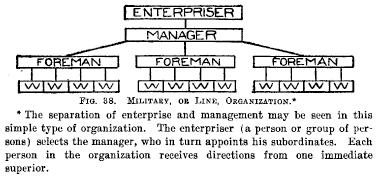
These images come from Frank Fetter’s second principles treatise, his Economic Principles (1915), which included chapters on “Enterprise” and “Management.” Note that at the top of the hierarchy sits the “enterpriser,” a term Fetter borrowed from Frederick Hawley), instead of “entrepreneur” or “adventurer,” both of which were then in common use to describe the business person. (Adventurer meant simply “one who undertakes a venture.”) Hawley preferred enterpriser because it suggested not simply management, but “responsibility,” or “the subjection [of one’s actions] to the results of production” (Hawley, 1908, p. 470). This is essentially the concept of entrepreneurship proposed in recent Foss-Klein papers (some of which you can find here), namely judgmental decision-making about the deployment of resources in the face of Knightian uncertainty.
Academic Journal Fakery
| Peter Klein |
As computer programs make images easier than ever to manipulate, editors at a growing number of scientific publications are turning into image detectives, examining figures to test their authenticity.
And the level of tampering they find is alarming. “The magnitude of the fraud is phenomenal,” says Hany Farid, a computer-science professor at Dartmouth College who has been working with journal editors to help them detect image manipulation. Doctored images are troubling because they can mislead scientists and even derail a search for the causes and cures of disease.
Ten to 20 of the articles accepted by The Journal of Clinical Investigation each year show some evidence of tampering, and about five to 10 of those papers warrant a thorough investigation, says Ms. Neill. (The journal publishes about 300 to 350 articles per year.)
This is from the Chronicle. The problem is partly cultural, it appears. “[Y]oung researchers may not even realize that tampering with their images is inappropriate. After all, people now commonly alter digital snapshots to take red out of eyes, so why not clean up a protein image in Photoshop to make it clearer?” Says Farid: “This is one of the dirty little secrets — that everybody massages the data like this.”
I suspect that outright fraud — making up data, changing regression coefficients — is unusual in empirical social-science research research. Sloppiness, ranging from data-entry errors to programming mistakes to misspecified regression models, is common. And social scientists typically “shade” results, e.g., by running fifty regressions and reporting only the one in which the signs and significance levels turn out to the researcher’s liking. (Hence the growing importance of the “robustness checks” section of any empirical paper.)
Ben Klein’s Contributions to Law and Economics
| Peter Klein |
Josh Wright has written a nice piece on Benjamin Klein for Josh’s forthcoming volume with Lloyd Cohen, Pioneers of Law and Economics. Klein’s 1978 paper with Armen Alchian and Robert Crawford and his 1981 paper with Keith Leffler are of course part of the organizational economics canon. His ongoing debate with Ronald Coase on the GM-Fisher Body case has helped clarify important issues on the role of asset specificity in vertical integration.
Trivia: Klein and Walter Block were college roommates at Columbia. Walter tells me they even went together to Ayn Rand’s apartment once during Walter’s Randian phase.
The Power of Ideas
| Peter Klein |
Expressed in sculpture. See the full set, from a 2006 Berlin exhibition, on Wikipedia. (Via politics-live.)

Reliving the 1980s
Peter Klein |
I recently watched the new Rambo film, an entertaining spectacle of blood and gore (for those who enjoy that sort of thing). The last few years have brought back several 1980s-era action heroes after long absences, not only Rambo but also Rocky Balboa, John McClane, the Terminator, and of course Indiana Jones.
We posted a while back on the golden decade of the 1970s, a fantastically productive period for research in organizational economics. How about bringing back the 1980s? Not the mullet, but the great works in organizational economics, strategy, entrepreneurship, and related subjects that appeared in that decade. Here are some of my favorites, listed chronologically. What are yours? (more…)
Best Paragraph I Read Today
| Peter Klein |
Money, money prices, market transactions, and economic calculation based upon them are the main targets of criticism. Loquacious sermonizers disparage Western civilization as a mean system of mongering and peddling. Complacency, self-righteousness, and hypocrisy exult in scorning the “dollar-philosophy” of our age. Neurotic reformers, mentally unbalanced literati, and ambitious demagogues take pleasure in indicting “rationality” and in preaching the gospel of the “irrational.” In the eyes of these babblers money and calculation are the source of the most serious evils. However, the fact that men have developed a method of ascertaining as far as possible the expediency of their actions and of removing uneasiness in the most practical and economic way does not prevent anybody from arranging his conduct according to the principle he considers to be right. The “materialism” of the stock exchange and of business accountancy does not hinder anybody from living up to the standards of Thomas a Kempis or from dying for a noble cause. The fact that the masses prefer detective stories to poetry and that it therefore pays better to write the former than the latter, is not caused by the use of money and monetary accounting. It is not the fault of money that there are gangsters, thieves, murderers, prostitutes, corruptible officials and judges. It is not true that honesty does not “pay.” It pays for those who prefer fidelity to what they consider to be right to the advantages which they could derive from a different attitude.
That’s Ludwig von Mises, writing on pp. 215-16 of Human Action (4th edition). Oh, how I love that man. I hereby pledge to use the phrase “mentally unbalanced literati” at least once per year.
Niche Business School Programs
| Peter Klein |
I’m surprised that the niche strategy isn’t used more in academia. Most economics departments at research universities strive to be the “MIT of [fill-in-the-blank].” Business schools tend to value the same set of academic journals, teach from the same set of cases, and hire faculty from the same set of top schools. Not only is this strategy unlikely to work for the typical mid-tier university, it has the undesirable social consequence of creating a bland conformism in which every department in Field X looks pretty much like every other department in Field X. The virtues of experimentation and learning are lost. Herd behavior is the order of the day.
Business Week recently ran an interesting piece about several undergraduate business programs that are trying the niche strategy. The University of Louisville runs a successful equine management program. Belmont University in Nashville offers a specialized music business degree. The University of Houston trains students for the energy industry. And Florida State University has a Professional Golf Management program.
What are your experiences with niche programs, where the niche is defined by applied focus (as in the above examples), by research method or approach, by a particular theoretical focus, or otherwise?
Tips for Presenting Your Research
| Peter Klein |
One of the most important skill young scholars must develop is the ability to give a technical presentation to a non-specialist audience. Everyone likes to strut his stuff but dissertation committee members, prospective academic employers, seminar audiences in various contexts, and others to whom you expose your work don’t necessarily want the gory details. Background, context, motivation, results, and implications are usually the most important parts of a presentation, but often the most neglected.
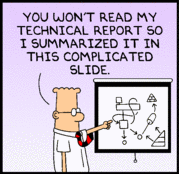 Two cartoons in my local paper today, this from Dilbert and this from Pickles, highlight that theme. Also, check out this article from Web Worker Daily, “10 Tips for Working with the Not-So-Tech-Savvy,” illustrated beautifully with an abacus. It’s written for techies working with regular folk, but many of the principles — avoid jargon, use analogies, include visuals, reference case studies, link to current events, be patient — apply to scholarly communication.
See also: Fabio’s Grad Skool Rulz.





 Organizations and Markets
Recent Comments