Author Archive
EBM Reconsidered
| Peter Klein |
Joe Mahoney, whose opinions are highly valued around here, thinks we are unfair to evidence-based management (EBM) (1, 2). Joe encourages readers to study Denise Rousseau’s 2005 Academy of Management Presidential Address and make up their own minds. Writes Joe:
Some of the leading folks in the evidence based-management (EBM) research program include past Academy of Management Presidents such as Jean Bartunek (Boston College), Jone Pearce (University of California, Irvine) and Denise Rousseau (Carnegie Mellon University). In the Strategy field, Ravi Madhavan (University of Pittsburgh), Alfie Marcus (University of Minnesota) and myself have recently become involved. The real leader of the Evidence-Based Management program is Denise Rousseau, who offers much of substance.
Joe reports that he attended a June 2007 workshop at Carnegie Mellon on EBM and came away much impressed. EBM, Joe writes, “means translating principles based on best evidence into organizational practices. Thus, organizational decisions are informed by social science and organizational research, which aid in solving organizational problems.” It’s hard to disagree with that.
Instrumental Variables versus Randomized Controlled Trials
| Peter Klein |
Despite the popularity of instrumental-variables estimators some empirical social-science researchers suggest dumping structural models altogether in favor of randomized controlled trials (RCTs), as used in biomedical research. (Like evidence-based management, but with substance.) MIT’s Poverty Action Lab (J-PAL) is the home of this movement. Princeton’s Angus Deaton is intrigued, but reminds us that RCTs are no panacea.
The movement is not modest in its claims, and it has attracted a good deal of acclaim from outside the profession. [J-PAL’s Abhijit] Banerjee has argued that the World Bank should cease to fund any activity (including presumably macro policy advice) that has not been previously subject to evaluation by an appropriate RCT. . . . There is much to be excited about in this program. J-PAL and other experimental researchers have come up with several surprising results that upset previous beliefs. And by replicating similar experiments in different settings they are beginning to create an impressive and valuable body of evidence. As might be expected in the first flush of enthusiasm, there has to date been less attention to some of the problems that have bedeviled RCTs in medicine, such as their limited value to physicians in practice, nor to the extent to which RCTs really do solve the standard problems of econometric analysis. (Indeed, many RCT papers subject their experimental results to various econometric corrections and analyses.) And the jury is still out on whether RCTs are any better than large data sets as substitutes for theory.
Thanks to Marshall Jevons (this one, not this one) for the pointer.
Content Analysis Using Amazon.com
| Peter Klein |
Arthur Diamond uses Amazon.com’s “Search Inside” feature to find books discussing “creative destruction” or other Schumpeterian concepts. Conclusion: Book authors, writing for the general reader, love Schumpeter while academic journal authors, writing for their fellow specialists, tend to ignore Schumpeter because his ideas are too difficult to model formally.
See also my earlier attempt to use Amazon to quantify bad academic writing.
How to Give a Guest Lecture
| Peter Klein |
Steve Carrell shows how it’s done on one of my favorite episodes of The Office. Seeing him rip up an economics textbook is classic. And how often do you hear the words “Herfindahl Index” on prime-time TV?
Update (7 November 2007): NBC’s lawyers made YouTube take down the clip. But here’s another (albeit incomplete) version.
The Best Business Book I’ve Read This Year
| Peter Klein |
It’s Phil Rosenzweig’s The Halo Effect (mentioned previously here). Rosenzweig systematically, but politely, demolishes the pretensions of best-selling management books and projects such as In Search of Excellence, Built to Last, Good to Great, and the Evergreen Project. These studies, Rosenzweig patiently explains, engage not in serious research — despite their pseudo-scientific pretensions (what Rosenzweig calls “The Delusion of Rigorous Research”) — but in storytelling.
The most common problems are sampling on the dependent variable (i.e., choosing a sample of high-performing companies and explaining what their managers did, ignoring selection bias) and using independent variables based purely on respondents’ ex post subjective assessments of strategy, corporate culture, leadership, and other “soft” characteristics. The latter is the “Halo Effect” of the book’s title. When a company’s financial or operating performance is strong, managers, consultants, journalists, and management professors tend to rate strategy, culture, and leadership highly, while rating the same strategies, cultures, and leadership poorly when a company’s performance is weak. It’s as if the authors of “guru” books have never taken a first-year graduate course on empirical research design. Or, as Rosenzweig puts it (p. 128): “None of these studies is likely to win a blue ribbon at your local high school science fair.” Ouch. (more…)
Dissing the Corporation
| Peter Klein |
Several papers in economic history, law, and political economy argue that the corporate form owes its emergence and persistence not to superior performance, but to legal privilege. This two-part series by Piet-Hein van Eeghen in the Journal of Libertarian Studies (1, 2) makes such a case, as do many essays by regular O&M commentator Kevin Carson. I tend to be somewhat skeptical of this literature, finding it insufficiently comparative institutional and not always consistent with the historical record as I understand it.
A new paper by Naomi Lamoreaux, whose work I very much admire, may force me to rethink my views, however. In “Putting the Corporation in its Place” (NBER Working Paper No. 13109) Lamoreaux and her coauthors Timothy Guinnane, Ron Harris, and Jean-Laurent Rosenthal argue that entrepreneurs in common-law countries tended to choose the corporate form over the next-best alternative, the partnership, only because a still more desirable alternative, the private limited liability company, was not available. (more…)
New Mises Biography
| Peter Klein |
Congratulations to Guido Hülsmann for the release of his 1,200-page biography of Ludwig von Mises, titled Mises: The Last Knight of Liberalism. Buy a copy here or read the whole thing online here. I’ve just started and the early chapters are terrific, placing Mises’s scientific ideas in their turn-of-the-century Viennese context and emphasizing the Jewish roots of Mises’s liberal Weltanschauung. I can’t wait to read the rest.
Economic Darwinism During Recessions
| Peter Klein |
Some version of the survivor principle, or “economic Darwinism,” underlies much economics and strategy research. While the term “survivor principle” was coined by Stigler (1968), the idea is usually attributed to Alchian (1950) and Friedman (1953). Alchian argued that even though theories about rational decision makers making “optimal” choices are clearly unrealistic, the predictions of such theories need not be. The quest for profit, combined with competitive selection forces, ensures that the average firm will tend to behave like those described by theories of rational behavior (Alchian, 1950). Friedman (1953: 22), defending the profit-maximization hypothesis, puts it this way:
[U]nless the behavior of businessmen in some way or other approximated behavior consistent with the maximization of returns, it seems unlikely that they would remain in business for long. Let the apparent immediate determinant of business behavior be anything at all — habitual reaction, random choice, or whatnot. Whenever this determinant happens to lead to behavior consistent with rational and informed maximization of returns, the business will prosper and acquire resources with which to expand; whenever it does not, the business will tend to lose resources and can be kept in existence only by the addition of resources from outside. The process of “natural selection” thus helps to validate the [maximization] hypothesis or, rather, given natural selection, acceptance of the hypothesis can be based largely on the judgment that it summarizes appropriately the conditions for survival.
The problem with Friedman’s strong version of the survivor principle is that we know little about how such competitive selection processes actually work. (more…)
Fun Activities for B-School Geeks
| Peter Klein |
Found these in Wired 15.09 (October 2007):
- Pecha-kucha: a sort of PowerPoint haiku in which presentations of exactly 20 slides, displayed for 20 seconds each, compete for honor and glory.
- Miss Management, a simulation game that let’s you play middle manager. “You’ll have to juggle incoming work tasks, keep everyone from getting stressed out, and help the coworkers achieve their goals, from flirting at the watercooler to getting more work done than anyone else!” Oh boy.
- And by the way, here are some social networking sites to avoid. Example: Trek Passions. “What it is: Sci-fi personals for Star Trek fans. Who you’ll meet: Men — sad, lonely men.”
Papers for São Paulo Workshop
| Peter Klein |
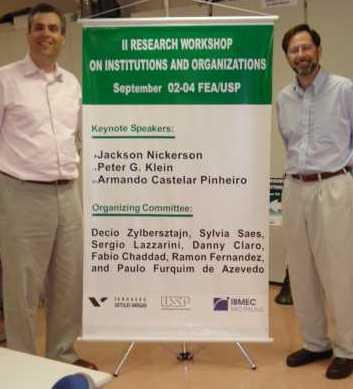
Papers for the II Research Workshop on Institutions and Organizations in São Paulo are now available here.
Keynote speakers Jackson Nickerson and I are headed to Brazil today. If I have time this morning I’ll post “My Favorite Things St. Louis Airport.”
Update (1 September): Here we are at PENSA, in a somewhat narcissistic pose, shortly after arrival.
Reports of My Assistant’s Death Are Greatly Exaggerated
| Peter Klein |
Received this email today from Harvard Business Online:
One of your course planning assistants, Mary E____, will be expiring on 09/12/2007.
Was she told? Does her husband know? Does the insurance company know?
Oh, wait: “This means that your assistant will no longer have access to your courses or be able to assist you with course planning in any way.” Whew!
New material for those funny lists you see from time to time.
SDAE Sessions
| Peter Klein |
Sessions from the SDAE section of the upcoming Southern Economic Association annual meeting (New Orleans, 18-20 2007) that may interest our readers:
- Peter Lewin (University of Texas at Dallas) and Howard Baetjer Jr. (Towson University),“Can Ideas be Capital? Can Capital Be Anything Else?”
- Per-Olof Bjuggren and Johanna Palmberg (Jönköpings International Business School), “Swedish Listed Family Firms and Entrepreneurial Spirit”
- Joseph T. Salerno (Pace University), “The Entrepreneur: Real and Imagined” (more…)
How Would You Know Him from Any Other French Professor?
| Peter Klein |
Phantom French Professor Claims Salary for 15 Years
PARIS (Reuters) — A French tax official cheated the government out of 600,000 euros (407,000 pounds) by creating a phantom identity as a university professor and claiming a salary for some 15 years, the government said on Monday.
Sorry, I couldn’t resist. But I’m excused.
Corporate Asset Purchases and Sales
| Peter Klein |
There’s a huge literature on mergers and sell-offs (see this excellent, if slightly dated, survey) but less work on the purchase and sale of corporate assets short of full acquisition or divestiture. Studying asset purchases and sales is a good way to learn about firms’ growth and retrenchment strategies because these transactions are not complicated by issues of corporate control.
Missaka Warusawitharana, a recent Wharton PhD now at the Federal Reserve Board, is doing interesting work in this area. In a forthcoming Journal of Finance paper he finds strong evidence that efficiency, not agency, considerations drive most asset purchases and sales. This contrasts with the M&A literature, in which the evidence on investment efficiency is mixed. A companion paper (with Sugata Ray) compares the sensitivity of acquisition returns to transaction value for both asset purchases and full acquisitions, finding evidence for value creation when corporate assets are purchased but not when an entire firm is acquired.
Write Like a Management Consultant
| Peter Klein |
With Mike Shor’s MBA Sentence Generator you can craft fine prose like this: “To proactively manage profit, our frictionless infrastructure parallels our world-class thought leadership.” You don’t even need an MBA!
HT to Luke Froeb, who also recommends Fred Kahn’s “My War Against Bureaucratese.”
Think Globally, Drink Locally
| Peter Klein |
Railing against corporate dictatorship, delocator.net helps consumers find locally-owned cafes, bookstores, and movie theatres in their area — alternatives to the “invasion” of Starbucks, Borders, and their ilk. The site itself is actually quite an interesting capitalist idea in its freshness and creativity, and people certainly should eat or drink or shop where they are most comfortable. That’s the beauty of competition! And the kind of community-building that often takes place at familiar, time-tested, local shops is to be encouraged.
But to say local businesses possess some kind of moral magic simply by virtue of being family-owned and homey is preposterous.
That’s Brooke Levitske, writing on the Acton PowerBlog. Recently a friend asked what I thought of Wendell Berry and his agrarian, anti-industrial philosophy. My response was similar: If people wish to live according to these principles, more power to them. I object only when materialist urbanites are forbidden by law from pursuing their own path to enlightenment.
Incidentally, does anyone remember the WSJ article a few years back suggesting that local cafes benefit when Starbucks moves to town? The theory is that the presence of a Starbucks increases local demand for premium coffee, providing spillover benefits to local stores. I haven’t seen any systematic evidence on this, however.
Summary of Kirzner’s Contributions
| Peter Klein |
Israel Kirzner received the 2006 International Award for Entrepreneurship and Small Business Research. Here is an article by Robin Douhan, Gunnar Eliasson, and Magnus Henrekson from the current issue of Small Business Economics summarizing Kirzner’s contributions to entrepreneurship theory.
Investor Protection and Firm Governance: Substitutes or Complements?
| Peter Klein |
The new institutional economics often treats the institutional environment and institutional arrangements as substitutes. In countries with stable legal institutions, relatively efficient courts, and reasonable default rules for contract terms, for example, contracts tend to be less complete. If contracting parties can trust the courts to fill in the gaps, why bother to write out every contingency? Likewise, if a country has an efficient external capital market, firms can be small and specialized, relying on the capital markets to allocate resources among business units, but if the external capital market performs poorly, diversified business groups may arise to exploit their internal capital markets.
It is thus surprising to learn, from a new paper by Reena Aggarwal, Isil Erel, René Stulz, and Rohan Williamson, that firms tend to establish better mechanisms for corporate governance in countries that already have strong rules for investor protection. “[O]ur evidence suggests that firm-level governance attributes are complementary to rather than substitutes for country-level investor protection, so that better country-level investor protection makes it optimal for firms to invest more in internal governance.” The better the institutional environment, in this case, the more effort agents put into designing efficient institutional arrangements.
Clearly more work is needed to understand the interactions between “macro” and “micro” institutions. What are some other good papers in this area?
Me in Chinese
| Peter Klein |
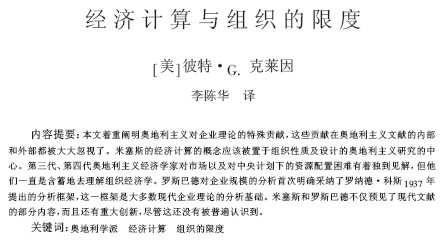
Here is a Chinese translation of my 1996 article “Economic Calculation and the Limits of Organization,” one of my favorites. It appears in Comparative Economic and Social Systems 116, no. 6 (2004): 70-78. The journal is edited by Wu Jinglian, an important Chinese economist specializing in economic reform. (Thanks to Chenhua Li for the translation and Kuo-Yang Tang for background information.)
Outsourcing Bleg
| Peter Klein |
A friend asks for good examples of companies outsourcing core functions or selling core technology and brands. Suggestions?





 Organizations and Markets
Recent Comments