Posts filed under ‘Austrian Economics’
Irrational Behavior and Rational Addiction
| Dick Langlois |
In 1962, Gary Becker published an article in the JPE called “Irrational Behavior and Economic Theory,” which prompted an interchange with Israel Kirzner (here, here, and here). Becker had tried to argue that one could derive the law of demand without recourse to an assumption of rationality: when relative prices change, the budget constraints of consumers will also change, making some previously available combinations infeasible. This will mean that, in the aggregate, consumers will demand less of the good that has become relatively more expensive. Kirzner pointed out that Becker still hadn’t eliminated rationality, since he is assuming that the consumers are price takers and that the prices are set on the supply side, presumably by firms who notice and respond rationally to price changes. (I discussed the issues here in some detail back in my 1986 book, which, by the way, is back in print in paperback thanks to the new technology of on-demand printing.)
I thought of the Becker-Kirzner exchange recently when I saw the abstract of this article: “So You Want to Quit Smoking: Have You Tried a Mobile Phone?”
Tobacco use, which is rising quickly in developing countries, kills 5.4 million people a year worldwide. This paper explores the impacts of mobile phone ownership on tobacco consumption. Indeed, mobile phone ownership could affect tobacco consumption because individuals might pay for their communication with money they would have spent on tobacco. Using panel data from 2,100 households in 135 communities of the Philippines collected in 2003 and 2006, the analysis finds that mobile phone ownership leads to a 20 percent decline in monthly tobacco consumption. Among households in which at least one member smoked in 2003, purchasing a mobile phone leads to a 32.6 percent decrease in tobacco consumption per adult over the age of 15. This is equivalent to one less pack of 20 cigarettes per month per adult. The results are robust to various estimation strategies. Further, they suggest that this impact materializes through a budget shift from tobacco to communication.
I leave it as an exercise to the reader to decide whether this sheds any light on the Becker-Kirzner exchange. Extra credit: what does this say about Becker’s theory of rational addiction?
Mises Quote of the Day
| Peter Klein |
OK, so the great line attributed to George W. Bush — “the problem with the French is they don’t have a word for entrepreneur” — turns out to be apocryphal. But check out this passage from the recent Mises collection, Marxism Unmasked, as noted in David Gordon’s review:
In French, the words “organize” and “organizer” were unknown before the end of the eighteenth century or the beginning of the nineteenth century. With regard to the term “organize,” Balzac observed “This is a new-fangled Napoleonic term. This means you alone are the dictator and you deal with the individual as the builder deals with stones.” (p. 45)
Thanks to Jeff Herbener for the pointer.
Computable Entrepreneurship
| Dick Langlois |
I just returned from New York, where I was a discussant at a session on entrepreneurship. (Peter was supposed to have been part of the session — too bad he couldn’t make it.) I discussed a presentation by my old friend Roger Koppl. I have written before about Roger’s work on forensic science administration. This presentation, which drew on a couple of Roger’s recent papers (see here and here), was called “Who Needs Entrepreneurs?” Here is the abstract:
The mathematics of “computable economics” proves that entrepreneurship policy is unlikely to succeed if it presumes policy makers can replace the unplanned results of the entrepreneurial market process with ex ante judgments about which enterprises are best. It is mathematically impossible for policy makers or their assignees to make the required computations of opportunity costs. Some business professors dream of finding a grand algorithm that will allow them to guide entrepreneurial decisions and to judge in advance which decisions are good and which bad. The logic of computable economics, however, reveals this dream to be a form of magical thinking.
This is fascinating stuff that should be of considerable interest to O&M readers.
Waugh’s House of Wittgenstein
| Peter Klein |
The Saturday Wall Street Journal features Janes Penrose’s review of Alexander Waugh’s House of Wittgenstein, a profile of the prominent Viennese family that produced not only the philosopher Ludwig, considered by many the greatest of the twentieth century, but also pianist Paul. Their father, Karl, was an important Austrian industrialist, and their home, nicknamed Palais Wittgenstein, a Viennese landmark. The WSJ also offers a sample chapter.
Hayek enthusiasts will of course remember that Hayek and Wittgenstein were second cousins, though they did not appear to know each other well (see Hayek’s “Remembering My Cousin Ludwig Wittgenstein” in Hayek, Collected Works, vol. 4, pp. 176-81). My old boss Bill Bartley, founding editor of Hayek’s Collected Works, wrote a controversial Wittgenstein biography in 1973 (Bartley’s book was the first to discuss Wittgenstein’s homosexuality publicly, for which Bartley was condemned by Wittgenstein’s literary executors and outcast by the Wittgenstein establishment). Hayek is also mentioned briefly in the popular book Wittgenstein’s Poker, which we discussed before.
John Gray argues that Hayek’s theory of language, as presented especially in The Sensory Order, was strongly influenced by Wittgenstein (even the numbering system copies that of the Tractatus). There are, writes Gray, “many evidences that Wittgenstein’s work reinforced Hayek’s conviction that the study of language is a necessary precondition of the study of human thought, and an indispensable prophylactic to the principal disorders of the intellect. Examples which may be adduced are Hayek’s studies of the confusion of language in political thought and, most obviously, perhaps, of his emphasis on the role of social rules in the transmission of practical knowledge.”
Skidelsky on Keynes and Hayek
| Peter Klein |
Keynes biographer Robert Skidelsky delivered the Manhattan Institute’s 2006 Hayek Lecture on Keynes and Hayek. The lecture will be broadcast this Sunday, 1 March 2009, 3:00 EST, on C-Span 2’s Book TV series. It will presumably appear later on C-Span’s YouTube channel. (Thanks to Warren for the pointer.)
Slides on “Putting Entrepreneurship into Strategy and Organization”
| Peter Klein |
You’ve read the book. You’ve seen the movie. You attended the seminar. Now download the slides. Or something like that. Anyway, Lasse begged me to post the slides from this morning’s talk at NHH — or maybe he begged me not to post them, I forget which — so here they are. Some of the slides may not make much sense without the animation (and accompanying patter), but sadly the event was not captured on video, where it could have won next year’s Oscar in the “Best Obscure Academic Talk” category.
Accounting Rules and Spontaneous Order
| Peter Klein |
David Albrecht thinks the US should not replace its accounting rules (GAAP) with the new, international standard (IFRS).
A language evolves to fit its culture. Language is not static. Moreover, there is no one best way for a language to be. . . .
If Americans wish to speak to a person from Peking, they can get their communication translated. The translation comes at a cost. The benefit from avoiding this cost by switching [to Chinese] would be much less than the huge opportunity costs of educating everyone in the U.S. to speak another language. If we continued using English, the translation to Chinese would (and is) a trivial expense, and a minor inconvenience.
Similarly, there is no good reason for anyone to have the U.S. discontinue using its accounting language (GAAP) and switch over to IFRS. Having multiple accounting languages in the world is a minor inconvenience and translation expenses are, in the grand scheme of things, trivial. Moreover, GAAP seems to fit our culture, economy and system of financial markets. . . .
Who would benefit if the U.S. switched to IFRS? Certainly not investors, for the same reason that they would not benefit if the country moved immediately to Chinese. The beneficiaries would be the accounting firms that would teach us the new IFRS, and company executives. (more…)
Demand for Commodities Is Not Demand for Labor
| Peter Klein |
Minnesota engineering professor David Levinson (via Mankiw), on the “shovel-ready” criterion for stimulus spending:
In the 1930s, when you were literally building with shovels, that might have made sense. That was largely unskilled labor. Today, it’s blue collar, but it’s not unskilled. . . . The guy brushing the asphalt back and forth is unskilled, but the guy operating the steamroller isn’t. And there’s an assumption out there that construction workers are interchangeable between residential and highway projects. But a carpenter isn’t a whole lot of help in building a road.
Modern Keynesian economics, which retains the Master’s belief in homogeneous labor and capital and his focus on macroeconomic aggregates, treats a worker as a worker as a worker. Lending and spending — on anything, it doesn’t matter what — brings idle resources into gainful use. Notes Hayek:
John Stuart Mill’s profound insight that demand for commodities is not demand for labor, which Leslie Stephen could in 1878 still describe as the doctrine whose “complete apprehension is, perhaps, the best test of a sound economist,” remained for Keynes an incomprehensible absurdity (Collected Works, vol. 9., p. 249).
And here’s Craig Pirrong:
There is no such thing as “aggregate output.” There are many industries, many goods, many sectors, all of which rely on specialized resources that are not readily redeployable among them. Directing — via coercion — spending to one sector or another is likely to worsen resource misallocations, rather than mitigate them. I find it particularly bizarre that some of the stimulus appears to be directed at supporting industries and sectors that resources should leave (e.g., construction, automobiles). We almost certainly built too many houses (due to perverse monetary policy, as John Taylor explains it), so resources should leave that business. Why stimulate it?
Viral Marketing
| Peter Klein |
My friend Tom Woods has written a new book, Meltdown, that explains the economic crisis from an “Austrian” perspective. Tom is a historian by training but has an excellent grasp of economic theory and policy (disclaimer: I consulted on the book). The book is aimed at the intelligent lay reader and was produced very quickly (Tom writes faster than I read) to take advantage of today’s unique educational moment. The book went on sale today.
Tom is promoting the book via the usual means (scholarly and popular websites and blogs, email lists, some TV and radio appearances) and some of his admirers have launched a viral marketing campaign, based at GetTomonTV.com. Can viral marketing work to promote a quasi-academic book? Will policy wonks, economic journalists, and concerned citizens blog, text, and twitter like Blair Witch groupies or Christian Bale fans? How does one promote books (and, for that matter, journal articles) in the Web 2.0 world? Most important, how do I use this knowledge to promote myself?
“We Are All Monetarists Now”
| Peter Klein |
“We are all Keynesians now,” Milton Friedman famously remarked in 1965. He meant that all mainstream macroeconomists, regardless of political persuasion, accepted the basic aggregate income-expenditure framework (and assumption of homogeneous capital) that underlies the neo-Keynesian model. How this model came to displace its predecessors, and how it remains in force today, despite the New Classical revolution and New Keynesian counterrevolution, is one of the most interesting stories of twentieth-century intellectual history. Greg Mankiw’s warm fuzzy for Bob Lucas — really a poke at Paul Krugman — is instructive in this regard. As is this anecdote shared by Steve Medema:
I was attending the small Claremont-Bologna monetary conference about a decade ago, and the participants included Friedman, Modigliani, Tobin, and Samuelson. I was sitting in a shuttle van that would take us to dinner, talking with Milton and Rose Friedman. Modigliani approached the van, saw Friedman, shook his hand vigorously, and exclaimed, “Milton, I’m a monetarist now!”
Keynesian, New Keynesian, Monetarist, and New Classical macroeconomics are variations on a theme. The capital-based macroeconomics of the Austrian school represents an entirely different approach, one I hope to blog more about soon. (See also: “Revenge of the Aggregates.”)
Update: Even Dick Armey, writing in today’s WSJ, gets it:
Keynes’s thinking was a decisive departure from classical economics, because arbitrary “macro” constructs like aggregate demand had no basis in the microeconomic science of human action. As Hayek observed, “some of the most orthodox disciples of Keynes appear consistently to have thrown overboard all the traditional theory of price determination and of distribution, all that used to be the backbone of economic theory, and in consequence, in my opinion, to have ceased to understand any economics.”
As Keynes’s Cambridge colleague Gerald Shove supposedly remarked (according to Joan Robinson), “Maynard never spent the half hour necessary to learn price theory.” Sadly, the same seems true of many of Keynes’s modern disciples.
Hayek on the Austrians
 | Peter Klein |
Those of you longing for a copy of my favorite volume in Hayek’s Collected Works, but unwilling to pay the hefty University of Chicago Press or Routledge price, can now get a handsome paperback edition for only $12, thanks to Liberty Press. The brilliant introduction and copious editor’s footnotes alone are worth the price!
Stimulus Haiku

 | Peter Klein |
From the great Bob Higgs:
Billions come bursting
From huge hydrants of money
I am stimulatedCredit freeze thaws now
Fed heats pipes until they steam
Winter is lovelyConsumers feel fine
Ready to mortgage their souls
John Maynard Keynes smilesSaving’s so passe
Capital stock may be assumed
Let K be capitalGiant debt you bet
Chinese will serve fine dinner
Children cannot voteLike rose in springtime
Welfare state blossoms anew
Laughter heard in hell
Feel free to try your hand in the comments section below. See also Bob’s reflections on the Inauguration.
Update: See also Morgan Reynolds’s bailout version of “I Fought the Law.”
Chapman on the US Economy
| Peter Klein |
My colleague, coauthor on several forthcoming projects, and former PhD student John Chapman was on Hugh Hewitt’s show last night, talking about the US economy. Like me John blames the Fed, not hedge funds and derivatives markets, for the housing bubble and crash. John’s investment advice: “Short the dollar and prepare for the 1970s.” Listen here (John comes on around 25:10).
Kirzner on Kirzner
| Peter Klein |
In a recent paper I wrote that much of the contemporary entrepreneurship literature on opportunity identification
misses . . . the point of Kirzner’s metaphor of entrepreneurial alertness: namely that it is only a metaphor. Kirzner’s aim is not to characterize entrepreneurship per se, but to explain the tendency for markets to clear. In the Kirznerian system, opportunities are (exogenous) arbitrage opportunities and nothing more. Entrepreneurship itself serves a purely instrumental function; it is the means by which Kirzner explains market clearing.
Some readers have challenged me on this point. In my defense, I call upon none other than Israel Kirzner, whose newest paper, “The Alert and Creative Entrepreneur: A Clarification,” appears in the February 2009 issue of Small Business Economics (working-paper version here). Kirzner seeks to clarify the nature of his classic contribution, concerned that he has been misinterpreted by friend and foe alike. Writes Kirzner:
[M]y own work has nothing to say about the secrets of successful entrepreneurship. My work has explored, not the nature of the talents needed for entrepreneurial success, not any guidelines to be followed by would-be successful entrepreneurs, but, instead, the nature of the market process set in motion by the entrepreneurial decisions (both successful and unsuccessful ones!). . . . This paper seeks (a) to identify more carefully the sense in which my work on entrepreneurial theory does not throw light on the substantive sources of successful entrepreneurship, (b) to argue that a number of (sympathetic) reviewers of my work have somehow failed to recognize this limitation in the scope of my work (and that these scholars have therefore misunderstood certain aspects of my theoretical system), (c) to show that, despite all of the above, my understanding of the market process (as set in motion by entrepreneurial decisions) can, in a significant sense, provide a theoretical underpinning for public policy in regard to entrepreneurship.
Kirzner devotes the bulk of his attention to the contrast between Kirznerian and Schumpeterian entrerpreneurship, while my paper focuses on the differences between Kirzner and Knight. Still, I’m gratified that Kirzner appears to view today’s applied entrepreneurship literature, in relation to his own work, the same way I do.
Schumpeter on Methodological Individualism
| Peter Klein |
Via Lani Elliott, here’s a PDF excerpt from Joseph Schumpeter’s first book, Das Wesen und Hauptinhalt der theoretischen Nationalokonomie (The Nature and Essence of Theoretical Economics), published in 1908. The book made quite a splash in the German-speaking world and Schumpeter received many requests for an English translation, but he wouldn’t allow it, or to have the book reprinted in German. In 1980 a single chapter, “Methodological Individualism,” was translated and published in pamphlet form, with a short introduction by Hayek (which I included here). The pamphlet has been very difficult to get until now. Thanks to Lani for tracking it down and Jeff Tucker for hosting a copy.
Hayek remarked:
Many of [Schumpeter’s] students will be surprised to learn that the enthusiast for macroeconomics and co-founder of the econometrics movement had once given one of the most explicit expositions of the Austrian school’s “methodological individualism.” He even appears to have named the principle and condemned the use of statistical aggregates as not belonging to economic theory.
That this first book of his was never translated is, I believe, due to his understandable reluctance to see a work distributed which, in part, expounded views in which he no longer believed.
On Schumpeter’s changing views see also Thorbjørn Knudsen and Markus C. Becker’s “The Entrepreneur at a Crucial Juncture in Schumpeter’s Work: Schumpeter’s 1928 Handbook Entry Entrepreneur,” Advances in Austrian Economics 6 (2003): 199–234.
Krugman’s Got the Disease
| Peter Klein |
Paul Krugman suffers increasingly from what might be called Stiglitz’s Disease, the inability to read (or cite) anyone but oneself. Some years ago Krugman wrote a rather silly and superficial piece on the Austrian theory of the business cycle, which he called the “hangover theory” of recessions. Krugman’s essay provoked strong reactions from Roger Garrison, John Cochran, David Gordon, and Bob Murphy, all of whom have considerable expertise regarding this particular theory. Naturally, Krugman didn’t read any of these responses because they weren’t written by, well, Paul Krugman. So, a couple of days ago, Krugman again trots out his “hangover” metahpor, oblivious to the fact that his original essay got the Austrian theory completely wrong. Ah, the joys of being a full-time dilettante!
My New Office Poster
| Peter Klein |
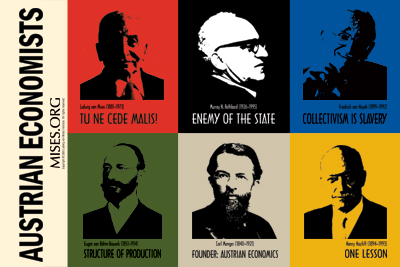
Cool, very cool. With these guys staring down at me I am sure to increase my productivity. That’s Mises, Rothbard, Hayek, Böhm-Bawerk, Menger, and Hazlitt, in case you can’t make out the captions (or, embarrassingly, don’t recognize the mug shots.) Sadly it doesn’t include Nicolai Foss, but you can’t have everything. Thank you, Santa! You can get yours here.
Macroeconomics Quote of the Day
| Peter Klein |
From Gary North (thanks to Dennis Lubahn):
Ben Bernanke . . . spent his career studying Milton Friedman’s now-dominant 1963 interpretation of the failure of Federal Reserve Policy, 1930-33, in not reversing the Great Depression. The FED did not inflate, Friedman said. This was in contrast to Murray Rothbard’s 1963 interpretation of the same era. He argued that the FED did inflate, 1924-29, which created the boom that busted in 1929. Had Bernanke studied Murray Rothbard’s 1963 book on Federal Reserve policy as the cause of the Great Depression, he might have had a very different career, perhaps teaching in a community college in North Dakota.
Of course, Rothbard’s approach to addressing the current crisis would be exactly the opposite of what has been done so far: stop inflating, allow interest rates to rise, encourage saving and capital accumulation, allow bankrupt financial and industrial firms to fail, etc. But we are all Keynesians now, right?
The Almost-Convergence of Mises, Parsons, and Popper
| Peter Klein |
O&M dabbles in economics, sociology, and the history and methodology of science so Rafe Champion’s new paper, “Mises, Parsons, and Popper: Comparison and Contrast of Praxeology, the Action Frame of Reference, and Situational Analysis,” may be of interest. Here’s the abstract:
During the 1930s three lines of thought converged on a common model of explanation in economics and the human sciences. Working in Europe, Ludwig von Mises of the Austrian school developed what he called “praxeology” to explore the sciences of human action. In the United States, Talcott Parsons, under the influence of Marshall, Pareto, Durkheim and Weber, offered the “action frame of reference” and in Australasia (in exile from Austria) Karl Popper elaborated “situational analysis”. Common features of the three models are methodological individualism, rejection of instrumentalism in favour of the search for real explanatory theories, and the use of a rationality principle to link the ends and means of action. General acceptance of the common features of these models would have significantly altered the criteria for theory development and appraisal in economics and the other social sciences. In the event, the three lines of thought did not merge to create a critical mass that might have made a difference in the scientific community at large. Their potential synergy has yet to be explored and there is scope for a synthesis of their most robust features with some modifications to each, especially to correct the views of Mises and Parsons on the methods that are effective in the natural sciences. A strange feature of the situation is that the three principals and their followers have, up to date, almost completely refrained from public comment or discussion of the work of the other two parties.
Comments are welcome here or at Rafe’s site.
Hayek Speaks on Inflation and Unemployment
| Peter Klein |
Kudos to Jeff Tucker for unearthing this 1975 interview from Meet the Press. Notes Jeff:
The line of questioning he endures is hilariously naive and idiotic. We think we have a Keynesian problem now; it’s clear that these people really believe that policy makers can manipulate the economy like a machine, trading off unemployment for inflation and back again, with no trouble.
John Cochran suggests another Hayek appearance from 1975, this one a lecture at the University of Colorado (provided by Fred Glahe). Here are a few more from the Mises.org audio archive. And see also the new book.





 Organizations and Markets
Recent Comments