Posts filed under ‘Bailout / Financial Crisis’
Leijonhufvud on the Current Crisis
| Nicolai Foss |
We have often blogged on the work of Axel Leijonhufvud on O&M (here). Here is a 2008 talk which was given in Denmark (and which, unfortunately, somehow missed my attention at that time) on “Keynes and the Crisis.” The talk contains many characteristic Leijonhufvudian themes (smashing of Ricardian equivalence, representative agent modeling, and the foundations of financial theory), little on Keynes (luckily!), and much critique of monetarism, in particular the choice of the CPI as the unique target of central bank policies and the notion of the independence of central banks from the political system. Here is Leijonhufvud’s overall diagnosis of the root causes of the current crisis:
The process leading up to today’s American financial crisis had the dollar exchange rate supported by foreign central banks exporting capital to the United States. This capital inflow was not even to be discouraged by a Federal Reserve policy of extremely low interest rates. The price elasticity of exports from the countries that prevented the appreciation of their own currencies in this way kept US consumer goods prices from rising. Operating an interest-targeting regime keying on the CPI, the Fed was lured into keeping rates far too low far too long. The result was inflation of asset prices combined with a general deterioration of credit quality (Leijonhufvud 2007a). This, of course, does not make a Keynesian story. It is rather a variation on the Austrian overinvestment theme.
Rogoff on Leverage
| Peter Klein |
An important point from Ken Rogoff:
Many commentators have argued that fiscal stimulus has largely failed not because it was misguided, but because it was not large enough to fight a “Great Recession.” But, in a “Great Contraction,” problem number one is too much debt. If governments that retain strong credit ratings are to spend scarce resources effectively, the most effective approach is to catalyze debt workouts and reductions.
For example, governments could facilitate the write-down of mortgages in exchange for a share of any future home-price appreciation. An analogous approach can be done for countries. For example, rich countries’ voters in Europe could perhaps be persuaded to engage in a much larger bailout for Greece (one that is actually big enough to work), in exchange for higher payments in ten to fifteen years if Greek growth outperforms.
I don’t agree with all of the discussion, for example Rogoff’s call for price inflation to mitigate the burden on debtors, but this is a big advance over the vulgar Keynesianism that passes for analysis at the New York Times. (See also Peter L.’s post on Rumelt.) The main point is that a recession like the present one is structural, and has nothing do with shibboleths like “insufficient aggregate demand.” I wish Rogoff (here or in his important book with Carmen Reinhart) talked about credit expansion as the source of structural, sectoral imbalances that generate macroeconomic crises.
Sovereign States Default, Repudiate; Sun Still Rises
| Peter Klein |
Frivolous commentary on the US debt crisis (like this) attributes to opponents of raising the debt ceiling the view that “defaults don’t matter.” Sensible people recognize, of course, that default (and even repudiation) are policy options that have benefits and costs, just as continuing to borrow and increasing the debt have benefits and costs. Reasonable people can disagree about the relevant magnitudes, but comparative institutional analysis is obviously the way to go here. (Unfortunately, most of the academic discussion has focused entirely on the possible short-term costs of default, with almost no attention paid to the almost certain long-term costs of continued borrowing.)
I’m a bit surprised no one has brought up William English’s 1996 AER paper, “Understanding the Costs of Sovereign Default: American State Debts in the 1840’s,” which provides very interesting evidence on US state defaults. It’s not a natural experiment, exactly, but does a nice job exploring the variety of default and repudiation practices among states that were otherwise pretty similar. Here’s the meat:
Between 1841 and 1843 eight states and one territory defaulted on their obligations, and by the end of the decade four states and one territory had repudiated all or part of their debts. These debts are properly seen as sovereign debts both because the United States Constitution precludes suits against states to enforce the payment of debts, and because most of the state debts were held by residents of other states and other countries (primarily Britain). . . .
In spite of the inability of the foreign creditors to impose direct sanctions, most U.S. states repaid their debts. It appears that states repaid in order to maintain their access to international capital markets, much like in reputational models. The states that repaid were able to borrow more in the years leading up to the Civil War. while those that did not repav were, for the most part, unable to do so. States that defaulted temporarily were able to regain access to the credit market by settling their old debts. More surprisingly, two states that repudiated a part of their debt were able to regain access to capital markets after servicing the remainder of their debt for a time.
Amazingly, the earth did not crash into the sun, nor did the citizens of the delinquent states experience locusts, boils, or Nancy Grace. Bond yields of course rose in the repudiating, defaulting, and partially defaulting states, but not to “catastrophic” levels. There were complex restructuring deals and other transactions to try to mitigate harms.
A recent CNBC story on Europe cited “the realization that sovereign risk, and particularly developed market sovereign risk exists, because most developed world sovereign was basically treated as entirely risk free,” quoting a principal at BlackRock Investment Institute. “With hindsight, we can say . . . that they have never been risk free, it’s just that we have been living in a quiet time over the last 20 years.” Doesn’t sound like Apocalypse to me.
The Treasury Bill as Myth and Symbol
| Peter Klein |
My father was a historian and helped organize local events to commemorate the bicentennials of the Declaration of Independence in 1976 and Constitution in 1987. I particularly remember the Freedom Train, a traveling exhibit housing memorabilia such as original copies of the Declaration, Constitution, Louisiana Purchase, and (I learn from Wikipedia, though I don’t remember these) Judy Garland’s dress from the Wizard of Oz and Joe Frazier’s boxing trunks.
Several years later, my Dad gave a conference paper (unfortunately unpublished) on “The Constitution as Myth and Symbol.” He noted that for many Americans, the founding documents, along with the Liberty Bell, Independence Hall, images of George Washington and Betsy Ross, etc., play the same kind of role as a Britain’s crown jewels, the Bastille, or Lenin’s tomb. The Constitution is important, in other words, not only for its text — some would argue the text is largely ignored today anyway — but for its symbolic value. It represents a particular myth of the American founding, usually associated with reason and noble ideals (Bernard Bailyn, Ayn Rand, Schoolhouse Rock) but occasionally with power or material self-interest (Charles Beard, Bertell Ollman).
 In following the debates over raising the US debt ceiling I”m struck by the frequent claim that defaulting on public debt is unthinkable because of the “signal” that would send. If you can’t rely on the T-Bill, what can you rely on? Debt instruments backed by the “full faith and credit of the United States” are supposed to be risk-free, almost magically so, somehow transcending the vagaries of ordinary debt markets. The Treasury Bill, in other words, has become a myth and symbol, just like the Constitution.
I find this line of reasoning unpersuasive. A T-bill is a bond, just like any other bond. Corporations, municipalities, and other issuers default on bonds all the time, and the results are hardly catastrophic. Financial markets have been restructuring debt for many centuries, and they’ve gotten pretty good at it. From the discussion regarding T-bills you’d think no one had ever heard of default risk premia before. (Interestingly, this seems to be a case of American exceptionalism; people aren’t particularly happy about Greek, Irish, and Portuguese defaults but no one thinks the world will end because of them.) So, isn’t it time to de-mythologize all this? Treasuries are bonds just like any other bonds. There’s nothing magic, mythical, or sacred about them. A default on US government debt is no more or less radical than a default on any other kind of debt.
FAIL
| Peter Klein |
Check out AdmittingFailure.com,
an open space for development professionals who recognize that the only “bad” failure is one that’s repeated. Those who are willing to share their missteps to ensure they don’t happen again. It is a community and a resource, all designed to establish new levels of transparency, collaboration, and innovation within the development sector.
Thanks to Josh Gans for the tip and some interesting discussion of failure in other contexts. (I’m not sure I’d use the term “missing market,” though; M&As, bankruptcy court, and indeed any asset markets could be described as markets for failure!)
Here’s an interesting paper by Rita McGrath on entrepreneurial failure. And of course there are huge academic literatures on divestitures, bankruptcies, and the like. At O&M we’ve often criticized bailouts and stimulus policy for retarding Schumpeterian competition by making it more difficult to identify, rectify, and learn from failures.
Creative Destruction in Popular Culture
| Peter Klein |
Thanks to Thomas B. for forwarding links to US Sen. Rand Paul’s Monday-night appearance on the Daily Show (part 1, part 2, part 3). At the start of part 3, while discussing government bailouts, Paul uses the words “creative destruction,” and Jon Stewart bursts out laughing, apparently hearing the term for the first time. I guess Schumpeter is not as culturally relevant as I thought!
The show had some interesting moments, but I found the discussions (in the parts I watched) pretty shallow. Stewart was grilling Paul on his “free-market” views, focusing on health, safety, and environmental regulation. Both Paul and Stewart took the milquetoast position that sure, some of this type of regulation is needed, but it shouldn’t be “too much.” They didn’t get into a serious discussion of theory or evidence, however, or explore specific trade-offs. There are huge political economy and public-choice literatures on the FDA, EPA, OSHA, etc., showing that these organizations are easily captured, tend to retard innovation, fail to weigh marginal benefits and costs, and so on. The Journal of Law and Economics under Coase’s leadership made its bones on these kinds of studies in the 1970s. The FDA has been a particular target. The Stewart view also ignores comparative institutional analysis — e.g., the role of private ordering (third-party certification, reputation, etc. ) in the protection of health and safety.
At least Paul didn’t say he intended to become the best Senator, horseman, and lover in all Washington!
Why Do Bad Ideas Spread? Luzzetti and Ohanian on the Rise and Fall of Keynesianism
| Peter Klein |
O&M generally takes a dim view of Keynesian economics. And yet Keynesianism triumphed after WWII and, while mostly dormant among academics from the 1970s to the 2000s, made a sweeping comeback over the last 2-3 years. If we anti-Keynesians are so smart, why is Keynesianism so popular?
This is an important question for the history, philosophy, and sociology of science, and we’ve addressed it before. Keynesianism appeals to fine-tuners, is easily formalized, appeared to “work” during and after WWII, has a “progressive” and “scientific” veneer, and justifies policies that governments have long championed (but all serious economists opposed).
Matthew Luzzetti and Lee Ohanian propose a similar narrative in their new NBER paper, “The General Theory of Employment, Interest, and Money After 75 Years: The Importance of Being in the Right Place at the Right Time.” In a nutshell, Keynesianism told people what they wanted to hear, gave them hope that the “new” economics could cure the Depression and bring long-term prosperity, worked well with the new empirical methods appearing in the 1940s and 1950s, and seemed consistent with observation. By the 1970s, however, the situation became almost reversed, and Keynesianism was dumped by the research community. Here’s an excerpt from the introduction: (more…)
Austrian Awakening?
| Peter Klein |
Following the Keynesian Consensus of the 1950s and 1960s Monetarism emerged as an alternative. By the late 1970s, there were Keynesians and Rational Expectations macroeconomists. When I took graduate macro in the late 1980s, I was told there were two schools of thought: New Keynesian and New Classical. (Elwood: “What kind of music do you usually have here?” Claire: “Oh, we got both kinds. We got country and western.”)
Old-style Keynesianism made a roaring comeback in the last two years. But cracks are starting to appear in the consensus edifice. An increasing number of commentators in the popular press are voicing disappointment with the results of deficit spending and money creation (aka “quantitative easing”), the classic Keynesian policy instruments. What are they turning to instead? Not Monetarism or New Classicism, which don’t seem like viable alternatives. Surprisingly, the mainstream press is rediscovering the Austrians.
 “We’re All Austrians Now,” declares CNBC, saying the Mises-Hayek theory “provides the best explanation for the business cycle we just lived through.” And pity the poor Fed: “the resurgent popularity of Austrian economics may actually be hampering the ability of the Federal Reserve to reflate the economy with low interest rate policies. Businesses, now aware of the dangers of a low inflation-sparked economic bubble, may simply be refusing to fall for the age-old boom-bust trap.” Sunday’s Newsweek noted “The Triumphant Return of Hayek,” citing “a growing backlash against the Fed’s monetary activism” and adding that Bernanke’s policy “suffers from the same fundamental flaw as Keynesianism, in that it protects inefficient players instead of injecting renewed vigor into the economy.” (Bonus quotation, via Larry White: “Keynesian theory . . . advocates a policy opposed to the interest of large investors and entrepreneurs and then, when this policy is about to be realized, holds the high liquidity preference of investors and the timidity of entrepreneurs responsible for the necessity further to increase taxation and public works.” — Otto von Mering, 1944) Even the staid Economist thinks the Austrian theory deserves more attention from policymakers.
Is there a shift in public attitude toward government management of the economy? Is the opinion-molding class changing its tune? Or are these reports anomalies? If public opinion and opinion among elites is changing, what explains the change? New evidence? Change in ideology? Self-interest?
Counterintuitive Is Cool: The Case of Markups
| Lasse Lien |
Counterintuitive empirical findings are endlessly more fascinating than expected or obvious ones. One counterintuitive finding I have picked up since the onset of the financial crisis is that markups are on average counter-cyclical. To spell it out: markups go up in a recessions and they fall in a boom (on average). Maybe it’s just me, but if asked about this two years ago I would have bet that markups were bid down during recessions in all but extreme market structures.
Here is a cool new paper that deals with this and several other interesting aspects of the dynamics of business cycles:
We characterise endogenous market structures under Bertrand and Cournot competition in a DSGE model. Short-run mark ups vary countercyclically because of the impact of entry on competition. Long-run mark ups are decreasing in the discount factor and in productivity, and increasing in the exit rate and in the entry costs. Dynamic inefficiency can emerge due to excessive entry under Cournot competition. Positive temporary shocks attract entry, which strengthens competition so as to reduce the mark ups temporarily and increase real wages: this competition effect creates an intertemporal substitution effect which boosts consumption and employment. Endogenous market structures improve the ability of a flexible prices model in matching impulse response functions and second moments for US data.
Etro, F. and Colciago, A., “Endogenous Market Structures and the Business Cycle,” Economic Journal 120 (2010): 1201–33.
Blinder: Keynesianism is Right, Because Keynesians Are Really Smart
| Peter Klein |
Alan Blinder’s defense of QE2 is as feeble as Mankiw’s defense of “emergency measures” more generally. Blinder’s argument is simply that QE2 isn’t all that different from standard Keynesian fine-tuning (true) and that Ben Bernanke is smarter than critics like Sarah Palin (duh).”To create the fearsome inflation rates envisioned by the more extreme critics, the Fed would have to be incredibly incompetent, which it is not.” This reminds me of Janet Yellen’s unfortunate 2009 statement that “the Fed’s analytical prowess is top-notch and our forecasting record is second to none. . . . With respect to our tool kit, we certainly have the means to unwind the stimulus when the time is right.”
Blinder apparently thinks that the anti-Keynesian backlash is just some quibbles about this little jot or tittle. He cannot grasp that the growing sentiment against monetary central planning, against fine-tuning, against the whole statist monetary establishment, is a rejection of Keynesianism at the most fundamental level. People are tired of the philosopher kings and their pretense of knowledge.
But this is folly to kings. Consider Blinder’s criticism of Bernanke:
What the Fed proposes to do is neither foolproof nor perfect. Frankly, it’s not the policy I would choose. As I’ve written on this page, I’d like the Fed to purchase private securities and to reduce the interest rate it pays on reserves, even turning it negative. The latter would blast reserves out of banks into some productive uses.
Ah, to think like a king! But the days of the monetary monarchy may be numbered.
Man Bites Dog …
| Scott Masten |
. . . and government swears it acts politically and is incompetent.
This might just be worth the cost to the U.S. taxpayer of bailing out GM. From GM’s prospectus for its upcoming IPO (via NPR):
…to the extent the UST [United States Treasury] elects to exert such control in the future, its interests (as a government entity) may differ from those of our other stockholders. In particular, the UST may have a greater interest in promoting U.S. economic growth and jobs than our other stockholders. For example, while we have repaid in full our indebtedness under our credit agreement with the UST that we entered into on the closing of the 363 Sale, a continuing covenant requires that we use our commercially reasonable best efforts to ensure, subject to exceptions, that our manufacturing volume in the United States is consistent with specified benchmarks. (p. 6)
We have determined that our disclosure controls and procedures and our internal control over financial reporting are currently not effective. The lack of effective internal controls could materially adversely affect our financial condition and ability to carry out our business plan. (p.29)
Now, the next time anyone says otherwise, you have can point to this.
A POMO Picture is Worth a Thousand Words
| Peter Klein |
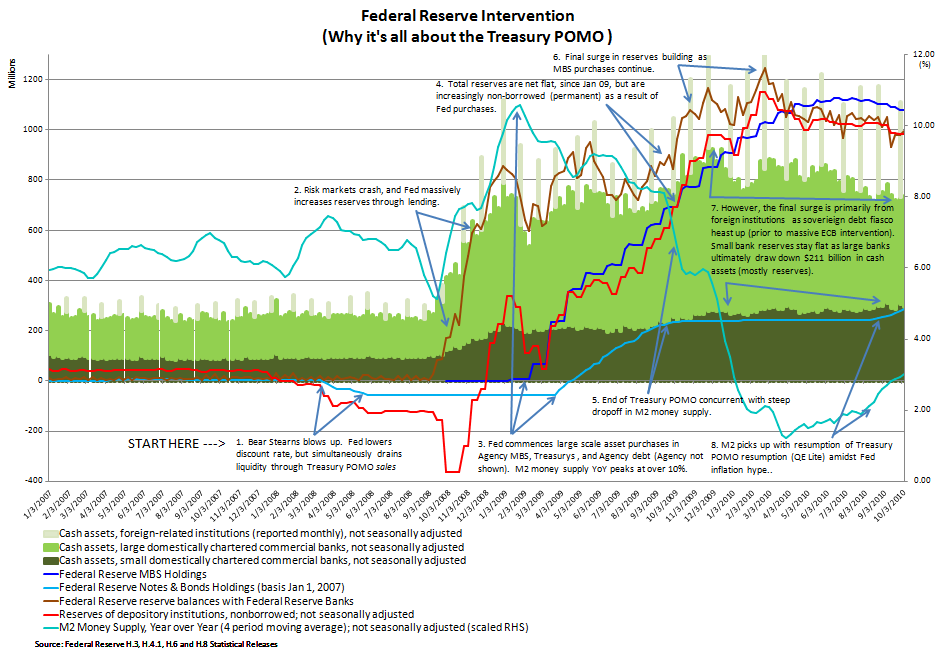
Not “pomo” as in Pomo Periscope, but “POMO” as in Permanent Open Market Operations. A fascinating graphic from Bob English (via EB) showing how the Fed is using its new tool (click to enlarge). In case you were worrying about the Fed “standing idly by” . . . .
The Pretense-of-Knowledge Syndrome
| Dick Langlois |
Has Ricardo Caballero been reading Hayek (or maybe Brian Loasby)?
In this paper I argue that the current core of macroeconomics — by which I mainly mean the so-called dynamic stochastic general equilibrium approach — has become so mesmerized with its own internal logic that it has begun to confuse the precision it has achieved about its own world with the precision that it has about the real one. This is dangerous for both methodological and policy reasons. On the methodology front, macroeconomic research has been in “fine-tuning” mode within the local-maximum of the dynamic stochastic general equilibrium world, when we should be in “broad-exploration” mode. We are too far from absolute truth to be so specialized and to make the kind of confident quantitative claims that often emerge from the core. On the policy front, this confused precision creates the illusion that a minor adjustment in the standard policy framework will prevent future crises, and by doing so it leaves us overly exposed to the new and unexpected.
Diamond-Dybvig (1983) and the Financial Crisis
| Peter Klein |
I started writing a really clever post about the famous Diamond paper (with Philip Dybvig) on financial intermediation and bank runs, its relevance for the financial crisis, and its elevated status in light of Monday’s Nobel announcement. Then I remembered that the author is Douglas Diamond, not Peter Diamond. Doh!
So I’ll try a different framing. “Speaking of guys named Diamond. . . .” The Diamond-Dybvig model, presented in a 1983 JPE article, has become famous enough to spawn an extensive secondary literature (and even sports its own Wikipedia entry). In a nutshell, it models fractional-reserve banks as intermediaries transforming illiquid assets into liquid liabilities and depicts the relationship among depositors as a coordination game with two Nash equilibria, one in which nobody tries to withdraw his funds because he believes no one else will try to withdraw his funds, and one in which everyone tries to withdraw their funds because they believe everyone else will try to withdraw their funds. Bank runs, in other words, constitute a Pareto-inferior Nash equilibrium. This framework led to extensive discussions about deposit insurance, option clauses, and other mechanisms to prevent the bad equilibrium by affecting depositors’ beliefs about solvency. (My former colleague Larry White devotes nearly a chapter of his Theory of Monetary Institutions to Diamond-Dybvig 1983.)
This is a hugely influential article, and I’m surprised it hasn’t been gotten more attention in the last two years. The essential fragility of a complex, interdependent, highly leveraged, fractional-reserve, implicitly government guaranteed system is at the heart of the financial crisis, so you’d think the Diamond-Dybvig framework would play an important role in the debate. But I can’t find much literature on this. The Richmond Fed devoted a special 2010 issue of its Financial Quarterly, guest edited by Ed Prescott, to the DD model, but it attracted little attention. Writes Prescott in his introduction: (more…)
Upcoming Public Appearances
| Peter Klein |
It’s a slow news day, blogospherically speaking, so I thought I’d share information about some of my upcoming public appearances, for reasons that have nothing at all to do with self promotion:
“Entrepreneurship, Strategy, and the Financial Crisis: Lessons from the Austrian School”
Sherlock Hibbs Distinguished Lecture in Business and Economics
24 September 2010, 2:00-3:30pm
205 Cornell Hall, Trulaske College of Business
University of Missouri
“Entrepreneurship and the Financial Crisis”
27 September 2010, 7:00pm
N021 Business Complex
Michigan State University
“Getting Out the Word: Alternative Research, Teaching, and Outreach”
Mises Institute Supporters Summit
8-9 October 2010
Auburn, Ala.
Cities and the Fetters of Nations
| Dick Langlois |
In Cities and the Wealth of Nations, Jane Jacobs argued that currencies should be promulgated by cities not nation states. If, for example, the currency of Detroit (the cadillac, let us say) could have floated against the currency of San Francisco (the silicon) during the late 20th century, there would have been another margin (other than the movement of capital and people) on which adjustments to technological change and shifting relative prices could have taken place, perhaps making Detroit less of a disaster area. I always found this idea appealing; but, not being a monetary economist and not having heard the idea discussed within professional economics, I wondered whether I might be missing some obvious counter-argument. Recently, however, I saw an NBER Working paper by Barry Eichengreen and Peter Temin that seems to make a similar point. Called “Fetters of Gold and Paper,” it argues that the euro and the dollar-renminbi peg are fixed-exchange-rate regimes like the gold standard. Such fixed-rate regimes may lower transaction costs in good times, but they prevent necessary adjustments in bad times, potentially leading to crises. Adjustment takes place via deflation that would otherwise have taken place through exchange-rate movement.
This is essentially the Eichengreen-Temin story about the Great Depression, which (to oversimplify) isn’t really very different from the Monetarist version. The Monetarists essentially say that gold wasn’t a fetter because there was never a real gold standard; it was a badly manipulated facsimile, which the Fed mismanaged. Eichengreen and Temin acknowledge this, but apply spin so that it was the mentalité of the gold standard that caused monetary authorities to behave as they did. In any case, as Eichengreen and Temin point out, the euro is actually a much stronger version of the fetters problem, since there is no adjustment mechanism akin to gold flows, however imperfect that mechanism might have been. Moreover, countries could (and eventually did) go off the gold standard; but there is no mechanism for countries to pull out of the euro without causing a major crisis. Interestingly, they see Bretton Woods as less of a problem, since there were international adjustment mechanisms in place. Also interestingly (for two economists of a Keynesian bent), they worry at length about the federal budget deficit and the level of government spending in the face of the renminbi peg and the current-account deficit. Usually, free-market economists worry about the budget deficit but not the current-account deficit, whereas left-of-center economists worry about the current account but not the budget. The renminbi peg makes them linked problems.
Which brings us back to Jacobs. The American dollar — one currency for all 50 states — was a prime model for the euro. And a Google search brings up dozens of comparisons between California and Greece. Why should the nation-state — whether the US or Europe — be the appropriate geographical domain of a currency?
Lachmann on Capital Heterogeneity
| Peter Klein |
We have written often on the role of capital heterogeneity in an entrepreneurial theory of the firm. “We are living in a world of unexpected change,” wrote Ludwig Lachmann in 1956; “hence capital combinations . . . will be ever changing, will be dissolved and reformed. In this activity, we find the real function of the entrepreneur.” Of course, the concept of heterogeneous resources is fundamental to transaction cost and resource-based views of the firm. It is mostly ignored by mainstream economists, however — macroeconomists in particular, as evidenced by the Old School Keynesianism that drives bailout and stimulus policy.
Here is Richard Ebeling with a fine overview of Lachmann’s capital theory, in contrast to Keynes’s superficial treatment:
A crucial element in Lachmann’s view of capital . . . is that the relationships between and among capital goods are those of substitutes and complements.
The Keynesian fallacy, Lachmann implies, is that Keynes tended to view and consider the capital stock has a more or less homogeneous aggregate under which all capital goods might be considered as interchangeable substitutes. Thus, any increase in capital investment lowers the “marginal efficiency of capital” (Keynes’ term) of every other unit of capital, since every unit of capital is a substitute with all other capital. . . .
Thus, if monetary manipulation brings about an increase in money and credit, and a resulting distortion of the rates of interest, and if this generates a tendency for misguided capital and related investments, and as a consequences capital goods and various types of labor are drawn into particular sectors of the economy and “stages” of the time structure of production, then . . .
You know the rest. And the coda too:
Government interventions and “stimulus” gimmicks merely serve to delay the adjustments and further distort an already distorted market. It is an attempt to maintain capital and labor complementary production and investment structures that are unsustainable in many of the patterns generated during the boom phase of the business cycle.
Add to: Facebook | Digg | Del.icio.us | Stumbleupon | Reddit | Blinklist | Twitter | Technorati
Regulatory Capture
| Dick Langlois |
I seem to be on the “communitarianism” mailing list of Amitai Etzioni, missives from which are usually good for a cold frisson of annoyance. The most recent one seemed promising, however, as it touted a paper revisiting the capture theory of regulation. Many people have rightly criticized the Dodd-Frank Act for piling on unnecessary administrative regulation despite the fact that (A) regulation was already extensive and provided all the powers that would have been needed to avert the crisis and (B) much of the new regulation is aimed at activities that have nothing to do with the financial crisis. Etzioni points out that the potential for regulatory capture is an additional reason for concern. Quite so. Dependably, however, Etzioni comes to the wrong conclusion about the nature of the problem and how to fix it. To Etzioni, the problem is not the inherent liabilities of administrative regulation but the specter of private money corrupting the system. (Notably, his examples do not include the money of labor unions, which have captured, at the very least, vast swaths of the Labor and Education Departments.) As political speech is a topic on which I have already fulminated at some length, I will just add that, even in a world in which regulators were somehow insulated from financial temptation, there would still be capture: the operation of regulatory agencies depends on the possession of large amounts of specialized knowledge in whose generation the subjects of regulation have considerable, and oftentimes overwhelming, advantage.
Add to: Facebook | Digg | Del.icio.us | Stumbleupon | Reddit | Blinklist | Twitter | Technorati
Summary of Dodd-Frank Act
| Peter Klein |
The Dodd-Frank Wall Street Reform and Consumer Protection Act — I’ll refrain from snarks about the title — was signed into law today by President Obama. Here is a very useful summary by William Sweet of the Act’s contents and likely consequences. In a nutshell: “The Dodd-Frank Act effects a profound increase in regulation of the financial services industry. The Act gives U.S. governmental authorities more funding, more information and more power. In broad and significant areas, the Act endows regulators with wholly discretionary authority to write and interpret new rules.” Aren’t you shocked that it passed?
Update: Larry Ribstein is not happy. Weil Gotshal provides further details.
Add to: Facebook | Digg | Del.icio.us | Stumbleupon | Reddit | Blinklist | Twitter | Technorati
Bailouts in Historical Perspective
| Peter Klein |
O&M has been consistently anti-bailout, whether recipients are banks, manufacturing firms, or homeowners. Besides encouraging moral hazard, bailouts also stymie the fundamental market process of moving productive assets from lower- to higher-valued uses. A market economy, after all, is a profit-and-loss system. Without losses, what’s the point?
A new edited volume, Bailouts: Public Money, Private Profit (Columbia University Press, 2010), explores bailouts in historical perspective, going back as far as the US financial crisis of 1792. Editor Robert Wright and his contributors try to steer a middle course, with Wright endorsing Hamilton’s Rule (formerly Bagehot’s Rule) of providing public loans to failing firms only if they have good collateral, and at “penalty” interest rates. Still, as Wright notes in his introduction, “There is no statistical evidence, however, that bailouts [of any kind] can speed economic recovery. In fact, bailouts can slow recovery by creating policy uncertainty, distorting market incentives, and in extreme cases fomenting sociopolitical unrest.”
Add to: Facebook | Digg | Del.icio.us | Stumbleupon | Reddit | Blinklist | Twitter | Technorati





 Organizations and Markets
Recent Comments