Posts filed under ‘Entrepreneurship’
Call for Papers: International Entrepreneurship
| Peter Klein |
The new Strategic Entrepreneurship Journal is rapidly becoming one of my favorite reads. (And not just because I’m the SEJ’s #1 author — it’s true, when my colleagues and I submitted this paper, we were assigned manuscript number SEJ-0001.) Here’s a call for papers for a special issue on international entrepreneurship edited by Douglas Cumming, Don Siegel, and Mike Wright. The call lists several potential research questions::
- How do government policies impact incentives to form strategic alliances among entrepreneurial firms in domestic versus foreign settings?
- What is the role of laws and public policy in stimulating transnational and returning entrepreneurs?
- What is the role of social networks in international entrepreneurship?
- What factors lead to the success of immigrant entrepreneurs in different countries?
- What is the interaction between public policy and foreign investment in entrepreneurial ventures?
- What explains international differences in governmental policies regarding intellectual property, entrepreneurship, and entrepreneurial finance?
- How does international entrepreneurship affect firm performance?
- How important is product and geographic focus for entrepreneurial success within different public policy settings?
- What are the implications of corporate entrepreneurship for multinational companies?
- How do corporate governance regulations impact international entrepreneurship?
- How do venture capitalists and private equity firms make decisions in an international context, including the decision to make cross-border investments and how to enter international markets?
- What is the role of academic entrepreneurship in various nations? Is their convergence or divergence in policies to stimulate academic entrepreneurship?
- How do universities stimulate international technology transfer and commercialization?
- What is the relative importance of patenting, licensing, and property-based institutions, such as science parks and incubators in stimulating entrepreneurship in various nations?
Submissions are due 31 December. Accepted papers will be presented at a conference at York University in April.
Westgren to Missouri
| Peter Klein |
I’m delighted to announce that Randy Westgren, organizational scholar, academic entrepreneur, bon vivant, and all-around great guy — and, most important, former O&M guest blogger — has been named McQuinn Professor of Entrepreneurial Leadership at the University of Missouri. I’ve greatly enjoyed interacting with Randy over the years from his perch in Urbana-Champaign and am looking forward to having him just down the hallway.
As McQuinn Professor Randy will also direct the McQuinn Center, which was launched in 2004 under the leadership of Bruce Bullock. The Center is creating an innovative and unusual program to research and teach the “functional” aspects of entrepreneurship, with particular emphasis on firm organization and strategy and applications to food, agriculture, biotechnology, natural resources, and rural development.
Please join me in congratulating Randy on his new post!
Messin’ With Entrepreneurship Data
| Peter Klein |
OK, it’s not as much fun as Messin’ with Sasquatch. But what happens if you mess with the two leading sources of global entrepreneurship data, the Global Entrepreneurship Monitor, which tracks startups, and the World Bank Entrepreneurship Survey dataset, which measures formal business registrations? One could explain the differences in terms of coverage, the sensitivity of the measurement instrument, and various forms of error. Or, like Zoltan Acs, Sameeksha Desai, and Leora Klapper, use the differences to measure the stages of entrepreneurial development. For commensurate data, that is, the ratio of registrations to startups provides information on the rate at which entrepreneurial ideas are transformed into feasible ventures. The abstract, from SSRN:
This paper compares two datasets designed to measure entrepreneurship. The Global Entrepreneurship Monitor dataset captures early-stage entrepreneurial activity; the World Bank Group Entrepreneurship Survey dataset captures formal business registration. There are a number of important differences when the data are compared. First, GEM data tend to report significantly greater levels of early-stage entrepreneurship in developing economies than do the World Bank data. The World Bank data tend to be greater than GEM data for developed countries. Second, the magnitude of the difference between the datasets across countries is related to the local institutional and environmental conditions for entrepreneurs, after controlling for levels of economic development. A possible explanation for this is that the World Bank data measure rates of entry in the formal economy, whereas GEM data are reflective of entrepreneurial intent and capture informality of entrepreneurship. This is particularly true for developing countries. Therefore, this discrepancy can be interpreted as the spread between individuals who could potentially operate businesses in the formal sector – and those that actually do so: In other words, GEM data may represent the potential supply of entrepreneurs, whereas the World Bank data may represent the actual rate of entrepreneurship. The findings suggest that entrepreneurs in developed countries have greater ease and incentives to incorporate, both for the benefits of greater access to formal financing and labor contracts, as well as for tax and other purposes not directly related to business activities.
Reading List for My Entrepreneurship Course
| Peter Klein |
This semester I’m teaching a new PhD seminar, “Economics of Entrepreneurship: Theory, Applications, Debate.” Here’s an excerpt from the course description. The reading list is below the fold. Comments and suggestions are welcome.
Entrepreneurship is one of the fastest-growing fields within economics, management, organization theory, finance, and even law. Surprisingly, however, while the entrepreneur is fundamentally an economic agent — the “driving force of the market,” in Mises’s (1949, p. 249) phrase — modern theories of economic organization and strategy maintain an ambivalent relationship with entrepreneurship. It is widely recognized that entrepreneurship is somehow important, but there is little consensus about how the entrepreneurial role should be modeled and incorporated into economics and strategy. Indeed, the most important works in the economic literature on entrepreneurship — Schumpeter’s account of innovation, Knight’s theory of profit, and Kirzner’s analysis of entrepreneurial discovery — are viewed as interesting, but idiosyncratic insights that do not easily generalize to other contexts and problems. . . .
This course presents a wide-ranging overview of the place of entrepreneurship in economic theory, with a special focus on applications to institutions, organizations, strategy, economic development, and related fields. It is intended for PhD students trained in economics, sociology, business administration, or a similar field (subject to instructor permission). Students are expected to be in at least their second year of their PhD program and to be working on a dissertation, or looking for a suitable dissertation topic. This is a research-oriented class in which students take an active role identifying suitable articles and topics for analysis, leading course discussions, and evaluating themselves and their peers. (more…)
Hoselitz’s “Early History of Entrepreneurial Theory”
| Peter Klein |
Thanks to my dedicated assistants Per Bylund and Mario Mondelli we now have an electronic copy of Bert Hoselitz’s hard-to-find 1951 essay, “The Early History of Entrepreneurial Theory” (Explorations in Entrepreneurial History, volme 3, pp. 193-220) and are happy to share it. This is one of the best surveys of the concept of entrepreneurship in pre-classical economics (but also including J. B. Say). (Hébert and Link (1988) think Hoselitz draws too sharp a line between Cantillon and Say.)
“El Pulpo”
| Peter Klein |
A few years ago I read, and enjoyed, Stephen Schlesinger and Stephen Kinzer’s Bitter Fruit: The Story of the American Coup in Guatemala. (Kinzer also has a nice book on the CIA’s role in Iran.) So when I saw Peter Chapman’s Bananas!: How The United Fruit Company Shaped the World in a local bookstore — yes, the bright-yellow cover caught my eye — I snapped it up. United Fruit — “El Pulpo” (the Octopus) to its detractors — is a fascinating company, the history of which should be required reading for students of international business. Bananas is a disappointment, unfortunately. I wasn’t expecting a scholarly treatment but, even by journalistic standards, the book is weak, substituting breathy clichés for facts and analysis. And Chapman’s unfamiliarity with even the most basic concepts of economics doesn’t help. (Spend your money on Bananas instead — my favorite Woody Allen movie.)
Today I learned of at least one scholarly treatment of United Fruit, focusing on its Colombian operations: Bananas and Business: The United Fruit Company in Colombia, 1899-2000 by Marcelo Bucheli (New York University Press, 2005). Alan Dye makes some interesting points about knowledge transfer in his review for EH.Net:
One important contribution is the story the book tells of how United Fruit eventually decided to abandon its initial policy of creating barriers to competition and accept fair dealing with rivals to its core business. Although its early history was one of raising barriers to competition and exploiting the weakness of unstable governments to establish its monospony position, he argues that in the long run the presence of this, or another multinational, was necessary for the development of a commercial banana industry in Colombia. United Fruit had pioneered techniques for how to commercialize a fragile and highly perishable product. Regardless of unethical practices when dealing with locals in the producing countries, the importation of the marketing techniques that such pioneers in the industry developed were of substantial value to local industry. (more…)
Please, No More “Preneurs”
| Peter Klein |
The term entrepreneur is well-established in the academic and practitioner literatures, if not always consistently used. (As I note here, the word is typically applied to self-employed individuals or, in adjective form, to new and small ventures, but I prefer the broader, functional notions of innovation, alertness, or judgment found in the classic economics literature on entrepreneurship.) The literal translation of the French entrepreneur, “undertaker,” isn’t quite right, though I’m rather drawn to the older English terms “adventurer” or “projector.”
In any case, there’s no excuse for the seemingly endless proliferations of
“-preneur” words floating around today. An entrepreneurial individual within a large firm is an intrapreneur. With some additional skills and an external perspective she might become an extrapreneur. A good manager can hope to be a manapreneur. You in the tech sector? You’re a technopreneur. Or you might be a minipreneur, actorpreneur, agripreneur, authorpreneur, seniorpreneur, or even a mompreneur. Enough!
Let’s stick to simple ideas, like manurepreneurship.
Random Thoughts from the AoM
| Peter Klein |
Back now from the AoM conference in Anaheim. Random thoughts:
1. The Critical Management Studies Division (yes, it really exists) featured, as a keynote speaker, none other than Ward Churchill, former professor of ethnic studies at the University of Colorado (fired in 2007 for professional misconduct). His talk: “On the Banality of Managerial Efficiency: The ‘Eichman Question’ Revisited.” Apparently the Late Unpleasantness (1, 2) did not disqualify him from this eminent academic honor. I did not attend the talk but was told he was “impressive.”
BTW, if you’re wondering about this division of the Academy, look no farther than the CMS website:
The Critical Management Studies Division is a forum within the Academy for the expression of views critical of unethical management practices and exploitative social order. Our premise is that structural features of contemporary society, such as the profit imperative, patriarchy, racial inequality, and ecological irresponsibility often turn organizations into instruments of domination and exploitation. Driven by a shared desire to change this situation, we aim in our research, teaching, and practice to develop critical interpretations of management and society and to generate radical alternatives. Our critique seeks to connect the practical shortcomings in management and individual managers to the demands of a socially divisive and ecologically destructive system within which managers work.
2. You know how all stereotypes are based on elements of truth? I noticed that the receptions hosted by groups and organizations dominated by economists (such as the BPS Division) tended to have cash bars, while those dominated by psychologists and sociologists (e.g., anything to do with organizational behavior) tended to have open bars. (more…)
O&M at the AoM
 | Peter Klein |
Ah, Los Angeles . . . land of “tattoos, breast implants, bleached hair, and vacuous egos,” as Nicolai recently wrote on Facebook. And then there are the people not in town for the Academy of Managment meeting!
As readers may know, the AoM is meeting this week in Anaheim. The O&M crowd is well represented, as usual. You can search the online program for your favorite person, subject, or interest area. Below are some of the sessions involving O&Mers, past and present: (more…)
Neuroeconomics and the Firm
| Peter Klein |
I’m not a big fan of neuroeconomics — Gul and Pesendorfer’s critique seems about right to me — but if you like that field you may be interested in this call for book chapters:
Neuroeconomics and the Firm
Editors:
Mellani Day
Angela Stanton
Isabell WelpeHow can we take advantage of neuroeconomics to inform organizations? Neuroscience can provide us with ways to understand causal relationships; it enables us to identify the biological drivers of beliefs, opportunity perception, opportunity analysis, risk-aversion or risk-seeking, motivation, incentives and reward mechanisms; in other words, we can map the pre-decisional dynamics of the human brain. Neuroeconomics has yielded important new insights and may provide powerful new ways of looking at the firm. (more…)
The Beauty of Entrepreneurship
 | Peter Klein |
Entrepreneurship is exciting, important, dynamic, unpredictable, creative, the “driving force” of the market economy, in Mises’s words. But is it beautiful? Yes, writes Evan Osborne in the new issue of the excellent Independent Review:
Commerce deserves a place next to literature, poetry, painting, music, and other conventional forms of art as an arena for human expression and a potential source of beauty. To expand the limits of human possibilities, entrepreneurs attempt to create value by rearranging scarce resources, and the methods they employ in these endeavors exhibit such dimensions of beauty as proportion, symmetry, and harmony.
The online edition of the article, “Commerce is Beautiful,” is behind a six-month moving wall but you can read the working-paper version here. It’s worth nothing that mathematics, another field not normally associated with the fine arts, also uses aesthetic terms like elegant, deep, austere, and beautiful to describe its achievements.
Conference Announcement: The Practice and Theory of Entrepreneurship
| Peter Klein |
The University of Missouri’s McQuinn Center for Entrepreneurial Leadership announces its 2008 conference, “Entrepreneurship: Where Practice and Theory Meet,” 6-7 November in St. Louis:
A conference bringing together practitioners and researchers to discuss current research and share best practices for creating successful new ventures and vibrant economies (with a special focus on rural entrepreneurship). The conference will highlight the Appalachian Regional Commission’s 10-Year Entrepreneurship Initiative, the W.K. Kellogg Foundation’s Entrepreneurship Development Systems in Rural America Program, and recent community initiatives.
Speakers include Elaine Edgcomb (Aspen Institute), Deb Markley (Rural Policy Research Institute), and John Potter (OECD). The conference is sponsored by the McQuinn Center, ExCEED / University of Missouri Extension, the Rural Policy Research Institute, and the Federal Reserve Banks of St. Louis and Kansas City. Further details including registration information, accomodations, etc. are available at the McQuinn Center website. Contact Ken Schneeberger for more information.
Opportunities and Entrepreneurship Research: A Critique
| Peter Klein |
The notion of economic “opportunities,” and their discovery or creation, is one of the core concepts of contemporary entrepreneurship research. But the use of opportunities as the unit of analysis poses several problems. The opportunity-discovery or opportunity-recognition perspective tends to treat economic opportunities as objective phenomena, while, under Knightian uncertainty, profit opportunities are always subjective, existing only in the imagination of economic actors. In an alternative view that Nicolai and I have elaborated in several papers, entrepreneurship is best understood not as perception, but as action, the investment of resources under uncertainty in anticipation of uncertain rewards.
In a new paper, “Opportunity Discovery, Entrepreneurial Action, and Economic Organization,” I critique the opportunity-discovery perspective in more detail. In particular, I argue that the literature has misunderstood Israel Kirzner’s concept of “discovery,” the theoretical basis of much of the research on opportunity discovery. Kirzner’s explanandum is not entrepreneurship per se, but equilibration. He invokes the entrepreneur, and his “alertness” to exogenously determined profit opportunities, as a metaphor, to explain the tendency of markets to clear. It is not meant as a positive account of the entrepreneurial function, but rather an instrumental explanation of the market process. Hence a research program based on operationalizing “opportunities,” exploring thow they can be “discovered without search,” and so on, is unlikely to bear fruit.
The paper is forthcoming in the Strategic Entrepreneurship Journal. Comments welcome. Abstract below the fold. (more…)
Searle Center Conference on the Economics and Law of the Entrepreneur
| Peter Klein |
I used to judge an academic conference by the number of big-name scholars in attendance. Now I look for big-name bloggers. What a delight, then, to be at the Searle Center Conference on the Economics and Law of the Entrepreneur with two of my favorite bloggers, Gordon from Conglomerate and Lynne from Knowledge Problem. The conference, organized by Dan Spulber, brings together economists and legal scholars to grapple with the challenges facing entrepreneurship research. Today’s sessions focused on venture finance and law, and tomorrow’s deal with economic growth, innovation, and the social context of entrepreneurship. I’m moderating a session featuring Simon Parker, Mirjam van Praag, Doug Cumming, Robert Miller, and Linda Yueh. The papers are available at the conference site and a selection will appear in a special issue of JEMS.
This the second Searle Center event I’ve attended this year and I’ve been impressed with both. The Center is only a year old but, under Henry Butler’s guidance, has already established itself as a major player in the fields of regulatory and entrepreneurial studies.
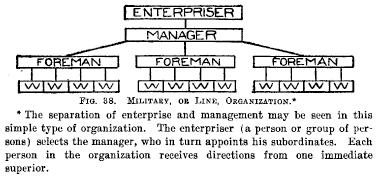
Organizational Charts from 1915
| Peter Klein |
These images come from Frank Fetter’s second principles treatise, his Economic Principles (1915), which included chapters on “Enterprise” and “Management.” Note that at the top of the hierarchy sits the “enterpriser,” a term Fetter borrowed from Frederick Hawley), instead of “entrepreneur” or “adventurer,” both of which were then in common use to describe the business person. (Adventurer meant simply “one who undertakes a venture.”) Hawley preferred enterpriser because it suggested not simply management, but “responsibility,” or “the subjection [of one’s actions] to the results of production” (Hawley, 1908, p. 470). This is essentially the concept of entrepreneurship proposed in recent Foss-Klein papers (some of which you can find here), namely judgmental decision-making about the deployment of resources in the face of Knightian uncertainty.
Reliving the 1980s
Peter Klein |
I recently watched the new Rambo film, an entertaining spectacle of blood and gore (for those who enjoy that sort of thing). The last few years have brought back several 1980s-era action heroes after long absences, not only Rambo but also Rocky Balboa, John McClane, the Terminator, and of course Indiana Jones.
We posted a while back on the golden decade of the 1970s, a fantastically productive period for research in organizational economics. How about bringing back the 1980s? Not the mullet, but the great works in organizational economics, strategy, entrepreneurship, and related subjects that appeared in that decade. Here are some of my favorites, listed chronologically. What are yours? (more…)
Mike Jensen Explains SSRN
| Peter Klein |
Mike Jensen, the distinguished financial economist and co-founder of SSRN, is interviewed here by Growthology’s Tim Kane. Everyone knows that electronic distribution of working papers has been extremely important for academic research in business and the social sciences. By the time most papers are published, they’ve already been read by many, if not most, of the target readers, from working-paper circulation, conference presentations, informal discussions, and the like. Jensen points out that electronic distribution has also had an important democratization effect. The elites always had access to cutting-edge research in advance of publication through informal networks, NBER workshops, and the like. “In my own field, I was part of a very small group doing cutting-edge work in the early days of modern finance, and I noticed that elites in all fields were 2-3 years ahead of other scholars just because they knew about research that took so much time to get distributed widely. The Internet allowed everyone to see the frontier.”
Note also Jensen’s comments about behavioral finance:
In the 1970s, I began to receive [as editor of the Journal of Financial Economics] quite a few papers challenging the efficient market hypothesis. The referees rejected them and I rejected them. Any one of these articles standing alone could be rejected, but I began to feel that as a package they cannot be ignored. The authors were onto something, even if we didn’t see it. Sometime around 1975, over the objection of my referees — many of them close friends — we published a special issue with a collection of those papers. That was controversial but proved to have great value. Subsequent to that, behavioral financial economics evolved.
In creating SSRN, I envisioned an alternative distribution vehicle.
Jensen has also been an important friend of and advisor to CORI, delivering the annual CORI Distinguished Lecture in 2005.
Against Government-Subsidized VC
| Peter Klein |
Government-subsidized venture capital underperforms private venture capital, according to a new analysis of Canadian data. Firms backed by subsidized VC are less profitable, less innovative, and less attractive to later-stage investors than firms backed by private VC. Poor governance and a negative signalling effect, and not adverse selection, appear to be the drivers. This is from a new NBER paper by James Brander, Edward Egan, and Thomas Hellman, “Government Sponsored Versus Private Venture Capital: Canadian Evidence.” Abstract:
This paper investigates the relative performance of enterprises backed by government-sponsored venture capitalists and private venture capitalists. While previous studies focus mainly on investor returns, this paper focuses on a broader set of public policy objectives, including value-creation, innovation, and competition. A number of novel data-collection methods, including web-crawlers, are used to assemble a near-comprehensive data set of Canadian venture-capital backed enterprises. The results indicate that enterprises financed by government-sponsored venture capitalists underperform on a variety of criteria, including value-creation, as measured by the likelihood and size of IPOs and M&As, and innovation, as measured by patents. It is important to understand whether such underperformance arises from a selection effect in which private venture capitalists have a higher quality threshold for investment than subsidized venture capitalists, or whether it arises from a treatment effect in which subsidized venture capitalists crowd out private investment and, in addition, provide less effective mentoring and other value-added skills. We find suggestive evidence that crowding out and less effective treatment are problems associated with government-backed venture capital. While the data does not allow for a definitive welfare analysis, the results cast some doubt on the desirability of certain government interventions in the venture capital market.
More on Agricultural Adaptation: Johnny Appleseed
| Dick Langlois |
The abstract of a new paper called “Alertness, Local Knowledge, and Johnny Appleseed” recently crossed my computer screen. By a grad student at George Mason called David Skarbek, the paper applies a Kirznerian account of entrepreneurship to the case of Johnny Appleseed, aka John Chapman (1774-1845). The entrepreneurial part will no doubt be of interest to many readers, including my estimable co-bloggers. But I’m more interested in the historical and institutional angle.
Skarbek points out that, contrary to the Disney-fueled myth, Johnny Appleseed didn’t scatter apple seeds randomly throughout Appalachia and the midwestern frontier. He planted clearly defined apple groves, totaling some 1,200 acres by the time of his death. This turned out to be crucial for homesteading, since under American state law the planting of fruit trees was one way to create a property right (in Lockean fashion) out of unowned land. Chapman was thus an institutional entrepreneur.
What Skarbek doens’t say, however, is something I learned at the NBER conference I wrote about earlier. In addition to having what we would nowadays call mental health issues, Chapman was also an evangelical Swedenborgian who shared with Thoreau the view that apples should aways be grown from seeds. (For documentation, see for example here.) In fact, apple trees grown from seeds are good for only one thing — cider — and, indeed, the Johnny Appleseed legend got a boost in Appalachia during Prohibition as the fruits (as it were) of his efforts were used for hard cider. Apple cultivation normally requires grafting, a form of hybridization known for centuries and practiced in Appleseed’s lifetime by the likes of Thomas Jefferson. The point is that Chapman saw hybridization as unnatural and immoral, and his quest was animated as much or more by this religious view as by environmentalist zeal or entrepreneurial insight. As the mention of Thoreau suggests, however, distaste for “unnatural” breeding methods is not exclusive to religious fundamentalists, and indeed today it is followers of Thoreau not (generally) Christian evangelicals who object to genetically modified organisms.
Climate (Change) and Agricultural Adaptation
| Dick Langlois |
Just for the fun of it, I drove up to Cambridge on Friday to take in one day of an interesting NBER conference on Climate Change: Past and Present. The conference was organized by Gary Libecap, whom I’ve known for years, and Richard Steckel, whose work I have always read with interest. Steckel is one of the people who have pioneered the use of archaeological techniques in economic history, notably measuring the heights of skeletons for evidence on nutrition in historical populations. This time he talked about using tree rings in historical research involving climate.
There were several excellent papers, which are available at the conference website. The two I liked the best have a flavor of evolutionary economics as well as evolutionary biology. Richard Sutch talked about the history of hybrid corn in the U. S. An important figure in the story is Henry Wallace, who founded one of the earliest hybrid-corn seed companies and, as Secretary of Agriculture, evangelized for hybrid corn and higher corn yields at the same time he was implementing pro-cyclical New Deal farm policies that restricted agricultural output in other commodities. But the main story is one of evolutionary learning. The major midwestern droughts of 1934 and 1936 accidentally revealed the (unintended) benefits of one kind of hybrid corn that was resistant to drought, thus changing the perceived payoffs to farmers of adopting the new technology, whose primary benefit was ultimately increasing yields. (more…)





 Organizations and Markets
Recent Comments