Posts filed under ‘Ephemera’
Undisputed Knowledge
| Lasse Lien |
Someone recently had the nerve to ask me for examples of undisputed knowledge generated from the social sciences. I.e., things we “know” that are both uncontroversial and does not require a lot of assumptions that are themselves in dispute (or not always true). . . .
I must admit that it was surprisingly (embarrassingly) difficult to come up with something that would qualify a strict interpretation of these criteria. Drawing a blank and under pressure to save face, I suggested that perhaps there would be universal agreement that there is nothing we can universally agree on. But then I realized that this would be an example of the liars paradox. I mean, it’s a logical impossibility that we can all agree that we cannot agree on anything.
So I guess my heroic defense of the social sciences boiled down to the claim that we can agree on only one thing, which unfortunately is a logical impossibility. . . .
Controynms Redux
| Peter Klein |
Last year’s post on contronymns — words that are their own antonyms — was one of our most popular. Anu Garg of Wordsmith.org ran a contronymns series this week, featuring cleave, continuance, asperse, copemate, and quiddity.
The series intro contained a few more:
When you sanction a project, do you approve of it or disapprove? Should one be commended for oversight (watchful care) or reprimanded for oversight (error or omission)? When you resign from a job, do you leave it or re-join (re-sign) it?
When a proposal gets tabled, is it being brought forward for discussion or being laid aside? Depends on which side of the pond you’re at. If the former, you’re in the UK; if the latter, you’re in the US.
I call them fence-sitters. They sit on fences, ready to say one thing or its opposite depending on which side they appear at. I’m not talking about politicians. These are words, known by many names: autoantonym, contranym, self-antonym, enantiodromic, amphibolous, janus word, and so on.
Sometimes it’s a result of two distinct words evolving into the same form (cleave from Old English cleofian and cleofan) but often a single word develops a split personality and takes on two contradictory senses. All of us have a bit of yin and yang and these words are no exception. The context usually provides a clue to help us understand the right sense in a given place.
Want to Understand the Financial Crisis?
| Lasse Lien |
This clip will tell you what you need to know.
HT: Erik Døving
A Political Slogan Even an Economist Could Love
| Peter Klein |
Spotted on Sheldon Richman’s blog:
Exploit Price Discrepancies, Not People!
(It links to Mises’s “Profit and Loss.”)
Nobel Pickin’ Time
| Peter Klein |
The econommics Nobel chatter has already begun (1, 2, 3, probably many more). I’ll just borrow from last year’s post for those who follow such things:
How about a prize for organizational economics? Coase, of course, whose 1937 paper is foundational to the field, has already won, as have Akerlof, Spence, Stiglitz, Mirrlees, Vickrey, Hayek, and others whose work has greatly informed the study of organizations. But, for a prize recognizing organizational economics per se, whom would you pick? Williamson, Holmström, Milgrom, Roberts, Hart, Tirole, Aghion? Perhaps Alchian, Demsetz, or Jensen. Maybe a personnel economist (Lazear) or someone in corporate finance or accounting (Bill Schwert, Stewart Myers, René Stulz, Raghuram Rajan, Cliff Smith, Milton Harris, Artur Raviv)? Suggestions?
An entrepreneurship Nobel for, say, Baumol and Kirzner isn’t out of the question, but seems unlikely. What do you think?
Ig Nobel
| Lasse Lien |
The Ig Nobel for economics has been awarded for 2008. The winners are:
Geoffrey Miller, Joshua Tybur, and Brent Jordan of the University of New Mexico, USA, for discovering that a professional lap dancer’s ovulatory cycle affects her tip earnings.
It’s tempting to pose the classic question: Could the direction of causality be an issure here?
Reference: “Ovulatory Cycle Effects on Tip Earnings by Lap Dancers: Economic Evidence for Human Estrus?” Geoffrey Miller, Joshua M. Tybur, Brent D. Jordan, Evolution and Human Behavior, vol. 28, 2007, pp. 375-81.
More on Facebook
| Nicolai Foss |
We bloggers face strong competition from Facebook, as recognized in earlier O&M posts. FB integrates numerous functionalities, including blogging features, and allows narcissism to run amok in a more interactive fashion than blogging allows for. Irresistible. Therefore, smart bloggers embrace FB. As of today, O&M also has a category called “Facebook.”
Facebook is, of course, also an attractive hunting ground for all those ICT-obsesssed network sociologists or computer scientists-turned-sociologists (e.g., here and here) out there, as well as for personality psychologists. Concerning the latter, in the latest issue of Personality and Social Psychology Bulletin, Laura Buffardi and W. Keith Campbell report on “Narcissism and Social Networking Web Sites.” The authors conclude, among other things, that narcissists have more friends (rather, acquaintances), more personal info and more glamorous pics of themselves on FB than non-narcissists. (Now, check this profile).
Perhaps not a surprising finding, but still good to now (particularly for job applicants, given that employers now routinely check FB profiles). And surely it won’t take long before we see the first applications in network studies of the “narcissism index” as an antecedent of this or that (“Narcissism as an Antecedent of Knowledge Sharing in Networks”). Heck, they come up with a new measure every morning anyway. (more…)
Klein Blue
| Nicolai Foss |
Behold, below, Klein Blue — Yves Klein’s famous 1959 painting.
 Here is how the Tate Collection describes it:
In 1947, Klein began making monochrome paintings, which he associated with freedom from ideas of representation or personal expression. A decade later, he developed his trademark, patented colour, International Klein Blue (IKB). This colour, he believed, had a quality close to pure space, and he associated it with immaterial values beyond what can be seen or touched. He described it as ‘a Blue in itself, disengaged from all functional justification’.
In contrast to the Klein Bottle, it is two-dimensional. I will leave it to the reader to draw the parallels to Peter (but offer “disengaged from all functional justification” as a clue).
Should We Regulate Branding Gurus?
| Nicolai Foss |
Ronald Coase famously argued that if one buys into utilitarian arguments for regulating “the market for goods,” it is hard to present a strong case against regulating the “market for ideas” (here).
I was reminded of Coase’s paper when I received an invitation to an “executive event” from the executive education branch of my School. The event is a presentation by “one of the world’s leading authorities on brand strategy and marketing,” Dr. Erich Joachimsthaler (here he is on Google Scholar), who will present the main messages in a new book co-authored with famous branding guru, David Aaker, Brand Leadership (I cannot locate it on Amazon, so it must be very fresh from the press). Here are some of the things that you can apparently learn from this book:
- Find new growth opportunities in plain sight that are ripe for the picking
- Optimize your existing portfolio to generate sustainable growth without relying on new products
- Innovate beyond product by creating new business models or consumer experiences
- Increase marketing spend effectiveness by directing your dollars to the most relevant aspects of consumers’ daily lives.
The first bullet is particularly lovely. Do you have to be a Chicago finance scholar to deny that there are “new growth opportunities” that are “in plain sight” and “ripe for the picking”? I doubt it. The general question is, how much over the top can you go in terms of advertising your products on the markets for ideas — and should regulators care? While I don’t think there is a general case for regulating these markets, there may exist a Pigovian case for subsidizing books such as this one.
Klein Bottle
| Lasse Lien |
Behold, below, the Klein Bottle.
It’s described in mathematical topology as a bottle with no distinct inside or outside. Just one side. Strictly speaking, it can only be constructed in four spatial dimensions, but in our three-dimensional world it might be useful for constructing witty remarks for Peter.

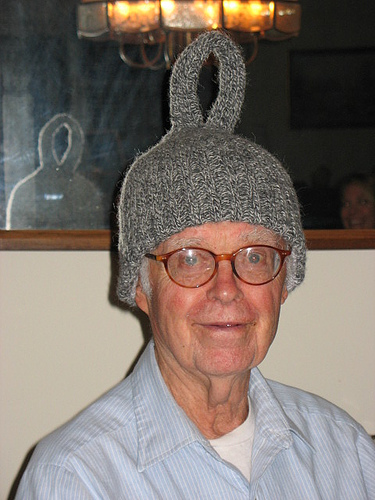 It’s also possible to construct a handsome Klein bottle hat, something the gentleman to the right has done. I don’t know about other O&M readers, but I am surely getting one.
Keep Academics Away from the Cinema
| Peter Klein |
Because they produce purple prose like this:
I have tried to show how the impossibility of a single filmic representation can serve as a refractory surface against which a series of analogies, paradigmatic shifts, and disarticulations located within distinct yet convergent planes of historical actualisation come into a view. It is in turn, across the strata of this unstable causal field (the discontinuities of which have been reconciled or reduced within the binary logic of the dominant supratext) that the reconstitution of the various ontogenetic stages of It’s All True (planning, production, dispersion) can be sketched.
This verbal assault is quoted, with appropriate mockery, by Simon Callow in the preface to volume 2 of his engrossing biography of Orson Welles, Hello Americans (2006). The reference is to Welles’s unfinished film It’s All True (about which an interesting documentary was made in 1993). Adds Callow: “The author of this remarkable passage, which, as far as I am aware, has not yet been translated into English, is a serious researcher who no doubt has much to tell us about Orson Welles, but we will never know what it is.”
The Downside of (Quasi-)Academic Blogging
| Peter Klein |
It goes like this: Blogger A, a writer or grad student or some other non-specialist commentator, takes on Big Issue X with a few glib sentences dismissing decades, or even centuries, of research by specialists on some important topic. A recent example involved a blogger, who apparently is some kind of grad student, opining on the minimum wage. The blogger quotes Kevin Murphy’s statement that economic theory predicts that a wage floor above the market-clearing wage will, ceteris paribus, reduce the demand for labor. But no, says our blogger — labor and commodities are different economic goods, so that the law of demand does not apply to the former! Well, gosh, economists have been thinking about the demand for factors of production for, I don’t know, about two hundred years, and have had a pretty sophisticated understanding of marginal productivity since the late nineteenth century. My guess is that our blogger has read a textbook or two, and maybe even a few recent journal articles on the minimum-wage controversy, but thinks this discovery that factor markets are different from commodity markets is a brilliant new insight. (Note to blogger: factor-market demand curves are also downward sloping.) If I were this blogger’s academic adviser, I would suggest that she consult a labor economist, or perhaps skim Lazear’s Personnel Economics, before writing this sort of drivel.
As they used to say about the internet: The good thing about blogging is that anyone can share his opinion with the world. The bad thing about blogging is that anyone can share his opinion with the world.
Order Yours Today!
| Peter Klein |
It’s great having graduate students with a sense of humor (and a knowledge of German):
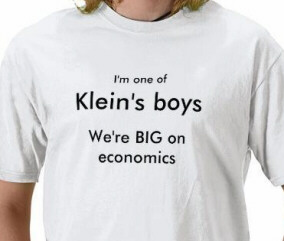
Now, if only they would spend as much time on their dissertations as they spend on their jokes. . . .
Understanding Professors: Graphical Expositions
| Peter Klein |
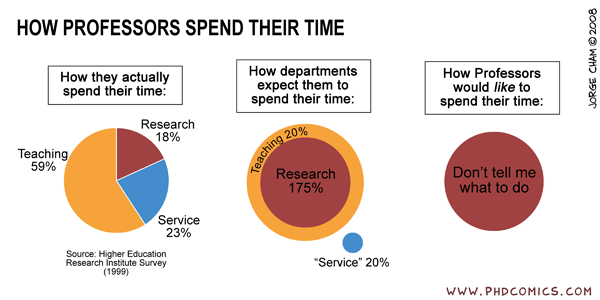
Here are some diagrams to help you understand how professors think. First, how they spend their time, from PhD Comics (via Art Carden). Click to enlarge.
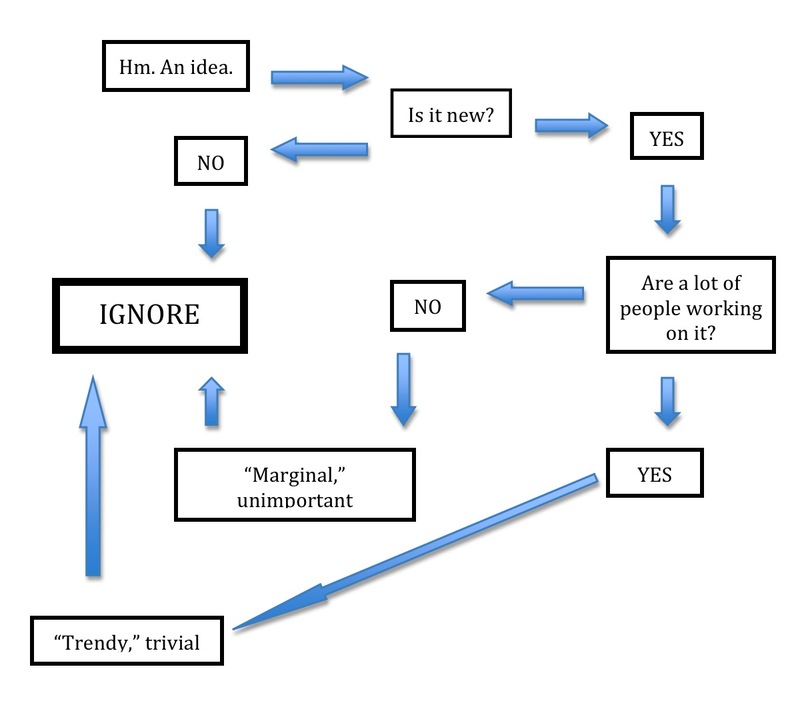
Second, how they choose research topics, from Marc Liberman (via Newmark):
Don’t Ask Me What This Means
| Peter Klein |
In 1999, a group of researchers including [endocrinologist Erma] Drobnis were working on a study comparing semen quality across major metropolitan areas, suspecting that sperm counts were dropping worldwide. They selected New York, Minneapolis and Los Angeles for their study. But reviewers of the grant application recommended adding add another, more rural town. They selected Columbia [Missouri].
Researchers believed that including Columbia would serve as a baseline by which to judge the other cities. More rural settings, so the theory goes, tend to have fewer toxic pollutants such as smog in the air that impact reproductive health.
So researchers were caught off-guard when the Columbia sperm samples turned out to be significantly lower than samples from three other cities.
Here’s the story from the local paper. I’m eagerly awaiting the witty comments.
Best Sentence I Read Today
| Peter Klein |
Justin Wolfers, on methodological conformity among mainstream economists:
Feel free to insert joke here about two-handed economists; although recognize that even an octopus couldn’t summarize the consensus within, say, sociology.
He’s mainly criticizing economists, however, adding: “Is it really the case that economics has advanced so little that 30 years later we are still having the same old debates?”
Top Ten Signs Your Airline is Cutting Costs
| Peter Klein |
Having done a fair amount of flying this summer I particularly appreciated this recent Letterman top ten list:
Letterman: Top Ten Signs Your Airline is Cutting Costs (August 5)
10. During flight they hit you with additional $200 “landing charge”
9. It’s day 4 of your honeymoon, and you’re still on the tarmac
8. Plane has a “Hyundai” hood ornament
7. When you arrive, Hawaii looks suspiciously like Detroit
6. Inflatable vest replaced with smaller inflatable bow ties
5. Plane can’t take off until you lose 20 pounds
4. In-flight entertainment: watching two fat guys fight for an armrest
3. Flight attendants wearing clothes you packed
2. The pilot — Andy Dick
1. During the captain’s preflight checklist, you hear him say, “close enough”
Postcard from Scandinavia
| Dick Langlois |
 Taking up Nicolai’s challenge, I offer a substance-free post in the spirit of Facebook. I am in Scandinavia, where I will have a chance to interact with both of my local co-bloggers. At the moment I am in Copenhagen, where I will participate in a Ph.D. course that Nicolai and his colleagues have organized. But I just returned from Bergen, where I met Lasse for the first time. I gave a talk at NHH and had a chance to see a bit of the city. Bergen is a beautiful place, and I was fortunate to see in it perfect weather, something I am told is rare on the rainy west coast of Norway. As I learned in the local museum, Bergen was one of four Hanseatic “office” cities (along with London, Bruges, and Novgorod), and it mainly traded salted fish and cod-liver oil — the first Norwegian oil industry — for grain products from Britain and the Baltic. I was also treated to whale meat for an appetizer at dinner last night — a politically incorrect meal in an otherwise politically correct country. (Since a whale is a mammal, it was more like beef than fish; but as it was served as a highly spiced (cooked) carpaccio, it was hard to determine the real taste: maybe just a bit gamier than beef.)
 The mercantile spirit is apparently still alive and well in Scandinavia. On the Copenhagen metro a little while ago, I spotted a young Dane sporting a T-shirt depicting bars of gold and proclaiming the slogan “the original currency of kings.” I intuited immediately that this wasn’t a Ron Paul supporter but a would-be hip-hop teenager. It turns out the that the shirt is made by a company called LRG, which is lauded as an up-and-coming (American) entrepreneurial venture. Unfortunately, I couldn’t seem to find a place to buy one cheaply on the web: it would be great to wear for lectures on monetary policy or on inflation in the early modern period. I think I will skip the dollar-sign bling, though.
| Nicolai Foss |
As you may have noticed — and as Peter points out in daily emails — my blogging activity has been rather light of late. Part of this is caused by being a department head, a task that has a notorious (and entirely correct) reputation for letting your brain rot. And part of it has been caused by the completion of some major projects.
I have , however, done the Facebook thing. FB seems to be overcoming its teenage bias, attracting more mature and normal people, such as academics. (Check the group Unlike 99.99% of the Facebook population, I was born in the 1960s). Indeed, I have noticed a very strong FB herd behavior among academics this last month, no doubt prompted by the summer vacation. Quite a number of people of interest to readers of O&M are now on FB (e.g., professors Jackson Nickerson, Nicholas Argyres, Russ Coff, and many others, including O&M’s own Peter Klein), and there are fan groups devoted to Herbert Simon, Michael Porter, Friedrich Hayek, Murray Rothbard, Ludwig Mises, etc. started by students and academics on FB.
I have also noted that fewer of academic friends and acquaintances are using Skype. I conjecture that overall blogging activity — not to mention research and writing activity — has also diminished. Possible conclusion? Blogging is becoming passé and the immediate future belongs to Facebook. Who wants article-like treatments of esoteric subjects, when they can have one-liners about going to the gym, reading, etc.?
More seriously, there are in fact blogging features on FB for those who have more to say to the world than “NN has gone kite surfing.” Indeed, FB combines the features of the homepage with the blog — and introduces even greater possibilities of ego massage than these two (e.g., it is terribly easy to upload pics).
Unpopular Economics
| Lasse Lien |
The Norwegian Directorate for Roads recently published a report concluding that politicians should scrap a plan to make roads safer for kids walking or riding bikes to school. The argument is that the investment required per life saved is too high compared with other measures that will primarily save the lives of grown-ups. The directorate bravely chose to publish this recommendation just four days before school starts.
While their cost/benefit analysis shows beyond reasonable doubt that this conclusion is consistent with maximizing national economic welfare, I don’t think I’ll brag about being an economist at the PTA meeting this evening.





 Organizations and Markets
Recent Comments