Posts filed under ‘Ephemera’
Rival Teams and Non-Rival Knowledge
| Dick Langlois |
A recent issue of the Journal of Quantitative Analysis in Sports, an all-electronic Bepress journal, carried a piece provocatively titled “Quantifying NFL Coaching: A Proof of New Growth Theory” by Kevin P. Braig. The paper is a rambling mix of sports anecdotes and goofy math. My favorite of the latter is:
| lim f(x) = 1 first down
x→10 |
But the piece is amusing reading and does make some interesting points.
The title is more than a bit fatuous, of course. What the author has in mind is that one can increase output not only by increasing the inputs but by learning to reorganize the way those inputs are combined. This was the growth theory of Smith and Marshall, of Rosenberg and Mokyr. The only contribution of the New Growth Theory has been to cram a diminished and mechanized version of these ideas into the formalism of the production function — and, of course, to receive credit in the popular mind for the very notion that growth is about the search for new “recipes.” Braig is on firmer ground when he associates himself with Carliss Baldwin‘s notion of designs.
What has this got to do with sports? Consider baseball, which is probably the most modular of major (American) sports. In baseball, the only real way to be more successful is to improve the quality of the players, what Braig likes to call their human capital. This is because the way players interact is relatively hard-wired and invariant among teams. Small adjustments are possible — shifts, bunting strategy — but no one ever redefines how to turn a double play. The so-called moneyball approach has been to find better statistical measures of the effectiveness of player human capital — not to reorganize how the players interact. (In testimony to the almost mystical numerology of this article, Braig finds wonder in the fact that average on-base percentage has remained nearly constant over the live-ball era at about 0.331, exactly the ratio one gets by recognizing that “the hitters’ needs (4 bases) exceed their resources (2 outs) by a 2-to-1 margin.” But this presumes that human capital in batting should somehow exactly keep pace with human capital in pitching — even though there is arguably more room for innovation in pitching. I think a closer examination would find that baseball rulemakers have tweaked subtle rules like the size of the strike zone or the height of the mound to keep the ratio constant.) (more…)
Laptop Bleg
| Peter Klein |
I’m in the market for a new laptop. My current model is a Sony Vaio TR3 and I want to stay in the ultraportable category (under 4 lbs., 12″ or smaller display). For now, I’m sticking with the WinTel platform (sorry, Teppo!).
Sony’s current offering in this category, the TZ, has the right combination of size, weight, and style, but it’s not quite as powerful (in RAM or clock speed) as some alternatives, like the Asus U2 and a few models by HP and Toshiba. I’m not particularly looking for a tablet, though I wouldn’t rule it out. The Lenovo X series is nice, but lacks the Sony’s built-in optical drive. Any suggestions?
The Price of Exclusivity
| Peter Klein |
 Whenever I fly first or business class — not nearly often enough — it’s usually an upgrade, and I feel sorry for the rich guys around me who shelled out serious coin partly to avoid sitting next to schmucks like me. Perhaps you’ve been to an expensive restaurant where the food isn’t that good, but the clientele is made up of people who can afford that kind of place and you enjoy the exclusivity. And you’ve heard stories about first-class train compartments that are identical to their second-class counterparts, only more expensive, catering to people who like to be surrounded by other rich people.
Here’s a cool modern example of this phenomenon: a $999 iPhone application that does nothing but announce to the world that you can afford a $999 iPhone application (via Josh). Talk about a separating equilibrium!
Moral Hazard
| Peter Klein |
Ten-year-old child wants a mobile phone. Parent buys a basic, inexpensive model with a pay-as-you-go plan. Child loses phone.
Parent: “You see, I thought that might happen, which is why I got you a cheap phone that’s easily replaceable and not one of those fancy, expensive ones you’re always asking for.”
Child: “But if I had a fancy one, I would have been more careful not to lose it.”
This Could Have Been Worse
| Peter Klein |
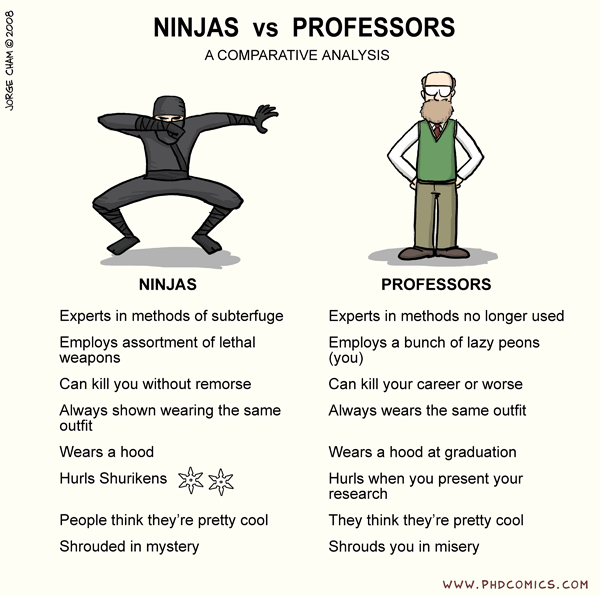
From PhD Comics, via Fabio. Part of an this week’s series poking fun at the professoriate.
The Long Tail, Serial-Killer Edition
| Peter Klein |
Visiting my Mom this past weekend I found an item in the local paper about Kelly Robinson and Dan Norder, a happy couple who met at a Jack the Ripper conference. That’s right, they’re fellow Ripperologists. They’re even hosting this year’s Ripper conference, 10-12 October in Knoxville, Tennessee. For every interest or hobby there’s a group or club, and in the new economy they’re all on the web. (I shouldn’t give Kelly and Dan too hard a time; after all, I met my wife at an Austrian economics conference.)
By the way, in case you missed it, the current issue of HBR features Anita Elberse’s critique of the Long-Tail phenomenon. Yes, she argues, the web has given us many niche markets, but almost all the money is being made at the left-hand side of the distribution. Here are Chris Anderson’s response and Elberse’s rejoinder.
Our Own Buzz
| Lasse Lien |
While we are (eagerly) awaiting the definition of beaconicity, here’s what the standard scientific jargon really means (original source unknown):
“IT HAS LONG BEEN KNOWN” — I didn’t look up the original reference.
“A DEFINITE TREND IS EVIDENT” — The data are practically meaningless.
“WHILE IT HAS NOT BEEN POSSIBLE TO PROVIDE DEFINITE ANSWERS TO THE QUESTIONS” — An unsuccessful experiment, but i still hope to get it published.
“THREE OF THE SAMPLES WERE CHOSEN FOR DETAILED STUDY” — The other results didn’t make any sense.
“TYPICAL RESULTS ARE SHOWN” — This is the prettiest graph.
“THESE RESULTS WILL BE IN A SUBSEQUENT REPORT” — I might get around to this sometime, if pushed/funded.
“THE MOST RELIABLE RESULTS ARE OBTAINED BY JONES” — He was my graduate student; his grade depended on this. (more…)
Journals and Social Networks
| Peter Klein |
Isn’t this a little much for nerdy academics?
As a registered user with Cambridge Journals Online (CJO) you may be interested to read about the latest additions we have made to the site. . . .
Users can now bookmark links from journal homepages and article abstracts using social bookmarking services, such as del.icio.us, Digg.com and Reddit.com enabling them to save web pages they want to remember or share.
What’s next, a Twitter feed for Peter’s daily research activities? [02:30pm July 10, 2008 from CoolProf: Just updated footnote 12.]
An Even Better Procrastinator’s Clock
| Peter Klein |
I blogged previously on an alarm clock designed for procrastinators and people with time-inconsistent preferences. It runs up to 15 minutes fast but in a random pattern so you don’t know how fast it really is. Here’s an even better clock: if you don’t wake up it starts dialing numbers randomly chosen from your phone’s contact list, annoying the living s__ t out of your friends until you turn it off. As Engadget notes, this is brilliance — “pure, sadistic, barbarous brilliance.”
Stop Using Military Buzzwords Too
| Dick Langlois |
It seems that, like the British Local Government Association, the US military is keen to get its people to stop using buzzwords, at least according to this February 2007 “Army Doctrine Update” I happened to see posted on a bulletin board in the Brazilian military academy where the Schumpeter Society Conference was meeting. Here are some highlights.
- Know the difference between maneuver and movement (we don’t maneuver networks; we move them).
- Battlespace is no longer a joint or Army term. Use “operational environment.”
- Use “civil considerations” (the C in METT-TC), not “human terrain.”
- Don’t use “red zone” at all; the term is “close combat.”
- Do not use “kinetic” and “nonkinetic” to describe operations, actions, activities, tasks, or targets. Use “lethal” and “nonlethal.”
Or perhaps the point is that they want people to use the right buzzwords.
IRB in the Movies
| Peter Klein |
Took my son to see The Incredible Hulk today. Best scene (paraphrasing from memory):
Bad guy Emil Blonsky, demanding at gunpoint for nerdy science professor to inject him with Bruce Banner’s radiation-infected blood: “Make me like him!”
Professor: “It’s extremely dangerous. You don’t know what it could do to you!”
Blonsky grabs professor by the throat and hoists him over his head.
Professor: “I didn’t say I wouldn’t do it. I just need informed consent.”
V for von Mises
| Dick Langlois |
 My Father’s Day present this year was something unusual: issue number 11 (Winter 1998) of something called The Batman Chronicles. (My sons are both into comics and graphic novels, though it was apparently my wife who stumbled onto this on the web.) The issue is a slim comic book featuring “The Berlin Batman,” wherein the story of Batman is reimagined as having taken place in pre-war Nazi Germany. The hero is Baruch Wane, wealthy Jewish socialite and decadent cubist painter, who becomes Batman by night after his parents are killed not by a robber but by anti-Semitic violence. His mission, of course, is to fight the tyranny of Nazism, which in this issue involves — and here’s the punch line — trying (in the end without success) to save the papers of Ludwig von Mises, which have been confiscated by the Nazis. The episode goes into great detail about why the work of von Mises was a threat to the Nazis and to authoritarians of all stripe.
This comic may be old news to many readers, but I found it amusing. The author, Paul Pope, is apparently well respected in comics/graphic novel circles for, among other things, a more elaborate reimagining of Batman in a totalitarian future.
Gore Vidal on Academic Biographers
| Peter Klein |
Gore Vidal, writing in 1981 in the New York Review of Books:
Lately, American biography has fallen more and more into the hands not of writers but of academics. That some academics write very well indeed is, of course, perfectly true and, of course, perfectly rare. When it comes to any one of the glorious founders of our imperial republic, the ten-volume hagiography is now the rule. Under the direction of a tenured Capo, squads of graduate students spend years assembling every known fact, legend, statistic. The Capo then factors everything into the text, like sand into a cement mixer. The result is, literally, monumental, and unreadable.
Thanks to LRC for the tip. The context is Gore’s praise for David McCullough’s short biography of Teddy Roosevelt (who Vidal calls a “sissy”), Mornings on Horseback.
Of course there are some terrific academic biographers writing today such as Thomas McCraw and Guido Hülsmann. But they are probably the exceptions that prove the rule.
The Power of Walt
 | Peter Klein |
“If you could be anyone in the world, who would it be?” My usual answer is Walt Mossberg, the legendary WSJ technology reviewer. Imagine having access to nearly every cool gadget in the world, and being paid to play with them. Nerd-topia!
But I underestimated Walt’s power. Two marketing professors have discovered that a positive review by Walt generates a 10-percent increase in the parent firm’s abnormal returns while a negative review causes a 5-percent drop. Those are big numbers in event-study world. (Via Gizmodo.)
Overheard at the Conference
| Peter Klein |
A prominent economic theorist, introducing a well-known business professor who has published in several fields: “In addition to his important scholarly contributions, he has also written several articles in management journals.”
The Power of Ideas
| Peter Klein |
Expressed in sculpture. See the full set, from a 2006 Berlin exhibition, on Wikipedia. (Via politics-live.)

Best Paragraph I Read Today
| Peter Klein |
Money, money prices, market transactions, and economic calculation based upon them are the main targets of criticism. Loquacious sermonizers disparage Western civilization as a mean system of mongering and peddling. Complacency, self-righteousness, and hypocrisy exult in scorning the “dollar-philosophy” of our age. Neurotic reformers, mentally unbalanced literati, and ambitious demagogues take pleasure in indicting “rationality” and in preaching the gospel of the “irrational.” In the eyes of these babblers money and calculation are the source of the most serious evils. However, the fact that men have developed a method of ascertaining as far as possible the expediency of their actions and of removing uneasiness in the most practical and economic way does not prevent anybody from arranging his conduct according to the principle he considers to be right. The “materialism” of the stock exchange and of business accountancy does not hinder anybody from living up to the standards of Thomas a Kempis or from dying for a noble cause. The fact that the masses prefer detective stories to poetry and that it therefore pays better to write the former than the latter, is not caused by the use of money and monetary accounting. It is not the fault of money that there are gangsters, thieves, murderers, prostitutes, corruptible officials and judges. It is not true that honesty does not “pay.” It pays for those who prefer fidelity to what they consider to be right to the advantages which they could derive from a different attitude.
That’s Ludwig von Mises, writing on pp. 215-16 of Human Action (4th edition). Oh, how I love that man. I hereby pledge to use the phrase “mentally unbalanced literati” at least once per year.
Economics and Sociology at Microsoft
| Peter Klein |
A couple of nuggets from today’s WSJ front-pager on the complicated relationship between Microsoft founder Bill Gates and current CEO Steve Ballmer:
Their relationship started at Harvard University in the mid-1970s, where the two played poker and thrived by pushing their intellectual limits. Once they skipped a graduate economics class for the entire semester, then teamed up a few days before the final exam to try to learn the material all at once. Mr. Ballmer recalls he got a 97; Mr. Gates a 99.
Who knew Harvard’s graduate economics program was so easy? And this:
One concern for Mr. Ballmer was how to preserve Mr. Gates’s role of technology visionary inside the company. Looking for guidance, Mr. Ballmer says he cracked open a book from his college years by Max Weber, the German sociologist, on how organizations handle the disappearance of “charismatic leaders.”
On March 28, 2006, Mr. Ballmer described the book to Microsoft’s board at a retreat in the San Juan Islands near Seattle, Microsoft executives say. One way for a firm to retain the charisma of a departing leader, Mr. Weber wrote some 100 years ago, is for the leader to name his own replacement.
Mr. Gates did just that.
Who says sociology isn’t useful?
A Radical New Idea
| Peter Klein |
Dynamic pricing is a relatively new idea that reflects consumer demand. If a show is popular, the system will increase the price of that show. Once it loses steam, the price will be lowered proportionally.
Prices that adjust according to supply and demand! Who’d a thunk it?
To be fair, the writer, CNET’s Don Reisinger, is talking about Apple’s plans to offer variable pricing on iTunes. But it’s still a startling statement, to an economist. I guess I shouldn’t really be surprised, though.
Incentives
| Randy Westgren |
This weekend, I am planning to drive to Columbia, Missouri, the home of Peter Klein. I had to check the map this afternoon, as there is a wire service report that Max Motors in Butler, MO, is offering each car buyer $250 toward the purchase of a gun or gasoline. According to the report, “General manager Walter Moore said that, so far, most buyers have chosen the gun, adding that he suggests they opt for a semiautomatic model because it holds more rounds.”
I note that Butler is on the other side of Columbia from my route of ingress, though I will remain watchful. I suppose it is the curse of being an economist that causes me to believe that cars and guns sold together are complementary goods. . . .





 Organizations and Markets
Recent Comments