Posts filed under ‘Ephemera’
Economists as Public Intellectuals
| Peter Klein |
I haven’t read Judge Posner’s 2002 book Public Intellectuals: A Study in Decline but I hear it’s one of his more interesting efforts. (Actually I haven’t read most of Posner’s books, but you can’t blame me — he writes ’em faster than I can read ’em.) Posner’s thesis, as is obvious from the title, is that today’s public intellectuals are a far cry from those of yore, and he blames this (in part) on the increasing professionalism of the Academy and its inward-looking, highly technical but ultimately ephemeral research. (I remember an economist colleague a few years back being chided, by his senior peers, for having published an op-ed in the Wall Street Journal, thus indicating his lack of commitment to “serious” scholarship.)
The current issue of Foreign Policy contains a list of today’s top 100 public intellectuals. Shockingly, none of your esteemed O&M bloggers made the list. Economics, however, is its most represented academic discipline. The list includes ten academic economists, if I counted correctly: Paul Collier (Oxford), Esther Duflo (MIT), William Easterly (NYU), Paul Krugman (Princeton), Steve Levitt (Chicago), Nouriel Roubini (NYU), Jeff Sachs (Columbia), Amartya Sen (Harvard), Michael Spence (Harvard), and Larry Summers (unemployed). Daniel Kahneman, a psychologist whose work has been extremely influential in economics, is also there, along with several think-tank economists or journalist-economists. A few observations:
- No one from management or busisness administration makes the list, though some of these gurus are plausible candidates. Perhaps “influential business thinker” and “public intellectual” are disjoint sets in the minds of people who edit magazines like Foreign Policy.
- Six of the ten are development economists. Only one, Larry Summers, is a macroeconomist. Remember when Keynes, Hayek, Friedman, and Samuelson were household names? Today development is the hot field.
- The list includes one academic sociologist, Slavoj Zizek. Oh, and one pop sociologist, Malcolm Gladwell (don’t blame me, that’s what FP calls him). Robert Putnam, a political scientist often mistaken for a sociologist, gets his props too. More fodder for the orgtheory crew.
See also: The Role of Economic Analysis in Public Policy and Econo-Bloggers and the Public Good.
Update: Michael Spence isn’t a development economist but has been working in that area, serving most recently as Chair of the World Bank’s Commission on Growth and Development. Bill Easterly characterizes the Commissions newly released report thusly: “After two years of work by the commission of 21 world leaders and experts, an 11-member working group, 300 academic experts, 12 workshops, 13 consultations, and a budget of $4m, the experts’ answer to the question of how to attain high growth was roughly: we do not know, but trust experts to figure it out.”
Great Moments in Laziness
 | Peter Klein |
Some people are calculator nerds. For the lazy nerd, however, the real action is in remote controls. Did you know the first commercially available TV remote came out in 1950? Check out this history of the remote, and don’t miss the slideshow.
But, really, how much fun is channel surfing with only four channels?
Remember Books?
| Peter Klein |
 Before multimedia, blog entries, and PowerPoint, people expressed their ideas in books. Appreciating books requires a longer-than-average attention span, a love of the tactile (no Kindles, please!), and a comfy chair. Anyway, if you’re into that whole Retro thing, there’s an official conference series on the Book. The sixth annual meeting is coming up this fall. From the conference blurb:
In the context of today’s rapid developments in information technologies, the book is indeed an old medium of expression. Do the new media (the internet, multimedia texts and new delivery formats) represent a threat or an opportunity? What is the book’s future as a creature of and conduit for human creativity?
This Conference will address the provocative suggestion that, rather than being eclipsed by the new media, the book will thrive as a cultural and commercial artifact. More than this, the information architecture of the book, embodying as it does thousands of years’ experience with recorded knowledge, may well prove critical to the success of the new media.
These crazy bibliophiles even have their own journal!
I Almost Didn’t Write this Blog Entry
| Peter Klein |
I mean, what’s the rush? But here it is, a pointer to Slate’s special issue on procrastination. Don’t put off reading it. Or do, if you want.
Politically Incorrect Company Logos
| Peter Klein |
 One of my favorite local restaurants sits next to a Sherwin-Williams paint store. When leaving the restaurant I always pause to gaze upon the Sherwin-Williams logo. A paint can dumping red ooze over the planet’s surface — you can’t get more politically incorrect than that! There’s even a tagline, “Cover the Earth,” in case you miss the point. In today’s environmentally sensitive age this logo is the Anti-Green. It screams: synthetic, industrial, man-made, unnatural. I love it.
I imagine there’s a lot of pressure on the company to reject the logo, but Sherwin-Williams soldiers on. There’s a brief description, charmingly apologetic, on the “Green Initiatives” page of the company website. “Created in the late 1800s, the logo’s purpose was to represent the company’s desire to help beautify and protect the buildings of the world. It was a symbol of a young company’s enthusiasm, idealism and hope regarding its future and the possibility for achievement that hovered on the nation’s horizon.” In other words, that was a different age, please forgive us. Today it’s simply “a figurative emblem signifying quality, integrity and service.” And no more oily residue!
What other firms have politically incorrect logos? Marlboro of course ditched the Marlboro man long ago. Joe Camel made it to 1997 before being ushered into retirement. Robertson’s kept Golly on its marmalade jars until 2001. Oh, and check out this funny set of politically incorrect ads of yesteryear (Santa smoking Chesterfields, a husband spanking his wife for serving the wrong coffee, a group of servicemen being warned “You can’t beat the Axis if you get VD”).
How People Find Us
| Peter Klein |
Like other blogs, O&M gets most of its new readers through links from other blogs and websites. But people also find us by searching. Our software shows us what search terms lead people here, and I recently looked up the most popular search terms from our 24 months of existence. Here’s the list.
- agency theory
- organizations and markets
- market based management
- corruption in organizations
- concept map
- organization and markets
- life in hell
- history of marketing
- strategic entrepreneurship journal
- swot model
- nicolai foss
- history of accounting
- theories of profit
- unusual business ideas
- market-based management
- queen bee syndrome
- peter klein
- pareto criterion
- management theory
- management theories
Obviously there’s something wrong with the order of items #11 and #17, but otherwise the software seems to work pretty well. . . .
Top Business Gurus
| Peter Klein |
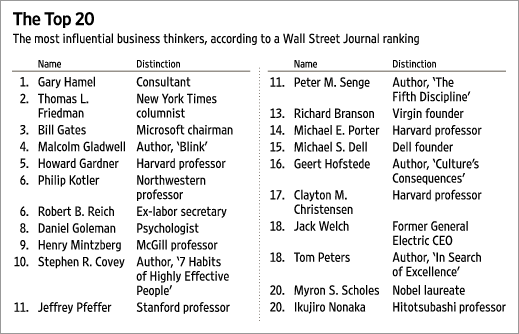
Did you catch the list of Top Business Gurus in Monday’s WSJ? Based on Google, Lexis-Nexis, and academic citation indexes, it puts Gary Hamel at the top, followed by Tom Friedman, Bill Gates, Malcolm Gladwell, and Howard Gardner. Our own Jeff Pfeffer checks in at #11. Click the picture below for the entire list. Hamel, Stephen Covey, Michael Porter, Clayton Christensen, and Tom Peters are obvious candidates for Guru Status, though the ranking algorithm produces some unlikely results too, such as Robert Reich and Myron Scholes.
Peter and Inspiration
| Randy Westgren |
Before enplaning for Vancouver, I spent a great day at the University of Missouri with Peter Klein and his (local) colleagues. I discovered that Peter and I share a common interest in the fiction of Richard Powers, a novelist whose works draw from the biological, physical, cognitive, and information sciences. Moreover, Peter acknowledged that his favorite Powers novel is The Gold Bug Variations; it’s my favorite as well. I finished my second reading on the airplane and found a passage that incites this post:
The world we know, the living, interlocked world, is a lot more complex than any market. The market is a poor simulation of of the ecosystem; market models will never more than parody the increasingly complex web of interdependent nature. (First edition, p. 411)
I agree that market models are pale abstractions compared to any ecosystem. But I have studied a great many models of ecosystems (dynamic system simulations, agent-based simulations, statistical models of species interactions, analytical models of populations) and find them to be pale abstractions of ecosystems, as well. I will propose — for refutation — that most market models I see are less interesting than ecosystem models; they are still undersocialized in the Granovetter sense. The ecological models seem to require more attention paid to the social interactions of the individuals.
Just a thought.
From Vancouver
| Randy Westgren |
I have been hunkered down in Vancouver for several days, teaching the final module of an executive education course. One of the amusing elements of the course is that it migrates from Halifax, Nova Scotia, to Vancouver, British Columbia during the year, with intermediate stops in Calgary and Niagara Falls. Execs and instructors get to spend time in some innovative, entrepreneurial firms outside their own regions (and escape the classroom).
From the Listel Hotel on Robson Street, one can reach 29 Starbucks stores within a 2 km by 2.5 km area of downtown. There are seven Starbucks on Robson Street alone, between the 400 and 1700 blocks — a 20 minute walk. Among these are the stores at 1099 Robson and 1100 Robson; they face each other kitty-corner across Thurlow Street. One of the execs stated that this constitutes a unique phenomenon within the Starbucks chain — two stores so closely juxtaposed.
1. Has anyone seen or heard of a similar situation in another city?
2. Has someone written about this (apparent) strategy of location-packing Starbucks stores?
BTW, if you are a Starbucks-hater, there twice as many direct competitors in the same 5 square km area, including 13 Blenz Coffee outlets, which is a local competitor with international ambitions (www.blenz.com). The best thing they do isn’t coffee; they will make you Japanese ceremonial green tea while you wait — bamboo whisk and all.
Live Long and Prosper
| Peter Klein |
 As a student of Austrian economics, I hope to inherit not only the clarity of thought, insight, originality, and productive habits of the great Austrians, but also their longevity. Carl Menger, founder of the Austrian school, lived to be 81 (fathering a son, the mathematician Karl Menger, Jr., at age 62). Mises died at 92, having taught his graduate seminar at NYU well into his eighties. Hayek made it to 93. Böhm-Bawerk died relatively young, at 63, though Wieser lived to be 75. I also admire Ronald Coase, still going strong at 97, and Armen Alchian, who turned 94 this month (and is still serving on PhD dissertation committees). So hopefully I have many good years left (unlike some people).
This came to mind when reading Steve Levitt’s account of his attempt to get a referee report out of a former Chicago economist:
[W]hen I asked the octogenarian economist if he could referee a paper for me, here is the response I received:
Much as I would like to do a review of this paper, my schedule looking ahead for as much as a year is just too crowded. Maybe next time!!
I hope when I am in my eighties “too busy” is the reason I am turning things down!
Where There’s Smoke. . . .
| Peter Klein |
So I wake up about 2:30 this morning to the sounds and lights of emergency vehicles outside my house. I look out the front window and see my neighbor’s house, across the street and two houses down, engulfed in flames. Firefighters are already on the scene, hooking up their hoses. Flames are shooting 25 feet into the air. The occupants, a young couple without children, are outside already, and no one is hurt. The husband says they were asleep in the bedroom when smoke started pouring out of the ceiling vents. My next-door neighbor said he heard loud pops and cracks, like fireworks.
The wife is shaking and crying, asking if she can go in and look for her wedding photos. I begin to wonder, if this happened to me, once my wife and children were safely outside would I foolishly run back in to retrieve my laptop, or my signed first edition of Risk, Uncertainty, and Profit, or my CDs with old Compustat data? My Blackberry? (I wouldn’t want to miss an important email while standing outside watching my house burn down.) What would you do?
Mises, as many of you know, lost virtually his entire personal library, and most of his notes and research materials, when the Nazis entered Vienna in 1938. (The papers ended up in Moscow, where they were discovered in the early 1990s.) Mises arrived in the US in 1940, a refugee without an academic position, without substantial personal funds, and having lost most of a lifetime’s worth of accumulated books and materials. Can you imagine starting over, at age 59, under such circumstances?
Who Says Economists Don’t Tackle the Tough Issues?
| Peter Klein |
How can anyone doubt the value added of mainstream economics research:
- Jeffrey S. DeSimone, “Fraternity Membership and Drinking Behavior,” NBER Working Paper No. W13262, July 2007.
- Jay Pil Choi, “Up or Down? A Male Economist’s Manifesto on Toilet Seat Etiquette.” Working Paper, Department of Economics, Michigan State University, 2002.
- Robert Oxoby, “On the Efficiency of AC/DC: Bon Scott versus Brian Johnson,” Economic Inquiry, forthcoming (via Lasse). The abstract’s worth quoting in full:
We use tools from experimental economics to address the age-old debate regarding who was a better singer in the band AC/DC. Our results suggest that (using wealth maximization as a measure of “better”) listening to Brian Johnson (relative to listening to Bon Scott) resulted in “better” outcomes in an ultimatum game. These results may have important implications for settling drunken music debates and environmental design issues in organizations.
Note that I’m not completely innocent in this area either.
See also: “Economics: Puzzles or Problems?”
O&M Two-Year Anniversary
| Peter Klein |
O&M went live 25 April 2006, exactly two years ago. Introducing ourselves to the world, we wrote:
We started this blog for two reasons. First, while there are many excellent blogs on economics, law, and public policy, there are relatively few on organization, strategy, and management, our main areas of research. Organizations and Markets hopes to help fill this gap. Second, we think we have a unique and interesting perspective on many of these issues, and we thought it would be fun to share this perspective with the world.
We may or may not be interesting (or fresh), but we think we’re still unique. While the econo-blogosphere has become thickly populated, only a few blogs focus on managerial and organizational issues. (Our blogroll includes most of our personal favorites.)
In the last two years we’ve written 1,275 posts in 32 categories (the most popular being Institutions, Management Theory, Methodology/Theory of Science, Strategic Management, Entrepreneurship, and, of course, Ephemera). We’ve hosted 283,822 unique visitors from dozens of countries (including, during just the last week, Slovenia, Iraq, Cameroon, Malaysia, and Guam). Thanks to our readers (students in particular), regular commentators, and former guest bloggers for their continued enthusiasm and support.
We’re planning significant changes to the site in the coming weeks. Watch this space for details!
Ken Lay Chair Filled
| Peter Klein |
The University of Missouri’s Kenneth L. Lay Chair of Economics, which we’ve written about before, has been filled, by an internal candidate, Joe Haslag. Joe is a monetary economist who, unlike many macroeconomists, does policy work (some with the controversial Show-Me Institute) and, unlike many economists, is a warm and friendly person. (Did I just write that?)
For those who think that economists, like other social-science and business academics, tend to be overly narrow and specialized, note what Joe says about his patron:
Haslag acknowledged being relatively uninformed about the Enron affair. “Actually, it’s not an episode that’s part of the economics I teach,” he said. “There isn’t anything about the story that entices me to spend a lot of time on it. I couldn’t talk about it with any amount of detail or any analysis.”
Best Billboard I Saw Today
| Peter Klein |
 OK, I didn’t see the actual billboard, just a photo of it. My colleague Peter Sukovsky, a professor of animal science at MU and a specialist in reproductive physiology, gave a presentation on his startup company AndroLogika at the University of Missouri’s Life Sciences Week. Peter concluded by showing us this picture, helping to illustrate that Missouri is a particularly good state for doing reproductive research. Where else would you find a summer festival like this? (In case you’re wondering, it’s a food festival; you can see examples of the cuisine here. It ain’t Guo-li-zhuang, but in the same genre.)
For My Next Blog. . . .
| Peter Klein |
What would be a fun and cool name for an econ-org-strategy-methodology-law-history-culture blog? I mean something clever, like Marginal Revolution, Asymmetrical Information [“Asymmetric”?], Division of Labour, Truck and Barter, Knowledge Problem, ArgMax, and the like. “Organizations and Markets” is descriptive, and easy to remember, but not terribly witty. Here are some better names. (These are mostly inside jokes, so they’re either funny or they’re not.)
- Stochastic Dominance
- Fundamental Transformation
- Apodictic Certainty
- Exogenous Shock
- Rationality Unbound
I believe these URLs are still available (cybersquatters, take note). Readers, what would you suggest?
Heard on NPR This Morning
| Peter Klein |
An item on the upcoming Italian elections featured a clip from comedian-activist Beppe Grillo denouncing both leading candidates, former PM Sylvio Berlusconi and former Rome mayor Walter Veltroni. Grillo, according to NPR’s Sylvia Poggioli, “has become the most powerful voice of protest in Italy. His blog is ranked among the 10 most-visited in the world, according to blog search engine Technorati.” I’m quite sure that’s the first time I’ve heard a national news program cite someone’s Technorati ranking as his main qualification!
Also curious: Later in the story Poggioli quotes Franco Ferrarotti, described as “one of Italy’s best-known sociologists.” How often have you heard an academic sociologist quoted in a general-interest news story?
Econ Grad Student Music Videos
| Peter Klein |
From the Berkeley econ skit party: No Dissertation and Stronger (via Mankiw).
As not only a former participant in, but also a two-time Master of Ceremonies for, said skit party, all I can say is thank goodness there was no YouTube in my day.
Overheard at Starbucks This Morning
| Peter Klein |
“She always referred to herself as ‘Dr. S____,’ so I assumed she was a medical doctor. Then I found out she was a former School Superintendent, with a Doctorate in Education.”
“Yeah, the only people who call themselves ‘Dr.’ are medical doctors and people with Doctorates in Education.”
Incentives Matter, Red-Light Camera Edition
| Peter Klein |
Auto-safety laws have an ambiguous effect on injuries because people drive less carefully when they feel protected from harm. (My former colleague Dwight Lee prefers a more colorful example: Distributing condoms on college campuses may increase the rate of sexually transmitted disease because students less reluctant to, um, engage in certain behaviors when they think their actions don’t carry consequences. Of course, as Dwight points out, the net effect depends on . . . wait for it . . . elasticity.)
 Now we learn that red-light cameras, installed to boost city ticket revenues by recording violations and issuing fines automatically, are actually bringing revenues down, as drivers at those intersections learn not to run red lights. Naturally, city governments are upset and plan to remove the cameras. (HT: Anthony Gregory.)





 Organizations and Markets


Recent Comments