Posts filed under ‘Ephemera’
The Anti-Blog
| Nicolai Foss |
One consequence of the expansion of the blogosphere is, in accordance with the basic Hegelian scheme, the emergence of the anti-blog. Here is the Anti-Becker-Posner-blog dedicated to smashing, well, you guessed it (and here is an alternative conception of what an anti-blog entails).
O&M has been accused of doing “right-wing craponomics,” Peter’s economics has been attacked by Sraffian Robert Viennau, and my comments about pomo and sociologists have often provoked angry reactions. I wonder when the Anti-O&M-Blog will appear? (Hmm, perhaps we shouldn’t play with fire; remember the Corsair Affair involving Søren Kierkegaard? (Tyler will know what I mean)).
Reports of My Assistant’s Death Are Greatly Exaggerated
| Peter Klein |
Received this email today from Harvard Business Online:
One of your course planning assistants, Mary E____, will be expiring on 09/12/2007.
Was she told? Does her husband know? Does the insurance company know?
Oh, wait: “This means that your assistant will no longer have access to your courses or be able to assist you with course planning in any way.” Whew!
New material for those funny lists you see from time to time.
How Would You Know Him from Any Other French Professor?
| Peter Klein |
Phantom French Professor Claims Salary for 15 Years
PARIS (Reuters) — A French tax official cheated the government out of 600,000 euros (407,000 pounds) by creating a phantom identity as a university professor and claiming a salary for some 15 years, the government said on Monday.
Sorry, I couldn’t resist. But I’m excused.
Write Like a Management Consultant
| Peter Klein |
With Mike Shor’s MBA Sentence Generator you can craft fine prose like this: “To proactively manage profit, our frictionless infrastructure parallels our world-class thought leadership.” You don’t even need an MBA!
HT to Luke Froeb, who also recommends Fred Kahn’s “My War Against Bureaucratese.”
Me in Chinese
| Peter Klein |
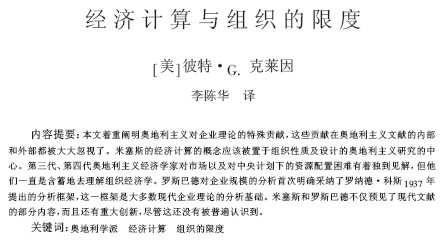
Here is a Chinese translation of my 1996 article “Economic Calculation and the Limits of Organization,” one of my favorites. It appears in Comparative Economic and Social Systems 116, no. 6 (2004): 70-78. The journal is edited by Wu Jinglian, an important Chinese economist specializing in economic reform. (Thanks to Chenhua Li for the translation and Kuo-Yang Tang for background information.)
We’re #28!
| Peter Klein |
Not that we’re obsessed with rankings or anything, but O&M ranks 28 out of 125 economics blogs studied here. Most of those ranked higher are general-interest sites like Freakonomics, Marginal Revolution, Mankiw, DeLong, etc., so we’re not doing too badly as a fairly specialized management blog. Thanks to all our readers for their support!
Software for Deconstructionists
| Peter Klein |
Software developer Andy Brice performs a Sokal experiment, with similar results.
Publish or Perish 2.2
| Peter Klein |
Anne-Wil Harzing’s Publish or Perish software, discussed here by Nicolai, is available in a new version. Anne-Wil notes that “[t]he choice for Google Scholar is particularly relevant for Management scholars as many good journals in our field are not ISI listed and hence citations in these journals are not counted by ISI.”
Mind Mapping
| Peter Klein |
Most academics I know take notes in a fairly linear, textual fashion. At your next conference, seminar, workshop, or committee meeting, why not try mind mapping instead?
Expensive Hayek Materials
| Peter Klein |
As Nicolai has reported, great economists’ autographs can be had for just a few dollars. This lot of Hayek artifacts — lecture notes, memoranda, autographed picture postcards, and the like — recently sold at auction for £3,400, according to Bonhams. Wonder what my stuff would go for?
O&M Gala Reception in Philadelphia
| Peter Klein |
Those of you coming to Philadelphia for the Academy of Management Annual Meeting are invited to a gala reception co-hosted by O&M and orgtheory.net. Well, um, not really. Actually Nicolai, Teppo Felin, Brayden King and I will gather at the bar in the Marriott hotel Sunday at 6:30pm 8:00pm to have a few drinks and compare hit counts. All current and former guest bloggers, regular and occasional commentators, lurkers, and other curious parties are invited to join us (Dutch treat).
Update: Note the corrected time above.
Will the Real Peter Klein/Kline Please Stand Up?
| Peter Klein |
Twice in recent months I’ve been contacted by someone who thought I was the Peter Klein — actually Peter Kline — who wrote Ten Steps to a Learning Organization (with Bernard Sanders, 1997). I was even invited to give a keynote speech! I suppose this happens because if you Google “Peter Klein organizations” or “Peter Klein learning organizations” you get me at or near the top of the list. (Who says academic blogging isn’t worthwhile?)
So, who is this Peter Kline? He has several interesting-sounding books: The Everyday Genius, The Genesis Principle: A Journey into the Source of Creativity and Leadership, and Why America’s Children Cannot Think. But I can’t find any biographical information on the author, nor contact information to hand out to his admirers. Any suggestions?
NB: See also this on more Kleins.
Fighting Illini
| Peter Klein |
Big things are happening at the University of Illinois. Former O&M guest blogger and longtime Illinois professor Joe Mahoney has been named Investors in Business Education Professor of Strategy in the College of Business. And O&M friend and regular commenter Randy Westgren has been appointed Head of the Department of Business Administration. Congratulations to Joe and Randy!
“As Bad as PowerPoint”
| Peter Klein |
The ubiquitous PowerPoint, discussed frequently on these pages (1, 2, 3), is becoming a metaphor for casual or perfunctory thought, word, and deed. I noticed this passage in a (mostly negative) review of the new Harry Potter movie:
[Screenwriter] Goldenberg has succeeded in condensing the book into the film equivalent of a PowerPoint presentation, bouncing from incident to incident without anything amounting to much, while [director] Yates can’t rise above the material he’s been given, seemingly missing the emotional point of some crucial scenes and just clicking for the next slide to come up.
What a great addition to the urban dictionary! “I’m worried about Bob. He seems so aimless, going through life just clicking for the next slide to come up.”
Beards
| Nicolai Foss |
Here are some Great Beards in Philosophy. Robert Aumann could join that club. So could my M.Sc. thesis committee member, the late Karl Vind. Both arguably contributed (almost) as much to analytical philosophy as to economics. The only management scholar with a comparable beard I know of (or at least remember) is R. Edward Freeman. Sid Winter and Michael Cohen come close, however. Are beards over-represented among philosophers and under-represented among economists and management scholars? Why?
That Yearly Narcissist Exercise
| Nicolai Foss |
OK, let’s pretend that you are in fact interested in what I plan to read this summer. All the other bloggers pretend, so why not? In other words, it is time for the yearly book-reading showoff/narcissist exercise (the social purpose of which may mainly be to let you inform the rest of the readership of the great books you will read — so please comment). So, here is what I plan to peruse in my two weeks of summer vacation starting on Friday: (more…)
The Strategic Advantage of Bad Writing
| Peter Klein |
Murray Rothbard’s concise and typically witty explanation for the triumph of Keynesian macroeconomics:
How was the Keynesian Revolution accomplished? How was this mare’s nest of discredited Mercantilist fallacies put over? In the first place, by intellectual intimidation. The old fallacies were dressed up by Keynes in such a wilderness of unclear writing and pretentious jargon, in such a bewildering morass of strange concepts, that the Keynesian disciples claimed to be the only ones able to understand the Master.
From a 1959 article included as the introduction to a new edition of Henry Hazlitt’s Failure of the “New Economics”. I feel better now about my bad writing. If I only had disciples. . . .
One (Electronic) User at a Time, Please
| Peter Klein |
Remember the old days when you’d go the library for a book or journal and find it checked out? (Student readers: the “library” was a large building with books and print journals — hardcopies, basically — that users could borrow and return. Ask your parents or grandparents about this.) Now that most journals are available electronically, on the web, you can get the article you need regardless of who else is using the same item. Or can you?
I clicked today for an article from the American Journal of Sociology (don’t ask) and got the following error:
The institutional subscription you are using to access this protected content allows for only one user at a time. Someone at your organization is currently using this subscription. Please try again later. Otherwise, after 30 minutes of inactivity by the first user, this subscription will be available to you.
Now, how do I find this other user and pester him or her to quit?
Americans and Caffeine
| Peter Klein |
An American thought for July 4. We Americans are aggressive, fast-talking, energetic, Type-A personalities. We drive Hummers and throw down a Jolt or Super Big Gulp while scarfing our Fourth Meal. We don’t do four-week vacations or afternoon siestas like wimpy Europeans or Latin Americans. So we are we the only people in the world who drink decaffeinated coffee?
The Pepper and Salt cartoon in Monday’s WSJ reminded me of living in Europe a few years ago. No decaf in restaurants or in grocery stores. Indeed, the concept is virtually unknown. Why is decaf so popular in the US? Any theories?

Spousal Combinations
| Peter Klein |
This post got me thinking: who are the top husband-and-wife teams (not named Foss or Klein) in economics, management, finance, and related fields? Some candidates:
- George Akerlof and Janet Yellen
- Birger Wernerfelt and Cynthia Montgomery
- David and Christina Romer
- Guido Imbens and Susan Athey
- Scott Schaefer and Rachel Hayes
There must be many more. Suggestions? More importantly, is there a good explanation — perhaps from team theory — for greater (or lower) productivity in spousal teams, compared to other types of collaborative units? (Serious answers only, please!)





 Organizations and Markets


Recent Comments