Posts filed under ‘Ephemera’
Best Sentence I Read Today
| Peter Klein |
From Fabio at orgtheory.net:
No one has forbidden the marriage of two economists, even though the thought churns my stomach.
What will he do if he runs into these people?
Signal Extraction Problems: Recommendation Letters
| Nicolai Foss |
Some kinds of recommendation letters need careful interpretation. A letter written for a student to help him or her study abroad usually doesn’t need much interpretation. But a letter written by a colleague for a colleague to a colleague is a different matter. One reason is that writers of recommendation letters differ. Some express themselves very directly, others more indirectly. The same words mean different things to different people. “Solid research” may mean “boring and unimaginative” to one person, but may mean, well, “solid” to another person. (more…)
Group-based Anti-Feng Shui?
| Chihmao Hsieh |
I’ve got a dream of building a house sometime in the next several years. Not for the matter of pride, but because around my 40’s I’d like a bona fide party house. I thought one key would be to have a loft-like open-air layout.
Then I read this post on Dr. Keith Sawyer’s blog about The Building that ‘Threw Up on Itself.’ (more…)
How to Get 19380+ People to Read Your Academic Work? The “F-Bomb” Constitutes Your Entire Title
| Chihmao Hsieh |
I got an auto-generated email early this morning telling me that some research I co-authored with Todd Zenger and Jackson Nickerson made one of the SSRN Top 10 downloaded lists (presumably Top 10 over the last 30 days?), apparently from the Entrepreneurship section of the website. So I’m searching around SSRN trying to find out where in the Top 10 this research landed, and that’s when I inadvertently found a very different, very unfamiliar research paper at the end of this “Top 10 All-Time Downloaded” list.
I hit the “Refresh” button and rubbed my eyes to make sure I wasn’t hallucinating. I don’t anticipate reading the manuscript, but I could see from the abstract that it is likely provocative. (more…)
Naming a Nation: Will the Real Wu-Tang Clan Please Stand Up?
| Chihmao Hsieh |
In the USA, the “Wu-Tang clan” refers to a family of Grammy-award-winning rappers formed in the 1990’s. In China, it’s about to refer to, well, just a normal family.
As described in this news report released yesterday by the AFP, today China has roughly 1.3 billion people, and 85% of them are covered by a mere 100 surnames. Ninety-three million people share the surname Wang, while 92 million are called Li and 88 million call themselves Zhang. For comparison, the 2007 estimated population in the United States totals 301 million. (You do the math!) And, as might be expected, the lack of variety in surnames is causing undue confusion in China (kind of like this?).
Thus, according to a recent report by the China Daily as mentioned in that news report, “under a new draft regulation released by the ministry of public security, parents will be able to combine their surnames for their children, a move that could open up 1.28 million new possibilities. (more…)
Squeezed Books
| Peter Klein |
Another open-source, wiki-style book abstracting service, similar to WikiSummaries. It’s just getting off the ground; why not add your own content and help make the world a better place?
Tennis Stat of the Day
| Peter Klein |
How dominant is Roger Federer? Rafael Nadal has been #2 in the ATP rankings, behind Federer, for 98 consecutive weeks — the longest anybody has been #2 without reaching #1 in the modern era. (Thanks to NBC for providing the stat during today’s French Open men’s final.)
It’s an interesting metric. What firms have held the #2 spot in their industries (sales, market share, earnings, etc.) the longest without reaching #1? Anybody with Compustat data and a few hours to spare want to crank some numbers for us?
Geek News de Jour
| Peter Klein |
 Stata 10 ships June 25.
Expect overnight campers and long lines at the university bookstore, like the crazy scene at Best Buy when the Xbox 360 went on sale. (HT: SSSB)
Nurkse at 100
| Peter Klein |
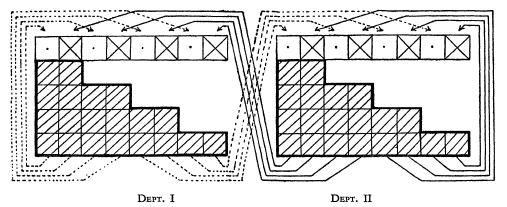
 Reader G. V. Varma reminds me that Ragnar Nurkse was born 100 years ago today, June 5. I don’t have anything to add to this earlier post except to share these funky diagrams from Nurkse’s 1935 Review of Economic Studies article on the structure of production. Each is supposed to illustrate a circular process in which fixed capital reproduces itself. (Neither, I’m afraid, will win an award for pedagogy.)
The spout-and-ring diagram is explained as follows: “The ‘ring’ is equivalent in meaning to Dept. I [which produces capital goods] and the ‘spout’ to Dept. II pouring forth its output of consumable goods. The output of Dept. I divides itself as the dotted line: part of it flows back into the ring (to maintain fixed capital in Dept. I itself). This picture, though less informative than the departmental scheme [pictured below] in bringing out the internal exchange relationships of a capitalist economy, may nevertheless be useful in illustrating the circular process of capital reproduction as lying, in a sense, behind the purposive orientation economic activity directed toward the creation of consumable income.”
Hopefully there is a Nurkse specialist out there who can help us make sense of the larger diagram.
Did Nobody Consider the Incentive Effects?
| Peter Klein |
Heard on NPR this morning:
SEOUL (AP) — A South Korean bank is offering to help heartbroken soldiers dumped by girlfriends while away on mandatory military service by providing special interest rates for stilted troops.
Soldiers who can show letters or e-mail proving their break-up to a bank clerk can receive a new deposit plan with better rates and waived service fees.
Look for a new Korean country-and-western song, “My Baby Dumped Me for a Basis Point.”
War, American Idol, the New “Kidney” Reality Show, and Markets for Attention
| Chihmao Hsieh |
I read two news articles today. One of them describes Cindy Sheehan’s decision to give up her anti-war protest, where she exclaims that Americans live in “a country which cares more about who will be the next American Idol than how many people will be killed in the next few months.” (For those of you who don’t watch any TV, American Idol is the American version of that popular season-long show where 15-20 contestants sing and compete for a record contract, voted upon via SMS text messaging by TV viewers like you and me.) The other news article describes the newest reality TV program in the Netherlands, where a patient with an inoperable brain tumor is donating her kidney and choosing the beneficiary based on televised interviews of three contestants, in a manner apparently reminiscent of a game show format.
How I described the latter article may not make you furl your eyebrows, but listen to this: TV viewers will vote via SMS text messaging who gets to receive the kidney.
Likely many types of societal issues are raised by the juxtaposition of these two news articles. One of the likely-provocative questions I have for the readership: Would you prefer to associate with a world that promotes “American Idol” or a world that promotes this new kidney donation game show?
UPDATE: The kidney reality show was all apparently an elaborate hoax.
Great Economists’ Autographs
| Nicolai Foss |
If you are into collecting autographs and admire Nobel Prize winning economists, ebay is (of course) the place for you. Here is Ronald Coase’s autograph — with a buy-it-now price of 10 USD; here is Nash’s — a bit more fancy (First Day Cover), and (therefore?) with a buy-it-now price of 85 USD; here is Uncle Milton at 34 USD, and one more Nash at 24 USD. The latter Nash autograph, the Friedman and the Coase ones are all on 3×5 unlined index cards. Still, there is a heavy disparity in terms of the asked price. The market values Friedman more than Nash who is valued more than Coase.
Quote of the Day: Poetry About Prices
| Peter Klein |
One of my favorite quotes about the beauty of the price mechanism:
[The market price] synthesizes a number of factors, so that there is difficulty in identifying them and even more in forecasting them: quantities, qualities, possibilities, calculations of interest, memories, fears, hopes. A price is not only the result of statistical figures. It includes all the vibrations of man’s thoughts and soul, since ever they have exercised an influence on the market. (Louis Baudin, La Monnaie et la Formation des Prix, 1836, quoted in Hoff, Economic Calculation in the Socialist Society, p. 299.)
Craft Production Is Fun
| Peter Klein |
Thank goodness for the factory system and mass production, which makes us wealthy enough to do things by hand. Naturally I thought of Budweiser’s critics when reading this piece in The Onion, “Grueling Household Tasks Of 19th Century Enjoyed By Suburban Woman.” (They forgot to include knitting, the latest craze among wealthy suburbanites.) Craft production sure is fun — unless you have to do it to survive, of course. (HT: Ryan McMaken.)
Random Post Link
| Peter Klein |
Got a few hours to kill? Try the O&M Random Post Link, which takes you to one of our many interesting archived posts. I don’t know about you, but I could spend all day doing this!
Hayek-Klein Day
| Peter Klein |
It’s Hayek-Klein Day. How are you planning to celebrate? (One suggestion: browse old O&M posts on Hayek.)
Nerd Practical Jokes
| Peter Klein |
We nerds appreciate practical jokes. OK, mine are not quite at the level of an MIT hack. Unlike the gearheads, however, we economists appreciate opportunity cost and strive for the best results with the least effort. For example, from a pharmacist friend I obtained some “Caution: May Cause Drowsiness” stickers which I bring to seminars and discreetly affix to hard copies of papers that are being distributed — always good for a chuckle.
How about you? What are your favorite nerd practical jokes?
How Well Do You Know Your Advisor?
| Chihmao Hsieh |
Unless you’ve already seen it, here’s a quite popular comic strip glorifying and lampooning school, and particularly graduate studies. Below was the comic for 04/23 (infinitely clearer version here). Another recent good one is the sheet used for Seminar Bingo. (Caution: The comic’s archive is a happily illuminating time sink.)

The Market for Organization Equals USD 7.6B
| Chihmao Hsieh |
Home organization (in 2009), that is.
A CNN article posted online last month has re-appeared in the headlines today, probably in response to the woman who is virtually selling virtually (sic) all her belongings in one single auction on EBay (see the actual listing here). To spare you the reading, the article essentially describes our “hyper-consumptive society deluged by its own belongings,” mentions the TV shows and firms that create products and promote services to help us organize our belongings, and highlights associations like the new-but-fast-growing National Association of Professional Organizers.
Personally, in the last few years I’ve become much more mindful of the number of discrete items I keep at home, that mindfulness mainly a side effect of thinking in terms of this kind of complexity theory and this subfield of cognitive science.
Five Blogs That Make Me Think
| Peter Klein |
 When Nicolai and I started this blog a year ago we were hoping for a plural readership. Now that we’ve hit that target we can move on to the next: making our readers think. Fortunately, we’ve already succeeded with at least one reader: Nijma of Camel’s Nose, who named O&M one of five blogs that make her think. This is one of those “memes” in which each blogger named is supposed to name five bloggers who make him think, who in turn name five bloggers that make them think, and so on, until everyone is nested under someone else, sort of like Amway but without money changing hands.
The Thinking Blog’s Ilker Yoldas is responsible for all this (and for supplying the nice graphic above). Yoldas describes the exercise as a humanistic alternative to blog ranking systems like Technorati based on quantitative analysis of linking patterns, just as “human-powered” search engines like ChaCha are alternatives to Google.
Anyway, I’ll play along. Here are five blogs that make me think. (To make things interesting I’ve excluded the sites listed already on the blogroll below.)
- Eunomia by Daniel Larison
- Social Science Statistics Blog by a bunch of Harvard professors
- God of the Machine by Aaron Haspel
- 3 Quarks Daily by Abbas Raza and guests
- Mouthing Off by the editors of Food and Wine Magazine (does thinking with my stomach count?)





 Organizations and Markets
Recent Comments