Posts filed under ‘Institutions’
Top Earners at Private US Colleges and Universities
| Peter Klein |
Some interesting factoids in this Chronicle of Higher Ed. story on compensation at 600 private US colleges and universities (via Gary Peters):
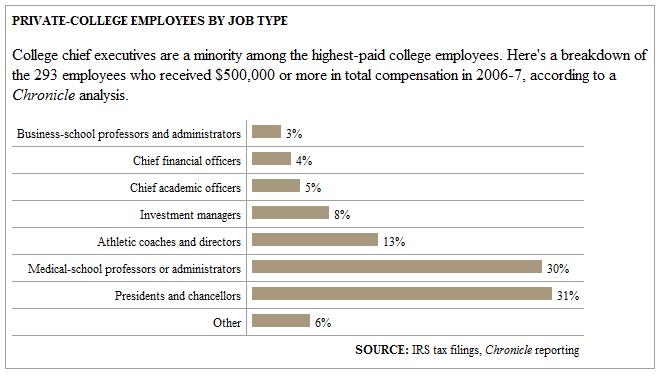
- Of the 88 employees earning more than $1 million in 2006-07, only 11 were chief executives. Most were coaches or medical school faculty.
- Median salary for full professors with MDs in the clinical sciences: $238,000
- Median salary for full professors in all other disciplines: $122,159
- Highest-paid employee: USC football coach Pete Carroll ($4.4 million)
- Second highest-paid employee: Columbia University dermatologist David Silvers ($4.3-million)
- Highest-paid economist: Columbia’s Henry Levin ($302,053)
- Highest-paid film-studies professor: Wesleyan’s Jeanine Basinger ($250,854)
No information given on marginal revenue products. I imagine Pete Carroll’s is at least $4.4 million. Don’t know about the rest.
See also the graphic below (click to enlarge):
More on the Evolution of Accounting
| Peter Klein |
For some reason posts dealing with accounting are among our most popular. Perhaps this says something about the Nerd Quotient of the typical O&M reader. Anyway, if you liked the recent post about the evolution of accounting rules, you may enjoy this paper that looks at the problem more systematically.
Accounting is an Evolved Economic Institution
Gregory B. Waymire and Sudipta Basu
We consider accounting from an evolutionary perspective. Accounting encompasses the creation of transactional records, the summarization of records in t-accounts, and the preparation of audited financial statements. Accounting’s history spans at least 10,000 years dating back to the first human settlements in ancient Mesopotamia. Our focus is on the study of accounting history in three ways: providing useful thoughts experiments valuable to researchers interested in the development of modern practices, the use of historical data to test formal hypotheses about the origins of accounting practices, and the development of theories and related empirical evidence that explain accounting based on evolution and ecological rationality. Within this third area, we describe the basis for hypotheses and empirical analyses concerning six issues: (1) the emergence of recordkeeping, (2) the effect of double-entry bookkeeping on the scale and scope of economic organization, (3) the spontaneous emergence of norms of practice in accounting, (4) the impact of law, regulation, and taxation on accounting, (5) the demand for broad principles in evaluating accounting method choices, and (6) the relation between economic crises and major discontinuities in accounting practice.
Tribal Ritual Among the Ag-Econ
| Peter Klein |
Henry Bahn and George McDowell’s spin-off of the Leijonhufvud classic. I wonder how many other sub- and sister disciplines have their own versions? Sample:
Almost all tribe members adhere to a fundamental belief system and set of basic tenets called Neoclassic Econ. However, different groups in the tribe, sometimes formalized into castes called “fields,” are more or less strict in their adherence to different parts of these tribal teachings. . . .
One group, the Quant-jocques, thinks the tribe should ascribe to a special language and method of communication and analysis. Others, known as Institoots, think the Quant-jocques are introverts, inclined to want to know more and more about less and less, and thus miss important issues along the way. The Quant-jocques reply that the Institoots have more than their fair share of the “mists” about their work as Agg-econ-ni-mists. One of the revered elders of a related tribe decided to resolve some of the philosophical issues among tribe members about who they were and what they believed by pronouncing that the belief system is simply “what the tribe does.”
Like other academic disciplines, agricultural economics has its share of adjuncts, consultants, and other semi-professorial types:
There are also landless tribe members — some of those perhaps more disposed to vagrancy — scattered throughout the land doing what Ag-econs do. Indeed, one group in the tribe has members who live apart from the Depts and are therefore obliged to do honest work for a living. This group is known by its hard work and industry and are called “industry types” or, in an apparent slight, “nonacademics.” Yet another view of this group is that many of them are akin to wandering minstrels who dash in and out of the protected communities, donning the protective robes of the Depts when it serves them well, and when more is to be gained from singing their minstrel song for more than the honor of the Depts, they sing for the highest bidder.
Also lots of insider references on journals and annual meetings. A related discipline, rural sociology, is described in the classic “Village Idiot” Python sketch.
Accounting Rules and Spontaneous Order
| Peter Klein |
David Albrecht thinks the US should not replace its accounting rules (GAAP) with the new, international standard (IFRS).
A language evolves to fit its culture. Language is not static. Moreover, there is no one best way for a language to be. . . .
If Americans wish to speak to a person from Peking, they can get their communication translated. The translation comes at a cost. The benefit from avoiding this cost by switching [to Chinese] would be much less than the huge opportunity costs of educating everyone in the U.S. to speak another language. If we continued using English, the translation to Chinese would (and is) a trivial expense, and a minor inconvenience.
Similarly, there is no good reason for anyone to have the U.S. discontinue using its accounting language (GAAP) and switch over to IFRS. Having multiple accounting languages in the world is a minor inconvenience and translation expenses are, in the grand scheme of things, trivial. Moreover, GAAP seems to fit our culture, economy and system of financial markets. . . .
Who would benefit if the U.S. switched to IFRS? Certainly not investors, for the same reason that they would not benefit if the country moved immediately to Chinese. The beneficiaries would be the accounting firms that would teach us the new IFRS, and company executives. (more…)
Google: Too Big to Fail?
| Peter Klein |
It’s horrible to contemplate, but is Google a future candidate for subsidization and regulation under the essential facilities doctrine? Matt Asay wonders. It’s right to ask these questions, but I think people who worry about the catastrophic effects of a Google failure on the economy underestimate how quickly market participants adapt to changes in product offerings, even in the presence of network effects.
New Leoni Collection: Law, Liberty, and the Competitive Market
| Peter Klein |
Transaction Publishers and the Instituto Bruno Leoni have just published a new collection of essays by Bruno Leoni, Law, Liberty, and the Competitive Market, edited by Carlo Lottieri. The essays elaborate on Leoni’s distinction between law and legislation, and the analogy between the latter and centralized economic planning, themes introduced in his best-known book, Freedom and the Law. Richard Epstein provides an informative introduction.
More Evidence Against the QWERTY Effect
| Peter Klein |
Via MR, an experimental study on path dependence finds that subjects do not get stuck using second-best technologies, even in the presence of network effects:
In this paper, we offer new evidence regarding the economic importance of QWERTY type outcomes. We use laboratory experiments to study platform competition. Experiments have several advantages in studying platform competition: the identity of the inferior platform is clearly defined; the degree to which a platform has a “head start” is controlled; and the “life cycle” of platform competition is reproducible. So far as we are aware, we are the first to study QWERTY in the lab.
We can easily summarize our results: Somehow, the market always manages to solve the QWERTY problem. In sixty iterations of dynamic platform competition, our subjects never got stuck on the inferior platform — even when it enjoyed a substantial first-mover advantage.
For more on path dependence, network effects, and QWERTY see this, this, and this. The more I learn about so-called QWERTY effects the more I’m convinced that they have no economic significance (and even less policy signficance).
More on Open-Source Peer Review
| Peter Klein |
 I’ve thought about setting up an academic version of the Fail Blog where scholars could post copies of rejected manuscripts, nasty referee reports and editor’s letters, and — of course — favorite student papers. But some current experiments in open-source peer review (a topic we’ve covered before) may do the trick. For example, this biology journal is making all submitted manuscripts and referee reports visible to the public:
Publication of research findings is very important to scientists. But scientists tend only to know about how things work at a scientific journal through personal experience and hearsay. By making the evaluation of manuscripts visible to everyone, The EMBO Journal aims to encourage constructive referee and author argumentation. Younger scientists will gain valuable insight into how to publish their research findings as well as how to deal with critique.
I’m not sure how anonymity will be preserved, and some potential authors and reviewers will likely shy away from participating. A very interesting experiment, to be sure. Here’s a wikipedia entry on the open-source peer-review movement more generally.
Skidelsky on Ferguson
| Peter Klein |
Thanks to Humberto Barreto for forwarding Robert Skidelsky’s review of Niall Ferguson’s The Ascent of Money: A Financial History of the World from the New York Review of Books. Here’s Ferguson talking about the book on NPR. There are plenty of reviews by journalists as well. I haven’t read the book but this review by former O&M guest blogger David Gordon makes me wonder if it’s worth the effort.
High-Powered Incentives
| David Gerard |
As I pack my bags for the American Economic Association meetings this weekend in San Francisco, I am reminded of a recent New Yorker article on the impacts of medical marijuana legalization. This is probably a rather mundane topic for you left-coasters, but here in Pennsylvania where we can’t even buy beer in grocery stores, it is a pretty exotic concept.
The article highlights a number of ways in which legalization foments organizational change, and also gives some anecdotal evidence on sharecropping terms, suggesting different terms for indoor and outdoor operations.
The easiest way to make this kind of small indoor scene work is to live in someone else’s house and nurture the plants in exchange for a third or half the profits, and that is how the Kid would be spending her time for the next two months.
On the outdoor side, however, this description of the “Humboldt Slide” suggests that landlords appear more willing to change the contracting terms:
“You start at this really great percentage, and you’re buddy-buddy and everything’s great,” Emily said. As the harvest approaches, growers inevitably begin to run out of money and get greedy, and the sharecroppers lose whatever leverage they had earlier in the growing cycle, when their daily attention was necessary for the young plants to survive. Emily’s wage the previous year was initially set at a third of the value of the plants that she harvested. Later, her boss “slid” her percentage to a sixth, meaning that she owned only a dozen of the eighty plants that she grew that season.
The explanation is that the laborers have no legal recourse, so the landlord is free to rewrite contracts as he pleases, but then wouldn’t we expect a slide in the case of the indoor operations as well?
I welcome suggestions for more systematic treatments for effects of the California legalization. One effect that I don’t expect is for it to have much of an impact on the average sobriety level at this weekend’s conference.
Guilds and Innovation
| Peter Klein |
Most economic and management historians see the guild system as partly responsible for the stagnation of the medieval European economy. A new book, Guilds, Innovation and the European Economy, 1400-1800 (S. R. Epstein and Maarten Prak, eds., Cambridge, 2008) offers a revisionist view, challenging the stereotype of guilds as “moribund rent-seekers whose habitual reaction to technical innovation was resistance and rejection.” The reality is more complex, says reviewer Christine MacLeod:
What emerges from this exceptionally coherent volume is not only the complexity of this institution, whose history spans more than half a millennium and a myriad of particular trades and local circumstances, but also the persistent tensions to which it was subjected, both internally from individualistic and capitalist challenges to its collective ethos and externally from the exigencies of nation states. Moreover, it adds another spur to the demanding search for innovation in the workshop and on the construction site, rather than in the too easily accessed and counted records of the patent office.
Ability and Specialization Among Economic Researchers
| Peter Klein |
Forgive the navel-gazing, but some of you may enjoy Todd Kendall’s paper in the December 2008 issue of MDE, “Ability and Specialization Among Economic Researchers,” which looks at the relationship between a researcher’s human capital and the scope of his activities. The sample consists of academic economists at top-50 US universities. Kendall shows that economists from more prestigious PhD programs tend to publish in more general journals, controlling for quality, and to list more JEL subject codes per paper. The quality control is important because the most prestigious journals (as in most fields) are also the most general. But the sample includes prestigious specialty journals and lower-tier general journals.
Naturally I’m tempted to ask for the raw data so I can analyze some sub-samples containing people I know personally. But perhaps it’s better not to go there. I do plan to defend myself against charges of being “eclectic” or “unfocused” by referring to this study and calling myself a “distinguished generalist.” At least it avoids Rothbard’s Law.
Interesting Blogs
| Peter Klein |
- Urban and Regional Studies, by Pedro Marquez
- Beerkens’ Blog, by Eric Beerkens
- Estzer’s Blog, by Eszter Hargittai
- Terminal Degree, by a funny music professor
What Do Boards Do and How Do They Do It?
| Peter Klein |
A new survey paper on Boards of Directors by Ben Hermalin and Mike Weisbach, updating their 2003 paper.
This paper is a survey of the literature on boards of directors, with an emphasis on research done subsequent to the Hermalin and Weisbach (2003) survey. The two questions most asked about boards are what determines their makeup and what determines their actions? These questions are fundamentally intertwined, which complicates the study of boards due to the joint endogeneity of makeup and actions. A focus of this survey is on how the literature, theoretical as well as empirically, deals – or on occasions fails to deal – with this complication. We suggest that many studies of boards can best be interpreted as joint statements about both the director-selection process and the effect of board composition on board actions and firm performance.
Don’t let James Walsh see this!
Education Quote of the Day
| Peter Klein |
There is a settled mediocrity in American college teaching, surpassed here and there by talented and energetic individuals, but seldom disturbed in its languorous self-satisfaction. On most campuses, mediocrity can rightly pride itself on being a whole lot better than the conspicuous dreadfulness of a handful of professors who dedicate themselves variously to the nine muses of bad teaching: Boredom, Mumbling, Disorganization, Confusion, Forgetfulness, Stridency, PowerPoint, Textbook, and Vacuity.
That’s from Peter Wood, whose subject is actually the division of labor at many large US universities between tenured/tenure-track faculty, who do research and teach small classes to graduate and advanced undergraduate students, and the specialized, non-tenured teaching specialists who handle the bulk of the undergraduate instruction, assisted by a “small army” of graduate and undergraduate TAs. Wood points out, rightly IMHO, that one day the universities may decide that the prestige and grant dollars and other bennies generated by the research faculty isn’t worth their high salaries, perhaps choosing to go the University of Phoenix route instead.
Creative Capitalism
| Peter Klein |
The book is coming out in a few weeks, and the blog is back in business. I didn’t follow all the previous discussion but what I read was of high quality and reflected diverse, and interesting, perspectives.
Historical Origins of “Open Science”
| Peter Klein |
An interesting piece on science and patronage by Paul David, with a comment by Ken Arrow:
The Historical Origins of “Open Science”: An Essay on Patronage, Reputation and Common Agency Contracting in the Scientific Revolution
Paul A. David, Stanford University & The University of Oxford
This essay examines the economics of patronage in the production of knowledge and its influence upon the historical formation of key elements in the ethos and organizational structure of publicly funded “open science.” The emergence during the late sixteenth and early seventeenth centuries of the idea and practice of “open science” was a distinctive and vital organizational aspect of the Scientific Revolution. It represented a break from the previously dominant ethos of secrecy in the pursuit of Nature’s Secrets, to a new set of norms, incentives, and organizational structures that reinforced scientific researchers’ commitments to rapid disclosure of new knowledge. The rise of “cooperative rivalries” in the revelation of new knowledge, is seen as a functional response to heightened asymmetric information problems posed for the Renaissance system of court-patronage of the arts and sciences; pre-existing informational asymmetries had been exacerbated by the claims of mathematicians and the increasing practical reliance upon new mathematical techniques in a variety of “contexts of application.” Reputational competition among Europe’s noble patrons motivated much of their efforts to attract to their courts the most prestigious natural philosophers, was no less crucial in the workings of that system than was the concern among their would-be clients to raise their peer-based reputational status. In late Renaissance Europe, the feudal legacy of fragmented political authority had resulted in relations between noble patrons and their savant-clients that resembled the situation modern economists describe as “common agency contracting in substitutes” — competition among incompletely informed principals for the dedicated services of multiple agents. These conditions tended to result in contract terms (especially with regard to autonomy and financial support) that left agent client members of the nascent scientific communities better positioned to retain larger information rents on their specialized knowledge. This encouraged entry into their emerging disciplines, and enabled them collectively to develop a stronger degree of professional autonomy for their programs of inquiry within the increasingly specialized and formal scientific academies (such the Académie royale des Sciences and the Royal Society) that had attracted the patronage of rival absolutist States of Western Europe during the latter part of the seventeenth century. The institutionalization of “open science” that took place within those settings is shown to have continuities with the use by scientists of the earlier humanist academies, and with the logic of regal patronage, rather than being driven by the material requirements of new observational and experimental techniques.
See also this and this on science funding. And of course Hayek’s Counter-Revolution of Science (free full text!) should be consulted.
B-School Naming Rights Up to $300 million
| Peter Klein |
At Chicago, anyway, now home to the Booth School of Business.
Here’s an interesting (if slightly dated) Business Week story on B-school naming rights. Wisconsin has taken the most innovative approach, announcing earlier this year that in exchange for $85 million it would pledge not to name the school for 20 years.
Here at Organizations and Markets we are committed to honest and open inquiry, free from restrictions imposed by corporate or individual sponsors. However, if you’d like to have this blog named after yourself, we’ll toss those principles right out the window. Send all inquiries to naming-rights@organizationsandmarkets.com.
The Emergence of English Commercial Law
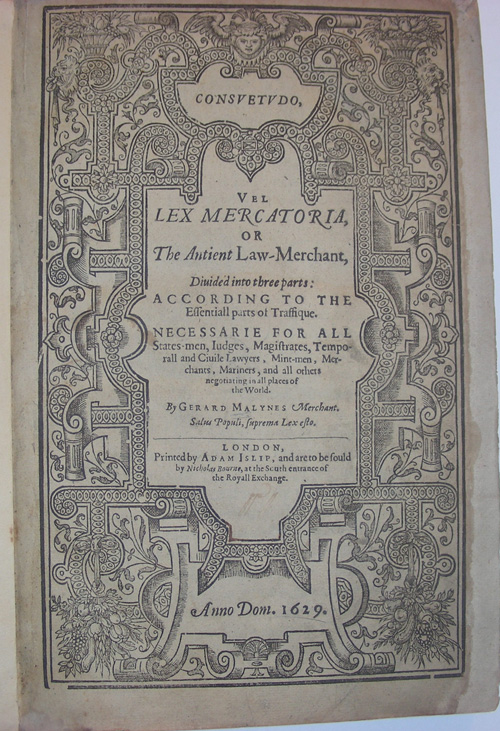
 The English system of commercial law or the lex mercatoria has been described as an example of “spontaneous order,” a set of rules that emerged without central direction and yet provided remarkable stability and favorable institutional environment for trade. Harold Berman and Bruce Benson, among others, have written extensively on this. Here’s an interesting paper by Daniel Klerman on the early history of English commercial law, framed as a comparison of the English and Ottoman systems:
Thirteenth-century England was a commercial backwater whose trade was dominated by foreigners. To accommodate and encourage foreign merchants, England modified its legal system by creating legal institutions which were available to both domestic and foreign traders. Among the most important of these institutions were streamlined debt collection procedures and mixed juries composed of both Englishmen and foreigners. By introducing institutions which treated locals and foreigners equally, England created a level playing field which enabled English merchants to become increasingly prominent in the later Middle Ages. England’s ability to modernize its law was facilitated by the secular nature of English law, the representation of merchants in Parliament, and legal pluralism. Medieval England contrasts sharply with the early modern Ottoman Empire. The latter created special institutions for foreign merchants, which eventually put Ottoman Muslims at a competitive disadvantage.
Always Two, There Are: A Master, and an Apprentice
| Peter Klein |
 Here are the proceedings of a conference on apprenticeship, the much-maligned, but frequently valuable, practice of learning a trade through experience, rather than formal classroom education.
Paul Ryan notes in his EH.Net review:
Its publication responds to the extensive contemporary interest in apprenticeship — among historians, as part of discussions of the role of guilds, proto-industrialization and social change; and among policy analysts, reflecting the benefits of apprenticeship for school-to-work transitions, notably in Germany. . . .
Most contributors subscribe to a revisionist historical view of apprenticeship, as less monolithic, standardized and guild-regulated, and more determined by economic factors, than in traditional interpretations, notably the ganze Haus perspective of the German historical school. Both individually and collectively, the papers document the heterogeneity of apprenticeship. Thus contract durations and completion rates are shown to have varied considerably, even within particular occupations in particular towns in particular periods, despite clear guild prescriptions.





 Organizations and Markets
Recent Comments