Posts filed under ‘– Klein –’
AoM Slides
| Peter Klein |
Thanks to Peter L. for his report on the “Austrian Economics and Entrepreneurship Studies” PDW at the Academy of Management conference. Here, for your viewing pleasure, are the slides: my opening remarks on the origins and development of the Austrian school, Henrik’s discussion of Israel Kirzner and his influence on entrepreneurship scholarship, and Todd’s presentation on Ludwig Lachmann’s unique approach. Enjoy!
Technology Quote of the Day
| Peter Klein |
Jobs and Apple have done the best job of answering with their products the question posed by wiki inventory Ward Cunningham: What’s the simplest thing that could possibly work? As I’ve stressed before, most technologists / nerds / geeks don’t think this way — they think that success comes from cramming in features and functions, bells and whistles.
I’ve made this point many times in my speaking and teaching on technology and innovation, particularly with regard to so-called “QWERTY effects” and the claim that markets with network externalities tend to select suboptimal technologies. A serious problem in this literature is that “optimal” is almost always defined from the engineer’s point of view, not the consumer’s (e.g., Betamax was “really” better than VHS because the picture quality was higher and the tapes more compact, even though the recording time was shorter and the recorders much more expensive). Aside from what the market chooses, by what standard do we deem one technology more “efficient” — in an economic sense — than another?
As one disgruntled RIM employee complained recently to upper management: “The whole campaign around the [Blackberry] Playbook seems to be ‘IT DOES FLASH! LOOK!’ . . . but honestly, my mother doesn’t know or care about that. She wants to know ‘can I play Angry Birds?'”
Peter Lewin Interview
| Peter Klein |
Adrián Ravier has put together a nice collection of Spanish-language interviews with economists of the Austrian school (volume 1, volume 2). The leading modern figures are all included: Mises, Hayek, Machlup, Lachmann, Rothbard, Kirzner, fellow travelers such as Buchanan and Shackle, and contemporary Austrians such as Garrison, Block, Hoppe, Higgs, Ebeling, Salerno, Boettke, and more.
Guest blogger Peter Lewin’s interview is coming out in a third volume, to be published later this year, and Adrián has given me permission to post the English version here. You’ll find Peter’s intellectual odyssey very interesting!
(I am also featured in the collection, via translation of an old interview from 1995. Those were the days!)
User-Driven Innovation, India Edition
| Peter Klein |
[E]very now and again one encounters an article in the American business press about jugaad, the uniquely Indian capacity to join broken things, and make them work, using country fixes. In on-going debates about innovation in India, it seems inevitable that one returns to the ‘ingenious fixes’ of those days, to ask how that talent and human inventiveness can be better harnessed towards the future.
The classic theory of innovation is provided in economic terms by Joseph Schumpeter, who listed several different kinds of changes that could be brought about through entrepreneurial action. These included the discovery and creation of new markets, the development of new methods of production and transportation, as well as new forms of industrial organization, and — this is critical — new kinds of consumer goods and the new experiences of value that they afford. It is striking to me that even though the country-mechanics and other jugaad specialists of India are capable of achieving none of these aims, they are still held up as somehow occupying a place or showing a kind of direction for innovation, that is not otherwise visible to us. It is as if we know, somehow, that all the abstract jargon of business thinking and economic reasoning has its place, but that it cannot replace that hands-on messing about with tools and things that artisans, craftspeople, and repairmen share. Jugaad seems to serve as a figure for design-thinking and problem-solving in the real world, capabilities which are scarce to the point of being unknown and unheard in many corners of Indian industry and public life.
Navi Radjou, Jaideep Prabhu, and Simone Ahuja, writing last year in HBR, call jugaad “the art of creative improvisation,” the Indian version of the long-standing tradition of user-driven innovation associated with Cyrus McCormick, the Danish windmill industry, and open-source software.
More Back-to-School Advice
| Peter Klein |
In the spirit of yesterday’s advice post for MBAs, here is some vital information for professors to share with their undergraduates, courtesy of the University of Missouri’s College of Agriculture, Food, and Natural Resources. The hook: “Have you received an e-mail from a student that made you wonder whether English was still taught in high school? Has a student asked you whether he or she was ‘missing anything important’ by not attending class? How about the cell phone? Have fingers been on the move during class — perhaps not in recording lecture notes?”
- E-mail Etiquette – Help students develop a habit of using professional e-mail communication by following these recommended guidelines. http://cafnr.missouri.edu/career-services/pro-dev/email-etiquette-guidelines.pdf.
- Missing Class – If students decide they must miss a class or laboratory session due to an extra-curricular or co-curricular activity they should follow these guidelines. http://cafnr.missouri.edu/career-services/pro-dev/missing-classes.pdf.
- Classroom Etiquette – To ensure a positive learning environment, students should adhere to these classroom expectations. http://cafnr.missouri.edu/career-services/pro-dev/classroom-etiquette.pdf.
Please add your own links, suggestions, etc. in the comments!
Common MBA Problem-Solving Mistakes
| Peter Klein |
From Luke Froeb, author of the excellent Managerial Economics: A Problem-Solving Approach, shares his most common comments on MBA student assignments. Excerpt:
“What about the organizational design?” Figure out what is causing the problem, and then think about how to avoid the problem. A lot of papers identified a bad decision, and then suggested reversing it. But they neglected to address the issue of why the bad decision was made, and how to make sure the same mistakes wouldn’t be made in the future.
“Don’t define the problem as the lack of your solution.” For example, if the problem is “the lack of centralized purchasing,” then you are locked into a solution of “centralized purchasing.” Instead, define the problem as “high acquisition cost” and then examine “centralized purchasing” vs. “decentralized purchasing” (or some other alternative) as two solutions to the problem.
“What is the trade-off?” Every solution has costs as well as benefits. If you list only the benefits, it makes your analysis seem like an ex post rationalization of a foregone decision, rather than a careful weighing of the benefits and costs. If you spent some time thinking through the tradeoffs, show it. If not, then you should.
These are excellent suggestions. For example, students want us to teach them solutions, but usually the best we can do as instructors is help them understand the relevant tradeoffs.
Are Ray-Guns “Idle Resources”?
 | Peter Klein |
Several people have called to my attention this extraordinary interview in which Paul Krugman states his belief that a military buildup to fight a mythical alien invasion would pull the economy out of recession. I guess it would be more entertaining than paying people to dig holes in the ground and paying other people to dig them up. Were Krugman’s remarks tongue-in-cheek? Unlikely, as he seems to believe in a sort of old-school, 1950s-era, hydraulic Keynesianism, and hasn’t otherwise demonstrated a sense of humor.
Of course, as Bob Higgs has tirelessly demonstrated, World War II didn’t end the Great Depression, but that doesn’t stop this canard being trotted out every time someone wants to justify deficit spending. Notes Mary Theroux: “the Great Depression ended in 1946, when 10 million individuals were returned to the ranks of the unemployed, and federal spending plunged 40% in the aftermath of FDR’s death and the abandonment of the New Deal.” But the more fundamental point is that spending for spending’s sake does not increase economic well-being. To see why, we must challenge the core Keynesian concept of “idle resources,” the idea that, when the economy is away from “full employment,” the usual laws of microeconomics — resources are scarce, decision-makers face tradeoffs at the margin, costs are opportunity costs — don’t apply. As Brad Delong recently put it in one of his characteristically classy missives: during a recession, “[t]he full-employment world of Bastiat is very very far away.” Of course, Bastiat’s brilliant demonstration of hidden costs and the fallacy of spending one’s way into prosperity has nothing to do with “full employment,” a concept that isn’t even coherent, given that efficiency in resource employment makes sense only with regard to the subjective production plan of the entrepreneur (cf. Penrose, 1959; Kirzner, 1966).
W. H. Hutt’s powerful and underappreciated critique of Keynes, The Theory of Idle Resources (1939) — available for free download at Mises.org — attacks this core Keynesian concept. As Hutt explains, all resources have alternative uses, and even “idleness” is a use, in the sense that the resource owner prefers to hold the resource for a future, as-yet-unavailable or unimagined use — a real option, if you like. Dragooning such resources into some random use, outside the price mechanism, serves no productive purpose. Even outside the mythical world of “full employment,” there are no free lunches.
So put those ray-guns back into storage, boys. We may need them later.
AOM 2011
| Peter Klein |
The Academy of Management conference in San Antonio is in full swing, with lots of interesting activities for O&Mers. Friday I co-facilitated the theory workshop for the Entrepreneurship Division Doctoral Consortium (slides here), and Peter Lewin and I participated yesterday in a great Professional Development Workshop on the role of Austrian economics in entrepreneurship research. Today O&M friend Joe Mahoney will receive the Irwin Outstanding Educator Award. And there are paper sessions, roundtables, keynotes, and other events dealing with organizational design, entrepreneurship, strategy, innovation, regulation, and other topics near and dear to our collective hearts. A good time is being had by all!
Renegotiation
| Peter Klein |
The idea of a renegotiation-proof equilibrium — a situation in which all commitments are credible such that no party has an incentive to alter the arrangement — became popular in the game-theoretic contract literature in the 1980s. A recent paper by Michael Roberts shows that renegotiation is much more common in bank lending than is commonly recognized (by academics), suggesting that in many cases, formal financial contracting arrangements should be seen as starting points for future negotiation, not equilibrium agreements.
The Role of Dynamic Renegotiation and Asymmetric Information in Financial Contracting
Michael R. RobertsWe show that bank loans are repeatedly renegotiated by the borrower in an effort to loosen contractual constraints designed to mitigate information asymmetry. The typical loan is renegotiated every eight months, or four times during the life of the contract. The frequency of renegotiation is closely linked to the restrictiveness of the initial contact and the degree of information asymmetry between borrower and lender. In addition to significantly altering the terms of the contract, renegotiation reduces the speed of information revelation – more anticipated renegotiation rounds lead to longer durations between those renegotiations as information evolves more slowly. Consequently, later renegotiation rounds are more sensitive to new information regarding the borrower and their outside options than early rounds. An important by-product of our study is to show that many of the observations in the Dealscan database correspond to renegotiations of the same credit agreement, as opposed to originations of new loans.
Warning to My Future Biographers
| Peter Klein |
Daniele Besomi, writing at the SHOE list (and shared with permission):
[N]ot only memory is treacherous and selective, but even archival sources are not always fully reliable. In my work on the papers of Roy Harrod I have found examples of self-selection of documents to be preserved for posterity. Already aged 30 he annotated some documents as witnessing his position on some university matters; at 32 he preserved his own side of the correspondence he entertained with some politicians apparently because he deemed it important to keep a trace of it (he normally never kept copies of his outgoing correspondence, almost all handwritten); at 45 he started going through his own archives, annotating some correspondence for the benefit of “future historians of thought.”
At some (probably later) point in life he organized his own archives for the benefit of future readers, and he is likely to have manipulated some contents (besides rearranging the correspondence: annoyingly, the archivists undid some of Harrod’s work and moved some papers to different folders …).
It is in fact very strange that one who preserved tailor’s bills and bus tickets had kept no documents relating to his activities with the New Fabian Research Bureau in the early 1930s: he didn’t keep any of the memoranda he wrote (two at least survive in the NFRB’s archives) nor the correspondence he received about it (but the outgoing letters are in the recipients’ archives), except for a letter from James Meade dealing with theoretical matters and mentioning the NFRB in a postscript — perhaps (I am speculating here) Sir Roy turned conservative was embarrassed of the left-wing tendencies of his younger self.
Look below the fold for some annotations and sources (via Daniele). (more…)
Rogoff on Leverage
| Peter Klein |
An important point from Ken Rogoff:
Many commentators have argued that fiscal stimulus has largely failed not because it was misguided, but because it was not large enough to fight a “Great Recession.” But, in a “Great Contraction,” problem number one is too much debt. If governments that retain strong credit ratings are to spend scarce resources effectively, the most effective approach is to catalyze debt workouts and reductions.
For example, governments could facilitate the write-down of mortgages in exchange for a share of any future home-price appreciation. An analogous approach can be done for countries. For example, rich countries’ voters in Europe could perhaps be persuaded to engage in a much larger bailout for Greece (one that is actually big enough to work), in exchange for higher payments in ten to fifteen years if Greek growth outperforms.
I don’t agree with all of the discussion, for example Rogoff’s call for price inflation to mitigate the burden on debtors, but this is a big advance over the vulgar Keynesianism that passes for analysis at the New York Times. (See also Peter L.’s post on Rumelt.) The main point is that a recession like the present one is structural, and has nothing do with shibboleths like “insufficient aggregate demand.” I wish Rogoff (here or in his important book with Carmen Reinhart) talked about credit expansion as the source of structural, sectoral imbalances that generate macroeconomic crises.
The Downside of Case Studies
| Peter Klein |
As Herbert Simon once noted, while a case study is only a sample of one, a sample of one is infinitely more informative than a sample of none. This is surely true, but cases must be used with caution, particularly when more systematic evidence is available.
A couple months back I saw a Huffington Post piece claiming that, because Lincoln Electric retains workers even during recessions, and Lincoln Electric is a profitable company, firms should not fire workers when the demand for their products declines. QED. The author laments that business schools don’t teach the virtues of a “no-layoffs” policy more generally. As evidence that business schools are corrupt or incompetent, the author shows that management experts do not, in fact, believe that such a policy is desirable.
A more troubling reason is that many professors at Harvard and other MBA schools are deeply skeptical of offering workers such a bargain.
“It’s a terribly non-optimal and inefficient policy,” says George P. Baker, the co-chair of the HBS doctoral program. “Lincoln Electric is a special case. Unless there is some other reason for having it, as part of an incentive system, you would be wrong to recommend it.”
“I’m not unsympathetic to guaranteed employment and the long-term social strengths it builds,” says James Rebitzer, Chair of the Business Policy Department at Boston University’ School of Management, “But I think there are only a very few special circumstances where a commitment to no-layoffs actually improves operating efficiency.”
Harvard students such as Corey Crowell (MBA 2009), who read the [Lincoln Electric] case just days before we met, got the message: “I just worry that the sense of a guaranteed job would create complacency . . . look at the auto industry.”
There you have it. Despite a wealth of theory and evidence that guaranteed lifetime employment is generally harmful to firm performance, if one firm follows such a policy and prospers, then all firms should do so. That business schools don’t embrace the non sequitur is “troubling.” Okey dokey.
No Wonder Our Readers Find Us Witty and Clever
| Peter Klein |
Confirmation bias, it appears, affects not only our scientific and political beliefs, but our aesthetic preferences as well. Now I understand why certain people read orgtheory.net!
Another Benefit of Globalization
| Peter Klein |
Better management practice:
The Land that Lean Manufacturing Forgot? Management Practices in Transition Countries
Nicholas Bloom, Helena Schweiger, John Van Reenen
NBER Working Paper No. 17231, July 2011We have conducted the first survey on management practices in transition countries. We found that Central Asian transition countries, such as Uzbekistan and Kazakhstan, have on average very poor management practices. Their average scores are below emerging countries such as Brazil, China and India. In contrast, the central European transition countries such as Poland and Lithuania operate with management practices that are only moderately worse than those of western European countries such as Germany. Since we find these practices are strongly linked to firm performance, this suggests poor management practices may be impeding the development of Central Asian transition countries. We find that competition, multinational ownership, private ownership and human capital are all strongly correlated with better management. This implies that the continued opening of markets to domestic and foreign competition, privatisation of state-owned firms and increased levels of workforce education should promote better management, and ultimately faster economic growth.
2011 Oliver E. Williamson Prize
| Peter Klein |
The Journal of Law, Economics, and Organization, co-founded by Oliver Williamson in 1985, has created a new best article prize in his name. The first winner is “Juvenile Delinquency and Conformism” by Eleonora Patacchini and Yves Zenou. Details about the award and this year’s winner and runners-up are available at Oxford’s JLEO site. Congrats!
Grade Inflation
| Peter Klein |
Via Steve Kates, some data on US grade inflation that may or may not surprise you. I leave discussion of root causes to the discussion thread.
Contemporary data indicate that, on average across a wide range of schools, A’s represent 43% of all letter grades, an increase of 28 percentage points since 1960 and 12 percentage points since 1988. D’s and F’s total typically less than 10% of all letter grades. Private colleges and universities give, on average, significantly more A’s and B’s combined than public institutions with equal student selectivity. Southern schools grade more harshly than those in other regions, and science and engineering-focused schools grade more stringently than those emphasizing the liberal arts. At schools with modest selectivity, grading is as generous as it was in the mid-1980s at highly selective schools. These prestigious schools have, in turn, continued to ramp up their grades. It is likely that at many selective and highly selective schools, undergraduate GPAs are now so saturated at the high end that they have little use as a motivator of students and as an evaluation tool for graduate and professional schools and employers.
Sovereign States Default, Repudiate; Sun Still Rises
| Peter Klein |
Frivolous commentary on the US debt crisis (like this) attributes to opponents of raising the debt ceiling the view that “defaults don’t matter.” Sensible people recognize, of course, that default (and even repudiation) are policy options that have benefits and costs, just as continuing to borrow and increasing the debt have benefits and costs. Reasonable people can disagree about the relevant magnitudes, but comparative institutional analysis is obviously the way to go here. (Unfortunately, most of the academic discussion has focused entirely on the possible short-term costs of default, with almost no attention paid to the almost certain long-term costs of continued borrowing.)
I’m a bit surprised no one has brought up William English’s 1996 AER paper, “Understanding the Costs of Sovereign Default: American State Debts in the 1840’s,” which provides very interesting evidence on US state defaults. It’s not a natural experiment, exactly, but does a nice job exploring the variety of default and repudiation practices among states that were otherwise pretty similar. Here’s the meat:
Between 1841 and 1843 eight states and one territory defaulted on their obligations, and by the end of the decade four states and one territory had repudiated all or part of their debts. These debts are properly seen as sovereign debts both because the United States Constitution precludes suits against states to enforce the payment of debts, and because most of the state debts were held by residents of other states and other countries (primarily Britain). . . .
In spite of the inability of the foreign creditors to impose direct sanctions, most U.S. states repaid their debts. It appears that states repaid in order to maintain their access to international capital markets, much like in reputational models. The states that repaid were able to borrow more in the years leading up to the Civil War. while those that did not repav were, for the most part, unable to do so. States that defaulted temporarily were able to regain access to the credit market by settling their old debts. More surprisingly, two states that repudiated a part of their debt were able to regain access to capital markets after servicing the remainder of their debt for a time.
Amazingly, the earth did not crash into the sun, nor did the citizens of the delinquent states experience locusts, boils, or Nancy Grace. Bond yields of course rose in the repudiating, defaulting, and partially defaulting states, but not to “catastrophic” levels. There were complex restructuring deals and other transactions to try to mitigate harms.
A recent CNBC story on Europe cited “the realization that sovereign risk, and particularly developed market sovereign risk exists, because most developed world sovereign was basically treated as entirely risk free,” quoting a principal at BlackRock Investment Institute. “With hindsight, we can say . . . that they have never been risk free, it’s just that we have been living in a quiet time over the last 20 years.” Doesn’t sound like Apocalypse to me.
Old Economics Test Questions
| Peter Klein |
The University of Missouri’s sprawling new student center recently opened Mort’s, a reproduction of an old campus hangout called The Shack, made famous by Beetle Bailey creator and Mizzou alumnus Mort Walker. I snapped the photos below from the entrance to Mort’s, which is full of old Walker cartoons. I spied a 1950 cartoon featuring an economics test. Click to enlarge the strip.
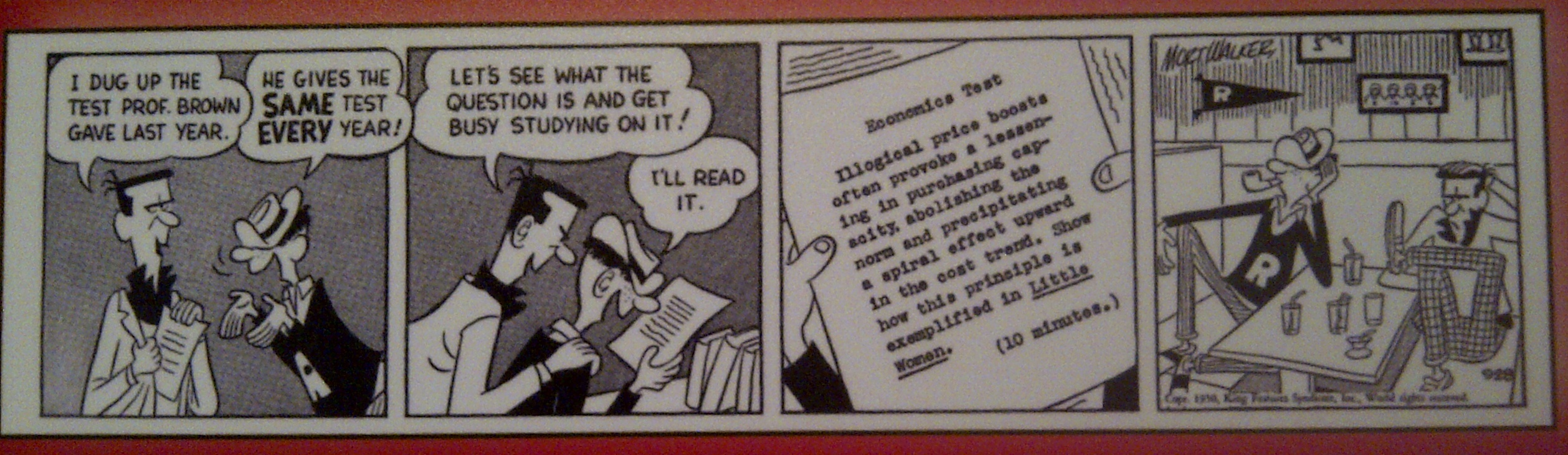
Funny, but what was Professor Brown smoking when he wrote that question? (Maybe he was just a Keynesian, bless his heart.)
Is the Internet “Transforming” Business?
| Peter Klein |
In the 1990s and early 2000s there was a huge debate about the impact of information technology on productivity. Robert Solow famously quipped, “You can see the computer age everywhere but in the productivity statistics.” Robert Gordon, Erik Brynjolfsson, Jack Triplett, and many others participated in this debate, with issues revolving around productivity measurement, workplace incentives, organizational complementarities, and more. (I did some work on this too.) The end result was a rough consensus that IT did increase productivity, but that the effects were modest.
The buzz over “wikified” organizations — open-source communities, highly disaggregated firms, crowdsourced production, and the like — gives me a strong sense of déjà vu. Indeed, we have not been kind to the wikinomics view in these pages. Now Don Tapscott, a leader of this movement, seems to be having second thoughts:
In our 2006 book Wikinomics, Anthony D. Williams and I looked at dozens of companies that have used the Internet to transform their business models and achieve tremendous success.
However, in the five years since the book’s publication, we’ve noticed something striking: the rate of business model innovation has not accelerated. Yes, some individual companies have achieved competitive advantage by exploiting the web and networked business models. But overall the gains have been modest.
The reason, says Tapscott, is that “it’s becoming difficult or even impossible for companies to achieve breakthrough success without changing their entire industry’s modus operandi.” This reminds me of the conclusion from the earlier literature that IT has the biggest effect when combined with complementary organizational practices (e.g., Milgrom and Roberts, 1995), which suggests that change doesn’t occur until all elements of the complementary bundle are in place — maybe a long time after the initial innovation.
Legal Rights of Academics and Journalists
| Peter Klein |
Do academic oral historians have the same legal protections as journalists? No, according to the US Department of Justice:
With the filing, the U.S. government has come down firmly on the side of the British government, which is fighting for access to oral history records at Boston College that authorities in the U.K. say relate to criminal investigations of murder, kidnapping and other violent crimes in Northern Ireland. The college has been trying to quash the British requests, arguing that those interviewed as part of an archive on the unrest in Northern Ireland were promised confidentiality during their lifetimes.
This is from Inside Higher Ed via Zachary Schrag, who notes that the DOJ brief
suggests that the Boston College researchers are mere academics, and seizing information from them should be easier than prying it from reporters “because the Constitution and the courts have long recognized the unique role which news reporters play in our constitutional system. See, e.g., Branzburg, 408 U.S. at 681; New York Times Co. v. Sullivan, 376 U.S. 254, 268-71 (1964). The limited protections afforded news reporters in the context of a grand jury subpoena should be greater than those to be afforded academics engaged in the collection of oral history.”
Lots of interesting stuff above about informed consent, academic freedom, confidentiality, etc.





 Organizations and Markets
Recent Comments