Posts filed under ‘– Klein –’
John Nye on the New Institutional Economics and Economic Development
| Peter Klein |
The always-thoughtful and interesting John Nye, speaking last December on the New Institutional Economics and economic development.
BTW, for your convenience, a copy of the hard-to-find 1989 Nabli and Nugent paper, “The New Institutional Economics and Its Applicability to Development,” is available here.
Sociologists on IRBs
| Peter Klein |
According to sociologists Carol A. Heimer and JuLeigh Petty (via Zachary), the basic problem is that IRBs “substitute bureaucratic ethics for professional ethics.”
Much of the literature on human subject regulation asserts that Institutional Review Boards (IRBs) have failed at the task of regulating human subjects research. These critiques of IRB law can be grouped into three loose categories: critiques of IRB law as law, critiques of IRBs as regulation, and critiques of IRBs as a system of norm creation. Moving beyond critique, we rethink the literature on IRBs drawing on the tools and scholarship of the social sciences. In particular, we examine human subjects regulation as an insufficient remedy to inequalities between weak and powerful actors, as a site of professional claims- and career-making, and as an occasion for institutionalization. Finally, distinguishing between the regulation of science and the regulation of ethics, we observe that the latter is far more difficult because ethics are contextual and subject to social construction. For these reasons, IRBs often substitute bureaucratic ethics for professional ethics.
They raise several interesting points, and to show my appreciation I’ll refrain from attaching the pomo periscope tag.
Transaction Cost Regulation
| Peter Klein |
At last year’s ISNIE conference in Stirling Pablo Spiller gave an excellent presidential address on “Transaction Cost Regulation,” the application of transaction cost economics to regulatory issues. The text of the address has now been released as an NBER Working Paper with the same name:
This paper discusses the fundamental underpinnings and some implications of transaction cost regulation (TCR), a framework to analyze the interaction between governments and investors fundamentally, but not exclusively, in utility industries. TCR sees regulation as the governance structure of these interactions, and thus, as in standard transaction cost economics, it places emphasis in understanding the nature of the hazards inherent to these interactions. The emphasis on transactional hazards requires a microanalytical perspective, where performance assessment is undertaken within the realm of possible institutional alternative. In that sense, politics becomes fundamental to understanding regulation as the governance of public / private interactions. The paper discusses two fundamental hazards and their organizational implications: governmental and third party opportunism. Both interact to make regulatory processes and outcomes more rigid, formalistic, and prone to conflict than envisioned by relational contracting.
You can see the slides from the ISNIE version here.
What an Arrow-Debreu Contract Might Look Like
| Peter Klein |
A visual reminder why real-world contracts are typically incomplete, giving rise to interesting problems of ex ante incentive alignment and ex post governance.
In Defense of Big Words
| Peter Klein |
A cardinal rule of clear communication is never to use a long, obscure word or phrase when a shorter, more common one will do. Orwell thought this was of Brobdingnagian importance — sorry, a big deal — and Hemingway famously rebutted Faulkner’s critique of his writing style by pitying
Poor Faulkner. Does he really think big emotions come from big words? He thinks I don’t know the ten-dollar words. I know them all right. But there are older and simpler and better words, and those are the ones I use.
Mencken, referring to the Danish linguist Otto Jespersen, says “[t]he prevalence of very short words in English, and the syntactial law which enables it to dispense with the definite article in many constructions . . . are further marks of vigor and clarity.” And of course we can all name scholars, even whole fields and genres, marked by particularly murky and obscure prose. (Question: Does academic jargon reform pass the remediableness criterion? LOL.)
However, according to a group of MIT linguists, as reported in Nature (via Azra Raza), big words often contain more information than their shorter counterparts, and word choice is mostly a function of information content:
For many years, linguists have tended to believe that the length of a word was associated with how often it was used, and that short words are used more frequently than long ones. This association was first proposed in the 1930s by the Harvard linguist George Kingsley Zipf.
Zipf believed that the relationship between word length and frequency of use stemmed from an impulse to minimize the time and effort needed for speaking and writing, as it means we use more short words than long ones. But Steven Piantadosi and colleagues at the Massachusetts Institute of Technology in Cambridge say that, to convey a given amount of information, it is more efficient to shorten the least informative — and therefore the most predictable — words, rather than the most frequent ones. . . .
But after analyzing word use in 11 different European languages, Piantadosi and colleagues found that word length was more closely correlated with their information content than with how often they are used.
Managing Innovation
| Peter Klein |
My old classmate Hank Chesbrough offers some thoughts on managing innovation in HBR’s Conversation Blog. Previous decades brought us systems analysis, PERT, TQM, supply chain management, and open innovation. What’s next? Hank’s predictions:
First, management innovation will become more collaborative. Opening up the innovation process will not stop with accessing external ideas and sharing internal ideas. Rather, it will evolve into a more iterative, interactive process across the boundaries of companies, as communities of interested participants work together to create new innovations. . . .
Second, business model innovation will become as important as technological innovation. . . . Third, we will need to master the art and science of innovating in services-led economies. Most of what we know about managing innovation comes from the study of products and technologies. Yet the world’s top advanced economies today derive most of their GDP from services rather than products or agriculture.
Kirznerian versus Knightian Entrepreneurs in Film
| Peter Klein |
Kirzner’s entrepreneur is a pure discoverer who owns no capital. Knight’s entrepreneur is an uncertainty-bearing, resource owner with skin in the game. So who do you think is the real entrepreneur, Jerry Lundegaard or Wade Gustafson?
Bonus: my favorite scene from Miller’s Crossing, useful to illustrate the differences between action (emphasized by Knight) and cognition (emphasized by Kirzner): (more…)
My New Favorite Journal
| Peter Klein |
It’s the Journal of Universal Rejection (HT: Joshua Gans). From the journal’s website:
The founding principle of the Journal of Universal Rejection (JofUR) is rejection. Universal rejection. That is to say, all submissions, regardless of quality, will be rejected. Despite that apparent drawback, here are a number of reasons you may choose to submit to the JofUR:
- You can send your manuscript here without suffering waves of anxiety regarding the eventual fate of your submission.
- You know with 100% certainty that it will not be accepted for publication.
- There are no page-fees.
- You may claim to have submitted to the most prestigious journal (judged by acceptance rate).
- The JofUR is one-of-a-kind. Merely submitting work to it may be considered a badge of honor.
- You retain complete rights to your work, and are free to resubmit to other journals even before our review process is complete.
- Decisions are often (though not always) rendered within hours of submission.
If I submit a paper titled “The Ubiquity of Knightian Uncertainty,” would that constitute a performative contradiction?
Organizing for Synergies
| Peter Klein |
Thanks for Mike S. for the pointer to this paper (published version here, ungated version here):
Organizing for Synergies
Wouter Dessein, Luis Garicano, and Robert GertnerLarge companies are usually organized into business units, yet some activities are almost always centralized in a company-wide functional unit. We first show that organizations endogenously create an incentive conflict between functional managers (who desire excessive standardization) and business-unit managers (who desire excessive local adaptation). We then study how the allocation of authority and tasks to functional and business-unit managers interacts with this endogenous incentive conflict. Our analysis generates testable implications for the likely success of mergers and for the organizational structure and incentives inside multidivisional firms.
This is an understudied topic in organizational design, I think. The large literature on the M-form, going back to Chandler and Williamson and flourishing in the 1970s and 1980s, compared functional to business-unit managers across organizations, but said much less about mixing them within organizations. The modern internal capital markets literature focuses on information problems between division heads and the central office, and conflicts over resources among division heads, but not the issues raised here by Dessein, Garicano, and Gertner. The vertical integration literature, as well, tends to treat firm-wide support services as peripheral to the incentive conflicts between vertically related divisions.
Economic Growth Quote of the Day
| Peter Klein |
The path of economic progress is strewn with the wreckage of failures. Every business man knows this, but few economists seem to have taken note of it. In most of the theories currently in fashion economic progress is apparently regarded as the more or less automatic outcome of capital investment, “autonomous” or otherwise. Perhaps we should not be surprised at this fact: mechanistic theories are bound to produce results which look automatic.
— Ludwig Lachmann, Capital and Its Structure (1956), pp. 36-37.
Unrelated Diversification, circa 1971
| Peter Klein |
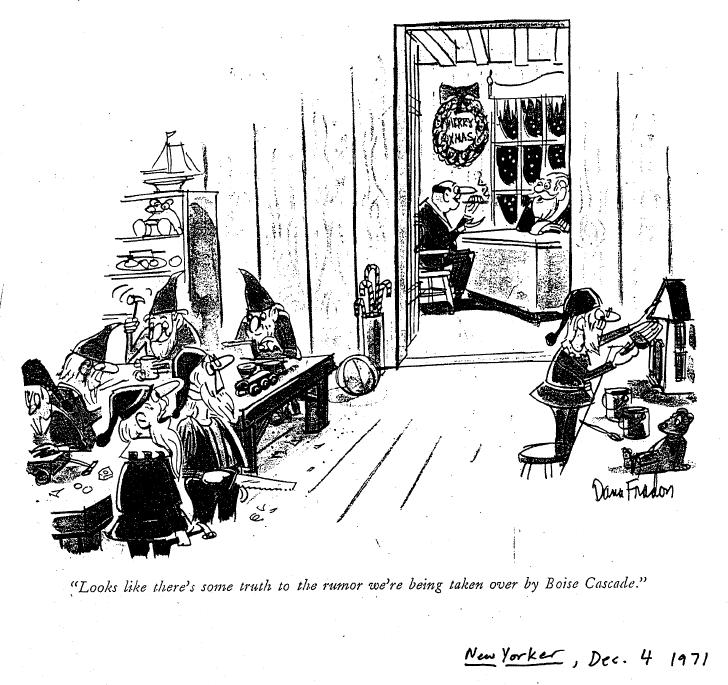
A funny (to me) New Yorker cartoon about diversification, appearing at the height of the conglomerate merger wave of the late 1960s and early 1970s. Click to enlarge. (I’ve been looking for this for a while; found it when cleaning out an old file cabinet.)
The Value of Steve Jobs
| Peter Klein |
As you have likely heard, Steve Jobs is taking an indeterminate leave of absence from Apple to deal with his continuing health problems. How will this affect Apple? How important is one person — albeit the founder and CEO — to a diversified multinational company with tens of thousands of employees? Apple’s stock slipped slightly on the news of Jobs’ leave (down 2.3 percent today, the first trading day after the announcement), but Jobs’s health problems are well known and Apple’s stock price presumably already included a discount reflecting the possibility he’d step down. To estimate the value of a particular employee to the firm in this way, we need an unanticipated departure, one that isn’t a response to poor performance and isn’t expected in advance.
Sure, enough, there’s an app for that — I mean, there’s a literature on that. An influential 1985 paper by Bruce Johnson, Robert Magee, Nandu Nagarajan, and Harry Newman looked at stock-price reactions to CEO deaths by plane crash, finding positive announcement effects for founders and negative announcement effects for professional managers. (One way to handle the founder-succession problem!) Macabre, I know, but nonetheless a clever way to deal with endogeneity. Naturally, this paper spawned a follow-up literature. Rather than cite the papers myself, I’ll just block quote a paper by Bang Dang Nguyen and Kasper Meisner Nielsen presented at last week’s AEA meeting, “What Death Can Tell: Are Executives Paid for Their Contributions to Firm Value?” and you can chase down the references on your own: (more…)
Guilt by Association?
| Peter Klein |
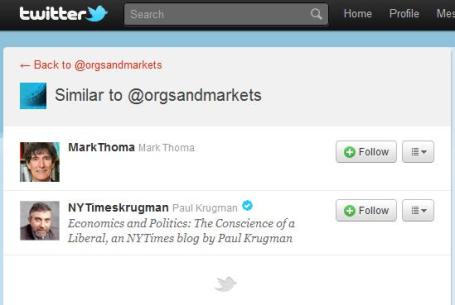
You may know that we have a Twitter feed, @orgsandmarkets. Twitter recently added a recommendation feature, “Similar to,” showing feeds its software judges similar to a given feed. See below what Twitter deems similar to O&M. I don’t mind being associated with Mark Thoma, who seems like a good guy even though I usually disagree with him, but that other one? I’m offended!
University Restructuring, Agricultural Economics Edition
| Peter Klein |
The current issue of AAEA Exchange, the newsletter of the Agricultural and Applied Economics Association (formerly American Agricultural Economics Association), features three perspectives on the long-term viability of maintaining separate departments of economics and agricultural economics. (Much of the discussion would apply to business economics departments too.) Ron Mittelhammer of Washington State argues for consolidation, Ken Foster of Purdue for keeping separate departments, and Rob King of Minnesota for the transformation of agricultural economics departments to applied economics departments.
The issues are organizational and strategic and familiar to O&M readers. Mittelhammer emphasizes tangible resources and a shared intellectual heritage and downplays accumulated routines and capabilities, organizational culture, etc.:
Arguably above all other rationale, mergers are also warranted because, fundamentally, economics is economics. Agricultural economics is a field of economics, not some other paradigm of economics, and is no more distinct from its parent discipline than other fields such as labor economics, international economics, health economics. . . .
Too often of late, it appears that the last ditch attempt at justifying the separation of economic units degenerates to the issue of faculty personalities, the correlated issue of seemingly unbridgeable differences in “professional cultures,” and the fear of open faculty warfare that might be ignited by a merger, rather than the existence of truly distinct and defensible differences in the methodologies used to do economic analysis in agricultural and applied, versus the “other” economics disciplines. (more…)
Economics of Wikipedia
| Peter Klein |
 Wikipedia turns ten today, as you’ve no doubt heard. Most Wikipedia content is recycled, so let me honor the subject by recycling an old O&M post: “Hayek and Wikipedia.” The relationship between the Wikipedia model and Hayek’s concept of dispersed, tacit knowledge, exploited through decentralized decision-making, is perhaps to obvious to note, but consider it noted. See also this Reason piece which emphasizes the Hayek connection. (Of course, in Hayek’s model, information is communicated and actions coordinated through changes in market prices, a feature absent from systems like Wikipedia.) You may also amuse yourself with other old O&M posts about tacit knowledge.
The Internet, circa 1972
| Peter Klein |
Very cool 1972 ARPANET diagram, via Gizmodo, which notes: “It’s pretty amazing to think that this smattering of cables turned into the bizarre, twisted, incredibly complex nebula of porn, parody, knowledge hatred, joy, and cat videos we now adore.”

I imagine the network effects (or, if you like, network externalities) were substantial, despite the small number of nodes. (But these guys were way behind the Victorians.)
For semi-informed musings about the origins of the Internet, and what this implies for organizations and markets, look here.
New Coase Interview
| Peter Klein |
In conjunction with Ronald Coase’s new book on China, he’s given a new interview to his co-author Ning Wang. (HT: Paul Walker via Mike Giberson.) Excerpt:
WN: You mentioned many times that you do not like the term, “Coasean economics,” and prefer to call it simply the “right economics” or “good economics.” What separates the good from bad, the right from wrong?
RC: The bad or wrong economics is what I called the “blackboard economics.” It does not study the real world economy. Instead, its efforts are on an imaginary world that exists only in the mind of economists, for example, the zero-transaction cost world.
Ideas and imaginations are terribly important in economic research or any pursuit of science. But the subject of study has to be real.
I’m sympathetic to this, but with some methodological reservations, expressed at the end of this post. Anyway, the interview focuses on China, its future economic prospects and likely influence, and the newly formed Coase China Society. Coase is bullish on China: “In the past, economics was once mainly a British subject. Now it is a subject dominated by the Americans. It will be a Chinese subject if the Chinese economists adopt the right attitude.” (more…)
CFP: Hayek and Behavioral Economics
| Peter Klein |
Forwarded on behalf of Roger Frantz:
CALLL FOR PAPERS
“Hayek and Behavioural Economics” (2011). Palgrave Macmillan. Vol 4 of Archival Insights into the Evolution of Economics. Robert Leeson Series Editor. Vol 4 editors, Roger Frantz and Robert Leeson.
Papers on all aspects of Hayek’s work as it relates to behavioral economics defined broadly which includes but not limited to economics and psychology, neuroeconomics, and topics in the history of economic thought.
Papers will be due by the summer of 2011. Send inquiries and an abstract to Roger Frantz (rfrantz@mail.sdsu.edu) or Robert Leeson (rleeson@stanford.edu).
History of Economic Thought Revival?
| Peter Klein |
More on the AEA meetings: I didn’t attend enough sessions to get a feel for overall directions and trends, but David Warsh (via Lynne) detected a revival of interest in the history of economic thought:
Interesting, too, was the undercurrent to be found in many conversations of interest in the history of economics itself. History of economic thought — or history of science, if you prefer — is a subject that has all but disappeared in the last thirty years as a topic of major research interest or as a subject of courses in top graduate schools — precisely the period of economic triumphalism.
I certainly can’t prove a resurgence of interest in economics past as it bears upon the present, or even document it beyond a few suggestive facts. The history of thought sessions in the meetings proceeded in their customary grooves — a retrospective on the rational expectations assumption fifty years after it was introduced, Irving Fisher’s The Purchasing Power of Money at one hundred.
But there were portents of change in at least one session on “rethinking the core” of graduate education. James Heckman, of the University of Chicago, endorsed the possibility of restoring to the graduate curriculum high-level elective courses in the history of economic thought. “People in the past were smart and they made mistakes and had insights,” he said afterwards. “We have sometimes forgotten the insights and we have sometimes repeated the same mistakes.”
An interesting challenge to what Murray Rothbard called the “Whig theory” of science, the view that dominates contemporary research in most of the social sciences.
Impressive Lunch Bunch
| Peter Klein |
Whenever the economics Nobel goes to an American, the AEA has a luncheon at the next (year+1) annual meeting, and this year the 2009 recipients were honored. Elinor Ostrom was unable to attend, so Oliver Williamson was the lone honoree. Avinash Dixit gave a nice talk summarizing Ostrom’s and Williamson’s achievements and Williamson offered some informal, personal remarks.
The head table, pictured below — sorry for the poor picture quality, my phone is megapixel-challenged, but you can click to enlarge — seated an impressive bunch: Bengt Holmström, Bob Hall, David Teece, Paul Joskow, Carl Shapiro, Steve Tadelis, Pablo Spiller, Orley Ashenfelter (behind podium), Avinash Dixit (at podium), Williamson, Gérard Roland, John Morgan, Dale Mortensen, Jackson Nickerson, Scott Masten, and David Kreps.
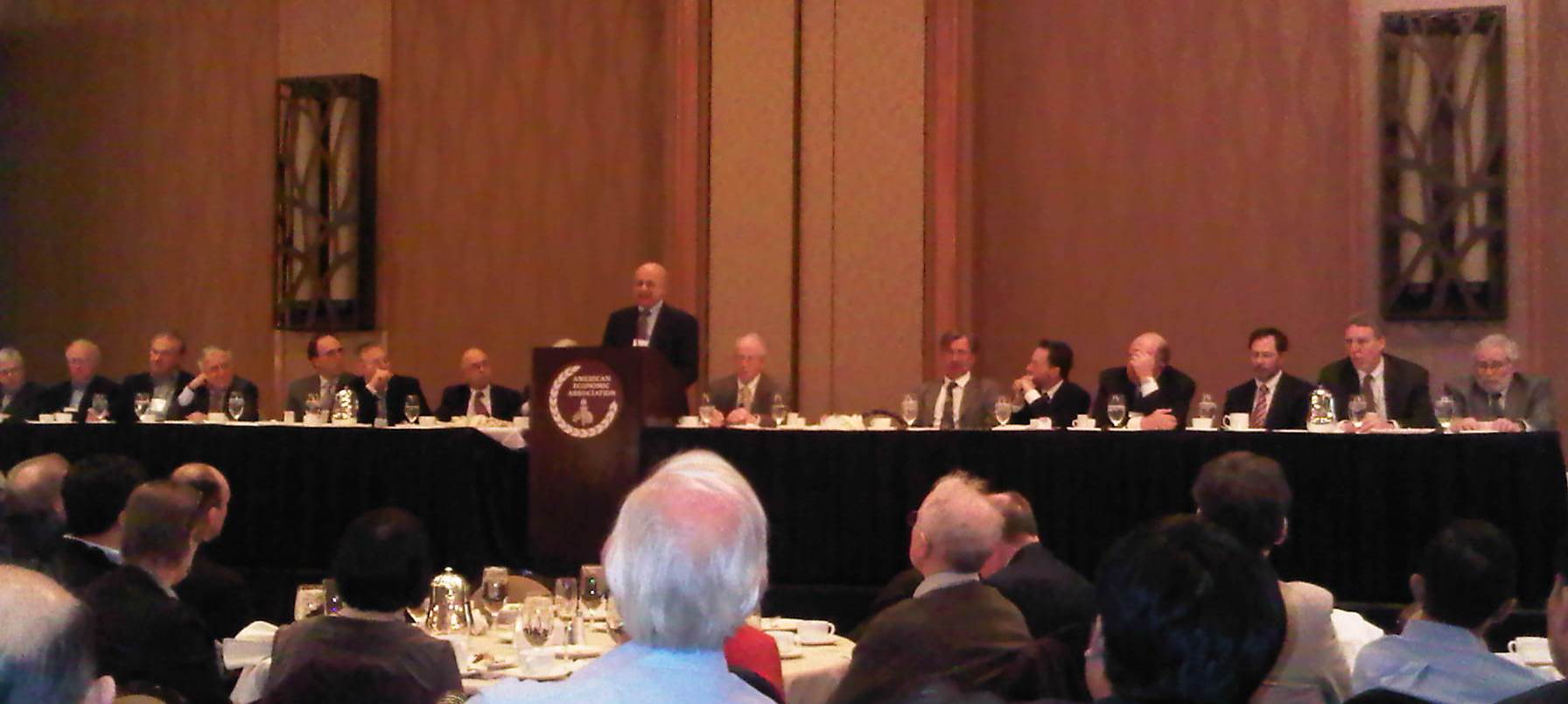
To my knowledge the only blogger among that group is our own Scott Masten, making O&M the sole blog represented on the panel. Take that, self-styled rivals!





 Organizations and Markets
Recent Comments