Posts filed under ‘– Klein –’
A POMO Picture is Worth a Thousand Words
| Peter Klein |
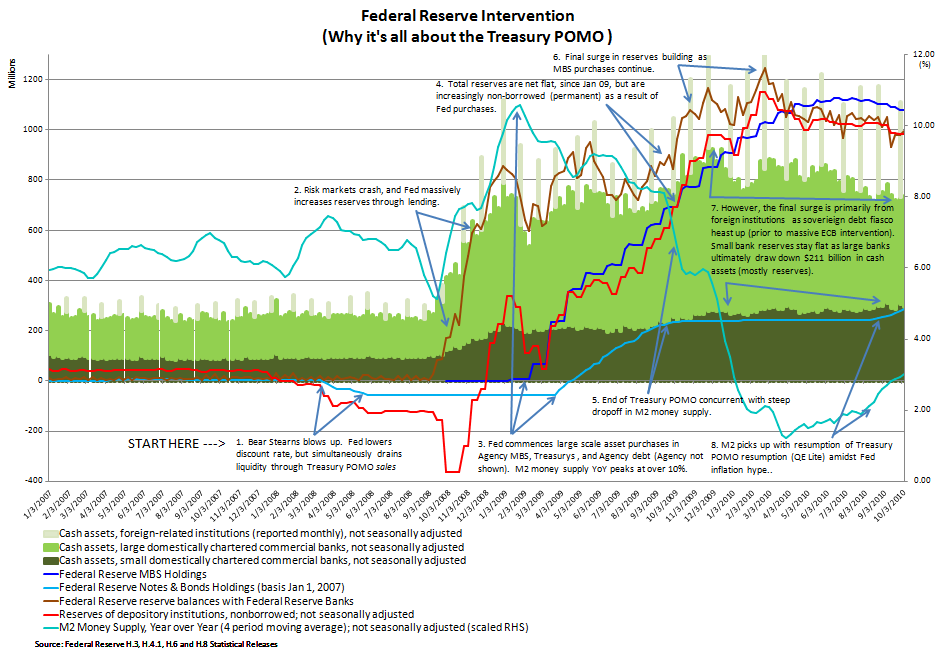
Not “pomo” as in Pomo Periscope, but “POMO” as in Permanent Open Market Operations. A fascinating graphic from Bob English (via EB) showing how the Fed is using its new tool (click to enlarge). In case you were worrying about the Fed “standing idly by” . . . .
The Legacy and Work of Douglass North
| Peter Klein |
Washington University, St. Louis is hosting a major international conference, 4-6 November, on the Legacy and Work of Douglass North. The all-star panel includes Lee Alston, Robert Bates, Joel Mokyr, Elinor Ostrom, Ken Shepsle, Barry Weingast, and many others. The conference is organized by Wash U’s Center for New Institutional Social Science.
In other conference news, the CFP for next year’s Atlanta Competitive Advantage Conference, 17-19 May 2011, has been posted. Featured presenters include Jay Barney, Joel Baum, and Rebecca Henderson.
Assorted Links
| Peter Klein |
- A new paper by Randall Morck and Bernard Yeung, “Agency Problems and the Fate of Capitalism.” A very good comparative-institutional analysis of shareholder democracy and its benefits and costs relative to “stakeholder” models.
- A Washington Post story on “moral licensing” (via Sheen Levine) — suggesting that some people view ethical behavior, like goods and services, in terms of trade-offs at the margin!
- A call for contributions to The Ethics and Economics of Agrifood Competition, a Springer volume in preparation by my colleague Harvey James.
- Videos and papers from the Coase centenary conference held last year at the University of Chicago Law School.
Using Content Analysis to Measure Scholarly Impact
| Peter Klein |
Two Princeton computer scientists have developed an algorithm for measuring scholarly impact based on content analysis, not citation data. Here’s the paper, and here’s a summary. I pay attention to impact factors (not as closely as some people) but am open to alternative measures — particularly any that might make me look better.
Missouri Information Encountering Workshop
| Peter Klein |
Sorry for the late notice, but my local readers may be interested in a two-day workshop today and tomorrow on the Opportunistic Discovery of Information, a version of information encountering with close parallels to Israel Kirzner’s concept of entrepreneurial discovery. Sanda Erdelez can provide more information.

The Five Stages of Grading
| Peter Klein |
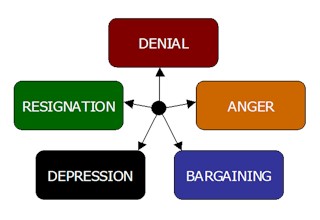
A nice complement to Daniel Solove’s classic guide to grading: “The Five Stages of Grading” at notthatkindofdoctor.com (via David Croson). “Everyone is familiar with Elisabeth Kübler-Ross and her stage model of coping with grief popularly known as the five stages of grief. What you may not know is that Kübler-Ross actually developed her theory as a graduate student, basing her conception of the process of loss on the experiences one goes through over a grading weekend.”
Econometrics Quote of the Day
| Peter Klein |
When I read empirical papers, I see many demonstrations of the IQ levels of economists, but I see the study of very few genuine empirical issues. I hardly see any intellectual capital at risk. As a result, I think we have much less progress as a science than we would if we made a serious effort to identify clearly some real issues.
That’s an Ed Leamer classic from 1988. The source is here. Related: “Puzzles or Problems?”
Diamond-Dybvig (1983) and the Financial Crisis
| Peter Klein |
I started writing a really clever post about the famous Diamond paper (with Philip Dybvig) on financial intermediation and bank runs, its relevance for the financial crisis, and its elevated status in light of Monday’s Nobel announcement. Then I remembered that the author is Douglas Diamond, not Peter Diamond. Doh!
So I’ll try a different framing. “Speaking of guys named Diamond. . . .” The Diamond-Dybvig model, presented in a 1983 JPE article, has become famous enough to spawn an extensive secondary literature (and even sports its own Wikipedia entry). In a nutshell, it models fractional-reserve banks as intermediaries transforming illiquid assets into liquid liabilities and depicts the relationship among depositors as a coordination game with two Nash equilibria, one in which nobody tries to withdraw his funds because he believes no one else will try to withdraw his funds, and one in which everyone tries to withdraw their funds because they believe everyone else will try to withdraw their funds. Bank runs, in other words, constitute a Pareto-inferior Nash equilibrium. This framework led to extensive discussions about deposit insurance, option clauses, and other mechanisms to prevent the bad equilibrium by affecting depositors’ beliefs about solvency. (My former colleague Larry White devotes nearly a chapter of his Theory of Monetary Institutions to Diamond-Dybvig 1983.)
This is a hugely influential article, and I’m surprised it hasn’t been gotten more attention in the last two years. The essential fragility of a complex, interdependent, highly leveraged, fractional-reserve, implicitly government guaranteed system is at the heart of the financial crisis, so you’d think the Diamond-Dybvig framework would play an important role in the debate. But I can’t find much literature on this. The Richmond Fed devoted a special 2010 issue of its Financial Quarterly, guest edited by Ed Prescott, to the DD model, but it attracted little attention. Writes Prescott in his introduction: (more…)
We Resemble That Remark
| Peter Klein |
The BBC’s Andrew Marr: “A lot of bloggers seem to be socially inadequate, pimpled, single, slightly seedy, bald, cauliflower-nosed young men sitting in their mother’s basements and ranting. They are very angry people.” Ha ha, the joke’s on him — I haven’t been “young” in years!
Nobel 2010
| Peter Klein |
I hope to have something intelligent and interesting to say about this year’s prize to Diamond, Mortensen, and Pissarides — not as much as last year, of course — but for now I just have a small snark. Here’s me, a couple of weeks ago:
It is said that when the Nobel Prize in economics was first established, prizes were given for using economics to teach people things they didn’t already know, e.g., that economic growth might increase inequality, that depressions are caused by central banks, that macroeconomic stabilization policy doesn’t work, etc. Now, prizes are given to economists who teach other economists things that regular people already know — politicians are self-interested, you shouldn’t put all your eggs in one basket, institutions matter, different people know different things, etc.
From today’s official press release, on the Laureates’ subject matter:
On many markets, buyers and sellers do not always make contact with one another immediately. This concerns, for example, employers who are looking for employees and workers who are trying to find jobs. Since the search process requires time and resources, it creates frictions in the market. On such search markets, the demands of some buyers will not be met, while some sellers cannot sell as much as they would wish. Simultaneously, there are both job vacancies and unemployment on the labor market.
Addendum: In other Nobel news, Maurice Allais passed away this weekend. I was going to blog something about Allais and the Austrians but Alex Tabarrok beat me to it.
Addendum II: Here’s a nontechnical summary of some of the Laureates’ contributions from Sandeep Baliga.
Mises Quote of the Day
| Peter Klein |
Mises is known for his uncompromising defense of apriorism in economics, yet he began his career as a historicist, trained by Karl Grünberg, a Marxist and prominent member of the German Historical School. (Mises’s first publications were on land reform in his native Galicia and child-labor laws in Austria, both tediously empirical and inductive.) It was only later, after encountering Menger’s Principles, that Mises turned to social theory.
One of this week’s Mises Dailies features an excerpt from Mises’s 1957 book Theory and History and I can’t resist passing along this nugget, which is hopelessly out of touch with today’s enthusiasm for all things experimental:
[H]istorical experience is always the experience of complex phenomena, of the joint effects brought about by the operation of a multiplicity of elements. Such historical experience does not give the observer facts in the sense in which the natural sciences apply this term to the results obtained in laboratory experiments. (People who call their offices, studies, and libraries “laboratories” for research in economics, statistics, or the social sciences are hopelessly muddle-headed.)
Mises isn’t talking about the literal laboratories used by today’s experimental economists, but the casual use of such scientistic jargon when collecting and analyzing non-experimental data, whether or primary or secondary. (He likewise rejected the language of “hypothesis testing” and the like when applied to social science.) Anyway, agree or disagree, you have to admit there are a lot of hopelessly muddle-headed people on university campuses.
Best Paper Excerpt I Read Today
| Peter Klein |
What I call here an “orthodox” or mainstream Austrian theory of the firm is an attempt to reshape a Coasian notion of the firm as a centrally planned hierarchy, by merging it with general Austrian theory of the market process and entrepreneurship. The principal Austrians of the present (Klein and Foss, 2005, Foss 1994, Langlois and Foss, 1997) developed a theory of the firm by trying to synthesize this Coasian notion of the firm as a hierarchical entity dominated by commands and orders, with a distinct Misesian theory of entrepreneurship and monetary calculation as preconditions of rational economic planning. This approach is entirely rejected in this paper.
Source. I always thought of myself as a Young Turk, but I guess I’m now Old Guard.
The (Very) Early Adoption of Modern HRM Practices
| Peter Klein |
Bruce Kaufman’s book Hired Hands or Human Resources? Case Studies of HRM Programs and Practices in Early American Industry (Cornell U. P., 2010) shows that US firms started adopting “modern” HRM practices around World War I, not during the New Deal, and they did so primarily to increase productivity, not in response to union or government pressure. Writes reviewer Chad Pearson:
Kaufman illustrates the ways in which several companies created professional human resource management (HRM) models after World War I. This is the most valuable part of the book principally because he used the records of the Industrial Relations Councilors (IRC), a consulting firm that began assisting employers in the 1910s. The IRC offered consulting services, provided research, and ran courses on industrial relations topics throughout the nation. Kaufman, the first scholar to examine these records, believes that “no other [industrial relations consulting firm] before World War II had IRC’s reach and influence” (p. 108). . . .
In most cases, these firms, in consultation with the IRC, began to, in Kaufman’s words, treat labor not as “a short-term commodity,” as was common in previous decades, but rather as “a longer-term human capital asset (the ‘human resource’ approach)” (p. 219). Why? Pressure from unions and the law were factors, but “they were less than half the story in the time period we are examining” (p. 228). In his view, employers’ desires to improve “management and productivity” better explain why companies improved workplace conditions (p. 227).
Labor historians and specialists in business regulation used to focus on the Progressive Era as a watershed period — e.g., Wiebe (1962), Weinstein (1981), and of course Kolko (1977) — but interest seems to have waned.
Misbehavioral Antitrust
| Peter Klein |
I suggested earlier that behavioral economics could use a dose of comparative institutional analysis. The New Paternalists are very worried about various biases and forms of “irrationality” on the part of consumers, managers, entrepreneurs, investors, etc. but have little or nothing to say about the rationality of regulators, legislators, judges, and other non-market actors. Josh Wright and Judd Stone offer a parallel critique of behavioral economics applied to antitrust law: the behavioralists focus on presumed bias and irrationality on the part of incumbents, while largely ignoring the cognitive attributes of rivals and potential entrants. Josh and Judd propose an “irrelevance theorem”: “If one assumes a given behavioral bias applies to all firms — both incumbents and entrants — behavioral antitrust policy implications do not differ from those generated by the rational choice models of mainstream antitrust analysis.”
Addendum: Steve Horwitz made the comparative institutional argument in an earlier post that I unfortunately missed.
Mmmmmm. . . . Bacon!
| Peter Klein |
 This post begged to be written. It started last weekend when I heard Jim Gaffigan’s bacon routine on the Slacker Comedy Channel. Then, during the week, the Mises Institute ran an excerpt from Murray Rothbard’s History of Economic Thought on Francis Bacon. (Rothbard wasn’t impressed, calling Bacon “the prophet of primitive and naive empiricism, the guru of fact grubbing.”) As if that weren’t enough, Rafe Champion decided around the same time to summarize Terence Kealey’s Economic Laws of Scientific Research, the first chapter of which contrasts Bacon’s and Adam Smith’s views on the relationship between science and economic growth. (Bacon’s model: State support -> Basic Research -> Technology -> Progress in human welfare. Smith’s model: Old technology -> New Technology -> Wealth and Welfare.) Bacon — you just can’t get enough!
Ig Nobel Economics and Management Prizes
| Peter Klein |
Thanks to Stéphane Saussier for reminding me that the 2010 Ig Nobel Prizes have been announced. The Economics award is a bit predictable:
ECONOMICS PRIZE: The executives and directors of Goldman Sachs, AIG, Lehman Brothers, Bear Stearns, Merrill Lynch, and Magnetar for creating and promoting new ways to invest money — ways that maximize financial gain and minimize financial risk for the world economy, or for a portion thereof.
But I’m particularly interested in the Management prize. I hadn’t heard of the paper, but anything with “Peter” in the title must be good:
MANAGEMENT PRIZE: Alessandro Pluchino, Andrea Rapisarda, and Cesare Garofalo of the University of Catania, Italy, for demonstrating mathematically that organizations would become more efficient if they promoted people at random.
REFERENCE: “The Peter Principle Revisited: A Computational Study,” Alessandro Pluchino, Andrea Rapisarda, and Cesare Garofalo, Physica A, vol. 389, no. 3, February 2010, pp. 467-72.
Fast Food and Obesity
| Peter Klein |
 A new Australian public-service ad compares fast food to heroin: “You wouldn’t inject your children with junk. So why are you feeding it to them?” (See the ad, along with Katherine Mangu-Ward’s funny meditations on the theme.) But does fast food really contribute to health problems, particularly obesity?
Not much, according to Richard Dunn’s study, “The Effect of Fast-Food Availability on Obesity: An Analysis by Gender, Race, and Residential Location,” in the July 2010 issue of the American Journal of Agricultural Economics (it’s peer reviewed, and not funded by corporations!). Previous research finds links between the number and density of fast-food restaurants and health problems, but has difficulty identifying cause and effect (fast food could make people overweight, but fast food restaurants could be put in areas where people are overweight anyway). Dunn uses the number of interstate exits as an instrument for restaurant location to tease out the causal relations, and finds little overall effect of fast food on obesity — none at all in rural areas, a bit in medium-density areas, and only among women and minorities.
The Peer-Review Fetish
| Peter Klein |
I respect peer review as much as the next person and have done my share of publishing in peer-reviewed outlets. But I question the belief, expressed often in academic, media, and policy circles, that “not peer reviewed” means “worthless” and “peer reviewed” means “should be accepted without question.” (A corollary belief is that “funded by a private foundation or company” means “biased” while “funded by a government grant” means “neutral.”) In practice, the distinctions are not nearly so clean.
My thoughts on this were triggered by a revealing statement from Ronald Coase, quoted by Josh Gans and George Shepherd in their study of famous economics papers that were initially rejected, about his limited experience with peer review: “I have never found any difficulty in getting my articles published. I have either published in house journals (e.g. Economica) or the article was written as a result of a request (e.g. for a conference) and publication was assured.” Certainly no one would discount the importance Coase’s 1937 and 1960 papers because they weren’t rigorously peer reviewed. (Can you imagine the inane referee remarks that “The Problem of Social Cost” would have generated?) More generally, consider the Journal of Law and Economics during Coase’s editorship in the 1960s and 1970s — the high-water mark of the JLE‘s influence. Or, for that matter, Public Choice under Gordon Tullock, the JPE under George Stigler, or the Journal of Libertarian Studies under Murray Rothbard. These were edited somewhat unevenly, led by charismatic and strong-willed editors with idiosyncratic tastes, yet have been vastly influential in their respective fields.
Peer review serves a useful function and probably improves the quality of published output, on average. But let’s not make a fetish of it.
Elgar Companion to TCE
 | Peter Klein |
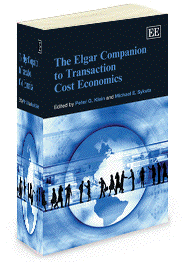
The Elgar Companion to Transaction Cost Economics, edited by Mike Sykuta and me, has just been published. Twenty-nine chapters cover the basic structure of TCE, its precursors and influences, fundamental concepts, applications and evidence, along with alternatives and critiques. Oliver Williamson was kind enough to contribute an introduction and overview. Co-blogger Foss is in there as well.
O&M readers can get it here 10 percent off the list price! (Actually, anybody can get the deal.) Mike beat me to the punch with an announcement and description, so I’ll just add that we’re really pleased with the final product and grateful to all the distinguished contributors and the production staff.
Here are previous O&M posts on transaction cost economics.
Introducing Guest Blogger Scott Masten
| Peter Klein |
It’s a real pleasure to introduce Scott Masten as our newest guest blogger. Scott is Professor of Business Economics and Public Policy at the University of Michigan’s Ross School of Business and a leading figure in the transaction cost approach. Trained by Oliver Williamson at Penn, Scott was one of the first (along with David Teece and a few others) to do systematic empirical work on alternative institutions of governance. Scott’s 1984 paper on procurement in aerospace, his 1985 paper (with Keith Crocker) on characteristics of natural gas contracts, and his 1991 paper (with James Meehan and Ted Snyder) on the costs of internal organization are classics in the transaction cost literature. Scott has also made important contributions to law and economics, antitrust, contract theory, and many other areas. He’s a past president of ISNIE, co-editor of JEMS, and, as I learned a few years ago at a conference for Williamson’s 70th birthday, a wickedly funny after-dinner speaker.
We’re delighted to have Scott on the team and look forward to his insights. Welcome, Scott!
24 September 2010 at 11:40 pm Peter G. Klein Leave a comment





 Organizations and Markets
Recent Comments