Posts filed under ‘– Klein –’
The Hodgson Petition
| Peter Klein |
Several friends and colleagues urged me to sign Geoff Hodgson’s petition on the financial crisis, but I declined. I agree with Krugman that economists have tended to mistake mathematical beauty for truth, but think this has little to do with the financial crisis. As discussed in previous posts, I view the financial crisis and recession as the (predicable!) result of government failure — massive credit expansion by the central bank, mortgage-lending rules and policies designed to inflate the housing market, a state-sponsored cartel of securities-rating agencies — not market failure resulting from unrealistic behavioral assumptions.
I respect many of the signatories to the petition, but statements like this (from Krugman), at the heart of the petition, are preposterous:
[Economists] turned a blind eye to the limitations of human rationality that often lead to bubbles and busts; to the problems of institutions that run amok; to the imperfections of markets — especially financial markets — that can cause the economy’s operating system to undergo sudden, unpredictable crashes; and to the dangers created when regulators don’t believe in regulation. . . . When it comes to the all-too-human problem of recessions and depressions, economists need to abandon the neat but wrong solution of assuming that everyone is rational and markets work perfectly.
“Regulators who don’t believe in regulation?” Paul, what color is the sky on your planet (1, 2, 3)? Notably absent from the petition’s list of villains is the Fed, Fannie and Freddie, the Treasury, or indeed anyone remotely connected with a government body.
Keep in mind it was Krugman himself who wrote in 2002: “To fight this recession the Fed needs more than a snapback; it needs soaring household spending to offset moribund business investment. And to do that . . . Greenspan needs to create a housing bubble to replace the Nasdaq bubble.” St. Alan followed Krugman’s advice to the letter, and here we are today.
Penrose (1959) Golden Anniversary
| Peter Klein |
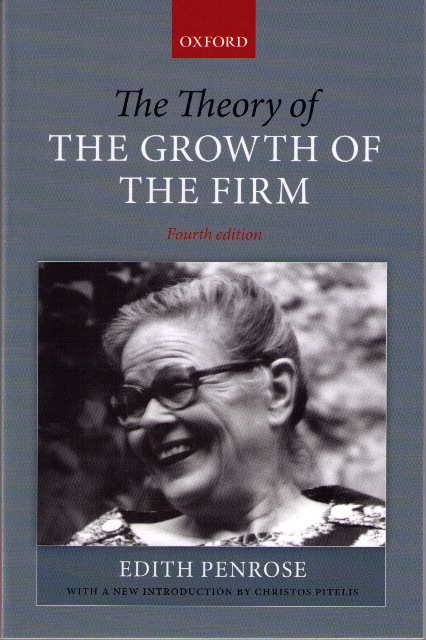 This year marks the 50th anniversary of Edith Penrose’s Theory of the Growth of the Firm (1959), one of the most important and influential books on the firm and firm strategy. To celebrate, Yasemin Kor and Christos Pitelis organized a roundtable at last week’s SMS conference with remarks by Christos, Yasemin, Joe Mahoney, Margie Peteraf, and Maurizio Zollo. The participants have graciously allowed me to post their slides and materials (1, 2, 3, 4). Christos, Penrose’s friend and literary executor, has edited and introduced a new edition of the 1959 book, which you can purchase here. You can read his introduction here. Nice!
Penrose trivia: During the 1950s Murray Rothbard made his living by reviewing literature and grant proposals for the William Volker Fund. When going through Rothbard’s correspondence a few years ago I came across a proposal for a study on firm growth submitted jointly by Penrose and Fritz Machlup, her dissertation supervisor at Johns Hopkins. Apparently at one point, the book was going to be a joint project. (Rothbard thought the ideas in the proposal didn’t fit with Penrose’s earlier warnings about the use of biological analogies in economics. However, as Joe Mahoney has noted, there is no inconsistency between the 1952 article and the 1959 book; Penrose is careful in her work on growth not to treat growth tendencies in firms as automatic, but to model them based on the preferences, beliefs, and actions of the firm’s personnel. In other words, she accepts natural selection in this context but not random mutation.)
BTW, what other important works in our field appeared in 1959, to be celebrated this year? Coase’s article on the Federal Communications Commission is one. The 1970s may have been the golden decade but there were major contributions in the previous decades as well. What are your favorites? Whose anniversary should we be preparing to celebrate?
Other Brushes with Official Greatness
| Peter Klein |
In the spirit of Lasse’s post, here are stories about some of my other direct and indirect contacts with academic royalty, people whose achievements have nothing to do with anything I’ve ever said or done.
- As regular O&M readers know, there is a history of disagreement between Ronald Coase and Benjamin Klein over the GM-Fisher case, among other issues. A few years ago I spent some time with Coase during his visit to Missouri for the CORI Distinguished Lecture. He concluded one conversation by announcing, with evident satisfaction: “I see all Kleins are not alike.”
- One of the funniest, and most unusual, people I knew at Berkeley was Matthew Rabin, then a new assistant professor and now a chaired professor, John Bates Clark medalist, and probable future Nobel laureate in economics. He had a little construction-paper clock on his office wall with one hand tracking years until the tenure decision and another, going the opposite direction, counting publications. I was later his TA for the second PhD micro theory course. Sample test question: “I have the opportunity to lock you up. If I lock you up, you will scream for help with probability p, which gives me a benefit of minus 30. . . .” I laughed often.
- My Dad had this remarkable distinction: there were two future Nobel laureates in his high school class. (It was an unusual school.) Herbert Hauptman got the prize in chemistry and Julian Schwinger in physics. Ken Arrow went to the same school, which also produced six Pulitzer Prize winners. (more…)
Best Part About Winning a Nobel Prize at Berkeley
| Peter Klein |
I might not believe it if I hadn’t seen these parking spaces — in very choice locations — with my own eyes. (Thanks to Peter H. for the link.)
The spaces are marked with special signs that read: “Reserved For NL/Special Permit Required At All Times.” That “NL,” of course, stands for Nobel laureate.
Physics professor George Smoot, who won the Nobel Prize in 2006, said there’s a catch to the permit: It’s free, but it’s not automatically renewed each year. Some of Berkeley’s Nobel laureates have let their permits lapse.
“It’s a temporary permit,” Smoot explained. “You’ve got to renew it every year — like your Nobel laureate’s going to go away, or something! And so, twice now I’ve gotten tickets because I didn’t, you know, remember to renew it on time.”
But Williamson says a little paperwork will not discourage him from getting the permit.
“I think it ought to be automated, but apply if I must, apply I will,” he said.

Williamson’s “Economics of Institutions” Syllabus
| Peter Klein |
I was pretty clueless when I started graduate school. I had good undergraduate training in economics, and had the privilege of attending my first Austrian seminar, where I met Murray Rothbard, Hans Hoppe, Roger Garrison, and David Gordon, before beginning graduate work. But I really didn’t know exactly what I wanted to study. Like most economics PhD students, I wasn’t exactly turned on by the core theory and econometrics classes. Then I took Williamson’s course ECON 224, “Economics of Institutions,” and it was a revelation. The syllabus dazzled me, with readings from Coase, Simon, Hayek, North, Arrow, Chandler, Alchian, Demsetz, Ben Klein, and many other brilliant and thoughtful economists, along with sociologists, political scientists, historians, and others. I decided then that institutions and organizations would be my area, and I’ve never looked back.
Since Monday I’ve been digging through my files trying to find a copy of that syllabus. I found my folder for that course, containing notes, readings, and exams (no, you can’t see my test scores), but for some reason the syllabus has disappeared. I must have taken it out to study, perhaps when designing my own course in institutions and organizations, and it didn’t make its way back into the file. But I did find an older copy, the Fall 1988 edition. That was, I believe, Williamson’s first year at Berkeley, after arriving from Yale (where he didn’t teach PhD courses, his main appointment being in the law school). I took the course in 1989, but the syllabi are very similar. So here it is. Note the range of authors, journals, subject areas. Not at all like the typical economics PhD course!
Wodehouse
| Peter Klein |
We interrupt Williamson Week to remind you that today, 15 October, is the birthday of the great P. G. Wodehouse. If I were really clever I’d write something like “Principal-Agent Conflicts between Wooster and Jeeves” or “Lord Emsworth as Charismatic Leader,” but the best I can do is share some favorite Wodehouse quotes that might apply to writing, research, and university life:
“I pressed down the mental accelerator. The old lemon throbbed fiercely. I got an idea.”
“He had just about enough intelligence to open his mouth when he wanted to eat, but certainly no more.” [A university administrator? Journal reviewer?]
“I just sit at a typewriter and curse a bit.”
“I know I was writing stories when I was five. I don’t know what I did before that. Just loafed I suppose.”
Williamson and the Austrians
 | Peter Klein |
My short piece on Williamsonian transaction cost economics and its relationship to the Austrian approach is up on Mises.org.
Williamson Miscellany, Continued
| Peter Klein |
5. Many useful summaries of Williamson’s (and Ostrom’s) contributions are appearing online, such as those by Ed Glaeser, David Henderson, John Nye, Jeff Ely, and Alex Tabarrok. I think the first few pages of my “make-or-buy” chapter in the NIE Handbook provide a decent overview too. I also have some slides on transaction cost economics (part 1, part 2) that may be helpful for those seeking more detail.
6. Joshua Gans credits me with anticipating the award, which is nice, but undeserved — it was just wishful thinking on my part!
7. Oliver’s son Dean reports that he’s having trouble getting through to his folks: “The house in Berkeley had become such a media circus with every media entity from UPI to Al Jazeera trying to get through that I’ve been holding off with some of my own phone calls.” More important, Dean says his dad
has had a good attitude about these things. For years Berkeley would ask him to sign off on candidate press releases. But this would just get him a little worked up, and he might have a hard time getting to sleep. Could they stop that, please? On top of that, he appreciates that life has been good. No complaints, no reason to get worked up. Better to be Zen about the whole thing.
8. Scott Masten tells me O&M made a list of 100 best professor blogs. Scott and I agree that Williamson would gladly trade the Nobel prize for this honor instead. (more…)
Hoisted from the Comments: Hoopes on Williamson
| Peter Klein |
Former guest blogger David Hoopes’s comment deserves its own post:
So, we’re leaving the serious discussion to our goody two-shoes organizations twin? Was Will Mitchell a Williamson student? No one has said anything about Teece. Teece’s early JEBO articles did a great job talking about economies of scope and transaction cost influences on strategy.
Unmentioned yet, there has been some contentious discussion about the implications of TC economics on strategy and organization. Many including Connor and Prahalad consider the implications of TC to lead to bad management and bad strategy. However, our very own Steve Postrel wrote a great paper, “Islands of Shared Knowledge” that (esp in an earlier version) does a great job of comparing and contrasting the RBV and TC as theories of the firm.
Harold Demsetz weighed in on this earlier in his, “Theory of the Firm Revisited” (which is one of my favorite all time papers). Harold argues that firms would exist without governance problems. Steve has tried to get Harold to see the light (i’m not sure i do) but to no avail.
Of course, CERTAIN org theorists, whose names i do not mention think that Williamson’s logic, as does all competition-based economic theory, leads to evil and terrible results: unethical business students who become tomorrow’s headlines.
I’m very happy to see Williamson win. His influence on strategy and organization is immense. And, at this point, I don’t see any theory of the competitive firm can reasonably leave him out. I will admit, in terms of competitive heterogeneity and competitive advantage I don’t think governance is anywhere near as important as productive capabilities. BUT, capabilities literature still has a lot of work to do to be specified as exactly as TCE.
David, more serious discussion is on the way. Unfortunately, we O&Mers have higher opportunity costs than the bloggers at our good-twin site, so we can’t get the posts up as quickly as they can. :-)
Williamson Miscellany
| Peter Klein |
1. I’ve been at the SMS conference, and traveling, and haven’t had a chance to read the vast blogospheric commentary on Williamson (and Ostrom). Those looking for an introduction to Williamson’s work will find good stuff in the forthcoming Elgar Companion to Transaction Cost Economics, including an introduction by Williamson himself, and chapters on core subjects by eminent Williamsoninans.
Briefly, my own (admittedly biased) take is that Williamson is second only to Coase as the key figure in modern organizational economics. Moreover, his work has revolutionized the way economists (and some antitrust lawyers) understand markets. The perfectly competitive general-equilibrium model, Williamson’s work shows, is unrealistic, irrelevant, and a distraction. The task of economists studying firms and markets is to understand the marvelous variety of organizational forms that emerge in competitive markets, virtually none resembling the “firm” of microeconomics textbooks (what Williamson calls the production-function picture of the firm). “Nonstandard” phenomena like vertical integration, vertical contractual restrictions, alliances and joint ventures, long-term supply or distribution agreements, and the like should be celebrated, not condemned. (Williamson is more circumspect, arguing that each form of organization should be evaluated on the merits, case by case — a refreshing contrast to the standard approach in antitrust law, which is to assume that every deviation from perfect competition is “anticompetitive.”)
2. The Nobel Committee’s scientific statement cites one of my papers. How cool is that? Coauthor Howard Shelanski tells me that law professors note on their CVs if one of their articles is cited in a Supreme Court decision. You can be sure I’ll find a way to list this on mine. (more…)
Williamsoniana
| Peter Klein |
My, we live in a fast-paced world: the Nobel announcement is just a few hours old, and we’re already being taken to task for not blogging enough about Williamson. For the high-time-preference folks, please see previous posts on Williamson and transaction cost economics, and the preview chapters of the Elgar TCE Handbook, while we work on our usual careful, thoughtful, and well-researched blog posts.
It’s Williamson, at Last!
 | Peter Klein |
A hearty congratulations to Oliver Williamson, co-recipient (along with Elinor Ostrom) of this year’s Nobel Prize in economics. As Williamson’s former PhD student, I’m thrilled beyond belief. The O&M crew have all been heavily influenced by Williamson (and, to a some degree, Ostrom too) and will have much more to say about this in the coming days. But, for now, just enjoy!
Ashley Judd and Bob Lucas
| Peter Klein |
The lovely and talented Ashley Judd was the celebrity guest this morning on NPR’s “Wait, Wait, Don’t Tell Me!” (Ashley and I have a close personal connection, she being a junior-high-school classmate of my wife’s younger brother. Can’t get closer than that.) She answered trivia questions about the Nobel prize, one of which centered on Bob Lucas. What unfortunate thing happened to Lucas, she was asked? (a) He died from eating bad fish at the awards dinner, (b) his ex-wife got half the Nobel money from a previous divorce settlement, or (c) [I forgot (c)]. The correct answer, I’m sure you know, is (b). Ashley and the other participants thought it hilarious that someone would include a Nobel-prize provision in a divorce agreement, but even in 1987, when Lucas was divorced, it was a foregone conclusion that he would eventually win (he got the prize in 1995). Next time I see dear Ashley I’ll point this out. Personally, I’ve already pledged half my future Nobel winnings to charity.
The Fate of Famous Economists
| Peter Klein |
 Even very famous ones. The Dundee Courier (what, you don’t read it?) reports that Adam Smith’s gravestone, in the courtyard of Canongate Kirk in Edinburgh, is in bad shape: “Smith’s gravestone could be in danger of deterioration after years of exposure to the elements, vandalism and neglect” (HT: MGK). According to a spokesperson for the World Monument Fund, cemeteries in the central parts of cities like Edinburgh have become “unsafe environment[s] home to illicit activities.” Apparently David Hume’s grave, elsewhere in Edinburgh, is also threatened. How ironic that we put dead politicians in great cathedrals and mausoleums (and, while living, give them Nobel Prizes), while actual heroes are abandoned and forgotten.
Nobel Stuff
| Peter Klein |
Because O&M is an econ-themed blog, I guess we’re obligated to post something about next week’s Nobel prize announcement. I confess I don’t follow the buzz that closely; the committee’s picks often make little sense to me and there are better things to do with one’s time. But, along the lines of this 2007 post, I note that several folks on Mankiw’s list of favorites work in the general area of organizational economics: Tirole, Milgrom, Hart, Holmström, Ostrom, Williamson, and Wilson.
Update: After today’s peace prize announcement, there is an obvious frontrunner: Ben S. Bernanke. Clearly actions and accomplishments don’t matter, only image and self-promoting rhetoric. (See also Mankiw’s take.)
Update II: Nolan McCarty (via Joshua Tucker) has an even more audacious prediction:
- Whereas Tirole, Nordhaus, Milgrom, and others have made important and fundamental scholarly contributions to economic theory and policy analysis, only Obama has the audacity to hope for better economic policy in the future. Can he design a health care system that covers everyone and saves money? Yes, he can! Can he reengineer the financial system to eliminate systemic risk, protect consumers while maintaining the benefits of modern finance? Yes, he can! Can he reduce greenhouse emissions without reducing jobs and economic growth? Yes, he can! What actual economist would dare say those things? For his vision alone, he deserves the prize.
- Obama has never been associated rational expectations theory or the efficient markets hypothesis. In fact, he’s turned his administration into one big Behavioral Economics Seminar.
- I’ve heard rumors that Obama still plans to broker a peace treaty between Paul Krugman and Bob Lucas. Unfortunately, the track 2 negotiations seem to have broken down.
- The Scandinavians could really stick it to George Bush by giving Obama two Nobel Prizes.
- He taught at the University of Chicago.
Masters of Finance
| Peter Klein |
The American Finance Association has assembled a terrific set of video interviews and lectures with eminent financial economists including Markowitz, Sharpe, Samuelson, Merton, Scholes, Arrow, Fama, and Myers. (HT: Fama/French.)
The First Secretary of Agriculture
| Peter Klein |
 Mises.org has posted Frank Chodorov’s 1952 classic, “Joseph, Secretary of Agriculture”:
The dream plan worked wonders — for Pharaoh and his secretary of agriculture. . . . On the other hand, it is told how a delegation of Egyptians came to Joseph and declared: “Thou hast saved our lives: let us find favor in the sight of my lord, and we will be Pharaoh’s servants.” Showing that the proletariat had come to terms with collectivism (since that was the only way to get by in this world) and were content with whatever security the secretary would provide.
Joseph, however, had to make some concession to private property, perhaps to encourage more taxable production; he restored to some of the Egyptians the land he had taken from them in their adversity, on a rental basis. The rent? One-fifth of all the annual output. By this well-timed act of policy, informs historian Flavius Josephus, “Joseph established his own authority in Egypt and increased the standing revenue of all its succeeding monarchs.”
Though the succeeding monarchs and the succeeding commissars did well under the plan introduced by Joseph, it seems (according to later historians) that it put upon the proletarians a moral blight, so that when conquerors from other lands came to Egypt they met with little resistance; those who had nothing to lose had nothing to fight for, so that even the monarchs had to beg the invaders for administrative jobs. And lots of dust fell on the civilization of Pharaoh.
Chodorov goes on to describe the obvious analogy to twentieth-century agriculture policy. Of course, without farm programs, how would we have food?
Management Miscellany
| Peter Klein |
1. We are not big on Jim Collins here at O&M but Toyota president Akio Toyoda is a fan, explaining his company’s woes in terms of Collins’s five stages of business decline. (Is “be headquartered in a country with an overvalued currency” one of the stages?)
2. Karen Ho’s Liquidated: An Ethnography of Wall Street (Duke, 2008) is reviewed by fellow anthropologist Gillian Tett in the FT. The key to understanding the financial crisis, we learn, is Bourdieu (why haven’t I read about this book on orgtheory.net?). “Massive corporate restructurings are not caused so much by abstract financial models as by the local, cultural habitus of investment bankers, the mission-driven narratives of shareholder value and the institutional culture of Wall Street.” Why didn’t I think of that?
3. I’ve been reading Yevgeny Zamyatin’s We, the first of great dystopian novels (in Natasha Randall’s new translation). I had head that Taylorism figures prominently in the novel, but didn’t know Taylor would be mentioned by name. “Yes, that Taylor was, without doubt, the most brilliant of the Ancients. True, he didn’t think everything through, didn’t extend his method throughout life, to each step, around the clock. He wasn’t able to integrate his system from an hour to all twenty-four. But all the same: how they could have written whole libraries about the likes of Kant — and not take notice of Taylor, a prophet, with the ability to see ten centuries ahead?” Of course, as we’ve noted before, there’s more to Taylor than meets the eye.
Stewart Macaulay
| Peter Klein |
Here’s a lecture I wish I could have attended: Stewart Macaulay gave today’s Annual Distinguished Lecture at BYU Law School. Macaulay, as noted in BYU’s blurb, is “an internationally recognized scholar and a leader of the law-in-action approach to contracts. He pioneered the study of business practices and legal work regarding contract law. He is also one of the founders of the law and society movement.” More important for our purposes, Macaulay’s emphasis on what Williamson calls “private ordering” — the governance of contractual relations by convention, private arbitration, and firms’ own “internal courts” — has been extremely influential for transaction cost economics.
Here’s the abstract of Macaulay’s lecture:
A Contract Crisis? “It Ain’t Necessarily So.”
There are several proposals for a new contract law. On one hand, our economic crisis suggests that many see the need to rewrite or rescind contracts to reflect the drastically changed conditions of the past few years. On the other hand, there are proposals for a far more formal law of contracts than are found in the Uniform Commercial Code and the Restatement (2d) Contracts. Drawing on calls for “a new legal realism,” Professor Macaulay suggests that there is much that we don’t know about the need for and the consequences of such major revisions. He stresses, however, that a key word in Ira Gershwin’s lyrics from “Porgy and Bess” is “necessarily.” The first step must be a better picture of contract law in action. Such a picture might support some but not other changes.
I hope the lecture will appear soon on Macaulay’s website, and that Gordon Smith will post reactions at the Glom.





 Organizations and Markets
Recent Comments