Posts filed under ‘– Klein –’
Group Blog of the NYU Austrian Economics Colloquium
| Peter Klein |
It’s ThinkMarkets, written by the members of the NYU Austrian colloquium (formerly currently known as the Colloquium on Market Institutions and Economic Processes). The group includes Mario Rizzo, Bill Butos, Gene Callahan, Young Back Choi, Sandy Ikeda, Roger Koppl, Chidem Kurdas, and Joe Salerno. The colloquium was established in the 1980s by Israel Kirzner, who is still an occasional participant.
A Silver Lining
| Peter Klein |
As I mentioned in a recent talk, one good thing to come out of the bailout disaster is the diminished reputation of St. Alan the Wise. It was fun watching the same Congressional clowns who months earlier praised the “Maestro” as the greatest Fed chair in history slap him down for failing to prevent the housing bubble. Of course, Greenspan, like these clowns, ignored the issue of credit expansion, expressing regret only that he had put “too much trust” in market forces. Ha!
Now Paulson, never too popular in the first place, is suffering a similar fate, as he abandons the Troubled Asset Relief Program — the rationale for the bailout itself — and praises Congress for giving him the broad authority to do, well, whatever the hell he wants. Oh, please, let Bernanke be next!
BTW, Bob Higgs continues to offer some of the best commentary on the disaster — the political, journalistic, and educational disaster, I mean, not the supposed economic disaster. I hope his term, “Bailout of Abominations,” catches on.
Update: The Economist puts it this way: “One of the most humbling features of the financial crisis is its ability to humiliate policymakers who, thinking that they have a bazooka in their closet, soon discover that it is a mere popgun.”
Bill Shughart’s Review of Prophet of Innovation
| Peter Klein |
It’s in the December 2008 issue of Managerial and Decision Economics. Excerpt:
Many readers, as I did, will close Prophet of Innovation with a feeling of dissatisfaction. On the plus side, McCraw’s life of Joseph Alois Schumpeter is not as dauntingly long as it seems: Nearly 30% of the volume is devoted to notes and other end matter, and so the text runs to a more digestible 506 pages. Generous line spacing and a respectable number of archival photographs speed the pace of reading.
On the minus side, Prophet of Innovation pales in comparison with the recent and far more penetrating biographies of John D. Rockefeller, Sr. by Ron Chernow, of J. P. Morgan by Jean Strouse, and of Andrew Mellon by David Cannadine. In the end, one doesn’t know Joseph Schumpeter quite as fully as one now knows those titans of industry. And we certainly don’t know him as well as we know Robert Skidelsky’s John Maynard Keynes, who was born the same year (1863). Something is missing from Prophet of Innovation, perhaps because McCraw chose not to be “concerned with Schumpeter’s economic thinking, narrowly construed” (p. xi). That choice, in my judgment, fatally compromises any attempt to tell the story of a man who lived and breathed economics over a distinguished, remarkably productive academic career that spanned four decades, taking him from the classrooms of the University of Vienna, where he (and Ludwig von Mises) studied under Eugen von Böhm-Bawerk, to Harvard Square.
New Blogs of Interest
| Peter Klein |
- Campus Entrepreneurship by David J. Miller
- Evolution and Complexity in the Social Sciences by Eliana Santanatoglia
- Anything Peaceful by the staff at FEE
Historical Origins of “Open Science”
| Peter Klein |
An interesting piece on science and patronage by Paul David, with a comment by Ken Arrow:
The Historical Origins of “Open Science”: An Essay on Patronage, Reputation and Common Agency Contracting in the Scientific Revolution
Paul A. David, Stanford University & The University of Oxford
This essay examines the economics of patronage in the production of knowledge and its influence upon the historical formation of key elements in the ethos and organizational structure of publicly funded “open science.” The emergence during the late sixteenth and early seventeenth centuries of the idea and practice of “open science” was a distinctive and vital organizational aspect of the Scientific Revolution. It represented a break from the previously dominant ethos of secrecy in the pursuit of Nature’s Secrets, to a new set of norms, incentives, and organizational structures that reinforced scientific researchers’ commitments to rapid disclosure of new knowledge. The rise of “cooperative rivalries” in the revelation of new knowledge, is seen as a functional response to heightened asymmetric information problems posed for the Renaissance system of court-patronage of the arts and sciences; pre-existing informational asymmetries had been exacerbated by the claims of mathematicians and the increasing practical reliance upon new mathematical techniques in a variety of “contexts of application.” Reputational competition among Europe’s noble patrons motivated much of their efforts to attract to their courts the most prestigious natural philosophers, was no less crucial in the workings of that system than was the concern among their would-be clients to raise their peer-based reputational status. In late Renaissance Europe, the feudal legacy of fragmented political authority had resulted in relations between noble patrons and their savant-clients that resembled the situation modern economists describe as “common agency contracting in substitutes” — competition among incompletely informed principals for the dedicated services of multiple agents. These conditions tended to result in contract terms (especially with regard to autonomy and financial support) that left agent client members of the nascent scientific communities better positioned to retain larger information rents on their specialized knowledge. This encouraged entry into their emerging disciplines, and enabled them collectively to develop a stronger degree of professional autonomy for their programs of inquiry within the increasingly specialized and formal scientific academies (such the Académie royale des Sciences and the Royal Society) that had attracted the patronage of rival absolutist States of Western Europe during the latter part of the seventeenth century. The institutionalization of “open science” that took place within those settings is shown to have continuities with the use by scientists of the earlier humanist academies, and with the logic of regal patronage, rather than being driven by the material requirements of new observational and experimental techniques.
See also this and this on science funding. And of course Hayek’s Counter-Revolution of Science (free full text!) should be consulted.
B-School Naming Rights Up to $300 million
| Peter Klein |
At Chicago, anyway, now home to the Booth School of Business.
Here’s an interesting (if slightly dated) Business Week story on B-school naming rights. Wisconsin has taken the most innovative approach, announcing earlier this year that in exchange for $85 million it would pledge not to name the school for 20 years.
Here at Organizations and Markets we are committed to honest and open inquiry, free from restrictions imposed by corporate or individual sponsors. However, if you’d like to have this blog named after yourself, we’ll toss those principles right out the window. Send all inquiries to naming-rights@organizationsandmarkets.com.
Price Gouging: The Latest Victims
| Peter Klein |
Please join me in support for poor, beleaguered gas station owners, the victims of unconscionable price gouging by ruthless consumers who are taking advantage of market conditions to reduce their demand for gasoline, driving down the price by nearly $2 per gallon over the last four months. Fortunately, governments are swinging into action. Georgia governor Sonny Perdue issued this statement: “The financial crisis has disrupted the consumption of gasoline, which will have an effect on prices. However, we expect the prices that Georgian gasoline station owners receive at the pump to be in line with changes in consumers’ incomes and the prices of substitutes and complements. We will not tolerate consumers taking advantage of Georgian business owners during a time of emergency.”
Halo Alert
 | Peter Klein |
Phil Rosenzweig’s excellent Halo Effect takes to task the typical “guru” book in business, one that picks a few successful companies, describes their business practices, and attributes success to those practies, without any attempt to design a “controlled experiment.” As I wrote last year:
The most common problems are sampling on the dependent variable (i.e., choosing a sample of high-performing companies and explaining what their managers did, ignoring selection bias) and using independent variables based purely on respondents’ ex post subjective assessments of strategy, corporate culture, leadership, and other “soft” characteristics. The latter is the “Halo Effect” of the book’s title. When a company’s financial or operating performance is strong, managers, consultants, journalists, and management professors tend to rate strategy, culture, and leadership highly, while rating the same strategies, cultures, and leadership poorly when a company’s performance is weak. It’s as if the authors of “guru” books have never taken a first-year graduate course on empirical research design. Or, as Rosenzweig puts it (p. 128): “None of these studies is likely to win a blue ribbon at your local high school science fair.” Ouch.
Look for a series of Halo-style analyses of the Presidential contest. Today’s NY Times, for example, contains a lengthy profile of the Obama campaign, “Near-Flawless Run Is Credited in Victory,” which recapitulates the Obama campaign’s hodge-podge of tactics, some good and some bad, without trying to isolate and identify the effects of particular tactics. The writers note that Obama’s chief strategists, David Axelrod and David Plouffe, have never before been involved with a successful campaign, which right away makes you wonder how “flawless” their strategy could have been. Still, the Times describes almost everything the campaign did as exactly right. Had Obama lost, no doubt the same pundits would be calling the same hodge-podge of tactics an obvious failure, placing the blaime on Alexrod and Plouffe and praising the McCain campaign’s own strategy and tactics. Post hoc, ergo propter hoc!
The Emergence of English Commercial Law
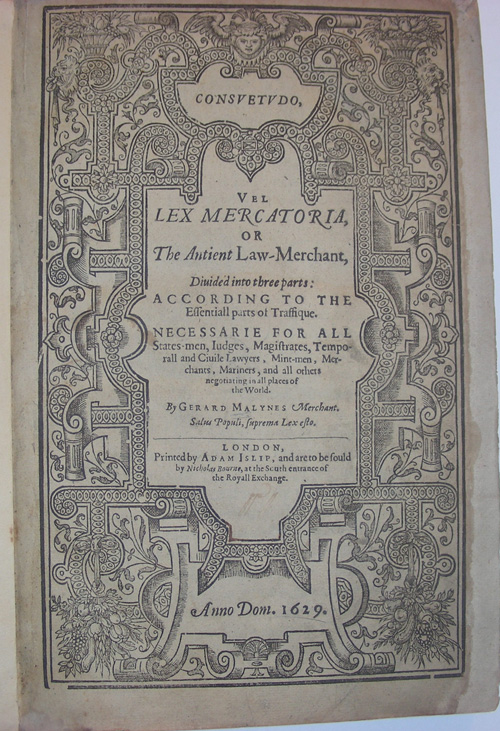
 The English system of commercial law or the lex mercatoria has been described as an example of “spontaneous order,” a set of rules that emerged without central direction and yet provided remarkable stability and favorable institutional environment for trade. Harold Berman and Bruce Benson, among others, have written extensively on this. Here’s an interesting paper by Daniel Klerman on the early history of English commercial law, framed as a comparison of the English and Ottoman systems:
Thirteenth-century England was a commercial backwater whose trade was dominated by foreigners. To accommodate and encourage foreign merchants, England modified its legal system by creating legal institutions which were available to both domestic and foreign traders. Among the most important of these institutions were streamlined debt collection procedures and mixed juries composed of both Englishmen and foreigners. By introducing institutions which treated locals and foreigners equally, England created a level playing field which enabled English merchants to become increasingly prominent in the later Middle Ages. England’s ability to modernize its law was facilitated by the secular nature of English law, the representation of merchants in Parliament, and legal pluralism. Medieval England contrasts sharply with the early modern Ottoman Empire. The latter created special institutions for foreign merchants, which eventually put Ottoman Muslims at a competitive disadvantage.
Food Miles
| Peter Klein |
My favorite economic geographer, Pierre Desrochers, has written (along with his better half, Hiroko Shimizu), a critique of the “food-miles” approach to measuring environmental impact.
As modern food production and distribution becomes ever more complex and globalized, a “buy local” food movement has arisen. This movement argues that locally produced food is not only fresher and better tasting, but it is also better for the environment: Because locally produced food does not travel far to reach your table, the production and transport of the food expend less energy overall. The local food movement has even coined a term, “food miles,” to denote the distance food has traveled from production to consumption and uses the food miles concept as a major way to determine the environmental impact of a food.
This Policy Primer examines the origins and validity of the food miles concept. The evidence presented suggests that food miles are, at best, a marketing fad that frequently and severely distorts the environmental impacts of agricultural production. At worst, food miles constitute a dangerous distraction from the very real and serious issues that affect energy consumption and the environmental impact of modern food production and the affordability of food.
See also these comments from Peter Gordon.
Beware of Geeks Bearing Formulas
| Peter Klein |
The entrepreneur, writes Mises in one of my favorite passages, “is a speculator, a man eager to utilize his opinion about the future structure of the market for business operations promising profits.” The entrepreneur relies on his “specific anticipative understanding of the conditions of the uncertain future,” an understanding that “defies any rules and systematization.”
 This passage was in my mind today as I read the WSJ front-pager about the computer models used by AIG to analyze asset risk. Poor Gary Gorton, who designed many of AIG’s models, is put on public display. AIG’s catastrophic failure is likely to fuel skepticism about the use of such models for risk analysis, though Gorton maintains the problem was the application of the models, not their basic design. (His Yale colleague Ian Ayres will likely agree.) Longtime skeptic Warren Buffet has the best line: “Beware of geeks . . . bearing formulas.”
Today’s paper also includes an item on Harry Markowitz, including this:
As with all new information tools at our disposal, applying portfolio theory to investing entails its share of trial and error. Mr. Markowitz admits some people might object to asking him how to repair the credit crisis. “You, Harry Markowitz, brought math into the investment process,” he imagines some people thinking. “It is fancy math that brought on this crisis. What makes you think now that you can solve it?”
He draws a line between his portfolio theory and its later misapplication. “Not all financial engineering is always bad,” he says, “but the layers of financially engineered products of recent years, combined with high levels of leverage, have proved to be too much of a good thing.”
Update (Nov. 5): See this related piece from the Times.
New Issue of Strategic Entrepreneurship Journal
| Peter Klein |
Volume 2, number 3 of the Strategic Entrepreneurship Journal, a special issue edited by Sharon Alvarez and Jay Barney on “Opportunities, Organizations, and Entrepreneurship,” is now out. It features my paper “Opportunity Discovery, Entrepreneurial Action, and Economic Organization,” Nicolai’s paper with Kirsten Foss, “Understanding Opportunity Discovery and Sustainable Advantage: The Role of Transaction Costs and Property Rights,” and several others of interest. The abstracts from my paper and the Foss & Foss paper are below the fold. (more…)
Things You Learn from David Gordon
| Peter Klein |
Nicolai has written on great beards in philosophy. From David Gordon’s talk this morning on “Money and Philosophy” I learn that Thomas Aquinas, among his many other distinctions, was also the heaviest of all the great philosophers. Apparently his church had to install a special altar with a large cutout so Aquinas could take communion. According to David, Aquinas’s only possible rival for the title of heaviest great philosopher is David Hume.
Interviews with Alchian, Coase, Kirzner, Manne
| Peter Klein |
 The Liberty Fund has put online several interviews from its Intellectual Portrait Series. Of particular interest to O&M readers:
- Armen Alchian, interviewed by Dan Benjamin
- Ronald Coase, interviewed by Richard Epstein
- Israel Kirzner, interviewed by Tibor Machan
- Henry Manne, interviewed by Fred McChesney
Update (Nov. 2): Manne link fixed.
Mises Quote of the Day
| Peter Klein |
Here is Mises on entrepreneurial “understanding,” a concept distinct from quantitative prediction according to a known model. You could even call it judgment. It’s particularly germane to current economic conditions and the phalanx of economic forecasters attempting to predict how the economy will do in the coming months and years. The source is a 1956 essay, “The Plight of Business Forecasting,” reprinted in Economic Freedom and Interventionism:
Economics can only tell us that a boom engendered by credit expansion will not last. It cannot tell us after what amount of credit expansion the slump will start or when this event will occur. All that economists and other people say about these quantitative and calendar problems partakes of neither economics nor any other science. What they say in the attempt to anticipate future events makes use of specific “understanding,” the same method which is practiced by everybody in all dealings with his fellow man. Specific “understanding” has the same logical character as that which characterizes all anticipations of future events in human affairs — anticipations concerning the course of Russia’s foreign policy, religious and racial conditions in India or Algeria, ladies’ fashions in 1960, the political divisions in the U.S. Senate in 1970; and even such anticipations as the future marital relations between Mr. X and his wife, or the success in life of a boy who has just celebrated his tenth birthday. There are people who assert that psychology may provide some help in such prognostications. However that may be, it is not our task to examine this problem. We have merely to establish the fact that forecasts about the course of economic affairs cannot be considered scientific.
Controynms Redux
| Peter Klein |
Last year’s post on contronymns — words that are their own antonyms — was one of our most popular. Anu Garg of Wordsmith.org ran a contronymns series this week, featuring cleave, continuance, asperse, copemate, and quiddity.
The series intro contained a few more:
When you sanction a project, do you approve of it or disapprove? Should one be commended for oversight (watchful care) or reprimanded for oversight (error or omission)? When you resign from a job, do you leave it or re-join (re-sign) it?
When a proposal gets tabled, is it being brought forward for discussion or being laid aside? Depends on which side of the pond you’re at. If the former, you’re in the UK; if the latter, you’re in the US.
I call them fence-sitters. They sit on fences, ready to say one thing or its opposite depending on which side they appear at. I’m not talking about politicians. These are words, known by many names: autoantonym, contranym, self-antonym, enantiodromic, amphibolous, janus word, and so on.
Sometimes it’s a result of two distinct words evolving into the same form (cleave from Old English cleofian and cleofan) but often a single word develops a split personality and takes on two contradictory senses. All of us have a bit of yin and yang and these words are no exception. The context usually provides a clue to help us understand the right sense in a given place.
Always Two, There Are: A Master, and an Apprentice
| Peter Klein |
 Here are the proceedings of a conference on apprenticeship, the much-maligned, but frequently valuable, practice of learning a trade through experience, rather than formal classroom education.
Paul Ryan notes in his EH.Net review:
Its publication responds to the extensive contemporary interest in apprenticeship — among historians, as part of discussions of the role of guilds, proto-industrialization and social change; and among policy analysts, reflecting the benefits of apprenticeship for school-to-work transitions, notably in Germany. . . .
Most contributors subscribe to a revisionist historical view of apprenticeship, as less monolithic, standardized and guild-regulated, and more determined by economic factors, than in traditional interpretations, notably the ganze Haus perspective of the German historical school. Both individually and collectively, the papers document the heterogeneity of apprenticeship. Thus contract durations and completion rates are shown to have varied considerably, even within particular occupations in particular towns in particular periods, despite clear guild prescriptions.
Today’s Episode of “The Onion or Reality?”
| Peter Klein |
White House to banks: Start lending now
By Jennifer Loven, AP White House CorrespondentWhite House tells banks getting federal aid to quit hoarding money and start lending it
[ . . . ]
“What we’re trying to do is get banks to do what they are supposed to do, which is support the system that we have in America. And banks exist to lend money,” White House press secretary Dana Perino said.
Those silly banks; first they made too many loans, causing the subprime crisis, now they’re making too few! (Via Manuel Lora.)
Let’s review: Some banks made bad loans, and some banks bought securities tied to these loans. When the bad loans went sour, some banks failed. Instead of letting those banks fail, freeing up scarce resources to flow to other banks and financial institutions, the government tried to prop up the entire banking system. Now, when the propped-up banks decide to hoard their taxpayer-provided cash, the government wants to make them lend — to whom, it doesn’t matter. Just lend, baby, lend! A loan, you see, is just like any other loan. All investments are the same. All banks are the same. No need to separate the good ones from the bad ones. We Are the World!
A Billion Here, A Trillion There
| Peter Klein |
How expensive is the bailout? Where will the money come from?
Consider the numbers: $29 billion for the Bear Stearns mess; $700 billion to buy spoiled assets; $200 billion to buy stock in Fannie Mae and Freddie Mac; an $85 billion loan to AIG insurance; another $37.8 billion for AIG; and $250 billion for bank stocks. Hundreds of billions in guarantees to back up money market funds and to guarantee bank deposits. And who knows what expenses are still to come. . . .
How will the U.S. pay for it all? Answer: by borrowing — raising worries about how the country’s ballooning annual budget deficits and aggregating debt will affect the economy and financial markets. Some guidelines, such as interest rates and the ratio of debt and deficits to gross domestic product, suggest the new debt will be digested easily. But some experts think those guidelines are misleading, warning that obligations are piling up like tinder on a forest floor.
“This kind of accounting that the government does — if they did it in the private sector they would go to jail,” says Kent Smetters, a professor of insurance and risk management at Wharton.
From Knowldge@Wharton, which reminds us that there’s plenty more to come — a probable bailout of Chrysler and G.M., for instance. And who knows what else. Of course, the US government now has a $10.5 trillion national debt. “To economists, the most frightening fact is that the enormous cost of today’s financial rescues is just a drop in the bucket.”





 Organizations and Markets
Recent Comments