Posts filed under ‘– Klein –’
Academic Journal Fakery
| Peter Klein |
As computer programs make images easier than ever to manipulate, editors at a growing number of scientific publications are turning into image detectives, examining figures to test their authenticity.
And the level of tampering they find is alarming. “The magnitude of the fraud is phenomenal,” says Hany Farid, a computer-science professor at Dartmouth College who has been working with journal editors to help them detect image manipulation. Doctored images are troubling because they can mislead scientists and even derail a search for the causes and cures of disease.
Ten to 20 of the articles accepted by The Journal of Clinical Investigation each year show some evidence of tampering, and about five to 10 of those papers warrant a thorough investigation, says Ms. Neill. (The journal publishes about 300 to 350 articles per year.)
This is from the Chronicle. The problem is partly cultural, it appears. “[Y]oung researchers may not even realize that tampering with their images is inappropriate. After all, people now commonly alter digital snapshots to take red out of eyes, so why not clean up a protein image in Photoshop to make it clearer?” Says Farid: “This is one of the dirty little secrets — that everybody massages the data like this.”
I suspect that outright fraud — making up data, changing regression coefficients — is unusual in empirical social-science research research. Sloppiness, ranging from data-entry errors to programming mistakes to misspecified regression models, is common. And social scientists typically “shade” results, e.g., by running fifty regressions and reporting only the one in which the signs and significance levels turn out to the researcher’s liking. (Hence the growing importance of the “robustness checks” section of any empirical paper.)
Ben Klein’s Contributions to Law and Economics
| Peter Klein |
Josh Wright has written a nice piece on Benjamin Klein for Josh’s forthcoming volume with Lloyd Cohen, Pioneers of Law and Economics. Klein’s 1978 paper with Armen Alchian and Robert Crawford and his 1981 paper with Keith Leffler are of course part of the organizational economics canon. His ongoing debate with Ronald Coase on the GM-Fisher Body case has helped clarify important issues on the role of asset specificity in vertical integration.
Trivia: Klein and Walter Block were college roommates at Columbia. Walter tells me they even went together to Ayn Rand’s apartment once during Walter’s Randian phase.
The Power of Ideas
| Peter Klein |
Expressed in sculpture. See the full set, from a 2006 Berlin exhibition, on Wikipedia. (Via politics-live.)

Reliving the 1980s
Peter Klein |
I recently watched the new Rambo film, an entertaining spectacle of blood and gore (for those who enjoy that sort of thing). The last few years have brought back several 1980s-era action heroes after long absences, not only Rambo but also Rocky Balboa, John McClane, the Terminator, and of course Indiana Jones.
We posted a while back on the golden decade of the 1970s, a fantastically productive period for research in organizational economics. How about bringing back the 1980s? Not the mullet, but the great works in organizational economics, strategy, entrepreneurship, and related subjects that appeared in that decade. Here are some of my favorites, listed chronologically. What are yours? (more…)
Best Paragraph I Read Today
| Peter Klein |
Money, money prices, market transactions, and economic calculation based upon them are the main targets of criticism. Loquacious sermonizers disparage Western civilization as a mean system of mongering and peddling. Complacency, self-righteousness, and hypocrisy exult in scorning the “dollar-philosophy” of our age. Neurotic reformers, mentally unbalanced literati, and ambitious demagogues take pleasure in indicting “rationality” and in preaching the gospel of the “irrational.” In the eyes of these babblers money and calculation are the source of the most serious evils. However, the fact that men have developed a method of ascertaining as far as possible the expediency of their actions and of removing uneasiness in the most practical and economic way does not prevent anybody from arranging his conduct according to the principle he considers to be right. The “materialism” of the stock exchange and of business accountancy does not hinder anybody from living up to the standards of Thomas a Kempis or from dying for a noble cause. The fact that the masses prefer detective stories to poetry and that it therefore pays better to write the former than the latter, is not caused by the use of money and monetary accounting. It is not the fault of money that there are gangsters, thieves, murderers, prostitutes, corruptible officials and judges. It is not true that honesty does not “pay.” It pays for those who prefer fidelity to what they consider to be right to the advantages which they could derive from a different attitude.
That’s Ludwig von Mises, writing on pp. 215-16 of Human Action (4th edition). Oh, how I love that man. I hereby pledge to use the phrase “mentally unbalanced literati” at least once per year.
Niche Business School Programs
| Peter Klein |
I’m surprised that the niche strategy isn’t used more in academia. Most economics departments at research universities strive to be the “MIT of [fill-in-the-blank].” Business schools tend to value the same set of academic journals, teach from the same set of cases, and hire faculty from the same set of top schools. Not only is this strategy unlikely to work for the typical mid-tier university, it has the undesirable social consequence of creating a bland conformism in which every department in Field X looks pretty much like every other department in Field X. The virtues of experimentation and learning are lost. Herd behavior is the order of the day.
Business Week recently ran an interesting piece about several undergraduate business programs that are trying the niche strategy. The University of Louisville runs a successful equine management program. Belmont University in Nashville offers a specialized music business degree. The University of Houston trains students for the energy industry. And Florida State University has a Professional Golf Management program.
What are your experiences with niche programs, where the niche is defined by applied focus (as in the above examples), by research method or approach, by a particular theoretical focus, or otherwise?
Tips for Presenting Your Research
| Peter Klein |
One of the most important skill young scholars must develop is the ability to give a technical presentation to a non-specialist audience. Everyone likes to strut his stuff but dissertation committee members, prospective academic employers, seminar audiences in various contexts, and others to whom you expose your work don’t necessarily want the gory details. Background, context, motivation, results, and implications are usually the most important parts of a presentation, but often the most neglected.
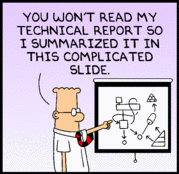 Two cartoons in my local paper today, this from Dilbert and this from Pickles, highlight that theme. Also, check out this article from Web Worker Daily, “10 Tips for Working with the Not-So-Tech-Savvy,” illustrated beautifully with an abacus. It’s written for techies working with regular folk, but many of the principles — avoid jargon, use analogies, include visuals, reference case studies, link to current events, be patient — apply to scholarly communication.
See also: Fabio’s Grad Skool Rulz.
Mike Jensen Explains SSRN
| Peter Klein |
Mike Jensen, the distinguished financial economist and co-founder of SSRN, is interviewed here by Growthology’s Tim Kane. Everyone knows that electronic distribution of working papers has been extremely important for academic research in business and the social sciences. By the time most papers are published, they’ve already been read by many, if not most, of the target readers, from working-paper circulation, conference presentations, informal discussions, and the like. Jensen points out that electronic distribution has also had an important democratization effect. The elites always had access to cutting-edge research in advance of publication through informal networks, NBER workshops, and the like. “In my own field, I was part of a very small group doing cutting-edge work in the early days of modern finance, and I noticed that elites in all fields were 2-3 years ahead of other scholars just because they knew about research that took so much time to get distributed widely. The Internet allowed everyone to see the frontier.”
Note also Jensen’s comments about behavioral finance:
In the 1970s, I began to receive [as editor of the Journal of Financial Economics] quite a few papers challenging the efficient market hypothesis. The referees rejected them and I rejected them. Any one of these articles standing alone could be rejected, but I began to feel that as a package they cannot be ignored. The authors were onto something, even if we didn’t see it. Sometime around 1975, over the objection of my referees — many of them close friends — we published a special issue with a collection of those papers. That was controversial but proved to have great value. Subsequent to that, behavioral financial economics evolved.
In creating SSRN, I envisioned an alternative distribution vehicle.
Jensen has also been an important friend of and advisor to CORI, delivering the annual CORI Distinguished Lecture in 2005.
Economics and Sociology at Microsoft
| Peter Klein |
A couple of nuggets from today’s WSJ front-pager on the complicated relationship between Microsoft founder Bill Gates and current CEO Steve Ballmer:
Their relationship started at Harvard University in the mid-1970s, where the two played poker and thrived by pushing their intellectual limits. Once they skipped a graduate economics class for the entire semester, then teamed up a few days before the final exam to try to learn the material all at once. Mr. Ballmer recalls he got a 97; Mr. Gates a 99.
Who knew Harvard’s graduate economics program was so easy? And this:
One concern for Mr. Ballmer was how to preserve Mr. Gates’s role of technology visionary inside the company. Looking for guidance, Mr. Ballmer says he cracked open a book from his college years by Max Weber, the German sociologist, on how organizations handle the disappearance of “charismatic leaders.”
On March 28, 2006, Mr. Ballmer described the book to Microsoft’s board at a retreat in the San Juan Islands near Seattle, Microsoft executives say. One way for a firm to retain the charisma of a departing leader, Mr. Weber wrote some 100 years ago, is for the leader to name his own replacement.
Mr. Gates did just that.
Who says sociology isn’t useful?
The New Comparative Economic History
| Peter Klein |
That’s the title and subject of a Festschrift for Jeffrey G. Williamson, edited by Timothy Hatton, Kevin O’Rourke, and Alan Taylor and published last year by MIT Press. Reviewer Dan Bogart describes the field thusly: “In a nutshell, this line of research analyzes the sources of economic growth, the importance of institutions, and the impact of globalization by making comparisons between actual economies. An illuminating contrast is made with early cliometrics, which addressed questions by constructing counterfactuals with the help of theory and calibration. ” As such, the new comparative economic history is a closely related to, though not identical with, the new institutional economic history associated with Douglass North, Barry Weingast, Avner Greif, and others mentioned frequently on these pages. The NCEH takes institutions seriously but does not give them quite as much weight as NIE historians in explaining economic performance.
Against Government-Subsidized VC
| Peter Klein |
Government-subsidized venture capital underperforms private venture capital, according to a new analysis of Canadian data. Firms backed by subsidized VC are less profitable, less innovative, and less attractive to later-stage investors than firms backed by private VC. Poor governance and a negative signalling effect, and not adverse selection, appear to be the drivers. This is from a new NBER paper by James Brander, Edward Egan, and Thomas Hellman, “Government Sponsored Versus Private Venture Capital: Canadian Evidence.” Abstract:
This paper investigates the relative performance of enterprises backed by government-sponsored venture capitalists and private venture capitalists. While previous studies focus mainly on investor returns, this paper focuses on a broader set of public policy objectives, including value-creation, innovation, and competition. A number of novel data-collection methods, including web-crawlers, are used to assemble a near-comprehensive data set of Canadian venture-capital backed enterprises. The results indicate that enterprises financed by government-sponsored venture capitalists underperform on a variety of criteria, including value-creation, as measured by the likelihood and size of IPOs and M&As, and innovation, as measured by patents. It is important to understand whether such underperformance arises from a selection effect in which private venture capitalists have a higher quality threshold for investment than subsidized venture capitalists, or whether it arises from a treatment effect in which subsidized venture capitalists crowd out private investment and, in addition, provide less effective mentoring and other value-added skills. We find suggestive evidence that crowding out and less effective treatment are problems associated with government-backed venture capital. While the data does not allow for a definitive welfare analysis, the results cast some doubt on the desirability of certain government interventions in the venture capital market.
Sudha R. Shenoy (1943-2008)
| Peter Klein |
I’m saddened to report the death yesterday of Sudha Shenoy, the distinguished Australian economic historian and important contributor to the “Austrian revival” of the 1970s. Her father, the eminent Indian economist B. R. Shenoy, was a student at the London School of Economics in the 1930s when Hayek gave his famous “Prices and Production” lectures and both father and daughter were deeply influenced by Hayek. Sudha too studied at the LSE and eventually took a position at the University of Newcastle, where she taught until her retirement in 2004. Sudha was writing a book on Hayek and would have given a week-long lecture series on Hayek at the Mises Institute this fall. Here is a 2003 interview, here are some audios and videos, and here are some materials collected by Google Scholar. Some obituaries and personal remembrances are here, here, and here.
Suhda was a regular reader and occasional commentator here at O&M. You can get a sense of her erudition from this blog post, one of our most popular, which was basically a cut-and-paste job from one of her emails.
Suhda was a quiet, kind, and gentle person. This may be hard for our younger American readers to comprehend but she didn’t know how to drive. I once had the pleasure of chauffeuring her around Auburn, Alabama at an Austrian Scholars Conference. Spending time with her was a real treat.
Allen Nevins Dissertation Award
| Peter Klein |
I received an email the other day from the Economic History Association soliciting nominations for its dissertation prizes, the Allan Nevins Prize for best dissertation in U.S. or Canadian economic history and the Alexander Gerschenkron Prize for the best dissertation in the economic history of, you know, what our textbooks call ROW (the Rest of the World). This brought to mind a couple of personal connections:
1. Last year’s Nevins prize went to a University of Missouri student, Mark Geiger, who wrote on grassroots financing of the US Civil War.
2. My dad got his PhD in history at Columbia in the 1950s and, while teaching there as a lecturer, worked in Nevins’ office. Dad told an interviewer:
Allan Nevins had retired, but I was allowed by him to use a desk in his office. He had an office twice the size as this, which was filled with books from ceiling to floor and piled high. And if you were at Columbia you were immediately well known, you know. A newspaper or journal would call me up or a publisher, “Would you review this book for us?” And I wouldn’t know anything about it, “Yes Sir,” and I’d look on Nevins’ shelf and find three books on the subject. (Laughter)
Being at Columbia and around Nevins at that time was a great launching pad for an academic career. Dad, holding the rank of lecturer (lower than assistant professor), was invited to interview for the department head position at Long Island University, which he was offered and accepted. The job came with tenure and the rank of full professor. Dad’s the only person I’ve known to be a tenured full professor without ever having been an assistant or associate prof.!
This Month in Business History
| Peter Klein |
Business history highlights for June, courtesy of Friends of Business History News:
June 1, 1495 — Friar John Cor records the first known batch of Scotch whiskey in the Exchequer Rolls of Scotland.
June 4, 1896 — Henry Ford drives his first automobile through Detroit streets.
June 9, 1790 — The Philadelphia Spelling Book becomes the first work registered under the federal copyright act (U.S. District Court of Pennsylvania).
June 15, 1851 — Jacob Fussell of Baltimore, Maryland sets up first ice cream factory.
June 26, 1848 — The first U.S. pure food law is enacted, banning the importation of adulterated drugs.
June 30, 1893 — The blue-white Excelsior diamond (995 metric carats) is discovered at the De Beers mine in Jagersfontein, South Africa. Until the discovery of the Cullinan in 1905, it was the world’s largest known uncut diamond.
Lien-Klein Paper on Relatedness
| Peter Klein |
Lasse and I have a new paper on the measurement of relatedness, the degree to which a diversified firm’s markets or industries are “close” to each other. Relatedness is a key concepts of corporate strategy, but it is difficult to define and measure consistently. We discuss a new, “survivor-based” approach and compare it to conventional measures. The survivor-based approach lets the competitive process and the knowledge of local decision makers replace the judgment of the researcher (or the SIC system) in determining what is related to what, giving it a Hayekian flavor. Specifically, we measure the relatedness between a pair of industries by comparing how often they are actually combined to what one would expect if diversification patterns were random. Industries are related when this difference is large and positive, and they are unrelated if it is negative. This concept was originally suggested by Teece, Rumelt, Dosi and Winter (1994) who used it to illustrate persistent patterns of “coherence” among US firms.
The paper, “Measuring Inter-Industry Relatedness: SIC Distances versus the Survivor Principle,” is available on SSRN. Here’s the abstract:
The conventional approach to measuring inter-industry relatedness uses the SIC system to capture the “distance” between industries. While relatedness measures based on SIC codes (or equivalent classifications) are readily available and easy to compute, they do not screen effectively for the conditions under which related diversification creates value. This paper constructs an alternative, survivor-based measure of inter-industry relatedness and compares it to similar measures based on distances between SIC codes. We find that survivor-based measures consistently outperform SIC-based measures in predicting firms’ decisions to enter new markets, even when herding tendencies and motives related to mutual forbearance are taken into account.
A Radical New Idea
| Peter Klein |
Dynamic pricing is a relatively new idea that reflects consumer demand. If a show is popular, the system will increase the price of that show. Once it loses steam, the price will be lowered proportionally.
Prices that adjust according to supply and demand! Who’d a thunk it?
To be fair, the writer, CNET’s Don Reisinger, is talking about Apple’s plans to offer variable pricing on iTunes. But it’s still a startling statement, to an economist. I guess I shouldn’t really be surprised, though.
Westgren at Missouri
| Peter Klein |
Those of you within driving distance of Columbia, Missouri should come over Monday (2 June) for a seminar by Randy Westgren, “The Entrepreneurial Niche,” at 2:00 2:30pm in 217 Mumford Hall. Abstract below the fold. The talk is sponsored by the McQuinn Center for Entrepreneurial Leadership. Email me for details. (more…)
Mike and Me on Externalities
| Peter Klein |
 Mike Moffatt responds to my post on externalities. I questioned the Pigouvian approach of using taxes as efficient remedies for negative externalities. I said if, say, carbon taxes are a good idea, then Pigouvian taxes on a range of activities that generate negative externalities should be even better. And what about Pigouvian subsidies? I rarely see members of the Pigou club explain what activities they would subsidize, at what rates, and with what resources.
Mike’s response, based on more detailed comments here, is interesting, but to my mind misses the main point. Pigouvian taxes aren’t perfect, Mike says, but neither are income taxes or excise taxes or any other taxes. Fine, I say, but the relevant comparison isn’t between Pigouvian taxes and other taxes, but between Pigouvian taxes and alternative institutions for dealing with externalities such as cap-and-trade, common-law tort remedies, etc. (more…)
Wikicheatia
| Peter Klein |
Facebook founder Mark Zuckerberg, reports the NY Times, skipped his college art history class:
When it came time for the end-of-term study period, he was too busy building the prototype of Facebook to bother to do the reading. So in an inspired last-minute save, he built a Web site with all of the important paintings and room for annotation. He then sent an e-mail to the students taking the class offering it up as a community resource.
In a half an hour, the perfect study guide had self-assembled on the Web. Mr. Zuckerberg noted that he passed the course, but he couldn’t remember the grade he received.
The pointer is from Joshua Gans, who calls this “an example of Wikicheatia or of Study Group 2.0.”
Middle Managers in the Theory of the Firm
| Peter Klein |
The current issue of Knowledge@Wharton features a piece on the challenges facing middle managers. The middle-management role is typically high in responsibility and low in authority — middle managers are accountable for the performance of their subordinates but selective intervention from above makes it difficult for them to commit to particular incentive schemes. Moreover:
[T]op reasons for dissatisfaction among middle managers include micromanagement by senior managers and lack of respect, says [author David] Sirota. “And sometimes the senior leader is just really ineffective; middle managers don’t want to be in a company that is run by that type of person.” . . .
Navigating the various relationships upward, downward and horizontally can be an emotional management challenge, adds Wharton management professor Sigal Barsade. “This is particularly noticeable with organizational change. If you are a middle manager, there may be a change that you didn’t have much to do with, but you need to translate it to your people and make them feel protected and valued. However, you are also someone being impacted by the change. Because you didn’t design the change, you might be left feeling like you don’t know what to do yourself, but you still need to comfort, protect and inspire your people.”
A more colorful description is provided by Chef Shuna Fish Lydon who blogs on all things culinary at eggbeater. Here she is on the role of the sous chef: (more…)





 Organizations and Markets
Recent Comments