Posts filed under ‘– Klein –’
Turgot and What Might Have Been
| Peter Klein |
As a Francophile and Turgot enthusiast I direct you to Frédéric Sautet’s remarks on today’s anniversary of Turgot’s dismissal by the French crown:
May 12, 1776 was one of the saddest days for France. It was the day Louis XVI removed A.R.J. Turgot from office. Turgot was the Minister of Finance of France, the greatest French economist of the 18th century, and a key figure of the French enlightenment (he was a close friend of Condorcet, and Voltaire came to his rescue). He had a great sense of duty, freedom, and civilization. Turgot was too successful, so to speak, in his economic reforms and in the fiscal discipline he imposed on the finances of the French Crown. He fell because he wanted to go too far in the removal of confiscatory taxes (la taille and la corvée), the deregulation of commerce and industry, and the abolition of privileges many guilds and others possessed at the time (e.g. les droits féodaux). Turgot is perhaps the greatest reformer the world has ever seen. If Louis XVI had trusted his Minister of Finance to the end, it is likely that the French Revolution would not have taken place.
Note that Turgot even had his own castle. Ricardo was almost certainly wealthier, though. Böhm-Bawerk was also a fine Minister of Finance.
Politically Incorrect Company Logos
| Peter Klein |
 One of my favorite local restaurants sits next to a Sherwin-Williams paint store. When leaving the restaurant I always pause to gaze upon the Sherwin-Williams logo. A paint can dumping red ooze over the planet’s surface — you can’t get more politically incorrect than that! There’s even a tagline, “Cover the Earth,” in case you miss the point. In today’s environmentally sensitive age this logo is the Anti-Green. It screams: synthetic, industrial, man-made, unnatural. I love it.
I imagine there’s a lot of pressure on the company to reject the logo, but Sherwin-Williams soldiers on. There’s a brief description, charmingly apologetic, on the “Green Initiatives” page of the company website. “Created in the late 1800s, the logo’s purpose was to represent the company’s desire to help beautify and protect the buildings of the world. It was a symbol of a young company’s enthusiasm, idealism and hope regarding its future and the possibility for achievement that hovered on the nation’s horizon.” In other words, that was a different age, please forgive us. Today it’s simply “a figurative emblem signifying quality, integrity and service.” And no more oily residue!
What other firms have politically incorrect logos? Marlboro of course ditched the Marlboro man long ago. Joe Camel made it to 1997 before being ushered into retirement. Robertson’s kept Golly on its marmalade jars until 2001. Oh, and check out this funny set of politically incorrect ads of yesteryear (Santa smoking Chesterfields, a husband spanking his wife for serving the wrong coffee, a group of servicemen being warned “You can’t beat the Axis if you get VD”).
How People Find Us
| Peter Klein |
Like other blogs, O&M gets most of its new readers through links from other blogs and websites. But people also find us by searching. Our software shows us what search terms lead people here, and I recently looked up the most popular search terms from our 24 months of existence. Here’s the list.
- agency theory
- organizations and markets
- market based management
- corruption in organizations
- concept map
- organization and markets
- life in hell
- history of marketing
- strategic entrepreneurship journal
- swot model
- nicolai foss
- history of accounting
- theories of profit
- unusual business ideas
- market-based management
- queen bee syndrome
- peter klein
- pareto criterion
- management theory
- management theories
Obviously there’s something wrong with the order of items #11 and #17, but otherwise the software seems to work pretty well. . . .
Toyota the Innovator
| Peter Klein |
Jim Surowiecki’s latest New Yorker column focuses on Toyota and makes several important points about innovation.
- Process innovation is at least as important as, though less visible than, product innovation.
- Innovation can be an incremental process in which “the goal is not to make huge, sudden leaps but, rather, to make things better on a daily basis.”
- Process innovations often bubble up from the bottom, rather than the top, of the hierarchy.
- Cumulative, bottom-up, process innovation is really hard to imitate. “[T]he fundamental ethos of kaizen — slow and steady improvement — runs counter to the way that most companies think about change. Corporations hope that the right concept will turn things around overnight. This is what you might call the crash-diet approach: starve yourself for a few days and you’ll be thin for life. The Toyota approach is more like a regular, sustained diet — less immediately dramatic but, as everyone knows, much harder to sustain.”
These points are well known in the innovation literature but Surowiecki’s succinct and elegant presentation is well worth a read, even by specialists.
See also Steve Postrel’s earlier post on Toyota.
Hayek on Intellectuals
| Peter Klein |
It’s Hayek-Klein Day, and bloggers are sharing their favorite Hayek quotes (Boudreaux, Horwitz). Here’s one of mine:
The typical intellectual . . . need not possess special knowledge of anything in particular, nor need he even be particularly intelligent, to perform his role as intermediary in the spreading of ideas. What qualifies him for his job is the wide range of subjects on which he can readily talk and write, and a position or habits through which he becomes acquainted with new ideas sooner than those to whom he addresses himself.
That’s from “The Intellectuals and Socialism,” published in 1949. (See this for an elaboration of Hayek’s argument.) Substitute “blogger” for “intellectual” and the passage could have been written today!
Wharton Private Equity Review
| Peter Klein |
A special report from Knowledge@Wharton:
While the credit crunch has put a damper on headline-grabbing large buyouts, private equity firms have found other ways to discover value in the current market. In this special report, produced in cooperation with the Wharton Private Equity Club, Knowledge@Wharton looks at how funds are adapting to changes in the credit environment, what opportunities exist in the developed markets of Europe and Japan, and the ways that proposed changes in taxation may affect the industry. Also included is a roundtable discussion on setting up a first-time fund in the current market, as well as an interview with David Rubenstein, co-founder and managing director of The Carlyle Group.
Get the report here. For more on private equity see the proceedings from last fall’s AEI conference.
Incidentally, I used Jensen’s “Eclipse of the Public Corporation” in my strategy class this semester amd continue to be impressed with Jensen’s insight and prescience in that piece, now nearly twenty years old. Still an excellent introduction to the organizational economics of private equity.
Top Business Gurus
| Peter Klein |
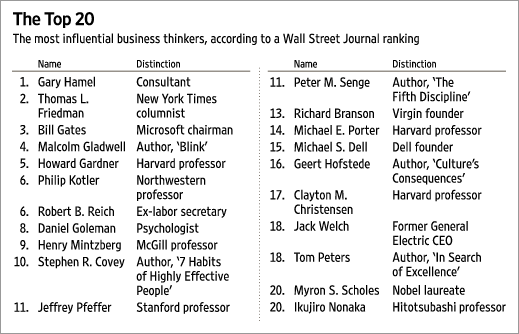
Did you catch the list of Top Business Gurus in Monday’s WSJ? Based on Google, Lexis-Nexis, and academic citation indexes, it puts Gary Hamel at the top, followed by Tom Friedman, Bill Gates, Malcolm Gladwell, and Howard Gardner. Our own Jeff Pfeffer checks in at #11. Click the picture below for the entire list. Hamel, Stephen Covey, Michael Porter, Clayton Christensen, and Tom Peters are obvious candidates for Guru Status, though the ranking algorithm produces some unlikely results too, such as Robert Reich and Myron Scholes.
Attack of the Identicons
| Peter Klein |
 If you troll our comments threads you may notice that each commentator is identified by a little image, what WordPress calls an Avatar. Registered WordPress users can upload custom images to serve as their Avatars. Otherwise, each commentator is now represented by an Identicon, which is not a kind of alien Transformer but a math-based image derived from a user’s IP address. Hope you like your new online self!
2008 Kauffman Data Symposium
| Peter Klein |
Next Tuesday, 13 May, is the proposal deadline for the 2008 Kauffman Symposium on Entrepreneurship and Innovation Data. I participated in the 2007 version and got a lot out of it. This year’s event takes place in Washington, DC instead of Kauffman headquarters in Kansas City.
Documents from the 2007 symposium can be reviewed at SSRN.
A personal note: While driving to last year’s symposium I found myself on Kansas City’s Volker Boulevard, named for the great philanthropist William Volker, whose support was instrumental in the rebirth of Austrian economics in the US during the 1950s and 1960s. The Volker Fund paid all or part of the salaries of Mises at NYU and Hayek at Chicago and employed Murray Rothbard as a consultant, book reviewer, and talent scout while he was writing Man, Economy, and State and America’s Great Depression. Wikipedia has some background information on the Volker Fund; you can find more in Hülsmann’s Last Knight (pp. 867-68 and passim) and Brian Doherty’s Radicals for Capitalism (pp. 181-87 and passim). In Kansas City Volker is remembered as a generous philanthropist who supported schools and hospitals, developed a program for prison reform, and was a major benefactor of the University of Kansas City (now the University of Missouri – Kansas City).
It would be nice to have a full-scale Volker biography. Anybody up to the task? Volker’s company and foundation records are housed at UMKC. Herb Cournelle wrote a short biography in 1951, Mr. Anonymous: The Story of William Volker, but I haven’t been able to locate a copy.
More Free Stuff: Herbert Simon and Edward Banfield
| Peter Klein |
In my list of Cowles monographs I forgot to include several classics by Herbert Simon, including his 1951 paper “A Formal Theory of the Employment Relationship,” issued by Cowles as a discussion paper in 1950. Here’s the full set of Simon materials at Cowles. Also, from a commentator over at orgtheory.net I learn that several of Edward Banfield’s books, including The Moral Basis of a Backward Society (1958) and The Unheavenly City (1970) are available as PDFs at this site.
A Question for the Pigou Club
| Peter Klein |
A few years ago Greg Mankiw coined the term Pigou Club, a label for those (like himself) who advocate higher Pigouvian taxes on gasoline consumption and other high-carbon-footprint activities. Personally, I don’t find the Pigouvian analysis very convincing, in this or the more general case. First, the idea of efficient Pigouvian taxes and subsidies ignores subjective value and the Hayekian knowledge problem. How can government officials possibly choose tax or subsidy amounts that compensate for the actual harm suffered by, or benefit enjoyed by, all possible third parties for all activities generating externalities? The problem is several orders of magnitude more complex than what is typically described in the the textbooks. As a mechanism design problem, it is as difficult as the general socialist calculation problem itself (and you know how I feel about that). Second, the Pigouvian approach ignores comparative institutional analysis altogether. What are the efficiency consequences of establishing, empowering, and funding a government agency to compute and implement Pigouvian taxes and subsidies? Where will the tax revenues go? How will the subsidies be financed? What are the effects of these distortions?
My preference is to treat “negative externalities” as torts, with property titles assigned by the homesteading principle rather than Coasean wealth maximization criteria. (Essentially the Rothbardian view.)
But my main beef with today’s Pigouvians is that they cherry-pick a case here and there — taxes on gasoline, primarily — without fully pursuing the implications of the analysis. If increasing gasoline taxes is efficient, why stop there? What other market failures should the state be empowered to remedy? Here’s my question, specifically:
Please name the activities you believe deserve Pigouvian subsidies. For each activity provide the efficient subsidy amount, explain how this was calculated, and say how the revenues should be raised.
I don’t recall Mankiw discussing Pigouvian subsidies on his blog. Greg, help us out!
The Sphere of Economic Calculation
| Peter Klein |
 Today’s Weekend Article from the Mises Institute is “The Sphere of Economic Calculation,” an excerpt from chapter 12 of Mises’s Human Action. (Check out the super-cool graphic!) The article expands on Mises’s pathbreaking 1920 paper on the need for prices in any system that aims at a rational allocation of resources.
Mises’s theory of factor pricing and its role in cost accounting — what he calls the problem of “economic calculation” — is near and dear to my heart, having written one of my first published articles on the subject. It’s also received a bit of attention here at O&M (1, 2, 3, 4, 5).
Are Brand Names a Modern Phenomenon?
| Peter Klein |
Not at all, says Gary Richardson, in a new NBER paper, “Brand Names Before the Industrial Revolution.” Branding has long been the target of largely uncomprehending critique from the likes of Veblen, Galbraith and sociologists such as Daniel Bell but its role in maintaining quality and reliability and securing contractual performance is now generally understood. Importantly, shows Gary (my former grad-school classmate), the use of seller-specific markers was widespread even before the Industrial Revolution and played an important role in facilitating the emergence of long-distance trade:
In medieval Europe, manufacturers sold durable goods to anonymous consumers in distant markets, this essay argues, by making products with conspicuous characteristics. Examples of these unique, observable traits included cloth of distinctive colors, fabric with unmistakable weaves, and pewter that resonated at a particular pitch. These attributes identified merchandise because consumers could observe them readily, but counterfeiters could copy them only at great cost, if at all. Conspicuous characteristics fulfilled many of the functions that patents, trademarks, and brand names do today. The words that referred to products with conspicuous characteristics served as brand names in the Middle Ages. Data drawn from an array of industries corroborates this conjecture. The abundance of evidence suggests that conspicuous characteristics played a key role in the expansion of manufacturing before the Industrial Revolution.
See also Gary’s EH.Net Encyclopedia entry on guilds.
Free E-Books
| Peter Klein |
The Mises Institute continues to have the best library of free e-books on economics and related subjects (new additions: Say’s Treatise on Political Economy, Mencken’s Notes on Democracy, the 1960 collection Essays in European Economic Thought, Lachmann’s Macro-economic Thinking and the Market Economy). Michael Greinecker points out that the Cowles Foundation monographs are also available online. Classics include Marschak and Radner’s Economic Theory of Teams, Markowitz’s Portfolio Selection, Arrow’s Social Choice and Individual Values, and, for those whose tastes run to such things, Debreu’s Theory of Value. Viva la Revolución Digital!
Is Management a General Skill?
| Peter Klein |
First Matthew Stewart, now Simon Blackburn — philosophers writing about management without actually knowing anything about management. Muses Blackburn:
People can be persuaded, and ordered, given incentives and penalties, suppressed and killed, but not managed. Human affairs can be administered, but administration is not management. One administers to people and their needs. One tries to manage them by ignoring whichever of their needs is inconvenient and by treating them as a mere means to your own ends. But, mirabile dictu, people treated like that become irritable and subversive and quite quickly unmanageable.
Daniel Davies tries valiantly to deconstruct this passage and concludes, rightly I think, that Blackburn hasn’t the slightest idea what he’s talking about. I find Davies’s own definition of “management” too narrow, focusing on routine administration and small-group leadership but excluding the activities of the general manager, but I think he gets Blackburn right. Philosophers, please stick to examining thyselves!
Live Long and Prosper
| Peter Klein |
 As a student of Austrian economics, I hope to inherit not only the clarity of thought, insight, originality, and productive habits of the great Austrians, but also their longevity. Carl Menger, founder of the Austrian school, lived to be 81 (fathering a son, the mathematician Karl Menger, Jr., at age 62). Mises died at 92, having taught his graduate seminar at NYU well into his eighties. Hayek made it to 93. Böhm-Bawerk died relatively young, at 63, though Wieser lived to be 75. I also admire Ronald Coase, still going strong at 97, and Armen Alchian, who turned 94 this month (and is still serving on PhD dissertation committees). So hopefully I have many good years left (unlike some people).
This came to mind when reading Steve Levitt’s account of his attempt to get a referee report out of a former Chicago economist:
[W]hen I asked the octogenarian economist if he could referee a paper for me, here is the response I received:
Much as I would like to do a review of this paper, my schedule looking ahead for as much as a year is just too crowded. Maybe next time!!
I hope when I am in my eighties “too busy” is the reason I am turning things down!
NIE Workshop for Law Professors
| Peter Klein |
The University of Colorado invites law professors to a one-day workshop, 11 June 2008, on the new institutional economics. Speakers are Lee Alston, Lynne Kiesling, Gary Libecap, Henry Smith, and Tom Ulen. Contents include:
(1) an introduction to NIE and why it matters to legal scholarship, particularly for property and intellectual property law; (2) an introduction to behavioral economics and experimental economics, including a simulation exercise that will demonstrate how experimental economics can be used to examine institutions in practice; and (3) an interactive discussion where all participants examine some case studies to evaluate the payoffs of using NIE and experimental economics to evaluate the merits of different legal regimes.
Sounds like fun (but where’s the theory of the firm?). Thanks to Thom Lambert, one of the lucky attendees, for the heads-up.
Where There’s Smoke. . . .
| Peter Klein |
So I wake up about 2:30 this morning to the sounds and lights of emergency vehicles outside my house. I look out the front window and see my neighbor’s house, across the street and two houses down, engulfed in flames. Firefighters are already on the scene, hooking up their hoses. Flames are shooting 25 feet into the air. The occupants, a young couple without children, are outside already, and no one is hurt. The husband says they were asleep in the bedroom when smoke started pouring out of the ceiling vents. My next-door neighbor said he heard loud pops and cracks, like fireworks.
The wife is shaking and crying, asking if she can go in and look for her wedding photos. I begin to wonder, if this happened to me, once my wife and children were safely outside would I foolishly run back in to retrieve my laptop, or my signed first edition of Risk, Uncertainty, and Profit, or my CDs with old Compustat data? My Blackberry? (I wouldn’t want to miss an important email while standing outside watching my house burn down.) What would you do?
Mises, as many of you know, lost virtually his entire personal library, and most of his notes and research materials, when the Nazis entered Vienna in 1938. (The papers ended up in Moscow, where they were discovered in the early 1990s.) Mises arrived in the US in 1940, a refugee without an academic position, without substantial personal funds, and having lost most of a lifetime’s worth of accumulated books and materials. Can you imagine starting over, at age 59, under such circumstances?
Introducing Guest Blogger Randy Westgren
| Peter Klein |
It’s a pleasure to welcome Randy Westgren as our newest guest blogger. Randy is Professor of Business Administration and Professor of Agricultural and Consumer Economics at the University of Illinois at Urbana-Champaign. A specialist in the economic organization of food sector, Randy’s interests span strategic management, strategic marketing, governance, Austrian and evolutionary economics, supply-chain management, and much more. Randy describes himself as someone who “switches from econ to management and back and forth” and “studies such peculiar things as agent-based modeling, cooperative member commitment, the foodie culture, and biotechnology supply chains.” In explaining his diverse set of interests, Randy quotes this passage from Ralph Waldo Emerson (“Self-Reliance,” from Essays: First Series, 1841):
There will be an agreement in whatever variety of actions, so they be each honest and natural in their hour. For of one will, the actions will be harmonious, however unlike they seem. These varieties are lost sight of at a little distance, at a little height of thought. One tendency unites them all. The voyage of the best ship is a zigzag line of a hundred tacks. See the line from a sufficient distance, and it straightens itself to the average tendency. Your genuine action will explain itself, and will explain your other genuine actions.
Randy has been one of our regular readers, and frequent commentators, from the beginning, showing that he is also a discriminating consumer of blogiana. Welcome, Randy!
Who Says Economists Don’t Tackle the Tough Issues?
| Peter Klein |
How can anyone doubt the value added of mainstream economics research:
- Jeffrey S. DeSimone, “Fraternity Membership and Drinking Behavior,” NBER Working Paper No. W13262, July 2007.
- Jay Pil Choi, “Up or Down? A Male Economist’s Manifesto on Toilet Seat Etiquette.” Working Paper, Department of Economics, Michigan State University, 2002.
- Robert Oxoby, “On the Efficiency of AC/DC: Bon Scott versus Brian Johnson,” Economic Inquiry, forthcoming (via Lasse). The abstract’s worth quoting in full:
We use tools from experimental economics to address the age-old debate regarding who was a better singer in the band AC/DC. Our results suggest that (using wealth maximization as a measure of “better”) listening to Brian Johnson (relative to listening to Bon Scott) resulted in “better” outcomes in an ultimatum game. These results may have important implications for settling drunken music debates and environmental design issues in organizations.
Note that I’m not completely innocent in this area either.
See also: “Economics: Puzzles or Problems?”





 Organizations and Markets

Recent Comments