Posts filed under ‘– Klein –’
Summary of Kirzner’s Contributions
| Peter Klein |
Israel Kirzner received the 2006 International Award for Entrepreneurship and Small Business Research. Here is an article by Robin Douhan, Gunnar Eliasson, and Magnus Henrekson from the current issue of Small Business Economics summarizing Kirzner’s contributions to entrepreneurship theory.
Investor Protection and Firm Governance: Substitutes or Complements?
| Peter Klein |
The new institutional economics often treats the institutional environment and institutional arrangements as substitutes. In countries with stable legal institutions, relatively efficient courts, and reasonable default rules for contract terms, for example, contracts tend to be less complete. If contracting parties can trust the courts to fill in the gaps, why bother to write out every contingency? Likewise, if a country has an efficient external capital market, firms can be small and specialized, relying on the capital markets to allocate resources among business units, but if the external capital market performs poorly, diversified business groups may arise to exploit their internal capital markets.
It is thus surprising to learn, from a new paper by Reena Aggarwal, Isil Erel, René Stulz, and Rohan Williamson, that firms tend to establish better mechanisms for corporate governance in countries that already have strong rules for investor protection. “[O]ur evidence suggests that firm-level governance attributes are complementary to rather than substitutes for country-level investor protection, so that better country-level investor protection makes it optimal for firms to invest more in internal governance.” The better the institutional environment, in this case, the more effort agents put into designing efficient institutional arrangements.
Clearly more work is needed to understand the interactions between “macro” and “micro” institutions. What are some other good papers in this area?
Me in Chinese
| Peter Klein |
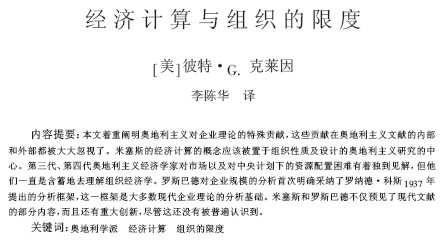
Here is a Chinese translation of my 1996 article “Economic Calculation and the Limits of Organization,” one of my favorites. It appears in Comparative Economic and Social Systems 116, no. 6 (2004): 70-78. The journal is edited by Wu Jinglian, an important Chinese economist specializing in economic reform. (Thanks to Chenhua Li for the translation and Kuo-Yang Tang for background information.)
Outsourcing Bleg
| Peter Klein |
A friend asks for good examples of companies outsourcing core functions or selling core technology and brands. Suggestions?
Knightian Financial Markets
| Peter Klein |
Frank Knight knew in 1921 what the world’s most sophisticated mathematical models could not capture today. That is, there is a fine line between risk with mathematical probabilities and uncertainty that cannot be measured. Although investors have no difficulty in pricing all sorts of risks, the “immeasurable” uncertainty and information asymmetries make them shy away from all forms of risk, especially in times of global anxiety. In our view, this is exactly what has happened in the past couple of weeks in financial markets, as credit risks linked to the US subprime-mortgage market spread out (through highly leveraged derivatives and structured instruments) and triggered a volatility wave across the world.
That’s Morgan Stanley’s Serhan Cevik and Katerina Kalcheva, writing in yesterday’s Global Economic Forum. Kudos to Cevik and Kalcheva for reminding investors (or, more likely, economists) that some risks cannot be measured and priced. But keep in mind that Knight treated uncertainty as ubiquitous, not some parameter that rises and falls with market conditions. “Profit arises out of the inherent, absolute unpredictability of things, out of the sheer brute fact that the results of human activity cannot be anticipated and then only in so far as even a probability calculation in regard to them is impossible and meaningless,” as he famously put it. (BTW you can get the full text of Risk, Uncertainty, and Profit online, courtesy of EconLib.)
Act versus Rule Self-Interest
| Peter Klein |
Ethicists commonly distinguish between “act” and “rule” utilitarianism. Act utilitarians believe that individual actions should be evaluated according to some standard of overall well-being, while rule utilitarians maintain that such standards need apply only to general rules, not specific acts. (Here is an argument that Ludwig von Mises was the latter type of utilitarian.)
By analogy, one can think of act and rule self-interest. Consider the standard repeated prisoner’s dilemma game in which a player can increase his payoff in the current period by defecting, but in doing so would trigger a matching response by his opponent, thus reducing his overall payoff relative to that in the Nash equilibrium in which each player cooperates every period. A merchant may refrain from cheating his customers today not out of moral obligation, but because the long-term gains from establishing a reputation for trustworthy behavior outweigh the short-term losses from honest dealing. (more…)
We’re #28!
| Peter Klein |
Not that we’re obsessed with rankings or anything, but O&M ranks 28 out of 125 economics blogs studied here. Most of those ranked higher are general-interest sites like Freakonomics, Marginal Revolution, Mankiw, DeLong, etc., so we’re not doing too badly as a fairly specialized management blog. Thanks to all our readers for their support!
Men of Wealth
| Peter Klein |
John T. Flynn’s 1941 classic Men of Wealth is back in print, courtesy of the Mises Institute. I’ve had an old copy on my shelf for years, having once stumbled across a rare first edition at Bell’s Books in Palo Alto. The book profiles Jacob Fugger, John Law, the Rothschilds, Robert Owen, Cornelius Vanderbilt, Henry Green, Hachirobei Mitsui, Cecil Rhodes, Basil Zaharoff, Mark Hanna, John D. Rockefeller, and J. Pierpont Morgan. Unlike the typical business history text (ahem), it is written in a lively and engaging style. To get the flavor, consider this excerpt from chapter 9 on the little-known but highly influential arms dealer Basil Zaharoff:
Zaharoff played a leading, if not the leading, role in that strange world comedy of the arms makers leading the double life of chauvinists and internationalists. They gave us the spectacle of Boers mowing down English regiments with Vickers’ pom-poms, Prussian surgeons picking out of Prussian wounded Austrian shrapnel fired by Krupp’s cannon, French poilus massacred by shot poured out of guns made in Le Creusot, English Tommies killed by weapons produced by Armstrong and Vickers, and American ships sent to the bottom by U-boats built on models supplied by American submarine builders. Zaharoff was the master of what one biographer has called the “principle of incitement,”under which war scares were managed, enemies created for nations, airplanes sold to one nation and antiaircraft guns to her neighbors, submarines to one and destroyers to another. He did what the cigarette people did, what the liquor industry, the beauty industry did — created a demand for his merchandise. The armament industry became a game of international politics, the arms salesman a diplomatic provocateur, the munitions magnates of all nations partners in cartels, combines, consolidations; exchanging plans, secrets, patents. He was the greatest of all the salesmen of death, and, as one commentator has observed, if you would see his monument, look about you at the military graveyards of Europe.
You can read the rest of the chapter here.
Two Entrepreneurship Papers
| Peter Klein |
- “International Financial Integration and Entrepreneurial Firm Activity” by Laura Alfaro and Andrew Charlton. Evidence from a large cross-country dataset establishes a strong correlation between entrepreneurial activity (what I call “structural entrepreneurship,” the proportion of new and small firms to total firms) and various measures of international financial integration. Suggests that international capital flows are good for economic growth (take that, neo-mercantilists!). See Maury Obstfeld’s 1998 JEP paper for some background.
- “Charles Le Maistre: Entrepreneur in International Standardization” by JoAnne Yates and Craig Murphy. Le Maistre was a pioneer of voluntary, international cooperation on technical standards. Summarizing Le Maistre’s accomplishments, Yates and Murphy argue that “industrial standardization, usually thought of as a staid field that limits, rather than promotes, innovation, is populated by multiple individuals who can be seen as entrepreneurs of standardization, either in a particular technical arena or on a broader, organizational level. “
Entrepreneurship, Arbitrage, and Capital
| Peter Klein |
Over the years I’m increasingly convinced that Israel Kirzner’s metaphor of entrepreneurship as costless discovery — a form of arbitrage, exploiting differences between actual prices and their Walrasian equilibrium values — is a misleading way to think about entrepreneurship. Emphasizing knowledge, the awareness of facts that other market participants do not possess, the metaphor leads our attention away from action, the employment of scarce means to achieve economic ends. I’ve argued in a series of papers (1, 2, 3) that opportunity exploitation, not opportunity discovery, drives the market process.
A key problem for the Kirznerian metaphor is that entrepreneurship does, in practice, involve capital investment, despite Kirzner’s insistence that “pure entrepreneurship” does not require ownership of resources. (As Joe Salerno reminds us, favorable reviews of Kirzner’s Competition and Entrepreneurship by Austrians Murray Rothbard, Henry Hazlitt, and Percy Greaves all pointed to the separation of entrepreneurship and property ownership as the lone weakness in Kirzner’s otherwise excellent exposition.) But what about financial-market arbitrage, an example often cited in the Kirznerian literature? Isn’t arbitrage an example of costless discovery of pure profit? Doesn’t the arbitrageur operate without capital? (more…)
Managing the Philanthropic Enterprise
| Peter Klein |
McKinsey’s Luis Ubiñas will become Ford Foundation CEO next year, reports the Chronicle. This is an unusual move because philanthropic foundations have traditionally chosen career insiders for top management posts. “It runs counter to the idea that grant making is a closed profession, that you stay in this field and you simply move through the field,” says UT-Austin’s Peter Frumkin, quoted in the Chronicle piece. Have foundations decided, like many US corporations, that functional expertise is less important than general managerial skill?
Software for Deconstructionists
| Peter Klein |
Software developer Andy Brice performs a Sokal experiment, with similar results.
Publish or Perish 2.2
| Peter Klein |
Anne-Wil Harzing’s Publish or Perish software, discussed here by Nicolai, is available in a new version. Anne-Wil notes that “[t]he choice for Google Scholar is particularly relevant for Management scholars as many good journals in our field are not ISI listed and hence citations in these journals are not counted by ISI.”
More Podcasts: Gordon, Weingast, Salerno-Klein
| Peter Klein |
- The History of Political Philosophy: From Plato to Rothbard by former O&M guest blogger David Gordon. A ten-lecture series delivered in June 2007 covering Plato, Aristotle, Aquinas, Hobbes, Locke, Rousseau, Kant, Hegel, Mill, Spooner, Spencer, Rawls, Nozick, Rothbard, and more. Only David Gordon could be an expert on all of these.
- Russ Roberts’s interview with Barry Weingast about the new book by North, Wallis, and Weingast, A Conceptual Framework for Interpreting Recorded Human History (what a title!). Weingast has become so prominent in political science it is easy to forget that he has an economics PhD (from Cal Tech) and started his career as an economics professor at Washington University in St. Louis. (His critics have not forgotten.)
- Fundamentals of Economic Analysis: A Causal-Realist Approach. Economics in the tradition of Carl Menger, starting with the basics of scarcity, choice, value, and exchange then moving to pricing, entrepreneurship, capital, competition, money, banking, and the business cycle. Joe Salerno and I give the lectures. You can also get these as videos in a handsome DVD set.
Machlup-Klein Day
| Peter Klein |
You all know about Hayek-Klein day. Did you know today is Machlup-Klein day? Economist Fritz Machlup, student and friend of Ludwig von Mises, contemporary of F. A. Hayek, and mentor to Edith Penrose, was born 15 August 1902. My dad’s birthday is also today, August 15! What is it about Kleins and great Austrian economists?
Economists and the Economy
| Peter Klein |
Chris Dillow, channeling yours truly, writes:
Economists are everywhere. Steve Levitt, Tim Harford and Steven Landsburg use newspaper columns and best-selling books to show how economics can account for why drug dealers live with their mums, why you can’t find space to park, why school teachers cheat, why people share umbrellas and why sexually transmitted diseases are so rife. Simple economics, it seems, can explain everything.
Everything, that is, except the economy. Although orthodox economics can do a good job of explaining why people get a divorce or the clap, it does a much worse job of accounting for what people think it should explain.
Dillow’s essay in the Times goes on to focus on the prediction problem. (more…)
Mind Mapping
| Peter Klein |
Most academics I know take notes in a fairly linear, textual fashion. At your next conference, seminar, workshop, or committee meeting, why not try mind mapping instead?
São Paulo Workshop on Institutions and Organizations
| Peter Klein |
Three Brazilian institutions — Fundação Getúlio Vargas São Paulo, IBMEC São Paulo, and the University of São Paulo — are jointly sponsoring a “Research Workshop on Institutions and Organizations” in São Paulo, 2-4 September 2007. Keynote speakers are Jackson Nickerson, Armando Castelar, and me. From the blurb:
Seminar participants will discuss recent developments in the analysis of institutions and organizations through the lenses of Economics, Management, Sociology, Law and other social sciences. Instead of focusing on the contributions of specific disciplines dealing with institutions and organizations, workshop participants will emphasize differences and commonalities among different approaches, leading to potential advances and refinements in the field.
Here is registration information and a preliminary schedule.
State-Owned Firms: Still Inefficient
| Peter Klein |
Generalissimo Francisco Franco is still dead, and state-owned firms are still inefficient. A survey of over 12,000 Chinese firms finds that “even after a quarter-of-century of reforms, state-owned firms still have significantly lower returns to capital, on average, than domestic private or foreign-owned firms.” This from “Das (Wasted) Kapital: Firm Ownership and Investment Efficiency in China” by David Dollar (great name!) and my former Berkeley classmate Shang-Jin Wei. “By our calculation,” they write, “if China succeeds in allocating its capital more efficiently, it could reduce its capital stock by 8 percent without sacrificing its economic growth.”
The paper is light on theory and interpretation, but there is a substantial literature on the problems of state ownership to which one can easily refer (good starting points here, here, and here.)
Austrian Economics at the AoM
| Peter Klein |
Last week’s Academy of Management meeting featured a pre-conference workshop, “The Austrian School of Economics: Applications to Organization, Strategy, and Entrepreneurship,” organized by Nicolai and myself. I began with an overview of the Austrian approach and reviewed some of the key figures in its development. Panelists Joe Mahoney, Yasemin Kor, Dick Langlois, Nicolai, and Elaine Mosakowski each gave some prepared remarks about aspects of the Austrian tradition that apply to their work, followed by general discussion among the panelists and the audience. Here are copies of the prepared remarks and here are some photos (courtesy of Peter Hofherr).

 We weren’t sure what to expect — a dozen or so participants, perhaps? — and were delighted when over 100 people showed up, leaving standing room only. This and other indicators suggest growing interest in Austrian economics among management scholars. Of course, a belief in the relevance of the Austrian approach to business administration is a core value here at O&M.





 Organizations and Markets

Recent Comments