Posts filed under ‘– Klein –’
The Methods of Management History
| Peter Klein |
Thomas Hobbes (1660/1994:32) observed that “Out of our conception of the past, we make a future.” It behooves us then, as managers and management scholars, to be satisfied that our conceptions of the past are developed in ways that, as far as possible, avoid the problems that would make them less than useful in creating that future.
Despite the importance of this subject, little attention has been given to the question of method/methodology in management history. A recent Google Scholar search found that, while the term “management history” produced 194,000 hits and “method in history” resulted in 674 hits, the terms “methodology in management history,” “method in management history,” “management history methodology,” and”management history method” produced no hits at all.
To address this deficiency the Journal of Management History is seeking contributions for a special issue on “Scholarship in Management History: The Importance of Methodology.” (I assume they know the difference between method and methodology.) Here is the call for papers.
Can readers suggest good books or papers on the methods of management history?
Kauffman Data Symposium
| Peter Klein |
The Kauffman Foundation is sponsoring a symposium on entrepreneurship and innovation data November 2-3 in Kansas City. The website indicates that seating capacity is filled, but proceedings and information on datasets will be available on the site. Mike Sykuta and I will give a presentation on the CORI contracts library.
Innovation manifests itself in different ways, and empirical researchers have used data on patent rates, R&D expenditure, new product introductions, and similar phenomena to measure it. On entrepreneurship data, however, there is far less consensus. In part this results from widely varying conceptions of what entrepreneurship is. Self-employment rates, the number of business startups, the ratio of small firms to large firms, and the like are measurable, but do they correspond to entrepreneurship? If entrepreneurship is alertness, adaptation, innovation, or — my favored concept — judgment, then occupational and structural measures may not capture it very cleanly.
Can Markets Be Designed?
| Peter Klein |
A fundamental distinction between organizations and markets is teleological: organizations are established by specific individuals to achieve specific purposes, while markets emerge, organically, from the bottom up. Carl Menger used the terms “organizations” and “orders” to distinguish these two categories of institutions; Hayek preferred the obscure Greek terms taxis and cosmos. Invoking this distinction does not deny, of course, that there are “organic” elements within firms, or that markets are infused with institutions that are at least partly “designed” (civil law codes, for instance).
What, then, is meant by “market design,” as in designing markets for cadaveric organs, education vouchers, or tradeable emissions permits? Do attempts to do so constitute what Hayek called “constructivist rationalism” or “constructivism,” the belief that we can remake social institutions that have emerged incrementally, over long periods of time, to suit our current whims?
Lynne Kiesling and Mike Giberson have been wrestling with this question over at Knowledge Problem (here and here). How, asks a reader, “does one invoke Hayek in one breath and then speak of ‘designing’ a market in the next while keeping a straight face?” Lynne and Mike offer several responses: (more…)
Squeezed Books
| Peter Klein |
Another open-source, wiki-style book abstracting service, similar to WikiSummaries. It’s just getting off the ground; why not add your own content and help make the world a better place?
Tennis Stat of the Day
| Peter Klein |
How dominant is Roger Federer? Rafael Nadal has been #2 in the ATP rankings, behind Federer, for 98 consecutive weeks — the longest anybody has been #2 without reaching #1 in the modern era. (Thanks to NBC for providing the stat during today’s French Open men’s final.)
It’s an interesting metric. What firms have held the #2 spot in their industries (sales, market share, earnings, etc.) the longest without reaching #1? Anybody with Compustat data and a few hours to spare want to crank some numbers for us?
Would You Publish Your Dissertation Drafts on the Web?
| Peter Klein |
Academic researchers have long circulated unpublished working papers, first on paper (remember those little yellow NBER working papers?) and now on the web. Of course, opinions differ on when papers should be circulated. Some scholars share their early drafts, hoping to solicit constructive feedback; others prefer to wait for a more mature product, worrying about unpolished writings that live forever in the Google cache.
But would you circulate rough drafts of dissertation chapters online? Advisers, would you encourage your students to do this? (more…)
Plasticity and Asset Specificity
| Peter Klein |
A reader asks what I think of Alchian and Woodward’s concept of “plasticity” and how it relates to Williamson’s notion of asset specificity.
The term was introduced in “The Firm is Dead: Long Live the Firm” (Journal of Economic Literature, 1988), Armen Alchian and Susan Woodward’s thoughtful review of Williamson’s Economic Institutions of Capitalism. They define plasticity as the range of uses to which an asset may be put. “We call resources or investment ‘plastic’ to indicate that there is a wide range of discretionary, legitimate decisions within which the user may choose” (p. 69). In the Barzelian language favored on this blog, plasticity can be interpreted as the number of attributes — realized or potential — that assets possess. Trucks and copy machines are highly plastic. So are R&D labs, in the sense that they can be used to pursue long- or short-term objectives, to satisfy clients’ objectives or to maximize the researchers’ utility, and so on. Steel mills are implastic because they can be used to make steel and little else. (more…)
Private Legal Enforcement in Global Commerce
| Peter Klein |
A new paper by Margaret Blair, Cynthia Williams, and Li-Wen Lin, “Assurance Services as a Substitute for Law in Global Commerce,” describes the market for “assurance services” as private means of enforcing commercial arrangements.
In this article we examine the rapid emergence and expansion of a private-sector compliance and enforcement infrastructure that we believe may increasingly be providing a substitute for public and legal regulatory infrastructure in global commerce, especially in developing countries where rule of law is weak and court systems are absent or inadequate. This infrastructure is provided by a proliferation of performance codes and standards, and a rapidly-growing global army of privately-trained and authorized inspectors and certifiers that we call the “third-party assurance industry.” The growth in the third party assurance business has been phenomenal in the last decade. The business first developed to facilitate making and carrying out private contracts, but in recent years, assurance services are being deployed for purposes that are more appropriately seen as regulatory in nature. Third-party assurance may thus be providing a new institutional structure through which private commercial exchange is being harnessed and regulated for essentially public purposes.
See also Alex Tabarrok on private assurance contracts, which function similarly to enforce contributions to public goods and club goods.
Geek News de Jour
| Peter Klein |
 Stata 10 ships June 25.
Expect overnight campers and long lines at the university bookstore, like the crazy scene at Best Buy when the Xbox 360 went on sale. (HT: SSSB)
Nurkse at 100
| Peter Klein |
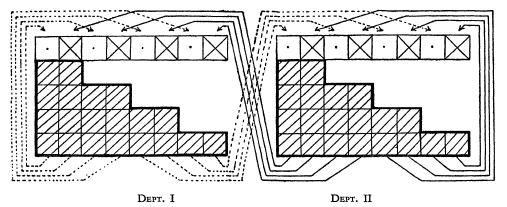
 Reader G. V. Varma reminds me that Ragnar Nurkse was born 100 years ago today, June 5. I don’t have anything to add to this earlier post except to share these funky diagrams from Nurkse’s 1935 Review of Economic Studies article on the structure of production. Each is supposed to illustrate a circular process in which fixed capital reproduces itself. (Neither, I’m afraid, will win an award for pedagogy.)
The spout-and-ring diagram is explained as follows: “The ‘ring’ is equivalent in meaning to Dept. I [which produces capital goods] and the ‘spout’ to Dept. II pouring forth its output of consumable goods. The output of Dept. I divides itself as the dotted line: part of it flows back into the ring (to maintain fixed capital in Dept. I itself). This picture, though less informative than the departmental scheme [pictured below] in bringing out the internal exchange relationships of a capitalist economy, may nevertheless be useful in illustrating the circular process of capital reproduction as lying, in a sense, behind the purposive orientation economic activity directed toward the creation of consumable income.”
Hopefully there is a Nurkse specialist out there who can help us make sense of the larger diagram.
Did Nobody Consider the Incentive Effects?
| Peter Klein |
Heard on NPR this morning:
SEOUL (AP) — A South Korean bank is offering to help heartbroken soldiers dumped by girlfriends while away on mandatory military service by providing special interest rates for stilted troops.
Soldiers who can show letters or e-mail proving their break-up to a bank clerk can receive a new deposit plan with better rates and waived service fees.
Look for a new Korean country-and-western song, “My Baby Dumped Me for a Basis Point.”
Concise Summary of Chandler’s Achievements
| Peter Klein |
Louis Galambos, writing at EH.News:
When Alfred D. Chandler, Jr., entered the subdiscipline of business history, the field was producing very little scholarship of great interest, even to other historians. When Chandler, the world’s leading historian of business, died recently (May 9, 2007) at the age of 88, his legacy included a vibrant, influential body of scholarship and active scholars producing studies that intersected creatively with important developments in economics, sociology, and political science — as well as modern history. Chandler remade business history by publishing a long series of works characterized by meticulous, penetrating research; careful analysis of the data; and, above all, original, imaginative synthesis. Drawing upon the sociology of organizations and Schumpeterian economic analysis of innovation, Chandler reconstructed our understanding of the rise of large enterprise in America and Europe. The business bureaucracies he described were innovative and efficient. Economies of scale and scope, as well as aggressive, successful research and development, enabled them to hold their positions in a capitalist system that was changing rapidly in the second and third industrial revolutions. Their leaders were investors, not Robber Barons; they guided the evolution of the giant, multinational, multidivisional enterprises that have played a central role in capitalist progress since the late nineteenth century. Chandler left the politics of political economy, the labor relations of the firm, and the gender and racial themes of interest to many American scholars of late to other historians of business. His focus throughout his long, amazingly productive career was on the large, successful corporations that have played the central role in global economic development in the modern era.
Klein-Mahoney Smackdown
| Peter Klein |
Those of you in the Pacific Northwest may wish to drop by the annual meeting of the American Agricultural Economics Association, 29 July to August 1 in Portland, Oregon, for this session organized by Randy Westgren:
Economic Theories of Entrepreneurship
Monday, July 30, 10:30am – 12:00pmThis session will offer the chance to explore the economic foundations for the study of entrepreneurship. Joseph Mahoney and Peter Klein will engage in a “Point-Counterpoint” discussion on the theory of entrepreneurial behavior using the lenses of classical, neoclassical, Austrian, institutional, and Carnegie School economics. The discussion will explicitly evoke audience participation in an open and informal design. The various lenses will be used to highlight where the (usually) amorphous study of entrepreneurship can benefit from theoretical foundations.
Last man standing wins.
More Robbins
| Peter Klein |
Further commemorations of the 75th anniversary of Lionel Robbins’s Nature and Significance of Economic Science. Next week’s History of Economics Society annual meeting in Fairfax, Virginia includes a Robbins session with papers by Steve Medema and Roger Backhouse, Dave Colander, and Alain Marciano.
Color Me Beautiful
| Peter Klein |
 The most popular colors on national flags are white and red, followed by blue, green, and black. Click here to see how the analysis was done, and to play a fun game of “identify the flag” (click on the pie charts to reveal the flags). (HT: SMCISS blog.)
I wonder how much of this clustering is explained by path dependence? The flags of many former European colonies are, of course, based on the mother country’s flag.
Here’s another interesting example of chromatic clustering: corporate logos. The graphic below (click to enlarge) ran in the June 2003 issue of Wired, in a feature called “The Battle for Blue.” This blurb accompanied the graphic:
Companies spend millions trying to differentiate from others. Yet a quick look at the logos of major corporations reveals that in color as in real estate, it’s all about location, location, location. The result is an ever more frantic competition for the best neighborhood.

I use this example in class to illustrate Hotelling’s law.
Today in Business History
| Peter Klein |
The Friends of Business History newsletter includes a fun feature, This Day in Business History. June 1 was a busy day.
- 1495: Friar John Cor records the first known batch of Scotch whiskey in the Exchequer Rolls of Scotland.
- 1774: The British government orders Port of Boston closed.
- 1812: President James Madison calls on Congress to declare war on Great Britain, after fiscally minded measures fail to dissuade the British from harassing American ports and ships.
- 1869: Thomas Edison receives a patent for a voting machine. It was his first patent for a device.
- 1905: The first world’s fair to be held in the Pacific Northwest, the Lewis & Clark Centennial and American Pacific Exposition and Oriental Fair opens in Portland, Oregon.
- 1911: The Equitable Life Assurance Society of New York issues the first U.S. group insurance policy to the Pantasote Leather Company and its 121 employees.
- 1917: Henry Leland, founder of the Cadillac Motor Car Company, resigns as company president.
- 1947: Corning Glass Works publicly announces its development of photosensitive glass.
- 1961: Regular FM multiplex stereo broadcasting debuts in Schenectady, New York and Chicago, Illinois.
Celebrate with me by pouring a glass of scotch, buying an insurance policy, selling your Cadillac, turning up the radio, and punching an Englishman.
Core Economics for Managers
| Peter Klein |
Previously I’ve noted the new managerial economics texts by Dwight Lee and Richard McKenzie and Luke Froeb and Brian McCann. Joshua Gans was kind enough to send me a copy of his Core Economics for Managers (Thomson, 2005) and it looks like a good option as well.
The first thing one notices about the book is its brevity and clean, minimalist design: just 206 pages, no fancy graphics, and few sidebars or mini-cases. The book focuses on the “core” areas of pricing, competitive strategy, incentives, and contracts, omitting corporate strategy, human resource management, and peripheral areas like ethics. As its main pricing model, the book features not the increasingly irrelevant perfectly competitive (general or partial) equilibrium model, but a negotiation framework like that in Brandenburger and Nalebuff’s 1996 book Co-opetition. That is, unlike the typical strategy text, cooperative game theory gets as much attention as its more familiar noncooperative counterpart.
Part IV of the book, on contracting, looks particularly good. It favors the property-rights approach to the firm (in my judgment, the correct approach) over the nexus-of-contracts approach, and features a section on relational contracting, a topic usually omitted from introductory managerial texts.
Joshua will be revising the text in the coming months for a new edition and would appreciate suggestions for improvement.
More on the Austrian Firm Conference
| Peter Klein |
Anthony Evans offers further reflections on the “Austrian Market-Based Approaches to the Theory and Operation of the Business Firm” conference, including the epic Klein-Sautet showdown.
Average versus Marginal: Blowback Edition
| Peter Klein |
Republican Presidential candidate Ron Paul caused a stir recently by suggesting, to the horror of the other Republican candidates, that US foreign policy might have something to do with Muslim anger toward the US. The Bush Administration, of course, maintains that “they hate us for our freedom.” No matter what the US government does, in other words, Islamic extremists will target Americans in retaliation for the Declaration of Independence, McDonalds, and Paris Hilton. (Rudy Giuliani, incredibly, claims he has never even heard of blowback.)
Of course, these explanations are not incompatible. US culture and institutions could, in theory, account for the average level of anti-Americanism in the Islamic world. To explain a specific terrorist act, however, we have to think in marginal terms. What we call “terrorism,” as Robert Pape has brilliantly explained, is a tactic, not an ideology. Whatever his general attitude toward the enemy, the terrorist must choose to attack this target or that, to attack now or later, to select one more target or one less. Even if exogenous US characteristics were responsible for overall terrorist attitudes and beliefs, blowback is probably still the best explanation for specific terrorist acts.
Note that this is an application of a more general point about intrinsic and extrinsic motivation, an important issue for management theory. (more…)
O&M at the AoM
| Peter Klein |
O&M will be well represented at the Academy of Management annual meeting in Philadelphia, 3-8 August 2007. Former guest blogger (and Philly native) Joe Mahoney is president-elect and program chair for the Business Policy and Strategy Division, so you know the program will be good.
I am chairing a Professional Development Workshop (PDW) titled “The Austrian School of Economics: Applications to Organization, Strategy, and Entrepreneurship” featuring former guest bloggers Mahoney and Dick Langlois along with Elaine Mosakowski, Yasemin Kor, Nicolai, and myself. Teppo of orgtheory.net has put together a session on “Entrepreneurship and Strategic Organization: Taking Stock, Problems, and Future Directions” which includes Jay Barney, Todd Zenger, Kirsten Foss, Mosakowski, Nicolai, and me. Other sessions of note include a PDW on the fifth anniversary of the excellent Strategic Organization (Nicolai is in that one too, along with O&M favorite and guest blogger Chihmao Hsieh’s mentor Jackson Nickerson); a session on the philosophical and epistemological foundations of strategy and organization theory, organized by Teppo and featuring regular O&M commentator J. C. Spender; a session on cognitition in organizational economics; and many other interesting workshops, lectures, and sessions on organization, strategy, entrepreneurship, and the market process.
PS: Before you go, be sure to study this article on Philadelphia dining from the current issue of Food and Wine Magazine.





 Organizations and Markets
Recent Comments