Posts filed under ‘Law and Economics’
Intellectual Steam
| Dick Langlois |
 There’s nothing like a rousing academic argument, especially when it deals with an intriguing historical case. “The Fable of the Keys” by Liebowitz and Margolis is the paradigm here. I recently stumbled upon another example, the (apparently ongoing) dispute that pits George Selgin and John Turner against Michele Boldrin and David Levine on the question of to what extent James Watt’s steam-engine patents retarded innovation in steam technology and slowed the British industrial revolution.
The Newcomen steam engine was a low-pressure device that, by using steam to create a vacuum, actually used air pressure to drive the engine. Watt invented and patented an improvement to the vacuum engine that involved a separate condenser to cool the steam, thus increasing efficiency. On the strength of his patent, Watt was bankrolled by the industrialist Matthew Boulton, and together they licensed the technology to others and did their best to block competing technology. Boldrin and Levine claim that the Watt patent constituted a wide-scope blocking patent, of the kind described by Merges and Nelson, which slowed development of rival technologies, including the high-pressure steam engine that was to be crucial in textiles and elsewhere. As a result, the Boulton-Watt patents and legal stratagems “delayed the industrial revolution by a couple of decades.” Selgin and Turner take issue with both facts and conclusions, arguing that patent law at the time, which derived from the 1625 Statute of Monopolies, actually forbade the patenting of a general idea and insisted that an innovation be instantiated in specific technology, in this case in the form of the condenser. In other words, they argue that patent scope was kept sensibly low in eighteenth-century Britain, something of which Merges and Nelson would approve. Thus Boulton and Watt could not, and in fact did not, slow the development of high-pressure steam through intellectual property, though they may have had an effect on the culture of contemporary inventors, who doubted the economies and feared the dangers of high-pressure steam at a time when complementary metallurgical technology was not yet up to the task. (Note to Selgin and Turner: here is a better reference on the dangers of high-pressure boilers in American steamboats.) (more…)
Manne on Fama and French
| Peter Klein |
An open letter to Gene Fama and Ken French from Henry Manne (also running today at Truth on the Market):
Dear Gene and Ken:
I must say that I was totally flabbergasted when I read your recent blog posting on insider trading. I know that your usual posts on investments, which I often cite to friends, are well-informed and empirically supported; your work over the years on these topics is important and influential — and rightly so. Unfortunately, in this post, you have deviated from your usual high quality. Anyone current on the topic of insider trading will recognize that you have been careless in your selection of anti-insider-trading arguments and that you omitted from your brief note the major part of the argument about insider trading: whether and how much it contributes to market efficiency. To say this is a strange omission coming from Fama and French would be an understatement.
Your first error is to assume that the insider trading debate is about informed trading only by “top management.” I suspect that this error may flow from my original argument for using insider trading to compensate for entrepreneurial services in a publicly held company, a matter you do not mention and which I will not pursue here except to note that “entrepreneurial services” does not equate to top management. Strangely no one seems to notice that most of the celebrated cases on the subject have not involved corporate personnel at all (a printer, a financial analyst, a lawyer, and Martha Stewart). (more…)
Third Searle Center Entrepreneurship Symposium
| Peter Klein |
The schedule is up for the Third Annual Searle Research Symposium on the Economics and Law of the Entrepreneur, 17-18 June 2010 in Chicago. Registration information is here. I participated in the 2008 version and enjoyed it very much.
Posner on Institutions and Organizations, Round Two
| Peter Klein |
Remember the infamous Posner-Coase-Williamson exchange from JITE, 1993? Posner dismissed the New Institutional Economics as a derivative form of Posnerian law and economics, prompting unhappy replies from Coase and Williamson. Here’s Coase:
Posner [1993, 79] says that the first part of his paper describes “the conception of the field [the new institutional economics] held by Ronald Coase.” Reading this part of his paper recalled to my mind Horace Walpole’s opening remarks in his book on King Richard the Third: “So incompetent has the generality of historians been for the province that they have undertaken, that it is almost a question, whether, if the dead of past ages could revive, they would be able to reconnoitre the events of their own times, as transmitted to us by ignorance and misrepresentation” (Walpole [1768, 1]). I have only one foot through the door but should the final yank come before this piece is published, Horace Walpole’s words would apply exactly to Posner’s highly inaccurate account of my views.
Adds Williamson, wryly: “Richard Posner is a prolific writer and distinguished jurist. He is frequently asked to speak with wisdom and authority on many issues. Whether he hits the mark or misses varies with his depth of knowledge and understanding of those issues. . . . I content that Posner’s [1993] commentary mainly misses.”
Now Geoff Hodgson has produced a reboot: a long essay by Posner in the Journal of Institutional Economics titled “From the New Institutional Economics to Organization Economics: with Applications to Corporate Governance, Government Agencies, and Legal Institutions,” with replies from Jürgen Backhaus, Bruno Frey, Lin Ostrom, John Roberts, Tom Ulen, and several others (but not Coase or Williamson!). Posner focuses almost exclusively on the principal-agent problem, perhaps unaware that information, delegation, coordination, and adaptation are also important issues in organizational economics. His main conclusion seems to be that both private firms and public agencies are equally inefficient. Interesting reading, to be sure (and much better than Posner’s solipsistic essay on his conversion to Keynesianism, inexplicably published by the New Republic).
Mannepalooza at Austrian Scholars Conference
| Peter Klein |
Tune in here at 3:45 EST today for a live broadcast of the ASC session, “The Contributions of Henry G. Manne,” organized by yours truly. Panelists include me, Alexandre Padilla, Richard Vedder, Thomas DiLorenzo, and Henry Manne. And buy your copy of the Collected Works.
Update: audio files are now available: Klein, Padilla, Vedder, DiLorenzo, Manne.
Unquenchable
| Dick Langlois |
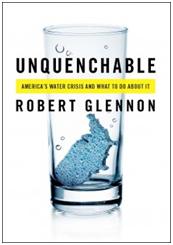 I attended an interesting lecture on Thursday, part of the University’s Edwin Way Teale lecture series on the environment. Normally these lectures do not tend, shall we say, to take perspectives that O&M readers would find congenial. But this lecture, by Robert Glennon of the University of Arizona Law School, was interesting along a number of dimensions. The talk was based on his book Unquenchable: America’s Water Crisis and What To Do About It. Here is the abstract:
From manufactured snow for tourists in Atlanta to trillions of gallons of water flushed down the toilet each year, Dr. Robert Glennon reveals the heady extravagances and everyday inefficiencies that are sucking the nation dry. The looming catastrophe remains hidden as the government diverts supplies from one area to another to keep water flowing from the tap. But sooner rather than later, the shell game has to end. And when it does, shortages will threaten not only the environment, but every aspect of American life. America must make hard choices — and Glennon’s answers are fittingly provocative. He proposes market-based solutions that value water as both a commodity and a fundamental human right.
The talk was interesting not only in that I learned a few things about the screwed-up water system in the U. S. (the broad contours of which I was vaguely familiar with) but also in that it presented an interesting case study in rhetoric. Glennon spent most of the talk revving up the environmentalist crowd, with lots of show and tell about the effects of bad water policy and a tour through various command-and-control policies that environmentalists might think of to fix the situation. (He even paused to make fun of Ann Coulter’s claim that the flush toilet is man’s greatest invention.) But Glennon’s bottom line, revealed at the very end, is that the only thing that will fix the problem is properly assigning property rights and trading those rights on markets. This was the conclusion I was expecting, not only because of the abstract but also because Glennon has an NBER Working Paper with Gary Libecap. Maybe this is the way to go in selling market-based solutions.
The Best and the Brightest
| Dick Langlois |
I read Peter’s post about paternalism — and the limits of smart people in government — just after I read about the death of Carl Kaysen, long-time MIT economist and one-time Kennedy advisor. Obituaries praise Kaysen for his role as a policy intellectual of great scope, especially in the area of nuclear non-proliferation. But they either fail to mention, or mention with considerable approval, Kaysen’s pivotal role in the famous 1954 United Shoe Machinery case. Kaysen’s view of the case, and of the role of economic analysis in antitrust, is a key example of what Williamson calls the “inhospitality tradition” — that any kind of contract we don’t understand must therefore be anticompetitive. In the eyes of many present-day economists, Kaysen is implicated in having destroyed the American shoe machinery industry and with it the American shoe industry. (The post-mortem is by Masten and Snyder.) Not exactly McNamara in Vietnam, but worth mentioning amid the hagiography of Kaysen, not to mention the reawakened culture of elitist decision-making in Washington.
Apocalypse Averted
| Dick Langlois |
In a recent post, I lamented the willingness of pundits (and dissenting Justices) to see rights as a consequential exercise: we should restrict the speech of group X, in this case private corporations, because allowing such speech would lead to a bad outcome, in this case the corruption of democracy by corporate interests. (Feel free to substitute here your own favorite candidate for silencing and your own associated bad outcome.) But, of course, those who argue in this manner must also demonstrate that the asserted bad outcome would actually happen. A recent article in the Times — bless some reporter’s or editor’s contrarian heart — asks the question: so, what effect does corporate money actually have on democracy?” The answer seems to be: none at all. One of the economists cited is Peter’s Missouri colleague, and my former student, Jeff Milyo: “There is just no good evidence that campaign finance laws have any effect on actual corruption.”
And while we are at it, a study by the Insurance Institute for Highway Safety finds no effect of cell phone laws on traffic accidents. This hasn’t stopped Connecticut’s Governor from calling for even stricter cell phone laws.
Now That’s a Complete Contract!
| Peter Klein |
A major theme of the contracting literature in organizational economics is that formal contracts are inevitably incomplete, meaning that they do not specify actions and remedies for every possible set of circumstances. Given genuine uncertainty about the future, parties may decide that formal contracts to not adequately protect relationship-specific investments, providing an important rationale for vertical integration or another mechanism to protect quasi-rents (alliances, equity-sharing arrangements, reputation, and other “hybrids”).
A recent WSJ piece suggests that writing complete contracts may not be so hard after all:
Decked out in sequined black and gold dresses, Anne Harrison and the other women in her Bulgarian folk-singing group were lined up to try out for NBC’s “America’s Got Talent” TV show when they noticed peculiar wording in the release papers they were asked to sign.
Any of their actions that day last February, the contract said, could be “edited, in all media, throughout the universe, in perpetuity.”
My Mom says she once told me I was the best little boy in the world, to which I responded, “and all the planets too?” The WSJ gives several examples of similarly expansive coverage:
- The terms of use listed on Starwars.com, where people can post to message boards among other things, tell users that they give up the rights to any content submissions “throughout the universe and/or to incorporate it in other works in any form, media or technology now known or hereafter developed.”
- In a May 15, 2008, “expedition agreement” between JWM Productions LLC, a film-production company, and Odyssey Marine Exploration Inc., a shipwreck-exploration outfit, JWM seeks the rights to footage from an Odyssey expedition. The contract covers rights “in any media, whether now known or hereafter devised, or in any form whether now known or hereafter devised, an unlimited number of times throughout the universe and forever, including, but not limited to, interactive television, CD-ROMs, computer services and the Internet.”
And my personal favorite:
A 189-word sentence in a September agreement between Denver-based Spicy Pickle Franchising Inc. and investment bank Midtown Partners & Co. — which has helped raise capital for the sandwich and pickle shops dotted across the region — unconditionally releases Spicy Pickle from all claims “from the beginning of time” until the date of the agreement.
Says Spicy Pickle’s Marc Geman, “the length of the paragraph is only limited by the creativity of the attorney.”
New Issue of ICC
| Dick Langlois |
A new issue of Industrial and Corporate Change is out (TOC here) with a bunch of interesting articles. Prominent among them is a well-researched and nicely written piece by Pierre Desrochers that argues a politically unpopular view about corporations and the environment. Free speech in action?
Paging John Stuart Mill
| Dick Langlois |
I have been amused by the firestorm of outrage in the press over the Supreme Court’s recent mild affirmation of the free-speech rights of corporations. As many readers of this blog will probably appreciate, the point of a right to free speech is that it must apply even to speech, and to speakers, we don’t like. Many if not most angry commentators, like the writers of the Times editorial on the subject, don’t even bother to worry about the nature of rights. To the Times and many others, constitutional jurisprudence is a purely consequentialist exercise no different from legislation (which, sadly, may be often be true in practice). But other writers and organizations aghast at the Court’s decision have a thorny problem of argument, to the extent that they have themselves invoked the First Amendment in an effort to protect speech of which they approve (or, more generally, to protect specific sub-spheres of discourse in which they themselves participate). A case in point is People for the American Way, which has called for a constitutional amendment to outlaw corporate political speech (via William Saletan). “People For the American Way,” they write, “has been at the forefront of defense of free speech and the First Amendment for almost 30 years. We continue in that role today.” In order to square the circle, PFAM and like-minded pundits and Justices have to find a way to define corporate speech as not speech. The answer? Spending is not speech and corporations aren’t people. So: does this mean that it would be OK under this logic for the government, say, to decree that the New York Times must limit its editorial budget — limiting dollars not ideas, after all — because the Times is a corporation not an individual? Why should this logic not apply to the other Amendments as well? The Times should flat-out not have freedom of the press because it is a corporation; and the Roman Catholic Church should certainly not have freedom of religion.
My favorite line, from Justice Stevens (in dissent): “The Court’s blinkered and aphoristic approach to the First Amendment may well promote corporate power at the cost of the individual and collective self-expression the Amendment was meant to serve.” So freedom of speech is really a neoclassical or Benthamite exercise in which we aren’t trying to protect individual (let alone corporate) speech but are instead trying to maximize the total amount of self-expression in society.
In its recent obituary of Erich Segal, the Times cites the following cringe-inducing line, spoken by college-student protagonist Oliver Barrett IV, as a measure of the literary caliber of Segal’s novel Love Story: “Jenny, for Christ’s sake, how can I read John Stuart Mill when every single second I’m dying to make love to you?” This suggests that many a Justice, editorial writer, and pundit must have fallen prey to similar distractions in college. They certainly failed to read John Stuart Mill.
The Collected Works of Henry Manne
 | Peter Klein |
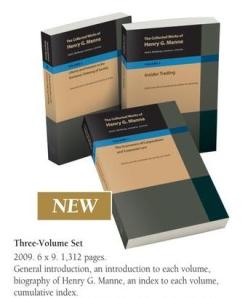
Via Geoff Manne, a description and ordering information for the new Collected Works of Henry Manne, produced by Liberty Fund. A great collection of scholarly articles, reviews, and shorter popular pieces divided into three volumes, “The Economics of Corporations and Corporate Law,” “Insider Trading,” and “Liberty and Freedom in the Economic Ordering of Society.” Order your copy today!
CFP: “Contracts, Procurement, and Public-Private Arrangements”
| Peter Klein |
It’s 14-15 June 2010 in Paris. Submissions are due 15 February. Stéphane Saussier is organizing, so you know it will be good. From the CFP:
This conference focuses on the recent developments in contract theories. Papers are invited on all topics of contract theories including:
- relational contracting,
- transaction costs,
- renegotiations,
- incentives,
- attribution mechanisms,
- incomplete contracting
- contract design, etc.
Papers presented may be theoretical or applied. A special attention will be given to proposals addressing issues related to procurement and public-private arrangements.
The Limits of Antitrust Revisited
| Dick Langlois |
I also just returned from an interesting conference, this one at the Searle Center at Northwestern Law School. The topic was the 25th anniversary of Frank Easterbrook’s 1984 paper “The Limits of Antitrust.” Here’s the agenda. I don’t think the papers are all available online, but the plan is to publish them eventually.
Thursday, October 29th
Welcome and Introduction
Henry N. Butler, Executive Director, Searle Center on Law, Regulation and Economic Growth
Opening Remarks: “The Limits of Antitrust” and the Chicago School Tradition, George Priest, Yale Law School
Session One – Easterbrook on Errors, Fred S. McChesney, Class of 1967 James B. Haddad Professor of Law, Northwestern Law
Session Two – The Limits of Antitrust in the New Economy, Joshua D. Wright, George Mason University School of Law, and Geoffrey A. Manne, Lewis & Clark Law School and ICLE .
Dinner Keynote Address: Ronald A. Cass, Dean Emeritus, Boston University School of Law.
Friday, October 30th
Session Three – The Limits To Simplifying the Application of Current U.S. Antitrust Law, Richard S. Markovits, John B. Connally Chair, University of Texas at Austin, School of Law.
Session Four – Microsoft and the Limits of Antitrust, William H. Page, Marshall M. Criser Eminent Scholar, University of Florida, Levin College of Law.
Closing Remarks: Hon. Frank H. Easterbrook, United States Court of Appeals for the Seventh Circuit.
Sidak and Teece on Dynamic Competition
| Peter Klein |
A “neo-Schumpeterian” framework for antitrust analysis that favors dynamic competition over static competition would put less weight on market share and concentration in the assessment of market power and more weight on assessing potential competition and enterprise-level capabilities. By embedding recent developments in evolutionary economics, the behavioral theory of the firm, and strategic management into antitrust analysis, one can develop a more robust framework for antitrust economics.
Via Truth on the Market (where my colleague Mike Sykuta has joined the blogging team). On a related note, see Jesús Huerta De Soto’s Theory of Dynamic Efficiency. It was a pleasure meeting De Soto at last week’s fantastic Mises conference in Salamanca, where he spoke on dynamic efficiency (based on the book’s first chapter). You have to love medieval university towns. We held our meetings in the Convent of San Esteban, including breakfast in the room where Christopher Columbus reportedly waited to hear if Queen Isabella would finance his little expedition West.
Williamson’s “Economics of Institutions” Syllabus
| Peter Klein |
I was pretty clueless when I started graduate school. I had good undergraduate training in economics, and had the privilege of attending my first Austrian seminar, where I met Murray Rothbard, Hans Hoppe, Roger Garrison, and David Gordon, before beginning graduate work. But I really didn’t know exactly what I wanted to study. Like most economics PhD students, I wasn’t exactly turned on by the core theory and econometrics classes. Then I took Williamson’s course ECON 224, “Economics of Institutions,” and it was a revelation. The syllabus dazzled me, with readings from Coase, Simon, Hayek, North, Arrow, Chandler, Alchian, Demsetz, Ben Klein, and many other brilliant and thoughtful economists, along with sociologists, political scientists, historians, and others. I decided then that institutions and organizations would be my area, and I’ve never looked back.
Since Monday I’ve been digging through my files trying to find a copy of that syllabus. I found my folder for that course, containing notes, readings, and exams (no, you can’t see my test scores), but for some reason the syllabus has disappeared. I must have taken it out to study, perhaps when designing my own course in institutions and organizations, and it didn’t make its way back into the file. But I did find an older copy, the Fall 1988 edition. That was, I believe, Williamson’s first year at Berkeley, after arriving from Yale (where he didn’t teach PhD courses, his main appointment being in the law school). I took the course in 1989, but the syllabi are very similar. So here it is. Note the range of authors, journals, subject areas. Not at all like the typical economics PhD course!
Stewart Macaulay
| Peter Klein |
Here’s a lecture I wish I could have attended: Stewart Macaulay gave today’s Annual Distinguished Lecture at BYU Law School. Macaulay, as noted in BYU’s blurb, is “an internationally recognized scholar and a leader of the law-in-action approach to contracts. He pioneered the study of business practices and legal work regarding contract law. He is also one of the founders of the law and society movement.” More important for our purposes, Macaulay’s emphasis on what Williamson calls “private ordering” — the governance of contractual relations by convention, private arbitration, and firms’ own “internal courts” — has been extremely influential for transaction cost economics.
Here’s the abstract of Macaulay’s lecture:
A Contract Crisis? “It Ain’t Necessarily So.”
There are several proposals for a new contract law. On one hand, our economic crisis suggests that many see the need to rewrite or rescind contracts to reflect the drastically changed conditions of the past few years. On the other hand, there are proposals for a far more formal law of contracts than are found in the Uniform Commercial Code and the Restatement (2d) Contracts. Drawing on calls for “a new legal realism,” Professor Macaulay suggests that there is much that we don’t know about the need for and the consequences of such major revisions. He stresses, however, that a key word in Ira Gershwin’s lyrics from “Porgy and Bess” is “necessarily.” The first step must be a better picture of contract law in action. Such a picture might support some but not other changes.
I hope the lecture will appear soon on Macaulay’s website, and that Gordon Smith will post reactions at the Glom.
Elgar Companion to Transaction Cost Economics
| Peter Klein |
Mike Sykuta and I are editing a volume for the Elgar Companion series, The Elgar Companion to Transaction Cost Economics. The volume is currently in production with an expected publication date in mid-2010. We’ve created a page here on O&M with more information, including a table of contents and some sample chapter drafts. Enjoy!
QWERTY in the Long Run
| Dick Langlois |
The new issue of Industrial and Corporate Change has an article by Andreas Reinstaller and Werner Hölzl called “Big Causes and Small Events: QWERTY and the Mechanization of Office Work.” Although it’s an interesting paper in many respects, I think it fails in its avowed aim to defend Paul David against the attack of Liebowitz and Margolis. Mostly, they don’t get L&M right (and explicitly get them wrong in footnote 1). The issue is whether the QWERTY keyboard is an example of what L&M call “third-degree” path dependency, that, is path dependency leading to an outcome that is both regrettable ex post and would somehow have been remediable ex ante. The criterion of “remediable” to R&H seems to be whether contemporaries “knew about” superior alternatives. That’s not quite right, of course: the real issue is whether any alternative institutional structure could have done a better job of choosing a standard under the conditions of knowledge at the time. Their only example is the existence of a French “Ideal” keyboard layout (which some people “knew about”) that was swept aside by the tidal wave of the American QWERTY standard (and became AZERTY in France). But they have no evidence about how much better this keyboard was — or if it was better at all. In footnote 1 they cite Donald Norman’s interesting book on design to the effect that the Dvorak keyboard is 10 per cent faster than QWERTY. But (A) Norman’s point in the book is how insignificant this difference is and (B) that doesn’t demonstrate third-degree path dependency, since no one “knew about” the Dvorak keyboard until Dvorak invented it (an extremely laborious process, according to Norman).
Again, I don’t want to be too hard on R&H: I think there’s a lot that’s interesting in the paper, especially the discussion of the mechanization of office work. What really struck me in this context, however, is how irrelevant, or at least dated, the QWERTY saga is. And I say this not for the usual reason: that computers now allow us to have any keyboard layout we like. Rather, what struck me is that the production of documents has long since become demechanized, making even more-than-nominal differences in typing speed irrelevant. Since we now all (or almost all) compose right on the computer, and never send our documents out to the typing pool, manuscript production has become a craft again. What is slowing us down is how quickly we think of something to say, not how fast we can type. And I doubt that, fifties nostalgia notwithstanding, we are unlikely to see the return of the typing pool anytime soon. So, from a historical perspective, QWERTY will have been technically inefficient (though not therefore economically inefficient) only for that brief historical period between the invention of Dvorak and the coming of the personal computer.
The same issue of ICC also has a paper by Ashish Arora and coauthors that’s worth a look.
Idea for Historical Law and Economics Thesis
| Nicolai Foss |
Apropos the always-topical issue of the efficacy of the death penalty, I was recently told by Siegwart Lindenberg that one of Gordon Tullock’s characteristically quirky proposals for reform was to institute the death penalty as the sanction that any crime would meet in the criminal justice system. However, there was a twist, because although any criminal would receive a death penalty, not all criminals would actually be executed. Specifically, all criminals would be strapped to the chair, but there was only a probability that the button would be pressed, the probability depending on the severity of the crime. Because of risk aversion and a tendency to overestimate probabilities (and for the Draconian symbolic value), this scheme would put an effective end to much crime. (I haven’t been able to find a reference for this idea; perhaps it exists only in the oral tradition that surrounds the Tullock figure).
It is easy to dismiss the Tullock scheme as “cruel,” “inhuman,” “far out,” “not practicable,” etc. But perhaps it does have a historical precursor. At its height the criminal law of England (the “Bloody Code”) included more than 220 crimes that were punishable by death, including “being in the company of gypsies for more than one month” (here is the Wiki). Other countries have had similar broad approaches to which crimes were punishable by death, though perhaps few as Draconian as England’s. However, one has to bear in mind that there generally was a pardon system, and that it is quite likely that some of the weirder crimes leading to death sentences were more likely to be pardoned than the really serious ones (e.g., a pardon may have been more likely in the case of the “crime” of being in the company in gypsies than outright murder). Could it be that this pardon system functioned in such a way that the probabilities of actual execution directly reflected the real severity of the crime? It seems likely. The data are definitely there. It is just collecting them and doing the analysis.





 Organizations and Markets
Recent Comments