Posts filed under ‘Management Theory’
Becker and Posner on Williamson and Organizational Economics
| Peter Klein |
Ruminations on the field of organizational economics from Becker and Posner. Both are inspired by Williamson’s Nobel but neither discusses his contributions very directly. Posner’s comment, the longer of the two, describes some of his own work (with Luis Garicano) on public organizations.
PS: I’ve been looking for some time for an electronic copy of the 1993 Journal of Institutional and Theoretical Economics exchange between Posner, Coase, and Williamson. If anyone has it, can you email me a copy?
The Lazy Manager Theory
| Peter Klein |
Good ideas from John Wilkins, who earned a PhD in (I think) evolutionary biology while working as a full-time manager (via Randy). Sample elements of the Lazy Manager Theory:
- Never do any piece of paperwork when the person who asked for it isn’t there and holding it when they make the request. If they don’t care enough to come see you, they probably don’t need it done. Also, you put faces to names and develop a good personal relationship with those who come to see you, so it’s win-win.
- If any piece of paper falls off your desk for any reason, throw it away. This is God’s way of telling you it is unimportant.
- Always sit on the left side of the table, at the far end from the secretary if you aren’t that person. This way when tasks are being handed out, you are less likely to be volunteered, as you are not in the immediate line of sight of either the chair or the secretary.
If you prefer meatier fare, try this paper from Philippe Aghion, John Van Reenen, and Luigi Zingales, “Innovation and Institutional Ownership,” which examines a version of the lazy-manager hypothesis:
We find that institutional ownership in publicly traded companies is associated with more innovation (measured by cite-weighted patents). To explore the mechanism through which this link arises, we build a model that nests the lazy-manager hypothesis with career-concerns, where institutional owners increase managerial incentives to innovate by reducing the career risk of risky projects. The data supports the career concerns model. First, whereas the lazy manager hypothesis predicts a substitution effect between institutional ownership and product market competition (and managerial entrenchment generally), the career-concern model allows for complementarity. Empirically, we reject substitution effects. Second, CEOs are less likely to be fired in the face of profit downturns when institutional ownership is higher. Finally, using instrumental variables, policy changes and disaggregating by type of owner we find that the effect of institutions on innovation does not appear to be due to endogenous selection.
Opening Lines I Wish I’d Written
| Peter Klein |
Last week was tough for Shakespeare scholars who wear tweed jackets with leather elbow patches and sip sherry in the faculty lounge. You know, the people otherwise known as Saab drivers.
That’s from a Friday WSJ piece on GM’s attempt to dump its Saab subsidiary. Readers outside the US may not get the joke. Trust me, it’s funny.
The article is actually pretty interesting, an illustration of Williamson’s “impossibility-of-selective-intervention” thesis. “The Saab saga also demonstrates how hard it is for a boutique company to retain its special appeal after being bought by a corporate goliath. GM did make some good Saabs over the years (the midsize 9-5 model of a decade ago was one), but they didn’t seem as special as the pre-GM Saabs, even though the key stayed in the floor.” Maybe, but it isn’t obvious why the mismanagement of the Saab brand (in the US) was GM’s fault, rather than that of Saab’s division heads. Saab may have tanked anyway. Anyway, I did learn a good line from Sir John Egan, the last independent CEO of Jaguar before its acquisition by Ford, that I’ll use the next time I’m teaching about selective intervention: “When an elephant gets in bed with a mouse, the mouse gets killed and the elephant doesn’t have much fun.” Oh, and the article ends well too: “As for those sherry-sipping profs, maybe they should consider buying Chevy Silverado pickups with all the trimmings: Mars lights, gun racks and monster-truck tires. Iconoclasm can take different forms, and the talk in the faculty lounge will never be the same.”
Bonus: That same issue of the Journal also contained a strange piece by John Cassidy praising Pigou, on the grounds that Pigou’s analysis of externalities gives us unique insight into the financial crisis. “Thus, for example, a blow-up in a relatively obscure part of the credit markets—the subprime mortgage industry—can undermine the entire banking system, which, in turn, can drag the entire economy into a recession, as banks refuse to lend.” Um, duh. “Externalities” are ubiquitous, and the idea of the general interdependence of markets has been discussed since, well, Bastiat, if not the Scholastics. Certainly Pigou didn’t offer any special insight into the interdependencies across financial markets or between financial markets and product markets. Writes Cassidy: “Economics textbooks have long contained sections on how free markets fail to deal with negative spillovers such as pollution, traffic congestion and the like. Since August 2007, however, we have learned that negative spillovers occur in other sectors of the economy, especially banking.” Since August 2007? Gee, before that, we all thought banking was an isolated sector of the economy with no connection to anything.
Peter Bernstein Interview
| Peter Klein |
Speaking of Peters, the McKinsey Quarterly site has a video interview with the late Peter Bernstein on risk. Bernstein was a deep thinker and an excellent writer. I once found myself on a plane next to an investment banker who was reading Bernstein’s Against the Gods. I mentioned that I too was a fan, and he told me he re-read the book at least once each year, out of professional obligation.
What Would Peter Say?
| Peter Klein |
 Peter Drucker, that is. The great management guru died in 2005 — and even then, he didn’t blog, unlike some other guys named Peter. If Drucker were alive today, what would he say about the financial crisis, health-care reform, climate change, and the other Big Issues of our day? Rosabeth Moss Kanter asks in the current issue of HBR, and thinks Drucker’s writings have important lessons for today’s problems. E.g.:
- Drucker would not have been surprised that incentives to take excessive risks contributed to the recent global financial meltdown. Back in the mid-1980s, he warned about a public outcry over executive compensation — a main theme on the U.S. government’s agenda following the fall of banks in 2008.
- Years ago, he warned of troubles ahead if GM executives remained stuck in memories of previous successes and failed to ask his famous “what to stop doing” question. GM was an iconic example of failure to see the need for significant innovation; its structure had become ossified, and its top management couldn’t consider a change.
- He focused on how organizations could best achieve their purpose, not on business per se or on profit as the main indicator of success. He championed a robust civil society of voluntary nonprofit organizations as an essential foundation on which business could thrive and people could prosper, because this sector plays a vital role in promoting health, education, and well-being. The role of government is fuzzier in Drucker’s writings, although it is clear that he mistrusted centralization of power and saw bureaucracy as a source of rigidity rather than innovation.
I hadn’t known before that Drucker’s father was friends with Schumpeter, often described as a major influence on Drucker’s thinking. “Regular guests of the Druckers included the economists Schumpeter, Hayek and Mises, with whom Drucker’s father had business relations in his function as director of the K.& K. trade museum,” according to Drucker’s official biography. Unfortunately the young Drucker was more attracted to Othmar Spann, described by Mises as an “anti-economist.”
The MSM Rediscovers the Classics
| Peter Klein |
The rediscovery of Keynes is one of the official storylines of the financial crisis and global recession. The problem is that Keynes was, in my judgment, a charlatan, a clever man obsessed with his own cleverness who never paid serious, thoughtful attention to economics (or any subject). You have to learn a little about Keynes to be well-educated and — because of his vast influence — to understand contemporary macroeconomic thought, but otherwise there is little intrinsic value in his writings.
Happily, the mainstream media is rediscovering other writers too. Last week the WSJ ran a nice piece on Mises, “The Man Who Predicted the Depression,” focusing on Mises’s 1912 Theory of Money and Credit (the book dismissed by Keynes as unoriginal, with Keynes admitting, a few years later, that he understood German well enough to comprehend things he already knew, but not to grasp anything new). “With interest rates at zero, monetary engines humming as never before, and a self-proclaimed Keynesian government, we are back again embracing the brave new era of government-sponsored prosperity and debt,” writes Mark Spitznagel. “And, more than ever, the system is piling uncertainties on top of uncertainties, turning an otherwise resilient economy into a brittle one. . . . How curious it is that the guy who wrote the script depicting our never ending story of government-induced credit expansion, inflation and collapse has remained so persistently forgotten.” Yesterday, Reuters ran Rolfe Winkler’s piece urging readers to study Mises and Hyman Minsky while Investor’s Business Daily featured an item on Schumpeter.
Today, Don Sull’s Financial Times column focuses on Frank Knight, whom Sull calls “an American Socrates.” (OK, it’s a blog, not a column, and Sull is a management professor at LBS, not some hack journalist, but you get the point.) “In these unsettled times,” Sull writes, “it worthwhile revisiting the contribution of Frank Knight, an economist who was among the earliest and most penetrating analysts of what uncertainty and risk meant, and how they influenced a firm’s ability to make a profit.” Knight is one of the greats, a brilliant and idiosyncratic thinker who could be spectacularly right (on profit) and spectacularly wrong (on capital). Sull’s blog entry today is a teaser, with a promised follow-up to deal more specifically with the risk-uncertainty distinction (my take is here). Watch for it!
No Required Ethics Course at Chicago-Booth
| Peter Klein |
Bucking the trend, the Chicago-Booth MBA program will not offer required courses in business ethics (via Cliff). The school “has no set standard for ethical case studies used in the classroom,” according to Executive Director of Faculty Services Lisa Messaglia,”but leaves it up to faculty, instead.”
[T]he business school is disciplined-based, meaning that classes are divided by disciplines such as sociology or psychology, rather than by industries. As a result, she said, professors may use different examples in their lectures, but Chicago Booth “[doesn’t] change required classes based on trends in the economy.”
I’m not keen on the way ethics is taught in most business schools so I’m sympathetic to the Chicago position. Some previous O&M posts on teaching ethics are here, here, here, here, here, and here.
Multitasking
| Peter Klein |
I was flipping channels last night and came across a Jimi Hendrix biopic. Lots of concert footage, with Hendrix doing his usual amazing Hendrix things — singing, crazy guitar riffs, playing with his teeth. Then I noticed something I hadn’t seen before: He’s doing all this while chewing gum. How can he sing without choking or spitting it out? How does he pluck guitar strings with his teeth and not leave a big wad on the pickups? Some people have trouble walking and chewing gum at the same time. How is he doing this?
Naturally, this got me thinking about multitask principal-agent problems. I liked one article that appeared in 2005 but didn’t generate much attention: Besanko, Regibeau, and Rockett’s “A Multi-Task Principal-Agent Approach to Organizational Form” (Journal of Industrial Economics, December 2005). Multitasking has often been applied performance evaluation, specifically the use of objective versus subjective performance measures. (If the agent is assigned multiple tasks, only some of which are measurable, than a quantitative evaluation scheme biases the agent’s effort toward more easily measurable tasks.) Besanko et al. apply this logic to divisionalization, examining the choice between product-line and functional organization:
This paper studies the choice of organizational forms in a multi-task principal-agent model. We compare a functional organization in which the firm is organized into functional departments such as marketing and R&D to a product-based organization in which the firm is organized into product lines. Managers’ compensation can be based on noisy measures of product-line profits. Measures of a functional area’s contribution to total profits are not available, however. This effect favors the product organization. However, if there are significant asymmetries between functional area contributions to organizational success and cross-product externalities within functions, organizing along functional lines may dominate the product organization. The functional organization can also dominate when a function is characterized by strong externalities while the other is not.
An obvious example: university faculty who are tasked with research, teaching, and service. Research is (in principle) easy to measure: publications, citation counts, grants, speaking invitations, etc. Teaching and service outputs are fuzzier. Even well-intentioned administrators tend to reward what they can count, which means refereed journal articles (and, in some fields, grant dollars) end up being the primary performance metric. Need I point out what this does to teaching?
The same issue is explored in Williamson (1975, pp. 155-75), where the ability to reward division managers based on standalone, divisional profit figures is cited as an advantage of the M-form structure.
How Machiavellian Are You?
| Peter Klein |
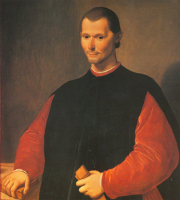 A test for university presidents, deans, department heads, center directors, etc. (via Anu).
(Yes, of course, there are management and leadership literatures on old Niccolò. Don’t act surprised!)
Sampling on the Dependent Variable: French Peasant Edition
| Peter Klein |
A useful example of the methodological flaw that plagues the “great companies” and “great leaders” literature in management, from Graham Robb’s excellent The Discovery of France (Norton, 2007):
[N]early every autobiographical account of ordinary life in eighteenth- and nineteenth-century France comes from the early chapters of memoirs written by exceptional men who rose through the ranks of the army or the Church, woo wrote their way to fame or who were plucked from obscurity by a patron, a lover or, eventually, an electorate. Few men and even fewer women had the means or the desire to write a book on “How I failed to overcome my humble origins.” Apart from the countless riches-to-riches tales written by aristocrats, almost all the lives that we know about follow the same untypical upward trend: the farmer’s son Restif de la Bretonne, the cutler’s son Diderot, the watchmaker’s son Rousseau, the Corsican cadet Napoleone Buonaparte.
These spectacular success are more typical of long-term trends than of individual lives. Categorical terms like “peasants,” “artisans,” and “the poor” reduce the majority of the population to smudges in a crowd scene that no degree of magnification could resolve into a group of faces. They suggest a large and luckless contingent that filled in the background of important events and participated in the nation’s historical development by suffering and engaging in a semblance of economic activity.
Likewise, business and entrepreneurial strategies can be understood by studying not only firms that tried them and succeeded, but also those that used the same strategies and failed. Reducing the majority of companies to smudges in an industry-wide or economy-wide crowd scene tells us little about what does and doesn’t work.
Penrose (1959) Golden Anniversary
| Peter Klein |
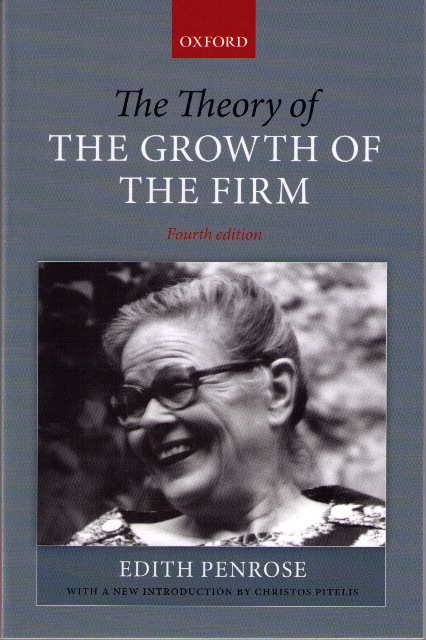 This year marks the 50th anniversary of Edith Penrose’s Theory of the Growth of the Firm (1959), one of the most important and influential books on the firm and firm strategy. To celebrate, Yasemin Kor and Christos Pitelis organized a roundtable at last week’s SMS conference with remarks by Christos, Yasemin, Joe Mahoney, Margie Peteraf, and Maurizio Zollo. The participants have graciously allowed me to post their slides and materials (1, 2, 3, 4). Christos, Penrose’s friend and literary executor, has edited and introduced a new edition of the 1959 book, which you can purchase here. You can read his introduction here. Nice!
Penrose trivia: During the 1950s Murray Rothbard made his living by reviewing literature and grant proposals for the William Volker Fund. When going through Rothbard’s correspondence a few years ago I came across a proposal for a study on firm growth submitted jointly by Penrose and Fritz Machlup, her dissertation supervisor at Johns Hopkins. Apparently at one point, the book was going to be a joint project. (Rothbard thought the ideas in the proposal didn’t fit with Penrose’s earlier warnings about the use of biological analogies in economics. However, as Joe Mahoney has noted, there is no inconsistency between the 1952 article and the 1959 book; Penrose is careful in her work on growth not to treat growth tendencies in firms as automatic, but to model them based on the preferences, beliefs, and actions of the firm’s personnel. In other words, she accepts natural selection in this context but not random mutation.)
BTW, what other important works in our field appeared in 1959, to be celebrated this year? Coase’s article on the Federal Communications Commission is one. The 1970s may have been the golden decade but there were major contributions in the previous decades as well. What are your favorites? Whose anniversary should we be preparing to celebrate?
Williamson’s “Economics of Institutions” Syllabus
| Peter Klein |
I was pretty clueless when I started graduate school. I had good undergraduate training in economics, and had the privilege of attending my first Austrian seminar, where I met Murray Rothbard, Hans Hoppe, Roger Garrison, and David Gordon, before beginning graduate work. But I really didn’t know exactly what I wanted to study. Like most economics PhD students, I wasn’t exactly turned on by the core theory and econometrics classes. Then I took Williamson’s course ECON 224, “Economics of Institutions,” and it was a revelation. The syllabus dazzled me, with readings from Coase, Simon, Hayek, North, Arrow, Chandler, Alchian, Demsetz, Ben Klein, and many other brilliant and thoughtful economists, along with sociologists, political scientists, historians, and others. I decided then that institutions and organizations would be my area, and I’ve never looked back.
Since Monday I’ve been digging through my files trying to find a copy of that syllabus. I found my folder for that course, containing notes, readings, and exams (no, you can’t see my test scores), but for some reason the syllabus has disappeared. I must have taken it out to study, perhaps when designing my own course in institutions and organizations, and it didn’t make its way back into the file. But I did find an older copy, the Fall 1988 edition. That was, I believe, Williamson’s first year at Berkeley, after arriving from Yale (where he didn’t teach PhD courses, his main appointment being in the law school). I took the course in 1989, but the syllabi are very similar. So here it is. Note the range of authors, journals, subject areas. Not at all like the typical economics PhD course!
Hoisted from the Comments: Hoopes on Williamson
| Peter Klein |
Former guest blogger David Hoopes’s comment deserves its own post:
So, we’re leaving the serious discussion to our goody two-shoes organizations twin? Was Will Mitchell a Williamson student? No one has said anything about Teece. Teece’s early JEBO articles did a great job talking about economies of scope and transaction cost influences on strategy.
Unmentioned yet, there has been some contentious discussion about the implications of TC economics on strategy and organization. Many including Connor and Prahalad consider the implications of TC to lead to bad management and bad strategy. However, our very own Steve Postrel wrote a great paper, “Islands of Shared Knowledge” that (esp in an earlier version) does a great job of comparing and contrasting the RBV and TC as theories of the firm.
Harold Demsetz weighed in on this earlier in his, “Theory of the Firm Revisited” (which is one of my favorite all time papers). Harold argues that firms would exist without governance problems. Steve has tried to get Harold to see the light (i’m not sure i do) but to no avail.
Of course, CERTAIN org theorists, whose names i do not mention think that Williamson’s logic, as does all competition-based economic theory, leads to evil and terrible results: unethical business students who become tomorrow’s headlines.
I’m very happy to see Williamson win. His influence on strategy and organization is immense. And, at this point, I don’t see any theory of the competitive firm can reasonably leave him out. I will admit, in terms of competitive heterogeneity and competitive advantage I don’t think governance is anywhere near as important as productive capabilities. BUT, capabilities literature still has a lot of work to do to be specified as exactly as TCE.
David, more serious discussion is on the way. Unfortunately, we O&Mers have higher opportunity costs than the bloggers at our good-twin site, so we can’t get the posts up as quickly as they can. :-)
Management Miscellany
| Peter Klein |
1. We are not big on Jim Collins here at O&M but Toyota president Akio Toyoda is a fan, explaining his company’s woes in terms of Collins’s five stages of business decline. (Is “be headquartered in a country with an overvalued currency” one of the stages?)
2. Karen Ho’s Liquidated: An Ethnography of Wall Street (Duke, 2008) is reviewed by fellow anthropologist Gillian Tett in the FT. The key to understanding the financial crisis, we learn, is Bourdieu (why haven’t I read about this book on orgtheory.net?). “Massive corporate restructurings are not caused so much by abstract financial models as by the local, cultural habitus of investment bankers, the mission-driven narratives of shareholder value and the institutional culture of Wall Street.” Why didn’t I think of that?
3. I’ve been reading Yevgeny Zamyatin’s We, the first of great dystopian novels (in Natasha Randall’s new translation). I had head that Taylorism figures prominently in the novel, but didn’t know Taylor would be mentioned by name. “Yes, that Taylor was, without doubt, the most brilliant of the Ancients. True, he didn’t think everything through, didn’t extend his method throughout life, to each step, around the clock. He wasn’t able to integrate his system from an hour to all twenty-four. But all the same: how they could have written whole libraries about the likes of Kant — and not take notice of Taylor, a prophet, with the ability to see ten centuries ahead?” Of course, as we’ve noted before, there’s more to Taylor than meets the eye.
Elgar Companion to Transaction Cost Economics
| Peter Klein |
Mike Sykuta and I are editing a volume for the Elgar Companion series, The Elgar Companion to Transaction Cost Economics. The volume is currently in production with an expected publication date in mid-2010. We’ve created a page here on O&M with more information, including a table of contents and some sample chapter drafts. Enjoy!
Two Quotations on Profits
| Peter Klein |
Henry Hazlitt, from Economics in One Lesson:
In a free economy, in which wages, costs and prices are left to the free play of the competitive market, the prospect of profits decides what articles will be made, and in what quantities — and what articles will not be made at all. If there is no profit in making an article, it is a sign that the labor and capital devoted to its production are misdirected: the value of the resources that must be used up in making the article is greater than the value of the article itself.
One function of profits, in brief, is to guide and channel the factors of production so as to apportion the relative output of thousands of different commodities in accordance with demand. No bureaucrat, no matter how brilliant, can solve this problem arbitrarily. Free prices and free profits will maximize production and relieve shortages quicker than any other system. Arbitrarily fixed prices and arbitrarily limited profits can only prolong shortages and reduce production and employment.
The function of profits, finally, is to put constant and unremitting pressure on the head of every competitive business to introduce further economies and efficiencies, no matter to what stage these may already have been brought.
Barack Obama, from last week’s address on healthcare:
I’ve insisted that like any private insurance company, the public insurance option would have to be self-sufficient and rely on the premiums it collects. But by avoiding some of the overhead that gets eaten up at private companies by profits and excessive administrative costs and executive salaries, it could provide a good deal for consumers, and would also keep pressure on private insurers to keep their policies affordable and treat their customers better. . . .
So, (a) profits and executive salaries are part of (avoidable) overhead, and (b) government agencies have lower administrative costs than private firms. Who knew? (Thanks to Gary for the quote.)
Corporate Diversification Humor
| Peter Klein |
As someone who works in the corporate diversification area I enjoyed this Onion piece on Yamaha:
Despite concerns over the recent global recession, Yamaha Corporation president Mitsuru Umemura announced last week that he was content with the current level of production of Jet Skis, alto saxophones, snowmobiles, power generators, scooters, and golf carts. “Initially we thought that the declining global market would result in overproduction of synthesizers, PA systems, DVD players, tone generators, and motocross bikes, but in fact our production quotas were almost perfectly attuned to the market in power amplifiers, heart-rate monitors, signal processors, analog mixers, engine oil, microphones, HiFi systems, and grand pianos,” said Umemura, who stressed that his company prides itself on attention to detail. “At the Yamaha Corporation we’re focused on one thing and one thing alone — quality sound chips, ceiling brackets, editing software, race-kart engines, sport boats, flugelhorns, ATVs, sequencers, outboard motors, conference systems, golf clubs, projectors, MIDI controllers, lamp cartridges, portable recorders, subwoofers, component systems, and motorcycles.”
I remember while doing my dissertation research coming across a mid-1960s cartoon from Fortune or Business Week showing Santa’s elves whispering nervously as Santa meets with a slick-looking conglomerator in the background. One elf to another: “I think we’re becoming a division of Gulf & Western!” Robert Sobel also tells a story (I think in The Rise and Fall of the Conglomerate Kings) about the conglomerate CEO who specializes in acquisition by stock-swap. One day his son announces that he’s sold the family dog for $1,000. “You got cash for that old pooch?” “No, I traded him for two $500 cats.”
And there’s the great line from Fortune about Peter Grace, whose famous acquisition sprees transformed W. R. Grace from a mundane shipping company into “a purveyor of everything from bull semen to grilled cheese sandwiches.”
Books About Work
| Peter Klein |
I blogged earlier about Matthew Crawford, whose book Shop Class as Soulcraft challenges our commonly held beliefs about white- and blue-collar work. In a feature in Saturday’s WSJ Crawford listed his five favorite books about work. It’s an unusual list: Harry Braverman’s Labor and Monopoly Capital, Alasdair MacIntyre’s After Virtue, Arlie Russell Hochschild’s The Managed Heart, Richard Sennett’s The Corrosion of Character, and Mike Rose’s The Mind at Work. After Virtue, for example, is well-known as an outstanding work in contemporary moral philosophy, but Crawford sees it in a different light:
Alasdair MacIntyre shows that the manager, that stock character in modern institutional life, is a moral relativist by stipulation — it’s just part of the job. Unlike an entrepreneur, a hired manager must accept the ends of an organization as given — as unavailable for rational scrutiny. His task is to adjust others, and indeed himself, to the realization of those ends, by whatever means are effective. As the business section of any chain bookstore confirms, what is wanted are therapeutic techniques of “self transformation”; the manager becomes a sort of institutional pop psychologist.
What are your favorite books (and articles) about the workplace? Besides Dilbert. I’m partial to Donald Roy’s 1952 classic, “Quota Restriction and Goldbricking in a Machine Shop.”
Postrel on Competitive Advantage
| Peter Klein |
Former guest blogger Steve Postrel gave an interesting presentation at last week’s AoM Professional Development Workshop on competitive advantage: “Competitive Advantage: Can’t Live With It, Can’t Live Without It.” Steve sent me the slides and was happy to share them here. Add your questions and comments below.
Steve provides a set of conditions that must be met for competitive advantage to be internally consistent and operationally meaningful, then presents his own (unique) definition, a simple and precise formulation in terms of gains from trade:
Seller 1 has competitive advantage over Seller 2 with respect to a specific transaction if and only if the economic surplus (gains from trade = V – C) from a transaction between 1 and the buyer is greater than the surplus from a transaction between 2 and the buyer. The difference in surplus is the CA.
A series of implications, qualifications, and applications follows. What do you think?
Mintzberg Interview
| Peter Klein |
 A short interview with Henry Mintzberg, mostly about his forthcoming book Managing, in today’s WSJ (not sure if it is gated). Best line:
I talk about what I call “the inevitably flawed manager.” We’re all flawed, but basically, effective managers are people whose flaws are not fatal under the circumstances. Maybe the best managers are simply ordinary, healthy people who aren’t too screwed up.





 Organizations and Markets
Recent Comments