Posts filed under ‘Methods/Methodology/Theory of Science’
It’s Not Autism
| Lasse Lien |
Here is a piece of good news, everyone. Economic science does not suffer from autism (though apparently there are parallels). As far as I know the jury is still out on the Tourette’s Syndrome. . . .
Abstract: A popular claim among critics is that economic science is suffering from autism, a severe developmental disorder characterised by impairments in social relations and communication, combined with rigid and repetitive behaviour. So far, this allegation has not been substantiated. This essay explores the claim of autism in economics based on modern schemes of diagnostics. A key finding is that the structure of the critique against mainstream economics bears a striking resemblance to the structure of the diagnostic criteria for autism. Based on an examination of three groups of key symptoms, I conclude that the required set of criteria for the autism diagnosis are not met. However, there are parallels which may serve as constructive reminders for the future development and application of economic theories and models.
HT: Klaus Mohn
Case Studies and Causal Inference
| Nicolai Foss |
Can case studies — in the extreme: a study of a single case — play any systematic role in causal inference? If so, how? These are the questions posed in a paper by brilliant LSE mathematical sociologist, Peter Abell, forthcoming in the European Sociological Review. The paper is essentially a summary of Abell’s work over more than two decades with building stronger foundations for “qualitative” or “case study” research (a more comprehensive statement can be found in the “A Case for Cases” paper on Abell’s site).
Of course, in the standard statistical interpretation of causal inference, N should be large, and certainly not equal to 1. And most social scientists believe there is no explanation without generalization (an issue discussed at length by Popper, Dray, Collingwood, and others in the philosophy of history as well as by more recent social scientists such as Ragin and Goldthorpe — and James March (here)), so causal inference is predicated on generalization and comparative method. (more…)
Risk, Uncertainty, and Financial Markets
| Peter Klein |
A quick follow-up to Nicolai’s post on the copula function: See also this item on Gary Gorton’s role in the financial crisis, which includes Warren Buffett’s great line: “Beware of geeks . . . bearing formulas.” And items on Knightian uncertainty here and here.
And there’s this passage from Darren Aronofsky’s cult classic Pi:
Restate my assumptions: One, Mathematics is the language of nature. Two, Everything around us can be represented and understood through numbers. Three: If you graph the numbers of any system, patterns emerge. Therefore, there are patterns everywhere in nature. Evidence: The cycling of disease epidemics;the wax and wane of caribou populations; sun spot cycles; the rise and fall of the Nile. So, what about the stock market? The universe of numbers that represents the global economy. Millions of hands at work, billions of minds. A vast network, screaming with life. An organism. A natural organism. My hypothesis: Within the stock market, there is a pattern as well. . . . Right in front of me . . . hiding behind the numbers. Always has been.
This is before the speaker, the mathematician protagonist Max Cohen, goes literally insane. That’s what quantitative financial modeling can do to you.
Relations Between Micro and Macro Levels
| Nicolai Foss |
Levels issues, micro-foundations, methodological individualism and collectivism, etc. have long been O&M favorites (e.g., here, here, here, and here). While the O&M bloggers are card-carrying methodological individualists, we also (like all other economists and management scholars) acknowledge that macro matters, in the sense that it may be meaningful to think of variables placed at macro levels exerting an influence on decisions made at micro variables (as in the Coleman diagram; see here). The question is, what is the nature of this “relation”? (more…)
“We Are All Monetarists Now”
| Peter Klein |
“We are all Keynesians now,” Milton Friedman famously remarked in 1965. He meant that all mainstream macroeconomists, regardless of political persuasion, accepted the basic aggregate income-expenditure framework (and assumption of homogeneous capital) that underlies the neo-Keynesian model. How this model came to displace its predecessors, and how it remains in force today, despite the New Classical revolution and New Keynesian counterrevolution, is one of the most interesting stories of twentieth-century intellectual history. Greg Mankiw’s warm fuzzy for Bob Lucas — really a poke at Paul Krugman — is instructive in this regard. As is this anecdote shared by Steve Medema:
I was attending the small Claremont-Bologna monetary conference about a decade ago, and the participants included Friedman, Modigliani, Tobin, and Samuelson. I was sitting in a shuttle van that would take us to dinner, talking with Milton and Rose Friedman. Modigliani approached the van, saw Friedman, shook his hand vigorously, and exclaimed, “Milton, I’m a monetarist now!”
Keynesian, New Keynesian, Monetarist, and New Classical macroeconomics are variations on a theme. The capital-based macroeconomics of the Austrian school represents an entirely different approach, one I hope to blog more about soon. (See also: “Revenge of the Aggregates.”)
Update: Even Dick Armey, writing in today’s WSJ, gets it:
Keynes’s thinking was a decisive departure from classical economics, because arbitrary “macro” constructs like aggregate demand had no basis in the microeconomic science of human action. As Hayek observed, “some of the most orthodox disciples of Keynes appear consistently to have thrown overboard all the traditional theory of price determination and of distribution, all that used to be the backbone of economic theory, and in consequence, in my opinion, to have ceased to understand any economics.”
As Keynes’s Cambridge colleague Gerald Shove supposedly remarked (according to Joan Robinson), “Maynard never spent the half hour necessary to learn price theory.” Sadly, the same seems true of many of Keynes’s modern disciples.
Andrew Gelman on Significance Testing
| Peter Klein |
A very insightful post on the McCloskey-Ziliak / Hoover-Siegler controversy, paradigmatic examples of signficance testing in economics, rational addiction, and other econometrics-related issues. An excellent discussion starter for a graduate course in research methods. Or your next dinner party.
Personal trivia: I’ve interviewed both Steve Ziliak and Mark Siegler for academic jobs. Both were deemed too smart to be a good fit.
More on Open-Source Peer Review
| Peter Klein |
 I’ve thought about setting up an academic version of the Fail Blog where scholars could post copies of rejected manuscripts, nasty referee reports and editor’s letters, and — of course — favorite student papers. But some current experiments in open-source peer review (a topic we’ve covered before) may do the trick. For example, this biology journal is making all submitted manuscripts and referee reports visible to the public:
Publication of research findings is very important to scientists. But scientists tend only to know about how things work at a scientific journal through personal experience and hearsay. By making the evaluation of manuscripts visible to everyone, The EMBO Journal aims to encourage constructive referee and author argumentation. Younger scientists will gain valuable insight into how to publish their research findings as well as how to deal with critique.
I’m not sure how anonymity will be preserved, and some potential authors and reviewers will likely shy away from participating. A very interesting experiment, to be sure. Here’s a wikipedia entry on the open-source peer-review movement more generally.
Geek Article of the Day
 | Peter Klein |
The NY Times profiles R, the open-source stat programming language that’s increasingly popular among quants.
Schumpeter on Methodological Individualism
| Peter Klein |
Via Lani Elliott, here’s a PDF excerpt from Joseph Schumpeter’s first book, Das Wesen und Hauptinhalt der theoretischen Nationalokonomie (The Nature and Essence of Theoretical Economics), published in 1908. The book made quite a splash in the German-speaking world and Schumpeter received many requests for an English translation, but he wouldn’t allow it, or to have the book reprinted in German. In 1980 a single chapter, “Methodological Individualism,” was translated and published in pamphlet form, with a short introduction by Hayek (which I included here). The pamphlet has been very difficult to get until now. Thanks to Lani for tracking it down and Jeff Tucker for hosting a copy.
Hayek remarked:
Many of [Schumpeter’s] students will be surprised to learn that the enthusiast for macroeconomics and co-founder of the econometrics movement had once given one of the most explicit expositions of the Austrian school’s “methodological individualism.” He even appears to have named the principle and condemned the use of statistical aggregates as not belonging to economic theory.
That this first book of his was never translated is, I believe, due to his understandable reluctance to see a work distributed which, in part, expounded views in which he no longer believed.
On Schumpeter’s changing views see also Thorbjørn Knudsen and Markus C. Becker’s “The Entrepreneur at a Crucial Juncture in Schumpeter’s Work: Schumpeter’s 1928 Handbook Entry Entrepreneur,” Advances in Austrian Economics 6 (2003): 199–234.
Good to Great: Neither Good nor Great
| Peter Klein |
I’m not a fan of “guru” books like In Search of Excellence, Built to Last, and Good to Great, for reasons well documented by Phil Rosenzweig in his excellent Halo Effect. These books suffer from ad hoc generalization, sampling on the dependent variable, and a host of related methodological and expository flaws. If Rosenszweig’s critique is startling, then two articles from the November 2008 Academy of Management Perspectives on Jim Collins’s Good to Great — perhaps the leading guru book of our time — are devastating. Here is Bruce Resnick and Timothy Smunt:
With sales of more than 4.5 million copies, Good to Great by Jim Collins provides an inspiring message about how a few major companies became great. His simple but powerful framework for creating a strategy any organization can use to go from goodness to greatness is certainly compelling. However, was Collins truly able to identify 11 great companies? Or was the list of great companies he generated merely the result of applying an arbitrary screening filter to the list of Fortune 500 companies? To test the durability of his greatness filter, we conducted a financial analysis on each of the 11 companies over subsequent periods. We found that only one of the 11 companies continues to exhibit superior stock market performance according to Collins’ measure, and that none do so when measured according to a metric based on modern portfolio theory. We conclude that Collins did not find 11 great companies as defined by the set of parameters he claimed are associated with greatness, or, at least, that greatness is not sustainable. (more…)
EJPE Now Available
| Peter Klein |
The Erasmus Journal for Philosophy and Economics has put out its first issue, which you can read online here. Highlights include several articles and reviews about methodology, an interview with Uskali Mäki, and a review of Donald MacKenzie’s An Engine, Not a Camera, much beloved in certain circles. (Via Dan D’Amico.)
Bygrave on the State of Entrepreneurship Research
| Peter Klein |
William Bygrave surveys the field and concludes that it’s “dominated by quantitative research driven almost exclusively by statistical analysis with SPSS and that qualitative research is seldom published in the leading entrepreneurship journals. He regrets that it is almost impossible to get purely empirical paper published in the leading journal. He pleads with journal editors and their review boards to become less narrow minded and much more pluralistic.”
Bygrave’s assessment is valuable but I think limited by its focus on the “traditional” entrepreneurship journals (e.g., JBV, ETP, SBE). Newer journals such as the SEJ and, more important, the entrepreneurship research that increasingly appears in the top mainstream strategy, organization, and economics journals tends to have a different, and more varied, character.
Rizzo and Whitman on the New Paternalism
| Peter Klein |
Mario Rizzo and Glenn Whitman offer a Hayekian critique of Richard Thaler and Cass Sunstein in their new paper, “The Knowledge Problem of New Paternalism.” From the abstract:
The “new paternalism” is a set of policy prescriptions based on recent findings in behavioral economics whose purpose is to help individuals overcome a wide variety of behavior and cognitive biases. According to its proponents, it does not aim at replacing the preferences of individuals with those of the paternalist but rather to uncover the “true” preferences of individuals, that is, the preferences they would have if they had perfect knowledge, unlimited cognitive abilities and no lack of willpower.
The purpose of this Article is to show that new paternalist policies founder on the shoals of a profound knowledge problem revealed in Friedrich Hayek’s famous critique of central planning. Feasible policies require not only accurate scientific knowledge but also accurate knowledge of “the particular circumstances of time and place” that constitute the local and personal knowledge of individuals. This knowledge is not accessible by paternalists.
See also this exchange between Rizzo and Thaler in last year’s WSJ.
Directions for a Troubled Discipline: Strategy Research, Teaching, and Practice
| Peter Klein |
That’s the title of a symposium in the new issue of the Journal of Management Inquiry, edited by Michael Lounsbury and Paul Hirsch.
Debates about relevance versus rigor in management research have only grown in intensity over the past decade (e.g., Pfeffer, 2008). The following dialog highlights how these concerns have become manifest in the field of strategy, in which there has been disquiet in some circles about the dominance of abstract theorization and a movement toward a re-engagement with practice and practitioners (e.g., Jarzabkowski, 2005; Kaplan, 2003; Whittington, 2006; Whittington et. al., 2003). After a brief introduction by Jarzabkowski and Whittington that situates the dialog, Bower’s article “The Teaching of Strategy: From General Manager to Analyst and Back Again?” defends the importance of a practitioner focus by highlighting the historical role of process research in the early development of the business policy field and the case-oriented teaching tradition at the Harvard Business School. In contradistinction, Grant’s article on “Why Strategy Teaching Should be Theory Based” emphasizes the importance of economic theory in both strategy teaching in research. Finally, in “A Strategy-as-Practice Approach to Strategy Research and Education,” Jarzabkowski and Whittington conclude with an argument hat aims to forge a truce between these often rhetorically opposed positions. They argue that a strategy-as-practice perspective can usefully bridge the divide between research and practice without sacrificing either rigor or relevance.
This issue of JMI also includes a 25-year retrospective on DiMaggio and Powell’s famous “Iron Cage Revisited” paper, for you institutional isomorphism types out there (we know who you are).
The Almost-Convergence of Mises, Parsons, and Popper
| Peter Klein |
O&M dabbles in economics, sociology, and the history and methodology of science so Rafe Champion’s new paper, “Mises, Parsons, and Popper: Comparison and Contrast of Praxeology, the Action Frame of Reference, and Situational Analysis,” may be of interest. Here’s the abstract:
During the 1930s three lines of thought converged on a common model of explanation in economics and the human sciences. Working in Europe, Ludwig von Mises of the Austrian school developed what he called “praxeology” to explore the sciences of human action. In the United States, Talcott Parsons, under the influence of Marshall, Pareto, Durkheim and Weber, offered the “action frame of reference” and in Australasia (in exile from Austria) Karl Popper elaborated “situational analysis”. Common features of the three models are methodological individualism, rejection of instrumentalism in favour of the search for real explanatory theories, and the use of a rationality principle to link the ends and means of action. General acceptance of the common features of these models would have significantly altered the criteria for theory development and appraisal in economics and the other social sciences. In the event, the three lines of thought did not merge to create a critical mass that might have made a difference in the scientific community at large. Their potential synergy has yet to be explored and there is scope for a synthesis of their most robust features with some modifications to each, especially to correct the views of Mises and Parsons on the methods that are effective in the natural sciences. A strange feature of the situation is that the three principals and their followers have, up to date, almost completely refrained from public comment or discussion of the work of the other two parties.
Comments are welcome here or at Rafe’s site.
Some Interesting Working Papers
| Peter Klein |
- Jennifer Arlen and Eric Talley, “Experimental Law and Economics”
This chapter provides a framework for assessing the contributions of experiments in Law and Economics. We identify criteria for determining the validity of an experiment and find that these criteria depend upon both the purpose of the experiment and the theory of behavior implicated by the experiment. While all experiments must satisfy the standard experimental desiderata of control, falsifiability of theory, internal consistency, external consistency and replicability, the question of whether an experiment also must be “contextually attentive” — in the sense of matching the real world choice being studied — depends on the underlying theory of decision-making being tested or implicated by the experiment.
- Matthew J. Holian, “Optimal Decentralization in Corporations and Federations”
Oates’ Theorem and the M-form Hypothesis are both organizational theories of decentralization, though they deal with different types of organizations. This brief note describes how the two theories complement one another, through both verbal description and mathematical models. The result is a simple but comprehensive account of the delegation problem.
- Abhijit V. Banerjee, Esther Duflo, “The Experimental Approach to Development Economics”
Randomized experiments have become a popular tool in development economics research, and have been the subject of a number of criticisms. This paper reviews the recent literature, and discusses the strengths and limitations of this approach in theory and in practice. We argue that the main virtue of randomized experiments is that, due to the close collaboration between researchers and implementers, they allow the estimation of parameters that it would not otherwise be possible to evaluate. We discuss the concerns that have been raised regarding experiments, and generally conclude that while they are real, they are often not specific to experiments. We conclude by discussing the relationship between theory and experiments.
Identification versus Importance
| Peter Klein |
At a recent workshop the subject of econometric identification came up. Identification is of course the major issue of our day among mainstream empirical economists. Some have described the dissertation process as the “search for a good instrument.” Instrumental-variables estimators have their critics, of course, but these critics are in the minority.
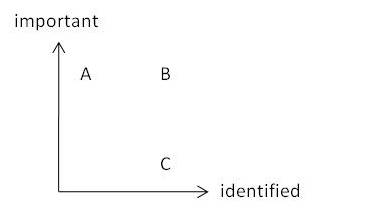
One of the workshop participants, a regular attendee at NBER events, summarized the consensus view among the elites of the profession with the following diagram:

A research problem can be important, and it can be well identified. The ideal problem is one in quadrant B, both important and identified. However, a problem in quadrant C is much more likely to be published in a top journal than a problem in quadrant A.
What does this say about the economics profession?
Against Gladwellism
| Peter Klein |
The blogosphere is atwitter over Malcolm Gladwell’s new book, Outliers (#4 on Amazon this morning). Outliers studies high achievers in art, science, business, and other fields, seeking to refute the myth of the self-made man: high achievers “are invariably the beneficiaries of hidden advantages and extraordinary opportunities and cultural legacies that allow them to learn and work hard and make sense of the world in ways others cannot.”
Abbeville (via 3quarks) expresses some reservations, not about Gladwell’s conclusion, but about his approach:
[Gladwell] is a skilled and entertaining writer, exemplifying the modern New Yorker “house style” for journalism with its combination of solid research, amused detachment, and quirky anecdotes in the Ken Burns mold. Tragically, Gladwell is also often very wrong. His work, famous for its forays into sociology, social psychology, market research, and other trendy disciplines, is a testament to both the exciting possibilities and the intellectual limitations of those fields. His penchant for what might be called pop statistical analysis sometimes leads to elegant, well-supported, and counterintuitive conclusions, but just as often recalls the man who couldn’t possibly have drowned in that river because its average depth was five feet. (more…)
New Blogs of Interest
| Peter Klein |
- Campus Entrepreneurship by David J. Miller
- Evolution and Complexity in the Social Sciences by Eliana Santanatoglia
- Anything Peaceful by the staff at FEE
Historical Origins of “Open Science”
| Peter Klein |
An interesting piece on science and patronage by Paul David, with a comment by Ken Arrow:
The Historical Origins of “Open Science”: An Essay on Patronage, Reputation and Common Agency Contracting in the Scientific Revolution
Paul A. David, Stanford University & The University of Oxford
This essay examines the economics of patronage in the production of knowledge and its influence upon the historical formation of key elements in the ethos and organizational structure of publicly funded “open science.” The emergence during the late sixteenth and early seventeenth centuries of the idea and practice of “open science” was a distinctive and vital organizational aspect of the Scientific Revolution. It represented a break from the previously dominant ethos of secrecy in the pursuit of Nature’s Secrets, to a new set of norms, incentives, and organizational structures that reinforced scientific researchers’ commitments to rapid disclosure of new knowledge. The rise of “cooperative rivalries” in the revelation of new knowledge, is seen as a functional response to heightened asymmetric information problems posed for the Renaissance system of court-patronage of the arts and sciences; pre-existing informational asymmetries had been exacerbated by the claims of mathematicians and the increasing practical reliance upon new mathematical techniques in a variety of “contexts of application.” Reputational competition among Europe’s noble patrons motivated much of their efforts to attract to their courts the most prestigious natural philosophers, was no less crucial in the workings of that system than was the concern among their would-be clients to raise their peer-based reputational status. In late Renaissance Europe, the feudal legacy of fragmented political authority had resulted in relations between noble patrons and their savant-clients that resembled the situation modern economists describe as “common agency contracting in substitutes” — competition among incompletely informed principals for the dedicated services of multiple agents. These conditions tended to result in contract terms (especially with regard to autonomy and financial support) that left agent client members of the nascent scientific communities better positioned to retain larger information rents on their specialized knowledge. This encouraged entry into their emerging disciplines, and enabled them collectively to develop a stronger degree of professional autonomy for their programs of inquiry within the increasingly specialized and formal scientific academies (such the Académie royale des Sciences and the Royal Society) that had attracted the patronage of rival absolutist States of Western Europe during the latter part of the seventeenth century. The institutionalization of “open science” that took place within those settings is shown to have continuities with the use by scientists of the earlier humanist academies, and with the logic of regal patronage, rather than being driven by the material requirements of new observational and experimental techniques.
See also this and this on science funding. And of course Hayek’s Counter-Revolution of Science (free full text!) should be consulted.





 Organizations and Markets
Recent Comments