Posts filed under ‘New Institutional Economics’
Some Interesting Working Papers
| Peter Klein |
- Jennifer Arlen and Eric Talley, “Experimental Law and Economics”
This chapter provides a framework for assessing the contributions of experiments in Law and Economics. We identify criteria for determining the validity of an experiment and find that these criteria depend upon both the purpose of the experiment and the theory of behavior implicated by the experiment. While all experiments must satisfy the standard experimental desiderata of control, falsifiability of theory, internal consistency, external consistency and replicability, the question of whether an experiment also must be “contextually attentive” — in the sense of matching the real world choice being studied — depends on the underlying theory of decision-making being tested or implicated by the experiment.
- Matthew J. Holian, “Optimal Decentralization in Corporations and Federations”
Oates’ Theorem and the M-form Hypothesis are both organizational theories of decentralization, though they deal with different types of organizations. This brief note describes how the two theories complement one another, through both verbal description and mathematical models. The result is a simple but comprehensive account of the delegation problem.
- Abhijit V. Banerjee, Esther Duflo, “The Experimental Approach to Development Economics”
Randomized experiments have become a popular tool in development economics research, and have been the subject of a number of criticisms. This paper reviews the recent literature, and discusses the strengths and limitations of this approach in theory and in practice. We argue that the main virtue of randomized experiments is that, due to the close collaboration between researchers and implementers, they allow the estimation of parameters that it would not otherwise be possible to evaluate. We discuss the concerns that have been raised regarding experiments, and generally conclude that while they are real, they are often not specific to experiments. We conclude by discussing the relationship between theory and experiments.
The Emergence of English Commercial Law
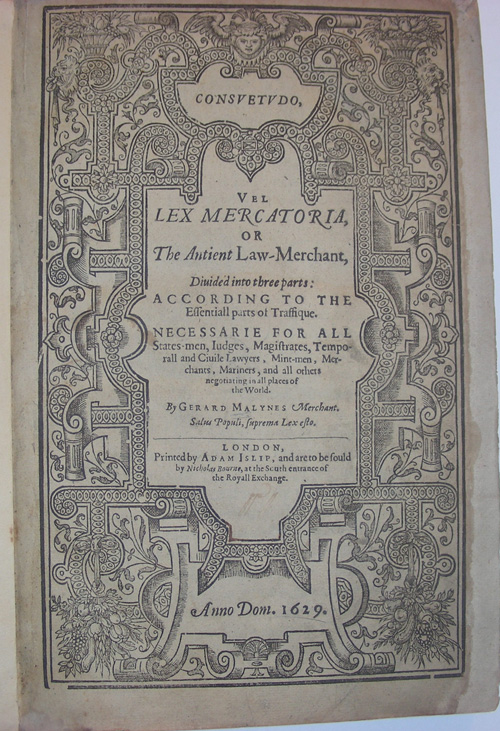
 The English system of commercial law or the lex mercatoria has been described as an example of “spontaneous order,” a set of rules that emerged without central direction and yet provided remarkable stability and favorable institutional environment for trade. Harold Berman and Bruce Benson, among others, have written extensively on this. Here’s an interesting paper by Daniel Klerman on the early history of English commercial law, framed as a comparison of the English and Ottoman systems:
Thirteenth-century England was a commercial backwater whose trade was dominated by foreigners. To accommodate and encourage foreign merchants, England modified its legal system by creating legal institutions which were available to both domestic and foreign traders. Among the most important of these institutions were streamlined debt collection procedures and mixed juries composed of both Englishmen and foreigners. By introducing institutions which treated locals and foreigners equally, England created a level playing field which enabled English merchants to become increasingly prominent in the later Middle Ages. England’s ability to modernize its law was facilitated by the secular nature of English law, the representation of merchants in Parliament, and legal pluralism. Medieval England contrasts sharply with the early modern Ottoman Empire. The latter created special institutions for foreign merchants, which eventually put Ottoman Muslims at a competitive disadvantage.
Interviews with Alchian, Coase, Kirzner, Manne
| Peter Klein |
 The Liberty Fund has put online several interviews from its Intellectual Portrait Series. Of particular interest to O&M readers:
- Armen Alchian, interviewed by Dan Benjamin
- Ronald Coase, interviewed by Richard Epstein
- Israel Kirzner, interviewed by Tibor Machan
- Henry Manne, interviewed by Fred McChesney
Update (Nov. 2): Manne link fixed.
ESNIE School on NIE Archives
| Nicolai Foss |
The European Society for New Institutional Economics, the semi-formal Euro branch of ISNIE, runs a yearly School on New Institutional Economics, usually taking place on Corsica. Organized by Eric Brousseau, the School has now run for seven consecutive years. The line-up is impressive, including Oliver Williamson, Sid Winter, Avinash Dixit, Doug North, Giovanni Dosi, Dick Langlois, Joanne Oxley, Jackson Nickerson, Lee Alston and many other luminaries. The great thing is that the PPTs of their talks are online (here)! Enjoy.
Organizational Economics and International Trade
| Peter Klein |
New NBER paper from Pol Antràs and Esteban Rossi-Hansberg, “Organizations and Trade” (ungated here). Surveys “an emerging literature at the intersection of organizational economics and international trade,” arguing that “a proper modelling of the organizational aspects of production provides valuable insights on the aggregate workings of the world economy.” Indeed, “certain predictions of standard models . . . are affected or even overturned when organizational decisions are brought into the analysis.”
A valuable survey, but the focus is quite narrow; an older and broader literature seeking to apply transaction cost economics to issues in international business, going back to Teece (1977), should also be consulted. (Joanne Oxley’s research page is a good place to start.)
Wiki Textbooks
| Peter Klein |
I teach two graduate courses without textbooks, Economics of Institutions and Organizations and Entrepreneurship: Theory, Applications, Debate. Maybe I should ask the students to create a Wiki Textbook? Anybody out there in the blogosphere want to coordinate such a project? (Thanks to Molly Burress for the link.)
See also previous entries on Wikisummaries, the Global Text Project, wiki notes, and Wikiversity.
How Well Does the Market Handle Network Effects?
| Peter Klein |
Quite well, according to Dan Spulber’s paper “Consumer Coordination in the Small and in the Large: Implications for Antitrust in Markets with Network Effects,” out recently in the Journal of Competition Law and Economics (June 2008). Dan distinguishes between network effects in small- and large-numbers bargaining situations; Coasean bargaining can solve the problem in the former while Hayekian “spontaneous order” can emerge in the latter. The paper also contains a useful, up-to-date summary of the network effects literature. Highly recommended!
Influence of E. A. G. Robinson on Coase
| Peter Klein |
The March 2008 issue of the Journal of the History of Economic Thought features “On Robinson, Coase, and ‘The Nature of the Firm'” by Lowell Jacobsen. Robinson is E. A. G. Robinson, the Cambridge economist and longtime editor of the Economic Journal, now known mainly as the husband of Joan Robinson. Coase was trained by Arnold Plant and has written much about Plant’s influence. Jacobsen argues that Coase was also influenced significantly by Robinson, an influence that has not been widely appreciated. Here’s a bit from the conclusion:
Robinson’s influence on Coase’s writing of ‘‘The Nature of the Firm’’ through his The Structure of Competitive Industry is both obvious and significant. This is understandable, as Robinson and Coase both embraced and looked to extend the Marshallian tradition with these noted works.19 They sought to directly engage the real world of business as they were keenly interested in how firms actually behave, and why. They pursued answers to very fundamental questions: Why do firms exist? and, To what size? In addition, the study of firms and their industries requires a variety of considerations if effective decision-making by the firms’ managers is to be properly understood. In Cairncross’ fine biography of Robinson, he noted the brilliance of Robinson was his ability ‘‘to look at problems from different angles, against an historical background, taking in technology, organisational considerations, political feasibility’’ (Cairncross 1993, p. 164). Much the same could be said about Coase. . . .
[Robinson and Coase] were both interested in applying simple, yet compelling, economic concepts and theory such as scale economies, substitution at the margin and, of course, transaction costs. Further, it was important for them that economic analysis be grounded on realistic assumptions; theory that depended on fabricated assumptions to ensure tractability and even elegance should be largely avoided. Moreover, mathematics should not be the sine qua non of economic theory. Unfortunately, formalism and a priori theorizing emerged in the 1930s (given such influences as Robbins, Pigou, and even Joan Robinson) to dominate, if not define, mainstream economics, including the treatment of the firm. As a result, Coase and Robinson arguably became ‘‘outsiders’’ as Medema (1994), in his equally fine biography, concludes about Coase.
The paper is free, for now at least, on the Cambridge Journals site, so grab it while you can.
Reflections on Cyert and March
| Peter Klein |
The April 2008 issue of JEBO features a symposium on Cyert and March’s 1963 classic, A Behavioral Theory of the Firm (an O&M favorite). The book has been highly influential in organization theory, somewhat influential in behavioral economics, but mostly ignored in the contemporary economics literature on the firm (see here). As Mie Augier and March note in their introduction to the special issue:
As long as the primary focus of the theory of the firm was on the aggregate outcomes of interaction among rational actors, the book’s role in economics was limited. As Cyert and March noted, “Ultimately, a new theory of firm decision making behavior might be used as a basis for a theory of markets, but at least in the short run we should distinguish between a theory of microbehavior, on the one hand, and the micro-assumptions appropriate to a theory of aggregate economic behavior on the other. In the present volume we will argue that we have developed the rudiments of a reasonable theory of firm decision making” (1963, 16).
As interest in economics moved slowly toward greater concern with behavioral micro-assumptions, ideas consistent with Cyert and March (1963) became more prominent ([Kay, 1979], [Day and Sunder, 1996] and [Day, 2002]), although with hesitations and qualifications ([Baumol and Stewart, 1971] and [Williamson and Winter, 1991]). Elements of a behavioral view of the firm can now be found in many modern developments in economics, but especially in transaction cost economics ([Williamson, 1996] and [Williamson, 2002]), evolutionary theory ([Nelson and Winter, 1982], [Nelson and Winter, 2002], [Winter, 1986] and [Dosi, 2004]), and organizational economics (Gibbons, 2003). Behavioral ideas have been elaborated not only in theories of the firm but also in collateral areas of economics, such as strategic management (Rumelt et al., 1991), organization theory (Argote and Greve, 2007), and the psychological foundations of economic choice ([Tversky and Kahneman, 1974], [Kahneman and Tversky, 1979] and [Camerer et al., 2004]). Ideas of bounded rationality, conflict, learning, and routines are now commonplace, as is the general idea that economic behavior is guided by principles of human behavior. Although those ideas have many ancestors, A Behavioral Theory of the Firm probably contributed some modest amount of DNA.
Of particular interest to the O&M crowd are “Outlines of a Behavioral Theory of the Entrepreneurial Firm” by Dew, Read, Sarasvathy, and Wiltbank; “Realism and Comprehension in Economics: A Footnote to an Exchange Between Oliver E. Williamson and Herbert A. Simon” by Augier and March; and “Unpacking Strategic Alliances: The Structure and Purpose of Alliance versus Supplier Relationships” by Mayer and Teece.
“El Pulpo”
| Peter Klein |
A few years ago I read, and enjoyed, Stephen Schlesinger and Stephen Kinzer’s Bitter Fruit: The Story of the American Coup in Guatemala. (Kinzer also has a nice book on the CIA’s role in Iran.) So when I saw Peter Chapman’s Bananas!: How The United Fruit Company Shaped the World in a local bookstore — yes, the bright-yellow cover caught my eye — I snapped it up. United Fruit — “El Pulpo” (the Octopus) to its detractors — is a fascinating company, the history of which should be required reading for students of international business. Bananas is a disappointment, unfortunately. I wasn’t expecting a scholarly treatment but, even by journalistic standards, the book is weak, substituting breathy clichés for facts and analysis. And Chapman’s unfamiliarity with even the most basic concepts of economics doesn’t help. (Spend your money on Bananas instead — my favorite Woody Allen movie.)
Today I learned of at least one scholarly treatment of United Fruit, focusing on its Colombian operations: Bananas and Business: The United Fruit Company in Colombia, 1899-2000 by Marcelo Bucheli (New York University Press, 2005). Alan Dye makes some interesting points about knowledge transfer in his review for EH.Net:
One important contribution is the story the book tells of how United Fruit eventually decided to abandon its initial policy of creating barriers to competition and accept fair dealing with rivals to its core business. Although its early history was one of raising barriers to competition and exploiting the weakness of unstable governments to establish its monospony position, he argues that in the long run the presence of this, or another multinational, was necessary for the development of a commercial banana industry in Colombia. United Fruit had pioneered techniques for how to commercialize a fragile and highly perishable product. Regardless of unethical practices when dealing with locals in the producing countries, the importation of the marketing techniques that such pioneers in the industry developed were of substantial value to local industry. (more…)
Organizational Structure and the Diversification Discount
| Peter Klein |
Do diversified conglomerates trade at a discount relative to more specialized firms? A huge literature in strategy and corporate finance emerged over the last couple of decades devoted to this question. Early studies claimed to find a substantial diversification discount, though more recent papers claim that the observed discount is due to measurement error, self-selection, and other characteristics, not a harmful effect of diversification per se. (For a good overview of this literature, now slightly dated, see this roundtable report edited by Belén Villalonga. Some of my own contributions are here and here.)
Seemingly lost in the search for a diversification discount, however, is a related question: What is being discounted? Potential benefits of diversification, according to the literature, include access to internal capital markets and more efficient redeployment of distressed assets; potential costs include inefficient rent-seeking, bargaining problems, and bureaucratic rigidity. But these benefits and costs have little to do with industry or geographic diversification per se — they apply to the management of any multi-unit organization, even if its activities do not span different industries or regions.
In a new paper, “Organizational Structure and the Diversification Discount: Evidence from Commercial Banking,” Marc Saidenberg and I try to distinguish the effects of diversification and organiztaional complexity by studying multi-unit firms within a single industry, commercial banking. (more…)
IBES-AAEA
| Peter Klein |
As the next phase of my Plan for World Domination I’ve taken office as Chair-Elect of the Institutional and Behavioral Economics Section (IBES) of the Agricultural and Applied Economics Association. One of my duties is to organize the section’s sessions for next year’s AAEA annual meeting, 26-28 July 2009 in Milwaukee, Wisconsin. I welcome participation from the O&M crowd so please email me your suggestions for session topics, papers, special formats, themes, or other ideas. Milwaukee is a lovely and interesting town (just ask Alice), so make plans to join us!
Homogeneity and Cooperation
| Peter Klein |
Why are Scandinavians so cooperative? Nicolai and Lasse might suggest it’s their superior moral character. La Porta et al. (1997), Putnam et al. (1992), and others point to Protestantism: hierarchical religions like Catholicism and Islam, it is argued, tend to discourage trust and retard the development of social capital. The Protestants, who already have Max Weber in their corner, seem to be piling it on.
Not so fast, says Kevin O’Rourke in a recent paper, “Culture, Conflict, and Cooperation: Irish Dairying Before the Great War” (Economic Journal, October 2007). O’Rourke compares the Danish and Irish dairy industries before 1914 and argues that cultural and ethnic homogeneity, not religion, explains the success of Danish cooperatives. Unlike recent large-sample econometric work on trust, the paper uses deeper, more robust indicators of cooperation. Key findings:
At first sight, the contrast between Protestant Ulster and the Catholic South (as well as between Denmark and Ireland as a whole) seems a striking confirmation of the LLSV hypothesis that culture matters for the ability to cooperate, and that hierarchical religions such as Catholicism undermine both trust and cooperation. However, on closer examination it appears that politics, not culture, was responsible for the lower Irish propensity to cooperate. Suspicion between Catholics and Protestants, and tenants and landlords, spilled over into Nationalist suspicion of the cooperative movement and hindered its spread, despite the efforts of the [Irish Agricultural Organisation Society] to remain apolitical. To this extent, the results are more consistent with the stress on [ethnolinguistic fractionalisation] in Alesina and La Ferrara (2000) than with the cultural perspective of LLSV, Knack and Keefer (1997) and Zak and Knack (2001).
Denmark benefited from several relevant advantages that Ireland did not enjoy during this period. In particular, it was an extremely homogeneous country, ethnically, religiously and linguistically. There was no conflict over who should own the land, since land reform in Denmark had been underway since the late eighteenth century. . . . Nor was there any ethnic conflict, or disputes over where national boundaries should lie (all such controversies became redundant following the loss of Schleswig-Holstein in 1864). The results suggest that this homogeneity of Danish society is what explains the success of cooperation there.
São Paulo Workshop on Institutions and Organizations
| Peter Klein |
See below for information on the Third Research Workshop on Institutions and Organizations, 13-14 October 2008 at Fundação Getúlio Vargas in Brazil. Session topics include “Organizations, law and corruption,” “Institutions and development,” “Institutions and environment,” “Psychological issues and organization strategies,” and “Industrial and competition policy.”
I participated in last year’s conference and enjoyed it tremendously. There is a growing network of Brazilian researchers working on various topics in the New Institutional Economics. It is a good group to be involved with. (more…)
NIE Guidebook
| Peter Klein |
 The long-awaited New Institutional Economics: A Guidebook is due out this September from Cambridge University Press. Editors Eric Brousseau and Jean-Michel Glachant assembled an all-star team including Oliver Williamson, Paul Joskow, John Nye, Gary Libecap, Lee Alston, Pablo Spiller, Benito Arruñada, Stéphane Saussier, Jackson Nickerson, Brian Silverman, Joanne Oxley, Mike Sykuta, Mike Cook, and many others — even Foss and Klein. You can pre-order yours today — the hardback’s a whopping $140 but the paperback’s only $59.
Here’s the official CUP page and here’s an information page put together by Eric Brousseau. It should be a valuable reference for years to come.
Pirrong on Speculation
| Peter Klein |
Following up Dick’s post on speculation, Craig Pirrong had a nice piece in Friday’s WSJ providng more details on oil markets. Notes Craig:
The unprecedented run-up in oil prices is painful for consumers around the world. But the focus on speculation is misguided, and represents a convenient distraction from an understanding of the real, underlying causes of high oil prices — most notably continuing demand growth in the face of stagnant production, supply disruptions and the weakening dollar.
More restrictions and regulations of energy markets, in the vain belief that such actions will bring price relief, are counterproductive. They will make the energy markets less efficient, rather than more so.
The pointer is from Mike Giberson, who provides more information and links to Craig’s (brilliantly named) blog, Streetwise Professor. Craig testified Friday on oil-market speculation before the US House Agriculture Committee; you can read his remarks here. And for a classic paen to speculation more generally, see Victor Niederhoffer’s classic “The Speculator as Hero.”
Note to graduate students: If you haven’t read Craig’s classic papers on bulk shipping, introducing the concept of “temporal specificity,” your education is incomplete. Check ’em out:
Pirrong, Stephen C. 1992. “An Application of Core Theory to the Study of Ocean Shipping Markets.” Journal of Law and Economics 35: 89–131.
Pirrong, Stephen C. 1993. “Contracting Practices in Bulk Shipping Markets: A Transactions Cost Explanation.” Journal of Law and Economics 36: 937–76.
Greif Responds to Edwards and Ogilvie
| Peter Klein |
I blogged earlier on Jeremy Edwards and Sheilagh Ogilvie’s provocative claim that Avner Greif misread the Geniza documents in constructing his influential account of the emergence of long-distance trade. Edwards and Ogilvie claim that formal law, not norms and custom, governed the behavior of the Maghribi traders.
Greif has prepared a formal response, now available on SSRN. Here’s the abstract:
Edwards and Ogilvie (2008) dispute the empirical basis for the view (Greif, e.g., 1989, 1994, 2006) that multilateral reputation mechanism mitigated agency problems among the eleventh-century Maghribi traders. Specifically, they assert that the relations among merchants and agents were law-based. This paper refutes this assertion and vindicates the position that the legal system had a marginal role in mitigating agency problems in long-distance trade in this historical era. The claim that merchants’ relations with their overseas agents were law-based is wrong.
The evidence presented here is based on quantitative analyses of the corpuses containing the hundreds of documents on which the literature relies and a careful review of the documents and the literature Edwards and Ogilvie cite. Their assertion is shown to be based on unrepresentative and irrelevant examples, an inaccurate description of the literature, and a consistent misreading of the few sources they consulted. This paper thereby reaffirms the empirical basis for the multilateral reputation view. Indeed, this empirical basis is stronger than originally perceived. In addition, this paper sheds light on the roles of the legal system and reputation mechanism during this period.
Business History Bleg: British Trading Houses
| Peter Klein |
I’m advising a PhD student in sociology (yes, it’s true) who’s studying the rise of British commercial influence in the Far East. He’s particularly interested in Jardine Matheson & Company, a Hong Kong trading company founded in 1832 that grew quickly into a pre-modern industrial conglomerate. Can anyone recommend references on the organization and strategy of 19th-century trading firms, their political, social, and cultural activities and influence, and their role in trade and economic growth more broadly?
Reliving the 1980s
Peter Klein |
I recently watched the new Rambo film, an entertaining spectacle of blood and gore (for those who enjoy that sort of thing). The last few years have brought back several 1980s-era action heroes after long absences, not only Rambo but also Rocky Balboa, John McClane, the Terminator, and of course Indiana Jones.
We posted a while back on the golden decade of the 1970s, a fantastically productive period for research in organizational economics. How about bringing back the 1980s? Not the mullet, but the great works in organizational economics, strategy, entrepreneurship, and related subjects that appeared in that decade. Here are some of my favorites, listed chronologically. What are yours? (more…)
The New Comparative Economic History
| Peter Klein |
That’s the title and subject of a Festschrift for Jeffrey G. Williamson, edited by Timothy Hatton, Kevin O’Rourke, and Alan Taylor and published last year by MIT Press. Reviewer Dan Bogart describes the field thusly: “In a nutshell, this line of research analyzes the sources of economic growth, the importance of institutions, and the impact of globalization by making comparisons between actual economies. An illuminating contrast is made with early cliometrics, which addressed questions by constructing counterfactuals with the help of theory and calibration. ” As such, the new comparative economic history is a closely related to, though not identical with, the new institutional economic history associated with Douglass North, Barry Weingast, Avner Greif, and others mentioned frequently on these pages. The NCEH takes institutions seriously but does not give them quite as much weight as NIE historians in explaining economic performance.





 Organizations and Markets
Recent Comments