Posts filed under ‘People’
Melnyk on Flew
| Peter Klein |
My Missouri colleague Andrew Melnyk penned this nice appreciation of Antony Flew, who passed away 8 April 2010. Flew “was for several decades a heroic defender of classically liberal political philosophy and indeed by far the best known professional philosopher in Britain over that period to champion classical liberalism.” As Andrew notes, “in challenging the spirit of the age as sharply and as unapologetically as he did, he was, and must have known that he was, irreparably damaging his reputation among his overwhelmingly left-leaning professional peers.”
Here are remarks on Flew’s political philosophy from David Gordon, David Conway, and Sean Gabb. Here’s a biographical sketch written for Flew’s 2001 Schlaurbaum Prize, and here’s the acceptance speech.
Add to: Facebook | Digg | Del.icio.us | Stumbleupon | Reddit | Blinklist | Twitter | Technorati
C. K. Prahalad (1941-2010)
| Peter Klein |
C. K. Prahalad died Friday at the age of 68. He’s best known for his “guru” work with Gary Hamel, but had turned his attention more recently to economic development , particularly the “bottom-of-the-pyramid” approach to poverty reduction. Here are thoughts and reminiscences from the WSJ, HBR, Ross Emmett, and the Ross School. HBR has already set up a Prahalad page. Here are previous O&M mentions. I last saw him at the 2009 SMS conference in Washington, D.C. where he spoke with Yves Doz on “The Future of Strategy.”
Add to: Facebook | Digg | Del.icio.us | Stumbleupon | Reddit | Blinklist | Twitter | Technorati
Edgerati
| Dick Langlois |
I just received an email from John Hagel informing me that I am among the inaugural class of what he and John Seeley Brown call the Edgerati. According the website, “Edgerati are people who venture out onto various edges, engage with participants on those edges, develop deep insight from their involvement on the edge and report back to the rest of the world what they have learned.” I’m glad to learn that what I had always thought to be the fringe or the margin is actually the edge. (Actually, I’m genuinely flattered.) Among the other Edgerati is one Nicolai Foss.
Add to: Facebook | Digg | Del.icio.us | Stumbleupon | Reddit | Blinklist | Twitter | Technorati
Mundaneum: The Google of 1910
| Peter Klein |
Fascinating article by Molly Springfield in Triple Canopy on the Mundaneum, an effort by two Belgian lawyers to collect and classify all the world’s information, using notecards and an innovative filing system. Information scientist Paul Otlet “was the first to imagine all the world’s knowledge as one vast ‘web,’ connected by ‘links’ and accessed remotely through desktop screens, and because of this he can be seen as the kooky grandfather of the Internet.” Unfortunately, the analog technology of the early twentieth century was not up to the task. (Here’s the wiki on the Mundaneum, which incidentally might make a good title for my next book.)

See also: The Victorian Internet by Tom Standage.
Ross Emmett on Innovation
| Peter Klein |
Here are some provocative videos on innovation from Ross Emmett. The series is called “The Constitution of Innovation.” The first three are posted at vimeo:
- Why “Picking Winners” Robs Us All of a Better Future
- National Innovation Systems: Too “National”; Not “Constitutional”
- The Promise of Failure
See Ross’s website for more information.
Mises Quote of the Day
| Peter Klein |
Nothing can be known about such matters as inflation, economic crises, unemployment, unionism, protectionism, taxation, economic controls, and all similar issues, that does not involve and presuppose economic analysis. All the arguments advanced in favor of or against the market economy and its opposites, interventionism or socialism (communism), are of an economic character. A man who talks about these problems without having acquainted himself with the fundamental ideas of economic theory is simply a babbler who repeats parrotlike what he has picked up incidentally from other fellows who are not better informed than he himself.
This is from Mises’s introduction to the 1959 edition of Böhm-Bawerk’s massive 3-volume set, Capital and Interest. Mises gives some further admonitions: “A man not perfectly familiar with all the ideas advanced in these three volumes has no claim whatever to the appellation of an economist.” This is, shall we say, a minority view. And my personal favorite: “A citizen who casts his ballot without having studied to the best of his abilities as much economics as he can fails in his civic duties. He neglects using in the appropriate way the power that his citizenship has conferred upon him in giving him the right to vote.”
Those lacking time to study Capital and Interest in its entirety may enjoy this new edition of Böhm-Bawerk’s essay “Control or Economic Law,” which is more easily digested.
Gene Fama’s Autobiography
| Peter Klein |
 Here’s an autobiographical essay by Gene Fama written for the Annual Review of Financial Economics. Fama’s work on agency theory (with Mike Jensen) and on corporate finance (with Ken French) should be of particular interest to O&Mers, though some may disagree with his introductory claim that “[f]inance is the most successful branch of economics in terms of theory and empirical work, the interplay between the two, and the penetration of financial research into other areas of economics and real-world applications.”
Fama’s Chicago-Booth colleagues add the following note about Fama’s institutional leadership, presumably directed at today’s Fama-bashers:
Rather than rest on his laurels or impose his own views on the group, Gene has always sought the truth, even when it appeared at odds with his own views. . . . The current finance group at Chicago includes a diverse set of people who specialize in all areas of modern finance including, behavioral economics, pure theory, and emerging, non-traditional areas such as entrepreneurship and development that were unheard of when Gene arrived at Chicago. Contrary to the caricatured descriptions, there is no single Chicago view of finance, except that the path to truth comes from the rigorous development and confrontation of theories with data.
Williamson Tribute in California Management Review
| Peter Klein |
Six new essays on Oliver Williamson by Haas School colleagues appear in the new issue of the California Management Review. They’re behind a subscription firewall, but just $6 a pop. Check ’em out:
Institutions, Politics, and Non-Market Strategy
de Figueiredo, Jr., Rui J.P.
Holdup: Implications for Investment and Organization
Hermalin, Benjamin E.
Antitrust Economics
Shapiro, Carl
Regulation: A Transaction Cost Perspective
Spiller, Pablo T.
Williamson’s Contribution and Its Relevance to 21st Century Society
Tadelis, Steven
Williamson’s Impact on the Theory and Practice of Management
Teece, David J.
Thanks to Mike Cook for the tip.
Happy Schumpeter Day
| Peter Klein |
Today’s the birthday of Joesph A. Schumpeter, one of the great theorists — and one of the great characters — in the history of economics. To celebrate, how about remembering some of the classic Schumpeter quotes:
“[Competitive] behavior . . . is the result of a piece of past history and . . . as an attempt by those firms to keep on their feet, on ground that is slipping away from under them.”
“The process of Creative Destruction is the essential fact about capitalism … it is not [price] competition which counts but the competition from . . . new technology . . . competition which strikes not at the margins of profits . . . of existing firms but at their foundations and their very lives.”
“Intellectuals are people who wield the power of the spoken and written word, and one of the touches that distinguishes them from other people who do the same is the absence of direct responsibility for practical affairs . . . .The critical attitude [arises] no less from the intellectual’s situation as an onlooker — in most cases, also an outsider — than from the fact that his main chance of asserting himself lies in his actual or potential nuisance value.”
“[C]apitalism, while economically stable, creates a mentality and a style of life incompatible with its own fundamental conditions. [It] will be changed, although not by economic necessity and probably even at some sacrifice of economic welfare, into an order of things which it will be merely a matter of taste and terminology to call Socialism or not.”
Update: Walter Grinder reminds me that it’s also Julian Simon’s birthday. Here’s a nice tribute from Steven Moore.
Brad’s Bloviations, Part #2,235
| Peter Klein |
Brad DeLong accuses non-Keynesians (Austrians, Chicagoites, and other sensible people) of “los[ing] themselves amidst their early-nineteenth century books, one hundred and seventy years behind the state of the art in economics,” just because they think public spending and deficits might be crowding out private-market activity, making it difficult — impossible, actually — to come up with meaningful estimates of “jobs saved” by stimulus spending. If you can get past Brad’s adolescent writing style (anyone citing Bastiat, for example, is “a truly clueless idiot”), you find that he is indeed very “progressive” in his thinking — he’s made it all the way to 1950. Brad, like most Keynesians, is stuck in the C + I + G world of undergraduate macro. His argument is that the stimulus can’t be crowding out private-sector jobs because (a) wages aren’t rising (implying that stimulus-funded workers aren’t being bid away from other potential opportunities) and (b) T-bill prices aren’t falling (suggesting that private employers aren’t competing with the Feds for credit).
Leave aside for the moment that Brad has no idea what wages and bond prices would be in the absence of stimulus. The key problem with Brad’s argument, noted by Russ Roberts, is its reliance on crude macroeconomic aggregates. As pointed out here many times, heterogeneity matters. Sensible economists care not about the aggregate unemployment rate, but the effect of stimulus activity on individual labor markets. Stimulus affects the composition of employment, not just its level. (more…)
Murray N. Rothbard
| Peter Klein |
Jeff Tucker reminds me that Murray Rothbard passed away 15 years ago today. I remember the moment when I heard the news, from Parth Shah at a restaurant in DC, where we were attending the American Economic Association meeting. (This was before smartphones, Twitter, and the like, and news traveled more slowly.) I was stunned — Rothbard was not yet 70 — but my wife reminded us that he hadn’t looked well when we saw him the last time, the previous summer at the Mises Institute instructional conference in Claremont. (He died of congestive heart failure.) Check out the photo montage at Jeff’s post — see if you can identify younger versions of Ralph Raico, Roger Garrison, Bill Evers, George Reisman, Leonard Liggio, and others.
I consider Rothbard one of the great theorists of the twentieth century, and think his contributions to technical economics are greatly undervalued, even by many of his Austrian-school admirers. My own work has been heavily influenced by Rothbard (one of my most-cited papers is basically a gloss on a Rothbardian idea). Joe Salerno and I are working on a price-theory text (based on our lecture series) that builds heavily on Rothbard’s analysis in Man, Economy, and State. We hope it contributes to renewed interest in mundane Austrian economics.
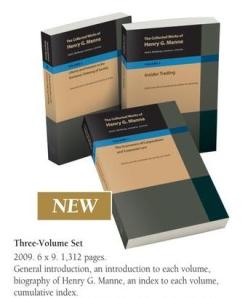
The Collected Works of Henry Manne
 | Peter Klein |
Via Geoff Manne, a description and ordering information for the new Collected Works of Henry Manne, produced by Liberty Fund. A great collection of scholarly articles, reviews, and shorter popular pieces divided into three volumes, “The Economics of Corporations and Corporate Law,” “Insider Trading,” and “Liberty and Freedom in the Economic Ordering of Society.” Order your copy today!
Studying Entrepreneurs
| Peter Klein |
Great opening from Robert Whaples’s EH.Net review of T.J. Stiles, The First Tycoon: The Epic Life of Cornelius Vanderbilt (Knopf, 2009):
Economists have always had a hard time dealing with entrepreneurs — as individuals and in the aggregate. We sort of know what entrepreneurship is and that it can have a profound impact on economic performance, but it’s usually just too difficult to model and measure. What we do not understand, we simply ignore and leave to others. After all, we are firm believers in comparative advantage and studying entrepreneurship — even if it is economically important — doesn’t seem to be our comparative advantage. In the view of most economic historians, it is the rules of the game — the incentives and the institutions — that really matter, not the players. American economic history has been cast as the story of millions of diligent and clever beavers working away and transforming the landscape. Take one of them away and nothing of great importance will really change. (In fact, most of us seem to believe that if you take away an entire technological complex, like the railroads, little of much importance would really change.)
Why, then, should economic historians study the careers of entrepreneurs? Not all of us should. But for some, the study of entrepreneurs will illuminate the past and the present — and put life into our cliometric narrative.
Joe Salerno has a valuable treatment of this problem in his 2008 paper “The Entrepreneur: Real and Imagined.”
Happy Birthday, Ronald!
 | Peter Klein |
Happy Birthday to Ronald Coase, 99 years young today. Live long and prosper!
Favorite under-appreciated Coase essay of the day: “Business Organization and the Accountant.”
Update: Oops, Mike Sykuta tells me that the birthday is actually tomorrow, 29 December. (I blame the Coase Institute, which sent out a Facebook message on 28 December saying “Congratulations to Ronald Coase on his 99th birthday today, December 29.” I didn’t catch the goof.)
Update II: A friend asks why new institutional economists live so long. I suggested a keen appreciation of comparative institutional analysis, reflected in a version of the old adage, “Getting old isn’t so bad, once you consider the feasible alternative.”
Ironies of Avatar
| Peter Klein |
I took the kids to see Avatar this weekend. From a technical standpoint, Jim Cameron’s film is remarkable, a breakthrough, as good as advertised. The alien world Pandora is stunningly realistic, detailed, convincing. The computer-generated characters look and move like real actors. The battle scenes are phenomenal.
But the storyline didn’t grab me. It’s a twist on that familiar Hollywood trope: evil, materialist, capitalist, militarist humans versus nature-loving, low-carbon-footprint, New Agey savages so noble they would have made Rousseau blush. The computer-generated landscapes are dazzlingly three-dimensional, but the characters, both human and alien, are cartoonish and one-dimensional (especially the Head Evil Capitalist, played here by Giovanni Ribisi, essentially reprising Paul Riser’s role from Cameron’s Aliens). The Pandorans are in their own way as clichéd as Peter Jackson’s much-derided Skull Islanders. I appreciate the film’s antiwar, anti-imperialist message, but really, the Earth First! propaganda is way, way over the top. And consider these ironies:
1. Avatar was written and directed by bazillionaire businessman Jim Cameron, is produced and distributed by giant corporation 20th-Century Fox, and will likely gross hundreds of million dollars. Naturally the film’s villain is — you guessed it — a giant corporation! Because, you know, businesspeople and money and corporations are evil and stuff.
2. The film was made possible by Cameron’s highly innovative, beyond-the-state-of-the-art, years-in-the-making technological innovations. Yet one of the film’s main themes is the evils of technology and capital accumulation and the beauty of live-for-today, pre-industrial society. The Pandorans literally worship their planet and don’t just hug their animals and tress, they physically bond with them through some mystical (and anatomically curious) process. The poor humans, one of the characters explains, have destroyed their own “Mother.” Blech.
Update: Peter Suderman beat me to it, calling Avatar
one of the stupidest major movies in recently memory, blithely peddling a message that its entire production process actually undermines. That Avatar’s melodramatic attacks on corporate interests and its defense of simple, natural living come packaged as one of the most expensive, and probably the most technically advanced, corporate films in history would seem to indicate that only quality bigger than the movie’s stupidity is its head-in-the-clouds hypocrisy. Cameron’s made a movie that he intends to be epic and awesome, but the only thing that’s awesome here is his total lack of self-awareness.
Stephan Kinsella sees a libertarian defense of property rights, and so do I, but for me that message was buried beneath the eco-propaganda. Had the earthlings homesteaded some piece of unoccupied Pandoran land, put it to productive use, and then the natives decided they needed the land or that its economic value belonged to “Mother Pandora,” is there any doubt what side Cameron would be on?
The Thoughtful President
| Peter Klein |
The President’s supporters portray him as thoughtful, well-informed, and deliberative. Unlike his predecessor, who acted on impulse, rarely considered dissenting points of view, and lived in a protective bubble, Obama reads, understands alternative perspectives, and thinks through arguments. Look how long it took him to decide on an Afghanistan policy!
And yet, on economic policy, the President is shockingly parochial. He has repeatedly challenged critics of his stimulus program to “produce a single economist” who opposes his actions. Anyone who disagrees with massive government borrowing and expenditures to “rescue” the economy is simply an obfuscationist, a partisan trying to score cheap political points at the expense of the national good. I think Obama genuinely believes this. He’s certain he’s right, so criticism bewilders him. He simply can’t fathom that there might be honest disagreement on basic economic issues. For Obama, the range of macroeconomic opinion runs from, say, Krugman to Summers. It’s like Pauline Kael’s famous line that Nixon couldn’t have won in 1972 because “no one I know voted for him.”
Of course, I’m not expecting a White House invitation for me and my friends to present Austrian business-cycle theory. But you’d think he might listen to Cochrane, Zingales, Mulligan, Becker, Glaeser, or even Mankiw.
This is our thoughtful, well-informed, deliberative Chief Executive?
I Wish I’d Written That
| Peter Klein |
Arnold Kling on PAS:
[P]rior to Samuelson’s formalization in economics, there were a lot of papers published that lacked clarity and insight. Now that formalization dominates, we also see a lot of papers that lack clarity and insight. If you compare the most insightful mathematical papers with the average non-mathematical papers, math wins. But one can also run the comparison the other way and reach the opposite conclusion.
Samuelson and Schumpeter
| Peter Klein |
Paul Samuelson, the enormously influential economic theorist, textbook writer, and teacher, died yesterday. The Times calls him “the foremost academic economist of the 20th century,” which may be true, depending what’s meant by “foremost.” He was certainly brilliant, talented, and creative. His Foundations of Economic Analysis (1949) changed forever the way economists think about their discipline (formerly a distinct, mostly verbal, logical science, economics became a branch of classical mechanics). His textbook Economics established a new style for introductory texts: lengthy, comprehensive, but ad hoc and unsystematic (Murray Rothbard called it a “vast potpourri . . . of bits and smidgens of technique and of data, none of them integrated into any sort of digestible or comprehensible whole”).
The blogosphere is beginning to spew out commentary, not all of it flattering (Krugman fawns, Ed Glaeser and Arnold Kling are more nuanced, Yuri Maltsev is gracious, Mario Rizzo is blunt). I don’t have much to add specifically for O&M readers, but I’m curious about one issue that may not get much play: the influence on Samuelson’s thought of Joseph Schumpeter, Samuelson’s dissertation supervisor at Harvard.
In many ways, they were opposites: Schumpeter the flamboyant, dramatic innovator, Samuelson the careful, rigorous systematizer; Schumpeter the defender of capitalism and critic of Keynes, Samuelson the interventionist and foremost American Keynesian; Schumpeter, someone I greatly admire, Samuelson. . . . well, you get the picture. Both were brilliant and egocentric (you all know the Schumpeter quip about wishing to become the greatest horseman, economist, and lover in Vienna, but achieving only two of the three; Samuelson once declared, “I can claim in talking about modern economics I am talking about me”).
Samuelson is mentioned in the Schumpeter biographies, including McCraw’s, mostly to illustrate Schumpeter’s enthusiasm for Samuelson’s brand of mathematical economics, which Schumpeter greatly admired even if he himself was not a practitioner. Samuelson has written a bit on his old teacher, mostly to praise Schumpeter’s brilliance (and celebrate his quirkiness, particularly in the classroom), but not much on Schumpeter’s specific theoretical contributions. (Here is Samuelson’s 1951 paper “Schumpeter as a Teacher and Economic Theorist,” which is a good read but not, ultimately, very informative; here is Samuelson’s critique of Schumpeter’s theory of equilibrium interest rates). Samuelson certainly didn’t give the entrepreneur a prominent place in his own system (here is a technical paper on innovation); what did he think of Schumpeter’s account of entrepreneurship and economic change?
Congratulations to Dick and Sid
| Peter Klein |
A comment from Dave Hoopes reminded me to congratulate Dick and Sid — Nelson and Winter, that is — for winning this year’s Dan and Mary Lou Schendel Best Paper Award from the Strategic Management Society, Dick for his 1991 paper “Why Do Firms Differ, and How Does it Matter?” and Sid for his 2003 paper “Understanding Dynamic Capabilities.” Dick’s paper is a particularly good introduction for economists wanting to understand what the strategy field is all about. I’m not a huge fan of dynamic capabilities — a friend calls the dynamic capabilities literature the “Derrida of strategic management” — but Sid’s paper strikes me as a particularly sensible approach.
On a personal note, many years ago I interviewed for a faculty position with Dick’s group at Columbia. I didn’t get the job, but Dick was a charming and gracious host. He has what you might call an impish sense of humor (I’m sure Dick Langlois can add some good stories). Sid Winter is a brilliant scholar and mentor to many in the strategy field (I only wish his views on macroeconomics were more, well, Kleinian).
Congratulations, gentlemen!
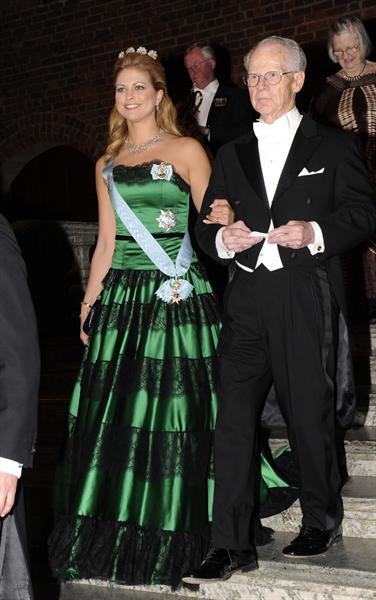
The Professor and the Princess
| Peter Klein |
Writes my source: “Madeleine is the youngest of the three royal children and referred to as the ‘party princess.’ Is that why he looks scared?”





 Organizations and Markets
Recent Comments