Posts filed under ‘Public Policy / Political Economy’
Decentralization and the Walmart Decision
| Peter Klein |
On Monday the US Supreme Court turned refused to hear the class-action discrimination suit against Walmart (technically, the Court denied to certify the plaintiffs as a single class for purposes of a class-action suit). I haven’t followed the case closely enough to have an opinion on the merits (or the role of sociologists). But a main legal issue in the case — whether Walmart’s policy of delegating hiring and promotion decisions to local managers makes the firm itself liable for illegal personnel behavior — raises important questions for organization theory.
According to the decision (no, I didn’t try to read all 42 pages):
Pay and promotion decisions at Wal-Mart are generally committed to local managers’ broad discretion, which is exercised “in a largely subjective manner.” . . . Local store managers may increase the wages of hourly employees (within limits) with only limited corporate oversight. As for salaried employees, such as store managers and their deputies, higher corporate authorities have discretion to set their pay within preestablished ranges.
Promotions work in a similar fashion. Wal-Mart permits store managers to apply their own subjective criteria when selecting candidates as “support managers,” which is the first step on the path to management. Admission to Wal-Mart’s management training program, however, does require that a candidate meet certain objective criteria,including an above-average performance rating, at least one year’s tenure in the applicant’s current position, and a willingness to relocate. But except for those requirements, regional and district managers have discretion to use their own judgment when selecting candidates for management training. Promotion to higher office — e.g., assistant manager, co-manager, or store manager — is similarly at the discretion of the employee’s superiors after prescribed objective factors are satisfied. (more…)
Mahoney and Pitelis Talk Public Entrepreneurship
| Peter Klein |
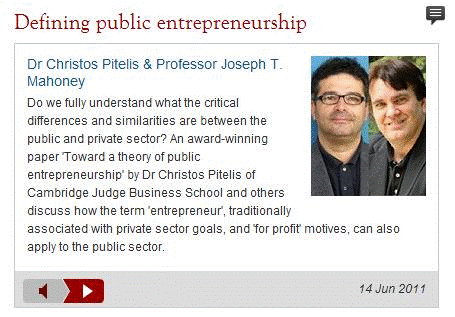
Here’s a podcast with my colleagues and good friends Joe Mahoney and Christos Pitelis on public entrepreneurship, part of an ongoing research project on public-private boundaries. Check it out!
Blessed Anonymity
| Peter Klein |
Critics of the market, from Marx and Karl Polanyi to Alasdair MacIntyre, John Gray, Robert Putnam, and some contemporary sociologists, decry the anonymity of commercial relations. Strong, local, community ties, they complain, are being displaced by long-distance, ad hoc, impersonal, weak ties. “Increasingly,” writes anthropologist Stephen Gudeman, “we commoditize things, leisure, body parts, reproductive capacities, DNA, and social relationships. As people flock to cities, sell their hardwood trees, change clothing styles, and watch television, community . . . shrinks.” (Thanks to Virgil Storr for this and many other good references.)
One response is to invoke Mises’s idea that social cooperation under the division of labor is actually the foundation of community. “The fundamental facts that brought about cooperation, society, and civilization . . . are the facts that work performed under the division of labor is more productive than isolated work and that man’s reason is capable of recognizing this truth” (Human Action, p. 144). Writers like Thomas Sowell and Walter Williams argue, for example, that the growth of the market stymies racism and other forms of prejudice.
Last week’s Economist had an interesting piece on supermarkets that brought these arguments to light:
The nostalgics don’t even have their history right. A big research project at the universities of Surrey and Exeter is currently studying shopping in post-war England. For one thing, high streets were not as quaint as politicians think. As far back as 1939, chain stores and co-operative (ie, mutual) retail societies already controlled about half of the grocery market. It was middle class matrons, the sort who dressed up to go shopping, who missed the deference shown by traditional grocers. Supermarkets were often welcomed by younger and working-class women. A retired secretary interviewed by the project recalled, as a young bride, asking the butcher for a tiny amount of mince. “Oh, having a dinner party, madam?” he sneered. A woman who bought anything expensive or unusual risked disapproving gossip, spread by shop assistants. The project
found press advertisements promoting the anonymity of supermarkets, as well as their convenience.
Some of you will remember a scene from Woody Allen’s Bananas, which also illustrates this point nicely.
Upcoming Conferences
| Peter Klein |
- ISNIE, 16-18 June in Palo Alto. Registrations are closed but latecomers could try lobbying the Treasurer to accept a late payment — never mind, that’s me, don’t bother.
- “Open Source, Innovation, and New Organizational Forms,” 1 August in Johannesburg. “This first IPEG conference intends to explore new theoretical and empirical advances in open source organization: the interest is not just on voluntary Open Source Software production and its potential innovation implications, but also on such related ‘open source’ phenomena as collective invention, online collaboration (e.g., Wikipedia), online social networking (e.g., Facebook), open innovation, open science, open source biology, and open standards.” The conference website is not live as of this posting, but organizer Giampaolo Garzarelli can provide details. O&M’s Dick Langlois is a keynote speaker. 500-word abstracts are due 24 June.
- “Achieving Coexistence of Biotech, Conventional & Organic Foods in the Marketplace,” 26-28 October in Vancouver. Speakers include FAO Deputy Director General Ann Tutweiler and Canadian Ag Minister Gerry Ritz. Coexistence conferences have been held every other year since 2003; the first 3 conferences came out of EU Commission efforts, the next was in Australia, and this one is the first to be held in North America. A co-organizer tells me “we hope to bring a more ‘practical’ view of coexistence than is commonly held in Europe.”
The Treasury Bill as Myth and Symbol
| Peter Klein |
My father was a historian and helped organize local events to commemorate the bicentennials of the Declaration of Independence in 1976 and Constitution in 1987. I particularly remember the Freedom Train, a traveling exhibit housing memorabilia such as original copies of the Declaration, Constitution, Louisiana Purchase, and (I learn from Wikipedia, though I don’t remember these) Judy Garland’s dress from the Wizard of Oz and Joe Frazier’s boxing trunks.
Several years later, my Dad gave a conference paper (unfortunately unpublished) on “The Constitution as Myth and Symbol.” He noted that for many Americans, the founding documents, along with the Liberty Bell, Independence Hall, images of George Washington and Betsy Ross, etc., play the same kind of role as a Britain’s crown jewels, the Bastille, or Lenin’s tomb. The Constitution is important, in other words, not only for its text — some would argue the text is largely ignored today anyway — but for its symbolic value. It represents a particular myth of the American founding, usually associated with reason and noble ideals (Bernard Bailyn, Ayn Rand, Schoolhouse Rock) but occasionally with power or material self-interest (Charles Beard, Bertell Ollman).
 In following the debates over raising the US debt ceiling I”m struck by the frequent claim that defaulting on public debt is unthinkable because of the “signal” that would send. If you can’t rely on the T-Bill, what can you rely on? Debt instruments backed by the “full faith and credit of the United States” are supposed to be risk-free, almost magically so, somehow transcending the vagaries of ordinary debt markets. The Treasury Bill, in other words, has become a myth and symbol, just like the Constitution.
I find this line of reasoning unpersuasive. A T-bill is a bond, just like any other bond. Corporations, municipalities, and other issuers default on bonds all the time, and the results are hardly catastrophic. Financial markets have been restructuring debt for many centuries, and they’ve gotten pretty good at it. From the discussion regarding T-bills you’d think no one had ever heard of default risk premia before. (Interestingly, this seems to be a case of American exceptionalism; people aren’t particularly happy about Greek, Irish, and Portuguese defaults but no one thinks the world will end because of them.) So, isn’t it time to de-mythologize all this? Treasuries are bonds just like any other bonds. There’s nothing magic, mythical, or sacred about them. A default on US government debt is no more or less radical than a default on any other kind of debt.
The Organizational Structure of Al Qaeda
| Peter Klein |
Speaking of organizational structure, here’s former O&M guest blogger Craig Pirrong on Al Qaeda:
There is a concerted effort underway to portray Bin Laden as exerting operational control over Al Qaeda, based on material collected during the raid on his compound. Color me skeptical.
First, it’s hard to imagine how he could exercise any control at anything but the broadest strategic and conceptual level while he was relying on couriers to communicate with subordinates. Second, this hierarchical model is contrary to virtually all that has been written about Al Qaeda going back to its early days: the organization has been consistently portrayed as networked and distributed rather than hierarchical. Indeed, the conventional characterization of Al Qaeda represents it as more of a franchise operation in which the franchisees have considerable autonomy.
But let’s assume for a moment that the organization was hierarchical, and that operational elements required direction and approval from Bin Laden to implement any attack. If that’s true, we may have actually done ourselves a disservice by killing Osama. For it would be almost trivially simple to get inside AQ’s OODA (“observe, orient, decide, and act”) loop and disrupt and destroy its operations. Even if we didn’t know what AQ was up to, we could disrupt their plans just by mixing (randomizing) our strategies, by unexpectedly changing up the way we do things. If response to such changes required the locals carrying out missions to report back to OBL via a painfully slow communications system, await a decision, and wait for the decision to be couriered back, they would be unable to do anything serious. In this case, killing OBL would free the locals to be more flexible and responsive — and hence more dangerous. It would permit AQ to become more of a network, less predictable, and more able to adapt to our moves.
I too doubt this emerging meme on OBL as operational figure, perhaps for somewhat different reasons: I assume that any official information about the operation and its significance is primarily propaganda, not transparent disclosure. Naturally the Administration would want to exaggerate the significance of Bin Laden’s, um, “retirement.”
Who Benefits from Coups?
| Peter Klein |
Not surprisingly — private interests:
Coups, Corporations, and Classified Information
Arindrajit Dube, Ethan Kaplan, Suresh Naidu
NBER Working Paper No. 16952, April 2011We estimate the impact of coups and top-secret coup authorizations on asset prices of partially nationalized multinational companies that stood to benefit from US-backed coups. Stock returns of highly exposed firms reacted to coup authorizations classified as top-secret. The average cumulative abnormal return to a coup authorization was 9% over 4 days for a fully nationalized company, rising to more than 13% over sixteen days. Pre-coup authorizations accounted for a larger share of stock price increases than the actual coup events themselves.There is no effect in the case of the widely publicized, poorly executed Cuban operations, consistent with abnormal returns to coup authorizations reflecting credible private information. We also introduce two new intuitive and easy to implement nonparametric tests that do not rely on asymptotic justifications.
In what can only be a pure coincidence, the following item appeared just below the NBER paper in my RSS reader: “Halliburton Profit More Than Doubles.”
4 Percent Project
| Peter Klein |
 On the way back from Brazil I will stop in Dallas to speak on entrepreneurship at a conference on economic growth, The 4 Percent Project, sponsored by the newly formed George W. Bush Presidential Center. The main speakers include four Nobel Laureates (Becker, Lucas, Scholes, Prescott), Ed Lazear, Allan Meltzer, Meg Whitman, Art Laffer, and W himself. I’m on a breakout panel with Bob Litan, Maria Minniti, and Jeff Friedman. The conference is the brainchild of O&M friend John Chapman, and should be quite an event!
CORS Lecture and Mises Brazil
| Peter Klein |
O&Mers in Brazil, come see me at two events this week. Thursday, 7 April, I will deliver the inaugural CORS Lecture at the University of São Paulo on “Entrepreneurship, Strategy, and Public Policy.” CORS, the Center for Organization Studies, is a new institute organized by O&M friends Sylvia Saes and Decio Zylbersztajn and involving many scholars familiar to O&M readers. The lecture is co-sponsored by the Mises Institute Brazil, my main host for the trip, and I will speak at the Institute’s Second Conference on Austrian Economics 9-10 April in Porto Alegre, along with Hans-Hermann Hoppe, Robert Murphy, Guido Hülsmann, Gabriel Zanotti, Ubiratan Iorio, Antony Mueller, Fabio Barbieri, and Dalton Gardimam. I’ll give one talk on entrepreneurship and another on networks. I would love to see you at one of these events!
If You’re Not a Cynic Yet, this Might Help…
| Lasse Lien |
Revolving Door Lobbyists
Jordi Blanes i Vidal, Mirko Draca, Christian Fons-Rosen.Abstract: Washington’s “revolving door” — the movement from government service into the lobbying industry — is regarded as a major concern for policy-making. We study how ex-government staffers benefit from the personal connections acquired during their public service. Lobbyists with experience in the office of a US Senator suffer a 24% drop in generated revenue when that Senator leaves office. The effect is immediate, discontinuous around the exit period and long-lasting. Consistent with the notion that lobbyists sell access to powerful politicians, the drop in revenue is increasing in the seniority of and committee assignments power held by the exiting politician.
By See the full paper here.
Creative Destruction in Popular Culture
| Peter Klein |
Thanks to Thomas B. for forwarding links to US Sen. Rand Paul’s Monday-night appearance on the Daily Show (part 1, part 2, part 3). At the start of part 3, while discussing government bailouts, Paul uses the words “creative destruction,” and Jon Stewart bursts out laughing, apparently hearing the term for the first time. I guess Schumpeter is not as culturally relevant as I thought!
The show had some interesting moments, but I found the discussions (in the parts I watched) pretty shallow. Stewart was grilling Paul on his “free-market” views, focusing on health, safety, and environmental regulation. Both Paul and Stewart took the milquetoast position that sure, some of this type of regulation is needed, but it shouldn’t be “too much.” They didn’t get into a serious discussion of theory or evidence, however, or explore specific trade-offs. There are huge political economy and public-choice literatures on the FDA, EPA, OSHA, etc., showing that these organizations are easily captured, tend to retard innovation, fail to weigh marginal benefits and costs, and so on. The Journal of Law and Economics under Coase’s leadership made its bones on these kinds of studies in the 1970s. The FDA has been a particular target. The Stewart view also ignores comparative institutional analysis — e.g., the role of private ordering (third-party certification, reputation, etc. ) in the protection of health and safety.
At least Paul didn’t say he intended to become the best Senator, horseman, and lover in all Washington!
Freedom to Trade and the Competitive Process
| Dick Langlois |
That’s the promising-sounding title of a new NBER Working Paper by Aaron Edlin and Joseph Farrell. Unfortunately, the argument turns out, in my opinion, to be extraordinarily wrongheaded. Here is the abstract.
Although antitrust courts sometimes stress the competitive process, they have not deeply explored what that process is. Inspired by the theory of the core, we explore the idea that the competitive process is the process of sellers and buyers forming improving coalitions. Much of antitrust can be seen as prohibiting firms’ attempts to restrain improving trade between their rivals and customers. In this way, antitrust protects firms’ and customers’ freedom to trade to their mutual betterment.
The promising part is that they talk explicitly about the competitive process.
The freedom-to-trade perspective . . . stresses the freedom of buyers and sellers to change their trading partners whenever that is mutually beneficial. The aspect of the competitive process that we study here is buyers and sellers exercising this freedom and forming improving coalitions (i.e., new configurations of trading partners). In a highly competitive market a seller who does not give its customers good deals will find that rivals offer better deals to attract these customers. The process of firms fighting over customers and offering them better and better deals raises consumers’ utility skyward. This competitive process is closely aligned with what Schumpeter called creative destruction.
As anyone who has read Schumpeter knows, of course, this is not even close to what he actually meant by creative destruction. (more…)
Is Counterfeiting Good for Business?
| Peter Klein |
Sometimes, according to Yi Qian in a new NBER Working Paper, “Counterfeiters: Foes or Friends?” In some cases, counterfeiting constitutes advertising that increases sales of the original product. It makes sense; how many buyers of faux Rolex watches or Gucci purses would have bought the authentic items if the fakes were banned? I suppose there’s a negative externality (more fakes means less exclusivity means a lower equilibrium price) that must be taken into account as well. An interesting analysis, in any case. Applications to digital media are left as an exercise for the reader.
Counterfeiters: Foes or Friends?
Yi Qian
NBER Working Paper No. 16785
Issued in February 2011This paper combines a natural policy experiment and randomized lab experiments to estimate the differential impacts of counterfeiting on the sales and purchase intent of branded products of various quality levels. I collect new product-line level panel data from Chinese shoe companies from 1993-2004. Exploiting the discontinuity of government enforcement efforts for the footwear sector in 1995 and the differences in authentic companies’ relationships with the government, I identify heterogeneous effects of counterfeit entry on sales of authentic products of three quality tiers. In particular, counterfeits have both advertising effects for the brand and substitution effects for authentic products. The advertising effect dominates substitution effect for high-end authentic product sales, and the substitution effect outweighs advertising effect for low-end product sales. The positive effect of counterfeits is most pronounced for the high-fashion products (such as women’s high-leg boots) and for the high-end shoes of the brands that were not yet well-known at the time of the entry by counterfeiters. I provide a theoretical framework to generalize such impacts due to counterfeits. Analogous heterogeneous effects of counterfeiting on consumer purchase intent for branded products of three quality tiers are also discovered in lab experiments. Responses in the lab allude to the fact that counterfeits could increase brand awareness as well as steal business.
Ginsburg and Wright on Behavioral Law and Economics
| Dick Langlois |
Judge Douglas Ginsburg will be presenting a paper (written with Josh Wright) called “Behavioral Law and Economics: Its Origins, Fatal Flaws, and Implications for Liberty” at Columbia next week. I am on the mailing list for the Law and Economics Workshop at Columbia, so I received a copy of the paper as an email attachment; but the email specifically requests that the paper not be forwarded, so I won’t make it available here. I imagine Josh will post it eventually. But if you’re in NYC, you can hear the paper presented on Friday, February 25, 11:30am-1:00pm, in the Levien Room (Warren Hall, W. 116th near Morningside, across from the main law school building, 10th Floor).
Mario Rizzo’s Graduate Course in Behavioral Economics
| Peter Klein |
Check out the syllabus and join the discussion at ThinkMarkets. I appreciate boat-rocking as much as anyone but am personally in what Mario terms (in his syllabus) the “classical” camp. Still, this is a course I would definitely take. If he’s an easy grader.
The Vanishing Hand: 19th-Century French Edition
| Dick Langlois |
Haven’t read this yet, but it looks interesting. Note also the futuristic publication date.
On the Origins of Vertical Unbundling: The Case of the French Transportation Industry in the 19th Century
Guy Numa
European Journal of the History of Economic Thought, Vol. 20, No. 2, 2013The paper retraces the origins of the unbundling of infrastructure, which is a monopoly, from services, which are subject to competition. Using the case of the railroad industry in France, I examine how both natural monopoly theorists and legislation dealt with this subject in the 19th century. I argue that the origins of vertical unbundling date to this period with legislation pertaining to inland waterways and railroads. This was particularly the case for the railroad industry due to pricing and competition rationales. I analyze the writings of Dupuit and Walras and show that they both agreed that infrastructure and services had to be unbundled for the inland waterways. In contrast, they expressed different justifications to defend the monopoly for the railroad industry. Following a chronological progression, the first section explores the origins of unbundling in legislation. The second section analyzes how theorists approached the way railroads had to be managed. Throughout, I highlight the interplay between their work and legislation.
Anita McGahan at TEDx
| Peter Klein |
Here is my good friend and colleague Anita McGahan, Professor and Rotman Chair in Management and Associate Dean for Research at the University of Toronto’s Rotman School, speaking at a recent TEDx event on the role business schools can play in making the world a better place. Anita is not only a gifted speaker and teacher, and a highly accomplished researcher, but also one of the most thoughtful people in the profession, emphasizing Big Problems as well as the more narrow, technical issues favored by the strategic management literature. Check her out!
Transaction Cost Regulation
| Peter Klein |
At last year’s ISNIE conference in Stirling Pablo Spiller gave an excellent presidential address on “Transaction Cost Regulation,” the application of transaction cost economics to regulatory issues. The text of the address has now been released as an NBER Working Paper with the same name:
This paper discusses the fundamental underpinnings and some implications of transaction cost regulation (TCR), a framework to analyze the interaction between governments and investors fundamentally, but not exclusively, in utility industries. TCR sees regulation as the governance structure of these interactions, and thus, as in standard transaction cost economics, it places emphasis in understanding the nature of the hazards inherent to these interactions. The emphasis on transactional hazards requires a microanalytical perspective, where performance assessment is undertaken within the realm of possible institutional alternative. In that sense, politics becomes fundamental to understanding regulation as the governance of public / private interactions. The paper discusses two fundamental hazards and their organizational implications: governmental and third party opportunism. Both interact to make regulatory processes and outcomes more rigid, formalistic, and prone to conflict than envisioned by relational contracting.
You can see the slides from the ISNIE version here.
ISNIE Annual Conference, Stanford University, June 16–18
| Scott Masten |
The 15th Annual Conference of the International Society for New Institutional Economics will be held this year at Stanford University on June 16-18. The conference is being organized by President-Elect Barry Weingast, and my inside, not-yet-public information is that the conference will have two very interesting keynotes. The ISNIE website has the just-released Call for Papers.


Short Course on Network Economics
| Peter Klein |
 I’m teaching a five-week, online course starting in January called “Networks and the Digital Revolution: Economic Myths and Realities.” It’s offered through the Mises Academy, an innovative course-delivery platform that is becoming its own educational ecosystem. A description and course outline is here, signup information is here. I’d love to have you join me!





 Organizations and Markets
Recent Comments