Posts filed under ‘Public Policy / Political Economy’
Foss and Klein Critique of Kirzner
| Peter Klein |
The Spring 2010 issue of the Journal of Private Enterprise contains a Kirzner symposium, including a paper by Nicolai and me, “Alertness, Action, and the Antecedents of Entrepreneurship.” We critique Kirzner’s concept of the “pure entrepreneur,” arguing that alertness is a historically contingent attribute of real-world business people — what Mises calls “promoters” — but not essential to the entrepreneurial function itself. We also suggest that Kirzner is inconsistent on the issue of antecedents, simultaneously holding that the entrepreneur-as-discoverer exists outside any particular institutional environment, and that certain public policies inhibit entrepreneurial discovery by blocking profit opportunities. Some of the material in the paper is familiar to readers of our other works, but our critique of the Kirznerian pure entrepreneur, in the context of ideal types, goes beyond previous arguments.
Oh, some of you may be more interested in the rest of the special issue, which leads with Dan Klein and Jason Briggeman’s broadside, “Israel Kirzner on Coordination and Discovery,” followed by a lengthy response from Kirzner himself. (Our paper is really an addendum.) Pete Boettke and Dan D’Amico, Steve Horwitz, Gene Callahan, Bob Murphy, and Martin Ricketts round out the Kirzner symposium.
Add to: Facebook | Digg | Del.icio.us | Stumbleupon | Reddit | Blinklist | Twitter | Technorati
The Wikileaks Data Dump
| Peter Klein |
I’ve been fascinated by the reaction to the Wikileaks release of 90,000+ classified documents related Afghanistan war. US and British (and Pakistani) authorities are predictably outraged, while critics of the war are encouraged that the disclosures could help turn the tide, as did the Pentagon Papers three decades prior. What interests me the most, however, is the massive size of the Wikileaks archive. As the Guardian’s Roy Greenslade remarked, this is “data journalism.” Wikileaks doesn’t analyze, synthesize, attempt to corroborate, seek alternative points of view, write up the inverted-pyramid lead, or do the other things respectable journalists are supposed to do; it just dumps the data and lets others sort it out.
Some find this approach distasteful. A Pakistani official said “these reports betray a lack of understanding of the complexities of the nations involved.” Well, sure. They’re raw data, nothing more. But isn’t sharing data, and not just analysis, a quintessential New Economy phenomenon? Don’t we have search and analysis tools, data-mining algorithms, page rankings, and other means to sift through the huge piles of stuff that constitute the long tail? Shouldn’t expert commentary and analysis be replicable? Many journals now mandate data-sharing. E.g.: “It is the policy of the American Economic Review to publish papers only if the data used in the analysis are clearly and precisely documented and are readily available to any researcher for purposes of replication. Authors of accepted papers that contain empirical work, simulations, or experimental work must provide to the Review, prior to publication, the data, programs, and other details of the computations sufficient to permit replication. These will be posted on the AER Web site.” Why should foreign-affairs reporting be different?
Add to: Facebook | Digg | Del.icio.us | Stumbleupon | Reddit | Blinklist | Twitter | Technorati
Performance Evaluation Links
| Peter Klein |
Performance evaluation is a favorite topic here at O&M; readers may enjoy these miscellaneous items on measurement:
- “Is Impact Measurement a Dead End?” by Alanna Shaikh, guest blogging at AidWatch.
- Moneyball’s Michael Lewis on basketball player statistics (HT: PB).
- The Urban Institute’s Outcome Indicators Project for nonprofits.
- Relevant Demotivators: Flattery, Ineptitude, and Mediocrity.

Add to: Facebook | Digg | Del.icio.us | Stumbleupon | Reddit | Blinklist | Twitter | Technorati
Summary of Dodd-Frank Act
| Peter Klein |
The Dodd-Frank Wall Street Reform and Consumer Protection Act — I’ll refrain from snarks about the title — was signed into law today by President Obama. Here is a very useful summary by William Sweet of the Act’s contents and likely consequences. In a nutshell: “The Dodd-Frank Act effects a profound increase in regulation of the financial services industry. The Act gives U.S. governmental authorities more funding, more information and more power. In broad and significant areas, the Act endows regulators with wholly discretionary authority to write and interpret new rules.” Aren’t you shocked that it passed?
Update: Larry Ribstein is not happy. Weil Gotshal provides further details.
Add to: Facebook | Digg | Del.icio.us | Stumbleupon | Reddit | Blinklist | Twitter | Technorati
The Organizational Economics of the BP Oil Spill
 | Peter Klein |
Now that passions are cooling regarding the BP disaster, it’s time to bring organizational issues into the discussion.
1. Everyone knows about the liability caps and the role they may have played in encouraging moral hazard. Just as bank deposits are guaranteed by government deposit insurance, and large banks themselves are probably Too Big to Fail, liability for property damage from oil spills off US waters is limited to $75 million (plus cleanup costs), based on a 1990 law passed after the Exxon Valdiz spill. This presumably mitigates drillers’ incentives to manage environmental risk. Indeed, oil companies enjoy a very cozy relationship with their ostensible guardians; as the NY Times noted, “[d]ecades of law and custom have joined government and the oil industry in the pursuit of petroleum and profit.” The federal agency that oversees drilling, the Minerals Management Service, rakes $13 billion a year in fees in what amounts to a public-private partnership. And does anyone really think the British government would “stand idly by” if BP’s status as an ongoing concern were threatened by criminal or civil penalties?
2. As Bill Shughart points out, BP did not own the Deepwater Horizon platform, but leased it from a company called Transocean. To Bill this suggests “a classic principal-agent problem in which the duties and responsibilities of lessor and lessee undoubtedly were not spelled out fully, especially with respect to maintenance and testing of the rig’s blowout preventer as well as to the advisability of installing a second ‘blind sheer ram,’ which may have been able to plug the well after the first (and only one then in service) failed to do so.” Would BP have paid more attention to safety if it owned, rather than leased, the platform? (more…)
Admongo
| Dick Langlois |
 Slate has a piece on a video game called Admongo, which the Federal Trade Commission has created to teach children the dangers of commercial advertising. Characteristically, the author rather likes this idea, and the only criticism of this micro-Orwellianism he can imagine is that it doesn’t go far enough in bashing commercial advertising and is fact in bed with commercial interests like Scholastic.
Add to: Facebook | Digg | Del.icio.us | Stumbleupon | Reddit | Blinklist | Twitter | Technorati
The Invention of Enterprise: Reviews
| Peter Klein |
If you haven’t yet had a chance to read Landes, Mokyr, and Baumol’s 600-page baby, The Invention of Enterprise: Entrepreneurship from Ancient Mesopotamia to Modern Times, here are reviews by Mansel Blackford and Reuven Brenner. Blackford is impressed; Brenner, not so much. Brenner is worth quoting at length:
[L]arge chunks of the book are more about the topic of inhibitions to enterprise and both the variety of ideas people came up with to rationalize them and the institutions rulers and governments put in place to enforce these ideologies. . . .
Unfortunately most of the chapters dealing with the topic of inhibitions miss the forest from the trees, as not one addresses what is to me the basic issue when examining “the invention of enterprise.” There is nothing more threatening to an established order — any order — than opening up, deepening, democratizing capital markets — accountably, allowing people to leverage their inventive, enterprising spirit. True, this would also disperse power — political power in particular. The deeper capital markets would also threaten established industries and commerce. Entrepreneurs, brilliant and ambitious as they might be, are not a threat. They can be sent to Siberia, forced into complacency by the Maos of this world, and the opportunistic ones will channel their ambition through the established powers.
But entrepreneurs with access to different, independent sources of risk capital — now that’s threatening, be they Brin and Page, Jobs or Milken at the time (quickly taking away much of the banks’ bread and butter of providing loans). Understanding this, even if not wanting to articulate it, provides enough incentives for those in power to subsidize, spread, and promote ideas and institutions inhibiting the deepening of capital markets under a wide variety of jargons, and thus inhibiting the invention and reinvention of enterprises. With time, people get accustomed to these institutions, their origins lost in the mist of time, inhibiting entrepreneurship and business for centuries. Today this may be happening a bit before our eyes. Suddenly, everything becomes a “bubble” — Internet, oil, houses, gold, bonds. Guess what: if everything is — why have capital markets to start with? If pricing no longer offers guidance to allocate capital; if stock and bond markets are not there to help correct mistakes faster — why should they continue to exist? And if they do not exist, who else remains but politicians, bureaucrats and the academics surrounding them — none of whom ever worked in a business even one day in their lives — who would then tax and borrow and subsequently allocate capital and “invent enterprises” based on — well — whatever.
Add to: Facebook | Digg | Del.icio.us | Stumbleupon | Reddit | Blinklist | Twitter | Technorati
Business Ethics Symposium in Reason Papers
| Peter Klein |
From Reason Papers 31 (Fall 2009):
Articles: Business Ethics Symposium
- Rival Paradigms in Business Ethics —Nicholas Capaldi
- The Need for Realism in Business Ethics —Elaine Sternberg
- The Virtue of Prudence as the Moral Basis of Commerce —Tibor R. Machan
- Hume and Smith on the Moral Psychology of Market Relations, Practical Wisdom, and the Liberal Political Order —Jonathan Jacobs
- Ethics without Profits —Douglas Den Uyl
- Is a Market for Values a Value in Markets? —Alexei Marcoux
- The Sloppiness of Business Ethics —Marianne Jennings
- The Business Ethics of Incarceration: The Moral Implications of Treating Prisons Like Businesses —Daniel D’Amico & Joseph Butt
Add to: Facebook | Digg | Del.icio.us | Stumbleupon | Reddit | Blinklist | Twitter | Technorati
Raising Rivals’ Costs, Goldman Edition
| Peter Klein |
One could also call this “From the Department of ‘Duh'”:
A powerful alumni network plus bundles of campaign cash mean Goldman will get what it wants — and contrary to the media narrative, what Goldman wants is not laissez-faire.
Politico quoted a Goldman lobbyist Monday saying, “We’re not against regulation. We’re for regulation. We partner with regulators.” At least three times in Goldman’s conference call Tuesday, spokesmen trumpeted the firm’s support for more federal control. . . .
Goldman reported on the conference call that it holds 15 percent “Tier 1 capital,” meaning it is very liquid and not very risky. Goldman can play it safe, you see, without needing a regulation. But regulations prevent smaller competitors from taking the risks needed to compete with Goldman (and every competitor is smaller).
The article is also very good on Obama’s Goldman problem. (Link from Steve Horwitz via Per Bylund.)
Add to: Facebook | Digg | Del.icio.us | Stumbleupon | Reddit | Blinklist | Twitter | Technorati
A New Organizational Chart
| Peter Klein |
Fodder for dozens of future PhD dissertations, no doubt! (Click to enlarge.)

Rothbard, Friedman on Health Care
| Peter Klein |
Murray Rothbard and Milton Friedman are no longer with us, unfortunately, but their opinions live on. Lew Rockwell is running a 1994 piece by Rothbard on what was then called Hillarycare, while the Saturday WSJ reprinted a 1996 essay by Friedman on “Soviet-Style Health Care.” My favorite excerpts:
Rothbard on “universal access”:
[T]here is one simple entity, in any sort of free society, that provides “universal access” to every conceivable good or service, and not just to health or education or food. That entity is not a voucher or a Clintonian ID card; it’s called a “dollar.” Dollars not only provide universal access to all goods and services, they provide it to each dollar-holder for each product only to the extent that the dollar-holder desires.
Friedman, quoting a a physician character in Solzhenitsyn’s 1967 novel The Cancer Ward, on Soviet-style “free” health care:
What do you mean by “free”? The doctors don’t work without pay. It’s just that the patient doesn’t pay them, they’re paid out of the public budget. The public budget comes from these same patients. Treatment isn’t free, it’s just depersonalized. If the cost of it were left with the patient, he’d turn the ten rubles over and over in his hands. But when he really needed help he’d come to the doctor five times over. . . .
Is it better the way it is now? You’d pay anything for careful and sympathetic attention from the doctor, but everywhere there’s a schedule, a quota the doctors have to meet; next! . . . And what do patients come for? For a certificate to be absent from work, for sick leave, for certification for invalids’ pensions: and the doctor’s job is to catch the frauds. Doctor and patient as enemies — is that medicine?
Unquenchable
| Dick Langlois |
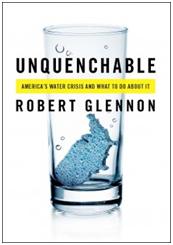 I attended an interesting lecture on Thursday, part of the University’s Edwin Way Teale lecture series on the environment. Normally these lectures do not tend, shall we say, to take perspectives that O&M readers would find congenial. But this lecture, by Robert Glennon of the University of Arizona Law School, was interesting along a number of dimensions. The talk was based on his book Unquenchable: America’s Water Crisis and What To Do About It. Here is the abstract:
From manufactured snow for tourists in Atlanta to trillions of gallons of water flushed down the toilet each year, Dr. Robert Glennon reveals the heady extravagances and everyday inefficiencies that are sucking the nation dry. The looming catastrophe remains hidden as the government diverts supplies from one area to another to keep water flowing from the tap. But sooner rather than later, the shell game has to end. And when it does, shortages will threaten not only the environment, but every aspect of American life. America must make hard choices — and Glennon’s answers are fittingly provocative. He proposes market-based solutions that value water as both a commodity and a fundamental human right.
The talk was interesting not only in that I learned a few things about the screwed-up water system in the U. S. (the broad contours of which I was vaguely familiar with) but also in that it presented an interesting case study in rhetoric. Glennon spent most of the talk revving up the environmentalist crowd, with lots of show and tell about the effects of bad water policy and a tour through various command-and-control policies that environmentalists might think of to fix the situation. (He even paused to make fun of Ann Coulter’s claim that the flush toilet is man’s greatest invention.) But Glennon’s bottom line, revealed at the very end, is that the only thing that will fix the problem is properly assigning property rights and trading those rights on markets. This was the conclusion I was expecting, not only because of the abstract but also because Glennon has an NBER Working Paper with Gary Libecap. Maybe this is the way to go in selling market-based solutions.
New Issue of QJAE
| Peter Klein |
The new issue of the Quarterly Journal of Austrian Economics (volume 12, no. 3) has several papers of likely interest to O&Mers. For instance:
Jack High, “Entrepreneurship and Economic Growth: The Theory of Emergent Institutions”
This paper enlarges Menger’s theory of the origins of money by making explicit the role of entrepreneurship in the theory and by extending the theory to market institutions other than money. Drawing on the research of anthropologists, archaeologists, and historians, the paper considers the origins of three institutions that underlie economic growth — the division of labor, monetary accounting, and private property. Menger’s generalized theory of the origins of institutions is used to interpret each of these institutions.
Laurent A.H. Carnis, “The Economic Theory of Bureaucracy: Insights from the Niskanian Model and the Misesian Approach”
Governmental interventions in the economy take numerous forms, and they require the existence of a public authority, a bureaucracy, to implement them. This article proposes an analysis of the origins and the dynamics of bureaucracy, and discusses means of escaping bureaucracy’s disadvantages. I will proceed by means of a comparison between the theories of Niskanen and Mises, two impressive and very representative works from the Public Choice School and the Austrian School of economics. Although Mises and Niskanen share a common analysis of the defect of bureaucratic management, there are strong disagreements between the two authors about the reasons for the existence of bureaus and about their functioning and their deficiencies. Inevitably, the means proposed by Niskanen and Mises for escaping the disadvantages of bureaucracy are different and cannot be reconciled.
The Best and the Brightest
| Dick Langlois |
I read Peter’s post about paternalism — and the limits of smart people in government — just after I read about the death of Carl Kaysen, long-time MIT economist and one-time Kennedy advisor. Obituaries praise Kaysen for his role as a policy intellectual of great scope, especially in the area of nuclear non-proliferation. But they either fail to mention, or mention with considerable approval, Kaysen’s pivotal role in the famous 1954 United Shoe Machinery case. Kaysen’s view of the case, and of the role of economic analysis in antitrust, is a key example of what Williamson calls the “inhospitality tradition” — that any kind of contract we don’t understand must therefore be anticompetitive. In the eyes of many present-day economists, Kaysen is implicated in having destroyed the American shoe machinery industry and with it the American shoe industry. (The post-mortem is by Masten and Snyder.) Not exactly McNamara in Vietnam, but worth mentioning amid the hagiography of Kaysen, not to mention the reawakened culture of elitist decision-making in Washington.
Comparative Institutional Analysis and the New Paternalism
| Peter Klein |
Comparative institutional analysis — defined as the assessment of feasible organizational or policy alternatives — is at the heart of the new institutional economics. Most economists and management scholars recognize, at least implicitly, that individuals and organizations don’t think, act, and choose with reference to some kind of global optimum, but are always evaluating trade-offs among imperfect alternatives. Yet, when it comes to public policy, even trained economists and strategy scholars easily lapse into Nirvana mode. Recent examples discussed her at O&M include the debate over Fed independence, the role of financial regulators more generally, and the “soft” or “libertarian” paternalism favored by Obama’s man Cass Sunstein, among others.
The new paternalism literature suggests that private actors suffer from biases and cognitive limitations such as lack of willpower or self-control, status quo bias, optimism bias, and susceptibility to framing effects leading them to make decisions that are inconsistent with their own preferences. By making marginal changes to the options available to market participants (“nudges”), the private benefits and costs of various actions, and the informational environment in which choices are made, market participants can be led to make “better” choices without reliance on heavy-handed, top-down regulation. The problem, of course, is that this literature virtually ignores the cognitive and behavioral limitations affecting policymakers. Incentive problems are an obvious example, along with the “slippery-slope” problem: the vulnerability of new paternalist proposals “to slippery slopes that can lead from modest paternalism to more extensive paternalism” (Rizzo and Whitman, 2009, p. 667).
Mario Rizzo and Glen Whitman’s have written an excellent set of papers on the new paternalism, the latest of which focuses on the knowledge problem, and how dispersed, tacit knowledge about preferences and constraints limits policymakers’ ability to plan paternalist policies that actually make people better off. The paper is here, and Mario blogs about it here. Highly recommended!
Industrial Policy Redux
| Peter Klein |
Keynesian economics is not the only once-discredited doctrine making a comeback following the financial crisis. Despite the well-publicized failures of MITI, Sematech, and similar ventures, people are now calling for a new US industrial policy. Here’s a former Shell executive writing in the WSJ about America’s “foolhardy fondness for ‘free market’ philosophies that tell us it’s OK to export all our jobs,” and complaining that “[w]e’ve never systematically used government incentives to help U.S. industry compete across the board. It’s time we did, like everyone else.” Oy vey. A more serious, but equally troubling, proposal comes from Nobel Laureate Edmund Phelps, calling for a “First National Bank of Innovation.” Writing in HBR, Phelps and Leo Tilman worry that high-risk, long-term investments aren’t getting adequate funding, but don’t explain exactly how government funders would compute NPV on anything other than political grounds (which suggests a new acronym: Net Political Value).
Kauffman Economic Outlook
| Peter Klein |
Here’s the inaugural release of the Kauffman Economic Outlook, based on a survey of distinguished economics bloggers (including Yours Truly). “America’s top economics bloggers represent a diverse group of writers with wide-ranging intellectual and political vantage points on one of the most important issues of the day — the economy. As independent thinkers who are immersed in discourse through the innovation of blogging, these economics writers have a unique voice and perspective, and potentially profound influence.” Take that, Old Media!
Lots of interesting charts. And who says economists don’t agree?
Despite being a balanced panel in terms of political alignment (16 percent Republican, 19 percent Democratic, 47 percent independent, and roughly 18 percent libertarian/other), there is a strong consensus around many policy recommendations. Seventy-one percent of economics bloggers think the U.S. government is “too involved in the economy,” with only 17 percent calling for greater involvement. When asked what the government should be doing, the only policies with more than 50 percent support are: 1) to increase high-skill immigration (63 percent), and 2) to increase legal immigration at all skill levels (57 percent). Two policies stood out sharply with near-unanimous opposition: increasing business regulation (9 percent) and increasing tariffs (4 percent). . . .
According to economics bloggers, the top three variables that policymakers should emphasize in a model of economic growth are human capital, innovation, and economic freedom. In a related question, bloggers were asked to rate the beneficial importance of numerous key players in the U.S. economy. One hundred percent of the panel rate entrepreneurs as “important” or “very important,” and innovation also had unanimous support. Only slightly less important are free trade and education, with nearly all respondents rating them as “important” or “very important.” In contrast, only 30 percent of economics bloggers think labor unions are important, and nearly 70 percent rate them as “unimportant” (numbers may not add to 100 due to non-responses and rounding). Opinion is decidedly mixed on manufacturing, while there is mild support for the importance of big business.
Apocalypse Averted
| Dick Langlois |
In a recent post, I lamented the willingness of pundits (and dissenting Justices) to see rights as a consequential exercise: we should restrict the speech of group X, in this case private corporations, because allowing such speech would lead to a bad outcome, in this case the corruption of democracy by corporate interests. (Feel free to substitute here your own favorite candidate for silencing and your own associated bad outcome.) But, of course, those who argue in this manner must also demonstrate that the asserted bad outcome would actually happen. A recent article in the Times — bless some reporter’s or editor’s contrarian heart — asks the question: so, what effect does corporate money actually have on democracy?” The answer seems to be: none at all. One of the economists cited is Peter’s Missouri colleague, and my former student, Jeff Milyo: “There is just no good evidence that campaign finance laws have any effect on actual corruption.”
And while we are at it, a study by the Insurance Institute for Highway Safety finds no effect of cell phone laws on traffic accidents. This hasn’t stopped Connecticut’s Governor from calling for even stricter cell phone laws.
Infographic of the Day: Bailouts Around the World
| Peter Klein |
Via HBR, bank bailouts and stimulus packages as percentages of GDP. China tops (bottoms?) the list with stimulus goodies worth a whopping 47% of GDP.

The Era of Laissez-Faire?
| Peter Klein |
One of the established memes about the financial crisis is that it demonstrates the failure of unfettered capitalism, the dog-eat-dog, laissez-faire environment that prevailed in the West over the last few decades, all driven by the ideology of “free-market fundamentalism.” This seems to be a truism among most of the Commentariat. Of course, as pointed out repeatedly on this blog, the truth is virtually the opposite: there was never any “deregulation,” the Bush Administration spent public money like a drunken sailor, and government continued to expand as it always does. But a picture is worth a thousand words, so try these on for size. (US data; click charts for sources.)

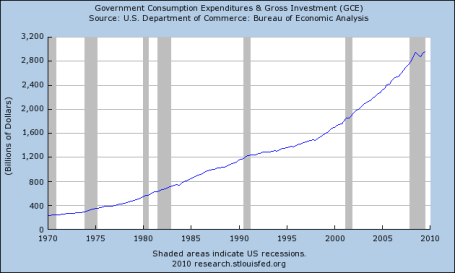
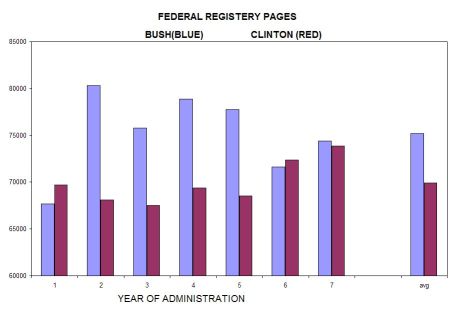
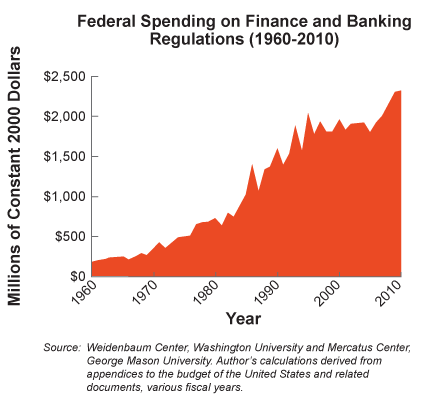
One response I sometimes hear is “Sure, there are more regulations and more government spending, but the set of things that should be regulated and the amount of government spending the economy needs are growing even faster!” This is essentially the Krugman-DeLong view about the stimulus: it just wasn’t big enough. Or they say that financial markets were “deregulated,” de facto, because the number of regulations and regulators increased more slowly than the number of new financial instruments and new markets. I wonder, though: are these falsifiable propositions? No matter how big the government is, if there are any problems, it’s always because the government isn’t big enough!





 Organizations and Markets
Recent Comments