Posts filed under ‘Strategic Management’
“This Paper Fills a Much-Needed Gap in the Literature”: Today’s Edition
| Peter Klein |
I was thumbing through the MDE issue containing Lasse and Nicolai’s paper when this sentence caught my eye: “Despite the widespread use of the production frontier approach to assess the efficiency of firms, there are no studies on ski lift operators.”
OK, I actually like the paper, “Are Multi-Resort Ski Conglomerates More Efficient?” by Martin Falk. It shows that resorts affiliated with a particular operator, Intrawest, have higher efficiency scores than independent resorts (and those affiliated with other ski conglomerates). There isn’t much theory, and I worry about endogeneity and unobserved heterogeneity — the major themes in recent empirical work on diversification — but I certainly agree that parental affiliation is an important, and often overlooked, issue. (Indeed, one of my favorite Brad De Long papers, from the old days before he became a full-time polemicist, deals with this problem.)
Maybe I’m just jealous that I didn’t think of this particular application when doing my own research on conglomerates. Oh, the travel grants I could have applied for!
Congratulations to Dick and Sid
| Peter Klein |
A comment from Dave Hoopes reminded me to congratulate Dick and Sid — Nelson and Winter, that is — for winning this year’s Dan and Mary Lou Schendel Best Paper Award from the Strategic Management Society, Dick for his 1991 paper “Why Do Firms Differ, and How Does it Matter?” and Sid for his 2003 paper “Understanding Dynamic Capabilities.” Dick’s paper is a particularly good introduction for economists wanting to understand what the strategy field is all about. I’m not a huge fan of dynamic capabilities — a friend calls the dynamic capabilities literature the “Derrida of strategic management” — but Sid’s paper strikes me as a particularly sensible approach.
On a personal note, many years ago I interviewed for a faculty position with Dick’s group at Columbia. I didn’t get the job, but Dick was a charming and gracious host. He has what you might call an impish sense of humor (I’m sure Dick Langlois can add some good stories). Sid Winter is a brilliant scholar and mentor to many in the strategy field (I only wish his views on macroeconomics were more, well, Kleinian).
Congratulations, gentlemen!
Becker and Posner on Williamson and Organizational Economics
| Peter Klein |
Ruminations on the field of organizational economics from Becker and Posner. Both are inspired by Williamson’s Nobel but neither discusses his contributions very directly. Posner’s comment, the longer of the two, describes some of his own work (with Luis Garicano) on public organizations.
PS: I’ve been looking for some time for an electronic copy of the 1993 Journal of Institutional and Theoretical Economics exchange between Posner, Coase, and Williamson. If anyone has it, can you email me a copy?
Internal and External Corporate Governance
| Peter Klein |
Most of the corporate governance literature focuses on external mechanisms for limiting managerial discretion: competition in product and factor markets; discipline from banks, institutional investors, and other large capital suppliers; and, of course, the market for corporate control. Firms have access to internal control mechanisms as well — performance-based pay, internal audits, a strong Board, competition among the top-management team, adoption of the M-form structure, and so on — but these are usually considered weaker, less effective instruments.
Viral Acharya, Stewart Myers, and Raghu Rajan have a new theory paper, “The Internal Governance of Firms,” on internal control mechanisms, focusing on dividend policy as a means of satisfying both internal and external constituents. NBER version here, ungated version here, older SSRN version here. Abstract:
We develop a model of internal governance where the self-serving actions of top management are limited by the potential reaction of subordinates. Internal governance can mitigate agency problems and ensure that firms have substantial value, even with little or no external governance by investors. Internal governance works best when both top management and subordinates are important in generating cash flow. External governance, even if crude and uninformed, can complement internal governance and improve efficiency. This leads to a theory of investment and dividend policy, where dividends are paid by self-interested CEOs to maintain a balance between internal and external control. Our paper can explain why firms with limited external oversight, and firms in countries with poor external governance, can have substantial value.
User Innovation and Collaborative Innovation
| Dick Langlois |
Two of my favorite scholars, Carliss Baldwin and Eric von Hippel, have bridged the Charles to team up on a joint manifesto pushing their related views on innovation. The paper is subtitled (or is it supertitled?) “Modeling a Paradigm Shift.” Here is the abstract.
In this paper we assess the economic viability of innovation by producers relative to two increasingly important alternative models: Innovations by single user individuals or firms, and open collaborative innovation projects. We analyze the design costs and architectures and communication costs associated with each model. We conclude that innovation by individual users and also open collaborative innovation increasingly compete with — and may displace — producer innovation in many parts of the economy. We argue that a transition from producer innovation to open single user and open collaborative innovation is desirable in terms of social welfare, and so worthy of support by policymakers.
Carliss has always been more willing than I am to make a normative case for modularity, which is the idea underlying the collaborative model. But she does have some analytical arguments to back that up. The “worthy of support by policymakers” part actually turns out to be a healthy argument against present-day political forces in the direction of stronger intellectual property rights. As this blog has noted in the past, these political forces are moving opposite to increased patent skepticism among scholars.
The Lazy Manager Theory
| Peter Klein |
Good ideas from John Wilkins, who earned a PhD in (I think) evolutionary biology while working as a full-time manager (via Randy). Sample elements of the Lazy Manager Theory:
- Never do any piece of paperwork when the person who asked for it isn’t there and holding it when they make the request. If they don’t care enough to come see you, they probably don’t need it done. Also, you put faces to names and develop a good personal relationship with those who come to see you, so it’s win-win.
- If any piece of paper falls off your desk for any reason, throw it away. This is God’s way of telling you it is unimportant.
- Always sit on the left side of the table, at the far end from the secretary if you aren’t that person. This way when tasks are being handed out, you are less likely to be volunteered, as you are not in the immediate line of sight of either the chair or the secretary.
If you prefer meatier fare, try this paper from Philippe Aghion, John Van Reenen, and Luigi Zingales, “Innovation and Institutional Ownership,” which examines a version of the lazy-manager hypothesis:
We find that institutional ownership in publicly traded companies is associated with more innovation (measured by cite-weighted patents). To explore the mechanism through which this link arises, we build a model that nests the lazy-manager hypothesis with career-concerns, where institutional owners increase managerial incentives to innovate by reducing the career risk of risky projects. The data supports the career concerns model. First, whereas the lazy manager hypothesis predicts a substitution effect between institutional ownership and product market competition (and managerial entrenchment generally), the career-concern model allows for complementarity. Empirically, we reject substitution effects. Second, CEOs are less likely to be fired in the face of profit downturns when institutional ownership is higher. Finally, using instrumental variables, policy changes and disaggregating by type of owner we find that the effect of institutions on innovation does not appear to be due to endogenous selection.
Israel Strategy Conference
| Peter Klein |
This year’s Israel Strategy Conference has an impressive lineup, featuring Jay Barney on “The Missing Conversation in Strategic Management,” Mike Hitt on “Strategic Management: Taking Stock and Looking Forward,” Anita McGahan on “The Agenda for Strategic Management: Implications of the Economic Crisis,” and Harbir Singh on “Creating Competitive Advantage across Firm Boundaries.” There are also paper sessions, interactive sessions, and a doctoral consortium. Info at the link above.
Tracking a Moving Arrow Core
| Nicolai Foss |
As argued by Nelson and Winter in their 1982 book, An Evolutionary Theory of Economic Change, and more explicitly by Winter and Gabriel Szulanski in their 2001 paper, “Replication as Strategy,” many firms leverage their competitive advantages by means of replication. Franchise chains come immediately to mind (the “McDonalds Approach”) but also firms like The Body Shop. In the Winter and Szulanski approach, replication is essentially a two-stage process: In the first stage, the replicator defines a template that approximates the “Arrow Core,” that is, essentially the full and correct specification of the fundamental replicable features of a business model as well as its ideal target applications. Unfortunately, no one can determine in advance the exact contents of the Arrow Core, and knowledge about it must be acquired through experiential learning. Learning about the Arrow Core may lead to one outlet being identified as a concrete “template” for further replication, or the template may be understood more abstractly in terms of a specification of preferred location choices, standard operating procedures, the products that shall be offered, etc., that is, a “formula.” In the second phase, the replicator replicates the template, trying to “copy exactly.” In this phase, the template or formula for replication is “frozen.”
In a recent paper, “Tracking a Moving Arrow Core: Replication-as-Strategy in IKEA,” Anna Jonsson, a Lund University expert on IKEA, and I argue that IKEA has not followed the rigid two-phase replication strategy described (and recommended) in Winter and Szulanski and other contributions to the replication literature, but has adopted and organized an approach that may be characterized as an ambidextrous one: Exploration and exploitation in IKEA are more like simultaneously ongoing processes than sequential ones. We also describe the organizational mechanisms that IKEA has implemented to steer this process, such as internal units that are responsible for intra-firm knowledge sharing, and we discuss how it is supported by organizational principles, such as corporate values that stress the importance of employees questioning proven solutions while continuously engaging in knowledge sharing. In other words, IKEA organization is geared towards the tracking of a constantly changing Arrow Core. Drop me a mail at njf.smg@cbs.dk if you want a copy of the paper.
Governing Firm-Specific Knowledge Assets
| Nicolai Foss |
In spite of book titles such as Competitive Advantage Through People, a whole subfield dedicated to linking human resources and firm-level performance outcomes (i.e., strategic HRM), and a general recognition that many knowledge-based competitive advantages are ultimately rooted in a web of complementary and firm-specific human capital, surprisingly little serious quantitative research exists that links firm-specific knowledge, employee governance mechanisms, and firm-level performance. In fact, there are few theoretical contributions that accomplish this. Work by Russ Coff as well as Gottschalg and Zollo come to mind (as well as this paper).
In “Firm-Specific Knowledge Resources and Competitive Advantage: The Roles of Economic- and Relationship-based Employee Governance Mechanisms,” in the December issue of the Strategic Management Journal (I received my copy October 28!), Heli Wang, Jinuy He, and former O&M guest blogger Joe Mahoney explore the economic- and relationship-based governance mechanisms that mitigate the latent underinvestment problem of employees making firm-specific human-capital investments. Overall, their results suggest that firms with more firm-specific knowledge resources are more likely to adopt those governance mechanisms that can reduce key employees’ concerns about potential hold-up.
The paper is very neat and clear, and my personal candidate for the best research paper in SMJ in 2009. Here is the abstract:
The resource-based view of the firm emphasizes the role of firm-specific resources, especially firm-specific knowledge resources, in helping a firm to achieve sustainable competitive advantage. However, the deployment of firm-specific knowledge often requires key employees to make specialized human capital investments that are not easily redeployable to other settings. Thus, in the absence of effective safeguards and trust building devices, employees with foresight may be reluctant to make such specialized investments. This study explores both economic- and relationship-based governance mechanisms that might mitigate this underinvestment problem. Effective use of these governance mechanisms enables a firm to obtain greater performance from its efforts to deploy firm-specific knowledge resources. Empirical results further support these key arguments.
Multitasking
| Peter Klein |
I was flipping channels last night and came across a Jimi Hendrix biopic. Lots of concert footage, with Hendrix doing his usual amazing Hendrix things — singing, crazy guitar riffs, playing with his teeth. Then I noticed something I hadn’t seen before: He’s doing all this while chewing gum. How can he sing without choking or spitting it out? How does he pluck guitar strings with his teeth and not leave a big wad on the pickups? Some people have trouble walking and chewing gum at the same time. How is he doing this?
Naturally, this got me thinking about multitask principal-agent problems. I liked one article that appeared in 2005 but didn’t generate much attention: Besanko, Regibeau, and Rockett’s “A Multi-Task Principal-Agent Approach to Organizational Form” (Journal of Industrial Economics, December 2005). Multitasking has often been applied performance evaluation, specifically the use of objective versus subjective performance measures. (If the agent is assigned multiple tasks, only some of which are measurable, than a quantitative evaluation scheme biases the agent’s effort toward more easily measurable tasks.) Besanko et al. apply this logic to divisionalization, examining the choice between product-line and functional organization:
This paper studies the choice of organizational forms in a multi-task principal-agent model. We compare a functional organization in which the firm is organized into functional departments such as marketing and R&D to a product-based organization in which the firm is organized into product lines. Managers’ compensation can be based on noisy measures of product-line profits. Measures of a functional area’s contribution to total profits are not available, however. This effect favors the product organization. However, if there are significant asymmetries between functional area contributions to organizational success and cross-product externalities within functions, organizing along functional lines may dominate the product organization. The functional organization can also dominate when a function is characterized by strong externalities while the other is not.
An obvious example: university faculty who are tasked with research, teaching, and service. Research is (in principle) easy to measure: publications, citation counts, grants, speaking invitations, etc. Teaching and service outputs are fuzzier. Even well-intentioned administrators tend to reward what they can count, which means refereed journal articles (and, in some fields, grant dollars) end up being the primary performance metric. Need I point out what this does to teaching?
The same issue is explored in Williamson (1975, pp. 155-75), where the ability to reward division managers based on standalone, divisional profit figures is cited as an advantage of the M-form structure.
Penrose (1959) Golden Anniversary
| Peter Klein |
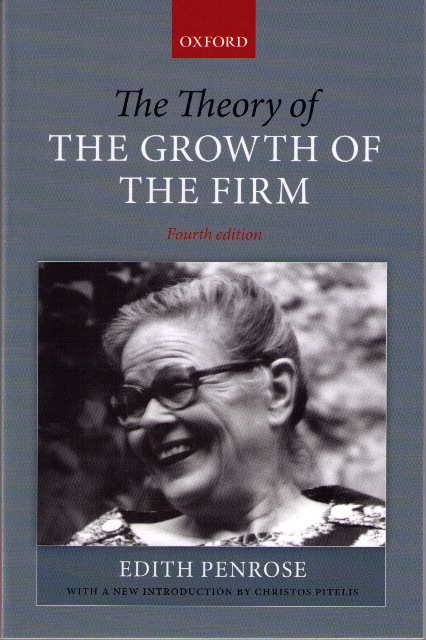 This year marks the 50th anniversary of Edith Penrose’s Theory of the Growth of the Firm (1959), one of the most important and influential books on the firm and firm strategy. To celebrate, Yasemin Kor and Christos Pitelis organized a roundtable at last week’s SMS conference with remarks by Christos, Yasemin, Joe Mahoney, Margie Peteraf, and Maurizio Zollo. The participants have graciously allowed me to post their slides and materials (1, 2, 3, 4). Christos, Penrose’s friend and literary executor, has edited and introduced a new edition of the 1959 book, which you can purchase here. You can read his introduction here. Nice!
Penrose trivia: During the 1950s Murray Rothbard made his living by reviewing literature and grant proposals for the William Volker Fund. When going through Rothbard’s correspondence a few years ago I came across a proposal for a study on firm growth submitted jointly by Penrose and Fritz Machlup, her dissertation supervisor at Johns Hopkins. Apparently at one point, the book was going to be a joint project. (Rothbard thought the ideas in the proposal didn’t fit with Penrose’s earlier warnings about the use of biological analogies in economics. However, as Joe Mahoney has noted, there is no inconsistency between the 1952 article and the 1959 book; Penrose is careful in her work on growth not to treat growth tendencies in firms as automatic, but to model them based on the preferences, beliefs, and actions of the firm’s personnel. In other words, she accepts natural selection in this context but not random mutation.)
BTW, what other important works in our field appeared in 1959, to be celebrated this year? Coase’s article on the Federal Communications Commission is one. The 1970s may have been the golden decade but there were major contributions in the previous decades as well. What are your favorites? Whose anniversary should we be preparing to celebrate?
Williamson’s “Economics of Institutions” Syllabus
| Peter Klein |
I was pretty clueless when I started graduate school. I had good undergraduate training in economics, and had the privilege of attending my first Austrian seminar, where I met Murray Rothbard, Hans Hoppe, Roger Garrison, and David Gordon, before beginning graduate work. But I really didn’t know exactly what I wanted to study. Like most economics PhD students, I wasn’t exactly turned on by the core theory and econometrics classes. Then I took Williamson’s course ECON 224, “Economics of Institutions,” and it was a revelation. The syllabus dazzled me, with readings from Coase, Simon, Hayek, North, Arrow, Chandler, Alchian, Demsetz, Ben Klein, and many other brilliant and thoughtful economists, along with sociologists, political scientists, historians, and others. I decided then that institutions and organizations would be my area, and I’ve never looked back.
Since Monday I’ve been digging through my files trying to find a copy of that syllabus. I found my folder for that course, containing notes, readings, and exams (no, you can’t see my test scores), but for some reason the syllabus has disappeared. I must have taken it out to study, perhaps when designing my own course in institutions and organizations, and it didn’t make its way back into the file. But I did find an older copy, the Fall 1988 edition. That was, I believe, Williamson’s first year at Berkeley, after arriving from Yale (where he didn’t teach PhD courses, his main appointment being in the law school). I took the course in 1989, but the syllabi are very similar. So here it is. Note the range of authors, journals, subject areas. Not at all like the typical economics PhD course!
Hoisted from the Comments: Hoopes on Williamson
| Peter Klein |
Former guest blogger David Hoopes’s comment deserves its own post:
So, we’re leaving the serious discussion to our goody two-shoes organizations twin? Was Will Mitchell a Williamson student? No one has said anything about Teece. Teece’s early JEBO articles did a great job talking about economies of scope and transaction cost influences on strategy.
Unmentioned yet, there has been some contentious discussion about the implications of TC economics on strategy and organization. Many including Connor and Prahalad consider the implications of TC to lead to bad management and bad strategy. However, our very own Steve Postrel wrote a great paper, “Islands of Shared Knowledge” that (esp in an earlier version) does a great job of comparing and contrasting the RBV and TC as theories of the firm.
Harold Demsetz weighed in on this earlier in his, “Theory of the Firm Revisited” (which is one of my favorite all time papers). Harold argues that firms would exist without governance problems. Steve has tried to get Harold to see the light (i’m not sure i do) but to no avail.
Of course, CERTAIN org theorists, whose names i do not mention think that Williamson’s logic, as does all competition-based economic theory, leads to evil and terrible results: unethical business students who become tomorrow’s headlines.
I’m very happy to see Williamson win. His influence on strategy and organization is immense. And, at this point, I don’t see any theory of the competitive firm can reasonably leave him out. I will admit, in terms of competitive heterogeneity and competitive advantage I don’t think governance is anywhere near as important as productive capabilities. BUT, capabilities literature still has a lot of work to do to be specified as exactly as TCE.
David, more serious discussion is on the way. Unfortunately, we O&Mers have higher opportunity costs than the bloggers at our good-twin site, so we can’t get the posts up as quickly as they can. :-)
Need Examples of Subversive Behavior in M&A
| Russ Coff |
I just finished teaching a simulation exercise to BBA students on the politics of post-acquisition integration. I was surprised that students had a great deal of trouble believing that managers would be subversive even in that kind of setting. If there are specific examples of such subversive behavior that you know about, I’d appreciate it if you would post here or email them to me.
Here are some details about the exercise (and a Dilbert cartoon) in case anyone is interested. (more…)
Management Miscellany
| Peter Klein |
1. We are not big on Jim Collins here at O&M but Toyota president Akio Toyoda is a fan, explaining his company’s woes in terms of Collins’s five stages of business decline. (Is “be headquartered in a country with an overvalued currency” one of the stages?)
2. Karen Ho’s Liquidated: An Ethnography of Wall Street (Duke, 2008) is reviewed by fellow anthropologist Gillian Tett in the FT. The key to understanding the financial crisis, we learn, is Bourdieu (why haven’t I read about this book on orgtheory.net?). “Massive corporate restructurings are not caused so much by abstract financial models as by the local, cultural habitus of investment bankers, the mission-driven narratives of shareholder value and the institutional culture of Wall Street.” Why didn’t I think of that?
3. I’ve been reading Yevgeny Zamyatin’s We, the first of great dystopian novels (in Natasha Randall’s new translation). I had head that Taylorism figures prominently in the novel, but didn’t know Taylor would be mentioned by name. “Yes, that Taylor was, without doubt, the most brilliant of the Ancients. True, he didn’t think everything through, didn’t extend his method throughout life, to each step, around the clock. He wasn’t able to integrate his system from an hour to all twenty-four. But all the same: how they could have written whole libraries about the likes of Kant — and not take notice of Taylor, a prophet, with the ability to see ten centuries ahead?” Of course, as we’ve noted before, there’s more to Taylor than meets the eye.
Elgar Companion to Transaction Cost Economics
| Peter Klein |
Mike Sykuta and I are editing a volume for the Elgar Companion series, The Elgar Companion to Transaction Cost Economics. The volume is currently in production with an expected publication date in mid-2010. We’ve created a page here on O&M with more information, including a table of contents and some sample chapter drafts. Enjoy!
The Soviets Really Did Have a Doomsday Machine
| Peter Klein |
 According to the new issue of Wired (via the Economist), the Soviets really did have a doomsday machine and, as in Dr. Strangelove, didn’t tell anyone about it. Interestingly, the interpretation is that the Soviets, like Schelling’s rational addict, were directing the credible commitment not toward their opponents, but toward themselves:
The silence can be attributed partly to fears that the US would figure out how to disable the system. But the principal reason is more complicated and surprising. According to both Yarynich and Zheleznyakov, Perimeter was never meant as a traditional doomsday machine. The Soviets had taken game theory one step further than Kubrick, Szilard, and everyone else: They built a system to deter themselves.
By guaranteeing that Moscow could hit back, Perimeter was actually designed to keep an overeager Soviet military or civilian leader from launching prematurely during a crisis. The point, Zheleznyakov says, was “to cool down all these hotheads and extremists. No matter what was going to happen, there still would be revenge. Those who attack us will be punished.”
This wouldn’t deter a Jack D. Ripper type, I suppose. Still, fascinating discussion for those who teach about strategic commitment.
Niche Markets for Obsolete Technologies
| Peter Klein |
 One of the most interesting papers I saw presented at this year’s ACAC meeting was Ron Adner and Daniel Snow’s “‘Old’ Technology Responses to ‘New’ Technology Threats: Demand Heterogeneity and Graceful Technology Retreats.” They show how incumbents sometimes react to disruptive innovation by repositioning the old technology as a niche product, aimed at specialized users or enthusiasts. Their examples are fascinating. One-way pagers, for example, are still popular in hospitals because their low-powered signals work better around, and interfere less with, complex medical equipment. Many audiophiles prefer vinyl records, with their rich, analog sound, to digital media. (Needles for high-end turntables sell for thousands of dollars.) Calligraphers prefer fountain pens to ball-point pens. And so on. Adner and Snow present a taxonomy of “reactive” strategies by incumbents facing innovative entrants and characterize the benefits and costs of each strategy. Here’s the abstract:
We explore the implications of a real and common alternative to attempting the transformation required to embrace a new, dominant, technology — the choice to maintain focus on the old technology. In considering this choice we distinguish between ‘racing’ strategies, which attempt to fight off the rise of the new technology by extending the performance of the old technology, and ‘retreat’ strategies, which attempt to accommodate the rise of the new technology by repositioning the old technology in the demand environment. Underlying our arguments is the observation that the emergence of a new technology does more than just create a substitute threat — it can also reveal significant underlying heterogeneity in the old technology’s broader demand environment. This heterogeneity is a source of opportunities that can support a new position for the old technology, in either the current market or a new one. Using this lens we explore the decision to stay with the old technology as a rational, proactive choice rather than as a mark of managerial and organizational failure. We then consider the distinctive challenges and organizational dynamics that arise in technology retreats, and their implications for the ways in which managers and scholars should approach questions regarding the management of capabilities, lifecycles, and ecosystems.
I came across another example this summer, in a NY Times piece on a Dutch firm resurrecting the Polaroid camera. And there was the 2006 Darren Aronofsky film The Fountain, which used a low-tech combination of soap bubbles, oils, and other liquids rather than digital technology to create its unusual visual effects.
Corporate Diversification Humor
| Peter Klein |
As someone who works in the corporate diversification area I enjoyed this Onion piece on Yamaha:
Despite concerns over the recent global recession, Yamaha Corporation president Mitsuru Umemura announced last week that he was content with the current level of production of Jet Skis, alto saxophones, snowmobiles, power generators, scooters, and golf carts. “Initially we thought that the declining global market would result in overproduction of synthesizers, PA systems, DVD players, tone generators, and motocross bikes, but in fact our production quotas were almost perfectly attuned to the market in power amplifiers, heart-rate monitors, signal processors, analog mixers, engine oil, microphones, HiFi systems, and grand pianos,” said Umemura, who stressed that his company prides itself on attention to detail. “At the Yamaha Corporation we’re focused on one thing and one thing alone — quality sound chips, ceiling brackets, editing software, race-kart engines, sport boats, flugelhorns, ATVs, sequencers, outboard motors, conference systems, golf clubs, projectors, MIDI controllers, lamp cartridges, portable recorders, subwoofers, component systems, and motorcycles.”
I remember while doing my dissertation research coming across a mid-1960s cartoon from Fortune or Business Week showing Santa’s elves whispering nervously as Santa meets with a slick-looking conglomerator in the background. One elf to another: “I think we’re becoming a division of Gulf & Western!” Robert Sobel also tells a story (I think in The Rise and Fall of the Conglomerate Kings) about the conglomerate CEO who specializes in acquisition by stock-swap. One day his son announces that he’s sold the family dog for $1,000. “You got cash for that old pooch?” “No, I traded him for two $500 cats.”
And there’s the great line from Fortune about Peter Grace, whose famous acquisition sprees transformed W. R. Grace from a mundane shipping company into “a purveyor of everything from bull semen to grilled cheese sandwiches.”
Wanted: Human Capital Research(ers)
| Russ Coff |
Human Capital Interest Group? First a self-serving announcement. I’m part of an effort to create a new SMS interest group on Human Capital & Competitive Advantage (HC&CA). I need to gauge interest and identify people who would want to be involved if the proposal moves forward. We need people who are interested in: 1) Program Chair or Associate Program Chair, 2) Launch Planning Committee, or 3) Friends of HC&CA (email list). Please nominate yourself or others here.
General Human Capital and Competitive Advantage. Now for the meat: Why I think human capital is such fertile ground. Strategy research tends to adopt very unrealistic assumptions about markets for human capital. As a result, shorthand like “firm-specific” human capital inaccurately reflects its strategic potential. (more…)





 Organizations and Markets
Recent Comments