Posts filed under ‘Strategic Management’
CORS Lecture and Mises Brazil
| Peter Klein |
O&Mers in Brazil, come see me at two events this week. Thursday, 7 April, I will deliver the inaugural CORS Lecture at the University of São Paulo on “Entrepreneurship, Strategy, and Public Policy.” CORS, the Center for Organization Studies, is a new institute organized by O&M friends Sylvia Saes and Decio Zylbersztajn and involving many scholars familiar to O&M readers. The lecture is co-sponsored by the Mises Institute Brazil, my main host for the trip, and I will speak at the Institute’s Second Conference on Austrian Economics 9-10 April in Porto Alegre, along with Hans-Hermann Hoppe, Robert Murphy, Guido Hülsmann, Gabriel Zanotti, Ubiratan Iorio, Antony Mueller, Fabio Barbieri, and Dalton Gardimam. I’ll give one talk on entrepreneurship and another on networks. I would love to see you at one of these events!
Interesting New NBER Papers
| Peter Klein |
Matching Firms, Managers, and Incentives
Oriana Bandiera, Andrea Prat, Luigi Guiso, Raffaella Sadun
January 2011
We exploit a unique combination of administrative sources and survey data to study the match between firms and managers. The data includes manager characteristics, such as risk aversion and talent; firm characteristics, such as ownership; detailed measures of managerial practices relative to incentives, dismissals and promotions; and measurable outcomes, for the firm and for the manager. A parsimonious model of matching and incentive provision generates an array of implications that can be tested with our data. Our contribution is twofold. We disentangle the role of risk-aversion and talent in determining how firms select and motivate managers. In particular, risk-averse managers are matched with firms that offer low-powered contracts. We also show that empirical findings linking governance, incentives, and performance that are typically observed in isolation, can instead be interpreted within a simple unified matching framework.
Business Failures by Industry in the United States, 1895 to 1939: A Statistical History
Gary Richardson, Michael Gou
March 2011
Dun’s Review began publishing monthly data on bankruptcies by branch of business during the 1890s. This essay reconstructs that series, links it to its successors, and discusses how it can be used for economic analysis.
The Consequences of Financial Innovation: A Counterfactual Research Agenda
Josh Lerner, Peter Tufano
February 2011
Financial innovation has been both praised as the engine of growth of society and castigated for being the source of the weakness of the economy. In this paper, we review the literature on financial innovation and highlight the similarities and differences between financial innovation and other forms of innovation. We also propose a research agenda to systematically address the social welfare implications of financial innovation. To complement existing empirical and theoretical methods, we propose that scholars examine case studies of systemic (widely adopted) innovations, explicitly considering counterfactual histories had the innovations never been invented or adopted.
Oxford Handbook of Human Capital
| Peter Klein |
I just received a copy of the Oxford Handbook of Human Capital, edited by Alan Burton-Jones and J.-C. Spender, and it looks terrific. The concept of “human capital” came from developments in macroeconomics and labor economics (and, it is often forgotten, entrepreneurship) but is increasingly influential in organization and strategy research. (Witness, for example, the new SMS Strategic Human Capital Interest Group.) These Handbook chapters “reveal the importance of human capital for contemporary organizations, exploring its conceptual underpinnings, relevance to theories of the firm, implications for organizational effectiveness, interdependencies with other resources, and role in the future economy,” says the cover blurb. O&M readers may especially like the section on “Human Capital and the Firm,” with chapters on TCE (by Foss), agency theory (Spender), the RBV (Jeroen Kraaijenbrink), entrepreneurship and the theory of the firm (Brian Loasby), and the knowledge-based theory of the firm (Georg von Krogh and Martin Wallin). Check it out!
Joe Mahoney Wins Irwin Award
| Peter Klein |
 Congratulations to O&M friend Joe Mahoney for winning the Irwin Outstanding Educator Award for 2011. The Irwin Award is issued each year by the Business Policy and Strategy Division of the Academy of Management to someone who “(1) has demonstrated outstanding teaching capabilities in business strategy over an extended period of time and the ability to enable future strategy scholars to contribute original research as well as teaching effectively; (2) has had an important impact on strategy pedagogy through demonstrated expertise; and (3) cares deeply about the subject of Strategic Management and the development of his or her students.”
Joe has been my friend and colleague for several years and it’s great to see him join such luminaries as Michael Porter, Mike Hitt, Don Hambrick, Jay Barney, Kathy Eisenhardt, Pankaj Ghemawat, Will Mitchell, and Anita McGahan on the list of Irwin winners.
Is Counterfeiting Good for Business?
| Peter Klein |
Sometimes, according to Yi Qian in a new NBER Working Paper, “Counterfeiters: Foes or Friends?” In some cases, counterfeiting constitutes advertising that increases sales of the original product. It makes sense; how many buyers of faux Rolex watches or Gucci purses would have bought the authentic items if the fakes were banned? I suppose there’s a negative externality (more fakes means less exclusivity means a lower equilibrium price) that must be taken into account as well. An interesting analysis, in any case. Applications to digital media are left as an exercise for the reader.
Counterfeiters: Foes or Friends?
Yi Qian
NBER Working Paper No. 16785
Issued in February 2011This paper combines a natural policy experiment and randomized lab experiments to estimate the differential impacts of counterfeiting on the sales and purchase intent of branded products of various quality levels. I collect new product-line level panel data from Chinese shoe companies from 1993-2004. Exploiting the discontinuity of government enforcement efforts for the footwear sector in 1995 and the differences in authentic companies’ relationships with the government, I identify heterogeneous effects of counterfeit entry on sales of authentic products of three quality tiers. In particular, counterfeits have both advertising effects for the brand and substitution effects for authentic products. The advertising effect dominates substitution effect for high-end authentic product sales, and the substitution effect outweighs advertising effect for low-end product sales. The positive effect of counterfeits is most pronounced for the high-fashion products (such as women’s high-leg boots) and for the high-end shoes of the brands that were not yet well-known at the time of the entry by counterfeiters. I provide a theoretical framework to generalize such impacts due to counterfeits. Analogous heterogeneous effects of counterfeiting on consumer purchase intent for branded products of three quality tiers are also discovered in lab experiments. Responses in the lab allude to the fact that counterfeits could increase brand awareness as well as steal business.
Creative Destruction, Music-Industry Edition
| Peter Klein |
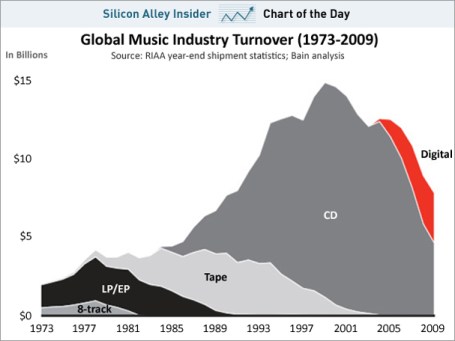
Note that the chart nicely illustrates not only the competition among formats, but the industry’s overall decline. Indeed, “creative destruction” is a good name for the the damage done to the creative arts by the recording industry’s approach to digital media.
WSJ on Conglomerates
| Peter Klein |
Industrial conglomerate ITT announced in January a split into three more focused companies, one concentrated in hotels and gaming, one in education (technical training centers), and a slimmed-down ITT Corporation containing the remaining manufacturing businesses. This is the second major restructuring for ITT, once the poster child of the conglomerate movement of the 1960s and early 1970s.
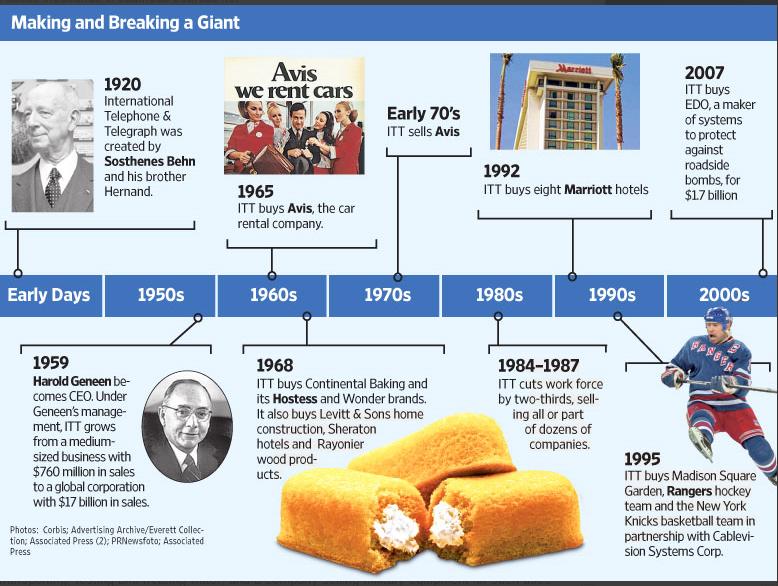 The Wall Street Journal’s article of 13 January contains a nice graphic on the firm’s history, including a picture of Harold Geneen, the quintessential “management by the numbers” CEO (click to enlarge). It also includes ruminations on the conglomerate form more generally, about which I have a continuing research interest. Yale’s Jeffrey Sonnenfeld says conglomerates represented “an unholy mix of opportunistic investment bankers, misguided consultants and the vanities of CEOs.” A companion article puts it this way: “Conglomerates blossomed five decades ago, when favorable interest rates made it relatively easy to boost revenue and stock prices with serial acquisitions. But they fell out of favor when the stock increases slowed and investors began to question whether promised efficiencies would materialize.”
But this is not quite right. In fact, the research literature finds little evidence that conglomerate growth was fueled mainly by cheap credit and rising stock prices. (more…)
Three New Review Papers
| Nicolai Foss |
Although they are in general not highly regarded, I love writing review papers. Writing such a paper is an excellent opportunity to revisit classic papers. Sometimes you get a new idea while reflecting on the current research frontier. They are great for establishing research contacts, for although review papers may not be cited a lot, they are read a lot. And they can usually be put quickly together. Here are three new review papers/chapters written over the last month or so:
- “Entrepreneurship in the Context of the Resource-Based Theory of the Firm.” Written for Kevin Mole and Monder Ram, eds., Perspectives in Entrepreneurship (Palgrave).
- “The Emerging Strategic Entrepreneurship Field.” Written with my PhD student Jacob Lyngsie for Daniel Hjorth, ed., Handbook of Organisational Entrepreneurship (Elgar).
- “Entrepreneurship and the Economics of the Firm.” Written with Peter G. Klein and Peter’s PhD student Per L. Bylund for the above-mentioned Hjorth volume.
ISNIE Annual Conference, Stanford University, June 16–18
| Scott Masten |
The 15th Annual Conference of the International Society for New Institutional Economics will be held this year at Stanford University on June 16-18. The conference is being organized by President-Elect Barry Weingast, and my inside, not-yet-public information is that the conference will have two very interesting keynotes. The ISNIE website has the just-released Call for Papers.


Organizing for Synergies
| Peter Klein |
Thanks for Mike S. for the pointer to this paper (published version here, ungated version here):
Organizing for Synergies
Wouter Dessein, Luis Garicano, and Robert GertnerLarge companies are usually organized into business units, yet some activities are almost always centralized in a company-wide functional unit. We first show that organizations endogenously create an incentive conflict between functional managers (who desire excessive standardization) and business-unit managers (who desire excessive local adaptation). We then study how the allocation of authority and tasks to functional and business-unit managers interacts with this endogenous incentive conflict. Our analysis generates testable implications for the likely success of mergers and for the organizational structure and incentives inside multidivisional firms.
This is an understudied topic in organizational design, I think. The large literature on the M-form, going back to Chandler and Williamson and flourishing in the 1970s and 1980s, compared functional to business-unit managers across organizations, but said much less about mixing them within organizations. The modern internal capital markets literature focuses on information problems between division heads and the central office, and conflicts over resources among division heads, but not the issues raised here by Dessein, Garicano, and Gertner. The vertical integration literature, as well, tends to treat firm-wide support services as peripheral to the incentive conflicts between vertically related divisions.
Unrelated Diversification, circa 1971
| Peter Klein |
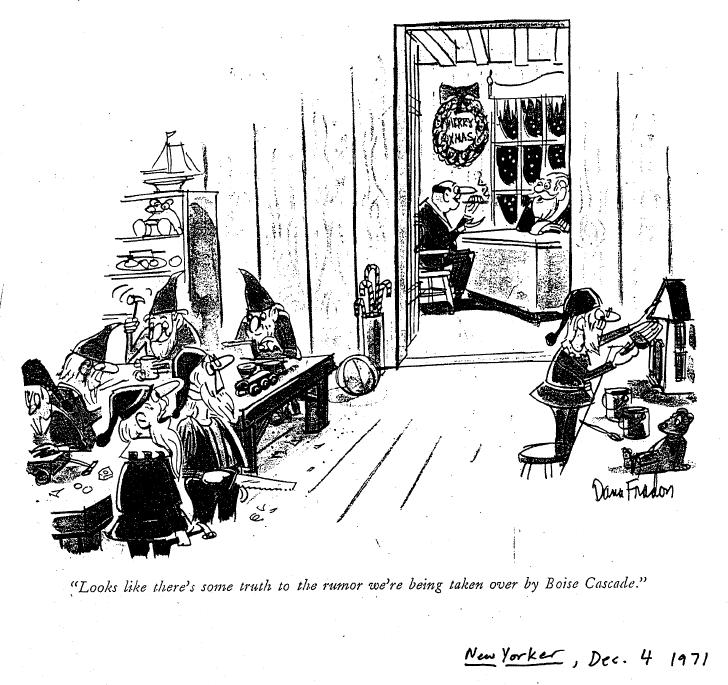
A funny (to me) New Yorker cartoon about diversification, appearing at the height of the conglomerate merger wave of the late 1960s and early 1970s. Click to enlarge. (I’ve been looking for this for a while; found it when cleaning out an old file cabinet.)
The Value of Steve Jobs
| Peter Klein |
As you have likely heard, Steve Jobs is taking an indeterminate leave of absence from Apple to deal with his continuing health problems. How will this affect Apple? How important is one person — albeit the founder and CEO — to a diversified multinational company with tens of thousands of employees? Apple’s stock slipped slightly on the news of Jobs’ leave (down 2.3 percent today, the first trading day after the announcement), but Jobs’s health problems are well known and Apple’s stock price presumably already included a discount reflecting the possibility he’d step down. To estimate the value of a particular employee to the firm in this way, we need an unanticipated departure, one that isn’t a response to poor performance and isn’t expected in advance.
Sure, enough, there’s an app for that — I mean, there’s a literature on that. An influential 1985 paper by Bruce Johnson, Robert Magee, Nandu Nagarajan, and Harry Newman looked at stock-price reactions to CEO deaths by plane crash, finding positive announcement effects for founders and negative announcement effects for professional managers. (One way to handle the founder-succession problem!) Macabre, I know, but nonetheless a clever way to deal with endogeneity. Naturally, this paper spawned a follow-up literature. Rather than cite the papers myself, I’ll just block quote a paper by Bang Dang Nguyen and Kasper Meisner Nielsen presented at last week’s AEA meeting, “What Death Can Tell: Are Executives Paid for Their Contributions to Firm Value?” and you can chase down the references on your own: (more…)
University Restructuring, Agricultural Economics Edition
| Peter Klein |
The current issue of AAEA Exchange, the newsletter of the Agricultural and Applied Economics Association (formerly American Agricultural Economics Association), features three perspectives on the long-term viability of maintaining separate departments of economics and agricultural economics. (Much of the discussion would apply to business economics departments too.) Ron Mittelhammer of Washington State argues for consolidation, Ken Foster of Purdue for keeping separate departments, and Rob King of Minnesota for the transformation of agricultural economics departments to applied economics departments.
The issues are organizational and strategic and familiar to O&M readers. Mittelhammer emphasizes tangible resources and a shared intellectual heritage and downplays accumulated routines and capabilities, organizational culture, etc.:
Arguably above all other rationale, mergers are also warranted because, fundamentally, economics is economics. Agricultural economics is a field of economics, not some other paradigm of economics, and is no more distinct from its parent discipline than other fields such as labor economics, international economics, health economics. . . .
Too often of late, it appears that the last ditch attempt at justifying the separation of economic units degenerates to the issue of faculty personalities, the correlated issue of seemingly unbridgeable differences in “professional cultures,” and the fear of open faculty warfare that might be ignited by a merger, rather than the existence of truly distinct and defensible differences in the methodologies used to do economic analysis in agricultural and applied, versus the “other” economics disciplines. (more…)
AEA Papers on Organizations, Institutions, and Entrepreneurship
| Peter Klein |
O&M readers attending the American Economic Association annual meeting in Denver may find these papers of particular interest:
Industrial Policy, Entrepreneurship, and Growth
PHILIPPE AGHION (Harvard University)Does Management Matter: Evidence from India
NICHOLAS BLOOM (Stanford University)
BENN EIFERT (University of California-Berkeley)
APRAJIT MAHAJAN (Stanford University)
DAVID MCKENZIE (World Bank)
JOHN ROBERTS (Stanford University)Efficiency and Adaptation in Organizations and Institutions
PETER G. KLEIN (University of Missouri-Columbia)
JOSEPH T. MAHONEY (University of Illinois)
ANITA M. MCGAHAN (University of Toronto)
CHRISTOS N. PITELIS (University of Cambridge)The Coevolution of Culture and Institutions in Seventeenth Century England
PETER MURRELL (University of Maryland) (more…)
The Future of Managerial Economics
| Peter Klein |
The December 2010 issue of Managerial and Decision Economics features an editorial by Paul Rubin and Tony Dnes on the state of the field, “Managerial Economics: A Forward Looking Assessment.” As they note, the “traditional approach” — basically applied neoclassical microeconomics, production theory in particular — has been augmented by new developments,
particularly in areas such as globalization, the economics of organization, information economics, strategic behavior, the learning organization, risk management, business ethics, and behavioral economics. All of these topics are hot in modern managerial economics and are slowly feeding through into MBA and similar courses.
The modern trends are often referred to as “the new managerial economics.” Some modern texts even use the term explicitly (Boyes, 2008) and focus on questions of “organizational architecture” including areas such as incentive structures in personnel economics. There are increasing numbers of specialist works emerging in these areas, which are coming to feature in influential handbooks (Lazear, 2009). Personnel economics, for example, applies economics to human resources topics, including information interactions, problems of team coordination, morale, and seniority systems. . . . In managerial terms, this field is a natural development of the economics of organization and of labor economics, and we hope to see much future research coming through. (more…)
Google Tries Selective Intervention?
| Peter Klein |
Can a large firm do everything a collection of small firms can do, and more? If not, how do we understand the limits to organization? Arrow focused on the information structure inside firms. I favor Mises’s economic calculation argument. Williamson’s preferred explanation for the limits to the firm is the impossibility of selective intervention — the idea that higher-level managers cannot credibly commit to leave lower-level managers alone, except when such selective intervention would generate joint gains. Williamson’s argument is not, however, universally embraced (or even understood the same way — see the comments to Nicolai’s post).
Google apparently sees things Williamson’s way and has formulated an explicit policy on “autonomous units” designed to address the problem. Such units “have the freedom to run like independent startups with almost no approvals needed from HQ, ” reports TechCrunch. “For these divisions, Google is essentially a holding company that provides back end services like legal, providing office space and organizing travel, but everything else is up to the pseudo-startup.” Can it work? Insiders are doubtful. The TechCrunch reporter even frames Williamson’s thesis in this folksy way:
There’s a lie that companies and entrepreneurs tell themselves in order to commit to an acquisition.
Oh, we’re not going to change anything! We’re just going to give you more resources to do what you’ve been doing even better!
Yeah! They bought us for a reason, why would they ruin things?
It usually works for a little while, but big company bureaucracy– whether it’s HR, politics or just endless meetings– almost always creeps in. It’s a law of nature: Big companies just need certain processes to run and entrepreneurs hate those processes because they stifle nimble innovation.
The Economist on Coase at 100
| Peter Klein |
 The new Economist celebrates Ronald Coase’s 100th birthday (this coming Wednesday) with a short piece on “The Nature of the Firm” (1937), the founding document of modern organizational economics (16,379 Google Scholar cites). (Thanks to Avi for the pointer.) It’s nice to see the theory of the firm get its props, and the first few paragraphs do a good job summarizing the paper. But the (anonymous) author has misread the modern literature, first in setting up an artificial conflict between Coase’s transaction-cost approach and the resource-based approach to the firm and, second, by missing the depth and nuance of Coase’s own research program.
 On the first point: Much recent work tries to reconcile transaction cost economics (TCE) and the resource-based view (RBV) (e.g., Silverman, 1999; Foss and Langlois, 1999; Tsang, 2000; Madhok, 2002; Foss and Foss, 2005), pointing out that the two theories are, in important ways, complementary. Put simply: TCE and RBV start with different explananda. The RBV asks which resources will be combined in which ways to produce which outputs, while TCE asks how this activity will be organized (market, hierarchy, or hybrid). RBV offers a theory of competitive advantage, while TCE focuses on boundaries and governance. Second, the Economist writer confuses Coase with the (Coase-inspired) transaction cost approach of Williamson (1971, 1975, 1979) and Klein, Crawford, and Alchian (1978): (more…)
Razors, Blades, and Bugattis
| Peter Klein |
 I learn from Car and Driver that the tires for the new Bugatti Veyron 16.4 Super Sport run $42,000 a set, last only 10,000 miles, and require a $69,000 wheel replacement after the third tire change. Is Bugatti playing razors and blades? (The real strategy, not the apocryphal one.) Um, nope, this Veyron itself costs $2,426,904. That’s one damn fine razor!
Short Course on Network Economics
| Peter Klein |
 I’m teaching a five-week, online course starting in January called “Networks and the Digital Revolution: Economic Myths and Realities.” It’s offered through the Mises Academy, an innovative course-delivery platform that is becoming its own educational ecosystem. A description and course outline is here, signup information is here. I’d love to have you join me!
Megachurches and Management Education
| Peter Klein |
This month’s Fast Company profiles Willow Creek, perhaps the world’s most famous megachurch. The article opens by describing a conversation between Willow Creek pastor Bill Hybels and management guru Peter Drucker:
Hybels decided that one of his unique contributions [to ministry] could be to create a resource for pastors who didn’t have firsthand access to thinkers like Drucker. The need was clear. A 1993 survey of evangelical pastors by seven seminaries found that while they said their education had prepped them well in church history and theology, they felt undertrained in administration, management, and strategic planning. “In the 1950s, a pastor preached on Sundays, did weddings and funerals, and visited the sick,” says Dennis Baril, senior pastor of the Community Covenant Church in Rehoboth, Massachusetts, which hosts a satellite summit site every year. “I have almost 50 ministries that need to be put together, scheduled, organized, and led. It’s a different skill set.”
Church conferences did little to address that need. “Most of them are pastors learning from pastors,” says Jim Mellado, who wrote a 1991 Harvard Business School case study on Willow Creek. “If you only hear preaching from the choir, you’re never stretched. You never see things from another perspective.”
Sounds a bit like university administrators, most of whom learn administration from, well, other university administrators. (Who may have been English professors in a previous life.)
Here’s the HBS case on Willow Creek, and here are Mike Porter’s PowerPoint slides from his 2007 presentation at Willow Creek’s leadership summit. Interesting factoid from the Economist via Wikipedia: in 2007, five of the world’s ten largest Protestant churches were in South Korea.





 Organizations and Markets
Recent Comments