Posts filed under ‘Teaching’
Cheer Up With the Depression Bundle
| Peter Klein |
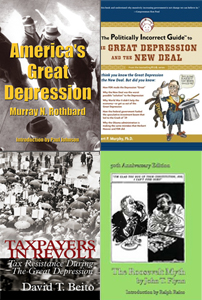 Sorry, couldn’t resist the headline. But check it out: Murray Rothbard’s America’s Great Depression, Bob Murphy’s Politically Incorrect Guide to the Great Depression and the New Deal, Dave Beito’s Taxpayers in Revolt, and John T. Flynn’s Roosevelt Myth, all for $49! That’s quite an uplifting deal.
More great news: Contra Keynes and Cambridge, vol. 9 of Hayek’s Collected Works, is now out in paperback from Liberty Fund, and just $14.50.
Management Theory and the Current Crisis
| Peter Klein |
 Here is a short piece by Nicolai and me written for a general audience, “Management Theory Is Not to Blame.” We discuss the role of resource heterogeneity in management theory and critique the vulgar Keynesianism that dominates mainstream commentary on the crisis. The graphic with the shovel alone is worth the click. Comments welcome here or at the Mises blog.
Change Management Bleg
| Peter Klein |
I am giving some lectures next week at the University of Angers, France, a series on change management and another on globalization. (And hanging out with old friend Guido Hülsmann.) I have some change-management materials prepared but am looking for additional readings, classroom exercises, cases, etc. If you have any teaching materials on change management suitable for MBAs or undergraduates (whose first language isn’t English!), I’d appreciate seeing them.
The Future of the Textbook
| Peter Klein |
Cliff Kuang at Fast Company points us to smARThistory, which looks very nice, and asks:
Why the hell are we still teaching kids from textbooks? Granted, the system works. But you’d at least expect more experiments in the genre, along the lines of smARThistory. For one, textbooks for each student routinely cost hundreds, even thousands per year — and a massive chunk of those costs aren’t in the production of the material, but rather its printing and distribution. Better to give kids laptops, and dynamic textbooks with high production values (like smARThistory). You could arrange them with assigned lessons that require modules to be checked off. A system of clicks or periodic questions could ensure that the kids are engaged. And what about flash animations that illustrate physics or math concepts? The list goes on. If done right, a virtual textbook would far outshine any print textbook we’ve ever cracked.
In economics and management we sometimes use online simulations, experiments, and other interactive learning tools, but the traditional textbook (or set of journal articles) reigns supreme. Do the newer tools work? Which are most effective? And, most important, what clever names can we give them? huMANresources? pricECONnections?
Facebook in the Classroom
| Peter Klein |
According a new survey, 76 percent of undergraduates here at the University of Missouri are on Facebook at least once a day, and they are more likely to get school-related information from Facebook than from email.
I’ve never used Facebook as an academic resource. If you have, could you share something about your experiences? For example, I could create Facebook Group pages for my courses and use them for announcements, discussion, chat, hosting course materials, etc. Facebook isn’t a substitute for Blackboard, or one of the other specialized teaching platforms, however; it lacks testing and grading features, doesn’t automatically import membership lists from enrollment data, isn’t supported by university IT people, etc. How can Facebook and Blackboard be used effectively as complements?
High-Powered Incentives
| David Gerard |
As I pack my bags for the American Economic Association meetings this weekend in San Francisco, I am reminded of a recent New Yorker article on the impacts of medical marijuana legalization. This is probably a rather mundane topic for you left-coasters, but here in Pennsylvania where we can’t even buy beer in grocery stores, it is a pretty exotic concept.
The article highlights a number of ways in which legalization foments organizational change, and also gives some anecdotal evidence on sharecropping terms, suggesting different terms for indoor and outdoor operations.
The easiest way to make this kind of small indoor scene work is to live in someone else’s house and nurture the plants in exchange for a third or half the profits, and that is how the Kid would be spending her time for the next two months.
On the outdoor side, however, this description of the “Humboldt Slide” suggests that landlords appear more willing to change the contracting terms:
“You start at this really great percentage, and you’re buddy-buddy and everything’s great,” Emily said. As the harvest approaches, growers inevitably begin to run out of money and get greedy, and the sharecroppers lose whatever leverage they had earlier in the growing cycle, when their daily attention was necessary for the young plants to survive. Emily’s wage the previous year was initially set at a third of the value of the plants that she harvested. Later, her boss “slid” her percentage to a sixth, meaning that she owned only a dozen of the eighty plants that she grew that season.
The explanation is that the laborers have no legal recourse, so the landlord is free to rewrite contracts as he pleases, but then wouldn’t we expect a slide in the case of the indoor operations as well?
I welcome suggestions for more systematic treatments for effects of the California legalization. One effect that I don’t expect is for it to have much of an impact on the average sobriety level at this weekend’s conference.
A Hostage Situation in Pittsburgh?
| David Gerard |
 I would like to thank Peter for inviting me to guest blog, as I have been a fan of Organizations & Markets for some time. I spent the better part of the past year developing courses that emphasized organizations, entrepreneurship, and innovation. O&M has been an invaluable resource, whether to “borrow” slides from Richard Langlois, or to get ideas for classroom topics.
I am writing from the “Steel City” of Pittsburgh, though the steel industry has largely fled the region. For evidence of that we need to look no further than our skyline (which we can now see because there is less smog), where the University of Pittsburgh Medical Center’s UPMC logo is now emblazoned atop the US Steel Tower. Health care accounts for about 15% of the region’s workforce.
Aside from being a case-study in post-industrialization, UPMC is also an interesting point of departure for exploration of some fundamental organizational questions. One that leaps to mind: Are non-profits where the real money is? Last year, UPMC generated $6 billion in revenue and cleared more than $600 million in “non-profit.”
A more traditional organizations question is the question of organization boundaries, and the tortured negotiations between UPMC and Highmark illustrate concepts such as transaction costs (hint for the exam: if it takes 3+ years to strike a deal, transaction costs may be high), vertical integration versus arm’s-length contracting, market power, bilateral dependency, credible commitment, and the hostage model. Indeed, the linchpin of the deal was Highmark kicking in for the construction of the new Children’s Hospital:
Highmark and UPMC have had a good working relationship since 2002, when the two companies signed a landmark 10-year deal. UPMC won a contract with its best customer, and hundreds of millions in loans and grants from Highmark so UPMC could build a new Children’s Hospital in Lawrenceville. Highmark, meanwhile, was guaranteed access to the wide UPMC network for a decade.
Having students explain why Highmark built a hospital rather than simply writing a check turned out to be a pretty good exam question.
The Pittsburgh Post Gazette ran a nice five-part series on the growth of UPMC growth and its phenomenal role in medical innovation. Despite the is long-term agreement, UPMC and Highmark are at odds over a proposed merger between Highmark and Independence Blue Cross. The federal authorities granted antitrust clearance, but Pennsylvania regulators won’t rule on the matter until next month. The state’s hesitation to give the green light gave Senator Specter and federal regulators time to reexamine the matter, and this might be a case to follow to see how the new Administration exercises its antitrust authority.
Directions for a Troubled Discipline: Strategy Research, Teaching, and Practice
| Peter Klein |
That’s the title of a symposium in the new issue of the Journal of Management Inquiry, edited by Michael Lounsbury and Paul Hirsch.
Debates about relevance versus rigor in management research have only grown in intensity over the past decade (e.g., Pfeffer, 2008). The following dialog highlights how these concerns have become manifest in the field of strategy, in which there has been disquiet in some circles about the dominance of abstract theorization and a movement toward a re-engagement with practice and practitioners (e.g., Jarzabkowski, 2005; Kaplan, 2003; Whittington, 2006; Whittington et. al., 2003). After a brief introduction by Jarzabkowski and Whittington that situates the dialog, Bower’s article “The Teaching of Strategy: From General Manager to Analyst and Back Again?” defends the importance of a practitioner focus by highlighting the historical role of process research in the early development of the business policy field and the case-oriented teaching tradition at the Harvard Business School. In contradistinction, Grant’s article on “Why Strategy Teaching Should be Theory Based” emphasizes the importance of economic theory in both strategy teaching in research. Finally, in “A Strategy-as-Practice Approach to Strategy Research and Education,” Jarzabkowski and Whittington conclude with an argument hat aims to forge a truce between these often rhetorically opposed positions. They argue that a strategy-as-practice perspective can usefully bridge the divide between research and practice without sacrificing either rigor or relevance.
This issue of JMI also includes a 25-year retrospective on DiMaggio and Powell’s famous “Iron Cage Revisited” paper, for you institutional isomorphism types out there (we know who you are).
Best-Selling Ivey Cases for 2007-08
| Peter Klein |
-
Starbucks, Mary M. Crossan, Ariff Kachra
-
Ellen Moore (A): Living and Working in Korea, Henry W. Lane, Chantell Nicholls, Gail Ellement
-
Ruth’s Chris: The High Stakes of International Expansion, Ilan Alon, Allen H. Kupetz
-
Eli Lilly in India: Rethinking the Joint Venture Strategy, Charles Dhanaraj, Paul W. Beamish, Nikhil Celly
-
Sabena Belgian World Airlines: Weytjens First Assignment, Mary M. Crossan, Barbara Pierce
-
Swatch and the Global Watch Industry, Allen Morrison, Cyril Bouquet
-
Cola Wars in China: The Future is Here, Niraj Dawar, Nancy Dai
-
Leo Burnett Company Ltd.: Virtual Team Management, Joerg Dietz, Fernando Olivera, Elizabeth O’Neil
-
Toyota: Driving the Mainstream Market to Purchase Hybrid Electric Vehicles, Jeff Saperstein, Jennifer Nelson
- Brand in the Hand: Mobile Marketing at Adidas, Andy Rohm, Fareena Sultan, David T. A. Wesley
The Ivey School, as you probably know, is second only to Harvard in the production of business cases.
Teaching Economics through Cinema
| Peter Klein |
 I wrote something a while back on the entrepreneur in film. Here’s a working paper on the use of cinema in economics education more generally. Gherardo Girardi experiments with movies in the clasroom and reports the results, summarized by this (perhaps unintentionally) droll remark: “The results from the student surveys show that the students strongly wish to see the proposed module introduced.” No kidding.
Girardi’s recommendions include some surprises along with familiar items:
- Death of a Salesman (Arthur Miller, 1949, US) – Choice of profession, sense of self worth based on economic performance;
- Grapes of Wrath (John Steinbeck, 1939, US) – Property rights, migration, trade unions;
- Oliver Twist (Charles Dickens, 1838, UK) – Economics of crime, economics of charities;
- Rogue Trader (James Dearden, 1999, US) / Wall Street (Oliver Stone, 1987, US; C) – Psychology of financial markets, business ethics;
- Balkanizateur (Sotiris Goritsas, 1998, Greece; C) – Efficiency of capital markets;
- La Terra Trema (Luchino Visconti, 1948, Italy) – Poverty and the risks of entrepreneurship;
- St. Francis (Michele Soavi, 2002, Italy) / Francis, God’s Jester (Rossellini, 1950, Italy) – Choice between wealth and poverty
- Mother India (Mehboob Khan, 1957, India; C) – Rural financial markets in poor countries;
- Pride and Prejudice (Jane Austin, 1813, UK) – Dowries, economics of inheritance;
- Ashani Sanket (a.k.a. Distant Thunder, Satyajit Ray, 1973, India) – Economics of famines;
- Robin Hood (author unknown, 1973 Walt Disney production recommended) – Morality of stealing from the rich/the state
See also From ABBA to Zeppelin, Led: Using Music to Teach Economics.
Online Managerial Economics Seminar with Luke Froeb
| Peter Klein |
Luke Froeb, co-author (with Brian McCann) of the excellent MBA text Managerial Economics: A Problem-Solving Approach and co-blogger at Management R&D is conducting an online seminar this Wednesday, “Teaching MBA Students How to Solve Problems Using Economics.” (I can’t bring myself to use the word “webinar.”) All you need to participate is an internet connection and a phone. It’s free but you have to register.
Reading List for My Entrepreneurship Course
| Peter Klein |
This semester I’m teaching a new PhD seminar, “Economics of Entrepreneurship: Theory, Applications, Debate.” Here’s an excerpt from the course description. The reading list is below the fold. Comments and suggestions are welcome.
Entrepreneurship is one of the fastest-growing fields within economics, management, organization theory, finance, and even law. Surprisingly, however, while the entrepreneur is fundamentally an economic agent — the “driving force of the market,” in Mises’s (1949, p. 249) phrase — modern theories of economic organization and strategy maintain an ambivalent relationship with entrepreneurship. It is widely recognized that entrepreneurship is somehow important, but there is little consensus about how the entrepreneurial role should be modeled and incorporated into economics and strategy. Indeed, the most important works in the economic literature on entrepreneurship — Schumpeter’s account of innovation, Knight’s theory of profit, and Kirzner’s analysis of entrepreneurial discovery — are viewed as interesting, but idiosyncratic insights that do not easily generalize to other contexts and problems. . . .
This course presents a wide-ranging overview of the place of entrepreneurship in economic theory, with a special focus on applications to institutions, organizations, strategy, economic development, and related fields. It is intended for PhD students trained in economics, sociology, business administration, or a similar field (subject to instructor permission). Students are expected to be in at least their second year of their PhD program and to be working on a dissertation, or looking for a suitable dissertation topic. This is a research-oriented class in which students take an active role identifying suitable articles and topics for analysis, leading course discussions, and evaluating themselves and their peers. (more…)
A Clever Classroom Exercise
| Peter Klein |
J. W. Verret, guest blogging at the Conglomerate:
I thought that I would talk about an exercise I conducted on my first day teaching Securities Regulation.
We ran an auction for a “gift certificate for dinner for two, plus drinks, at a local restaurant,” the proceeds of which would be donated to the American Cancer Society. I informed them, by way of a disclosure statement via email, that I informally asked some friends on the faculty what they would bid based on the same limited information that the students received. I told the students that the result of that informal survey was an average bid of $93.50, and I mentioned that if the students obtained the item for lower than its value they might even sell it for a profit. My disclosure email was riddled with the sort of dry and equivocal statements one might find in a registration statement, and my first day sales pitch was a little more puffed up.
The result: The winning bid was $85 for a $10 gift certificate to McDonald’s. I think it got their attention, which was a good intro to my overview of what we’ll cover in the class.
Who else wants to share an effective classroom experiment or exercise? (Russ Coff has also suggested some here.)
Save Grandma, Don’t Give Makeup Exams
| Peter Klein |
I quit giving makeup exams years ago because they were Granger-causing the deaths of too many grandmothers. I believe the relationship between makeup exams and grandma mortality is well known among college professors, but I only recently discovered Lee Jussim’s analysis (via Teppo). (He suggests giving only really difficult makeup exams, which has a similar effect.)
Hayek, Read, Mises in the Classroom
| Peter Klein |
Today the University of Missouri welcomes its largest freshman class in history, with 5,680 student expected at their desks for the first day of the semester. (Could the increased enrollment be the result of Mizzou football’s surprising 10-2 record, and Big Twelve North Championship, last season? Not as crazy as you might think.) I am teaching an undergraduate class, “Economics of Managerial Decision Making,” that focuses on organizational and managerial issues. Finding good readings is often a challenge, though the textbook options are much better than a generation ago (Brickley, Besanko, Froeb, Hendrikse, and more.) Here are a couple of classroom resources I discovered today:
- A short paper by Russ Roberts summarizing the (somewhat difficult) argument in Hayek’s “Use of Knowledge in Society” (1945)
- Roger Meiners’s PowerPoint version of Leonard Read’s classic “I, Pencil”
Mises is not usually considered “classroom friendly” but I have found that “Profit and Loss” (1958) works well with undergraduates. And of course Mises emphasizes the entrepreneur as the driving force behind price adjustment, an aspect missing from Hayek’s treatment (in which agents are modeled as responders, not initiators). Section I of Bureaucracy, on “Profit Management,” is also quite good, and only 20 pages.
A Note to My Undergraduate Students
| Peter Klein |
From a former student:
I was in your Managerial Economics back in Spring 2005. I guess I actually learned something and remembered it. I am going back to school for my MBA and I was able to test out of my basic economics class using the knowledge I gained in your class. Since I actually paid attention to you talking about game theory, I was able to save myself from taking an extra graduate class.
Pay attention now, save $$$ later!
Research and Teaching: Friends or Foes?
| Peter Klein |
Administrators at every research university know the mantra, repeated endlessly to parents, funders, and overseers: cutting-edge research and top-notch (undergraduate) teaching go hand-in-hand. But there is surprisingly little work, theoretical or empirical, investigating the relationship. Here is an edited transcript of a discussion between economists Jim Gwartney (Florida State), Dirk Mateer (Penn State), Rich Vedder (Ohio U), and Russ Sobel (West Virginia) about the relationship between research and teaching. They were asked (1) is research needed for good teaching, and (2) can research activity harm teaching?
Higher education has two key missions: transferring existing knowledge to students, and discovering new knowledge. While the two functions are not mutually exclusive, there is a growing awareness that trade-offs exist between them. Does an emphasis on research detract from undergraduate education? Are too much time and money spent on research rather than teaching? Is career advancement (such as tenure) too dependent on research, a la “publish or perish?”
We asked four noted university-based economists to discuss those issues. . . .
Hat tip to Vedder, whose higher ed blog is on my regular reading list.
Our Own Buzz, Continued
| Peter Klein |
Lasse’s post reminded me of the classic “What the Professor Really Means.” Students, take note. Graduate students, study this carefully for its pedagogical wisdom.
Stop Using Management Buzzwords
| Peter Klein |
That’s the command to town and village officials from Britain’s Local Government Association, which urges its members to dump trite words and phrases like core values, evidence base, facilitate, fast-track, holistic, level playing field, process driven, quick hit, and my personal favorite, predictors of beaconicity (no idea what it means). Here’s the list, and here’s the CNN story (via Josh). From CNN:
The list includes the popular but vague term “empowerment;” “coterminosity,” a situation in which two organizations oversee the same geographical area; and “synergies,” combinations in which the whole is greater than the sum of its parts.
Officials were told to ditch the term “revenue stream” for income, as well as the imprecise “sustainable communities.” The association also said councils should stop referring to local residents as “customers” or “stakeholders.”
The association’s chairman, Simon Milton, said officials should not “hide behind impenetrable jargon and phrases.”
Business-school educators, please take note!
Niche Business School Programs
| Peter Klein |
I’m surprised that the niche strategy isn’t used more in academia. Most economics departments at research universities strive to be the “MIT of [fill-in-the-blank].” Business schools tend to value the same set of academic journals, teach from the same set of cases, and hire faculty from the same set of top schools. Not only is this strategy unlikely to work for the typical mid-tier university, it has the undesirable social consequence of creating a bland conformism in which every department in Field X looks pretty much like every other department in Field X. The virtues of experimentation and learning are lost. Herd behavior is the order of the day.
Business Week recently ran an interesting piece about several undergraduate business programs that are trying the niche strategy. The University of Louisville runs a successful equine management program. Belmont University in Nashville offers a specialized music business degree. The University of Houston trains students for the energy industry. And Florida State University has a Professional Golf Management program.
What are your experiences with niche programs, where the niche is defined by applied focus (as in the above examples), by research method or approach, by a particular theoretical focus, or otherwise?





 Organizations and Markets

Recent Comments