Posts filed under ‘Theory of the Firm’
Complete Contracts: Roomate Agreement Edition
| Peter Klein |
Contractual completeness is a core issue in organizational economics. A colleague helpfully suggested this illustration of a nearly complete contract. Note the deliberate omission of language dealing with an extreme low-probability event (time for Nicolai and Scott to resume their debate over bounded rationality?).
CFP: ISNIE 2012
| Peter Klein |
 The Call for Papers for the 2012 ISNIE conference, 14-16 June 2012 at the University of Southern California, is now posted. Proposals are due 30 January 2012, so start working on those abstracts!
I have been involved with ISNIE for many years and currently serve as the organization’s treasurer. The conferences are terrific, with a variety of papers, panels, and keynotes spanning the broad range of institutional and organizational social science research.
Trivia: I first met the good Professor Foss at the inaugural ISNIE conference in 1997 in St. Louis So if it weren’t for ISNIE, this blog might not exist. . . .
Moral Culpability of Independent Contractors
| Peter Klein |
Anita McGahan gave two fantastic talks last week on the economics and strategy of health care, including some work on intellectual property and pharmaceutical research and a larger project on public health around the world. At lunch Anita talked about her work with Joel Baum on private military companies. As we discussed, much of the literature on privatization and contracting out takes the focal organization’s objectives as given, then studies the least costly methods of meeting those objectives. But objectives are endogenous to production costs. Predator drones lower the cost of extrajudicial killings, so we get more extrajudicial killings, ceteris paribus. If prison privatization lowers the cost of incarceration, we should expect more incarceration. And so on. For this reason, the desirability of contracting out depends on whether we want more of thing that is being contracting out, a point made eloquently by Bruce Benson.
A related question is the extent to which contractors should be legally liable, not to mention morally culpable, for the outcomes they help facilitate. Most of us reject the Nuremberg defense, but how far are we willing to go? Is Xe partly responsible for US military strategy and tactics in Iraq and Afghanistan? Do private prison operators share some of the blame for the US’s astonishingly high incarceration rate?
See below for the classic discussion of this issue.
CFP: “Managing Wicked Problems: The Role of Multi-Stakeholder Engagements”
| Peter Klein |
O&M friend Brent Ross sends along this CFP for a track session of the 2012 Wageningen International Conference on Chain and Network Management. The session, “Managing Wicked Problems: The Role of Multi-Stakeholder Engagements for Resource and Value Creation,” is linked to a special issue of the International Food and Agribusiness Management Review. Info below the fold: (more…)
strategyprofs.net
| Peter Klein |
At O&M we’ve long prided ourselves on being one of the top academic group strategy blogs. We believed this with great confidence, mainly because we were the only academic group strategy blog. Other blogs deal with strategic issues — Dick Rumelt’s blog, Knowledge Problem, Managerial Econ, Digitopoly, and of course the Good Twin, among others — but the Herfindahl index for academic group strategy blogs has been pretty close to 1.0.
We’re happy now to introduce a new entrant, strategyprofs.net, brainchild of Freek Vermeulen, Karim Lakhani, Mike Ryall, Russ Coff, Steve Postrel, and Teppo Felin. The first posts are already up, and the discussion is extremely interesting. Welcome to the blogosphere, Strategy Profs!
Strategic Entrepreneurship Conference Starts Today!
| Peter Klein |
 The SMG-McQuinn conference, “Multi- and Micro-Level Issues in Strategic Entrepreneurship,” starts today. Not sure if live-blogging will be feasible (“Nicolai Foss has stepped to the podium. Blue tie, white shirt. Scans the crowd….”) but we’ll post information when we can. The program is here. Some reflections on last year’s conference are here. Naturally Nicolai and I will be in book-promotion mode, hopefully not obnoxiously so.
Update: Per Bylund is doing some live blogging at the McQuinn blog.
Now Ready for Pre-Order!
| Peter Klein |
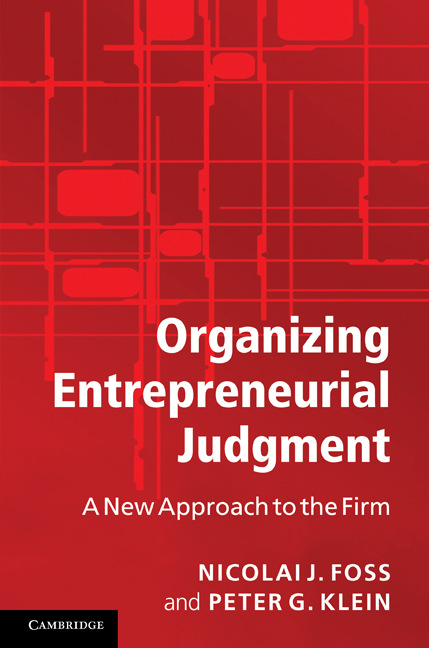
This is a placeholder page without much detail, but you can pre-order today! The best news is the price: just £55.00 for the hardback and a mere £19.99 for the paperback — less than a family outing to the cinema, and far more rewarding!
Reader Bleg: Transaction Costs and the Boundaries of the State
| Peter Klein |
O&M reader VL asks:
I have noticed an interesting link between transaction cost economics and the explanation of the long-term political units size (as Braudel would have said, on “la longue durée”). For example, it is highly probable that classical Greek poleis were being integrated and desintegrated in response to changes in the nature of military and political contracts. I wish to explore that perspective in my own doctoral thesis and I would like to ask for your help. Do you know about any work that examines that matter? I have read books of Coase, Williamson, and North, and further articles of Alchian, Demsetz, and others. But I don’t know of any work treating organization economics from a political anthropological or political historical perspective.
I suggested privately that he look at David Friedman’s 1977 JPE paper and recent work by Alberto Alesina and coauthors, though none of these works from a transaction cost perspective. Can the rest of you offer some suggestions? If not TCE, then how about resource-based, dynamic capabilities, or property-rights perspectives on the boundaries of the polis?
Digitopoly
| Peter Klein |
A new group blog by Erik Brynjolfsson, Joshua Gans, and Shane Greenstein. Should be interesting and informative. The authors
noticed that there were many blogs devoted to digital developments and consumer products but the selection focussing on economic and business aspects of the digital world was very limited. Digitopoly’s mission is to provide an economic and strategic management perspective on digital opportunities, trends, limits, trade-offs and platforms; expanding commentary in this important space.
The blog’s name — Digitopoly — reflects our broad interests in the impact of digital technology on competition. While, in some cases, our concern is the preservation of competition in the face of pressures toward monopoly, in others we see opportunities for greater competition and welfare benefits.
Our logo is deliberately iconic. The heavy set line in the graph could represent Moore’s Law (for processing power as time progresses) or Metcalfe’s Law (for the value of networks as more join). It overtakes the simple linear trend represented by thin, broken line. This reflects the idea that linear ways of thinking rarely serve us well in the digital economy.
EGOS 2012, “Self-reinforcing Processes in Organizations, Networks and Professions”
| Peter Klein |
The European Group of Organizational Studies (EGOS) is having the 2012 annual conference in Helsinki, July 2-7. The overall theme is design, and one of the subthemes is “Self-reinforcing Processes in Organizations, Networks and Professions,” a subject sure to interest many O&Mers. See the links above for details. Blurb after the fold: (more…)
In the Journals
| Peter Klein |
Three newly published papers of likely interest to O&Mers:
- Jeffrey L. Furman and Scott Stern, “Climbing atop the Shoulders of Giants: The Impact of Institutions on Cumulative Research,” American Economic Review 101, no. 5 (August 2011).
While cumulative knowledge production is central to growth, little empirical research investigates how institutions shape whether existing knowledge can be exploited to create new knowledge. This paper assesses the impact of a specific institution, a biological resource center, whose objective is to certify and disseminate knowledge. We disentangle the marginal impact of this institution on cumulative research from the impact of selection, in which the most important discoveries are endogenously linked to research-enhancing institutions. Exploiting exogenous shifts of biomaterials across institutional settings and employing a difference-in-differences approach, we find that effective institutions amplify the cumulative impact of individual scientific discoveries.
- Antti Kauhanen, “The Perils of Altering Incentive Plans: A Case Study,” Managerial and Decision Economics 32, no. 6 (September 2011).
This paper studies a retail chain that introduced a sales incentive plan that rewarded for exceeding a sales target and subsequently cut the incentive intensity in addition to increasing the target. Utilizing monthly panel data for 54 months for all 53 units of the chain the paper shows that the introduction of the sales incentive plan increased sales and profitability, whereas the changes in the plan lead to a marked drop in sales and profitability. Thus, modifying the incentive plan proved costly for the firm. The results are consistent with the gift-exchange model of labor contracts.
- Oriana Bandiera, Iwan Barankay, and Imran Rasul, “Field Experiments with Firms,” Journal of Economic Perspectives 25, no. 3 (Summer 2011).
We discuss how the use of field experiments sheds light on long-standing research questions relating to firm behavior. We present insights from two classes of experiments—within and across firms—and draw common lessons from both sets. Field experiments within firms generally aim to shed light on the nature of agency problems. Along these lines, we discuss how field experiments have provided new insights on shirking behavior and the provision of monetary and nonmonetary incentives. Field experiments across firms generally aim to uncover firms’ binding constraints by exogenously varying the availability of key inputs such as labor, physical capital, and managerial capital. We conclude by discussing some of the practical issues researchers face when designing experiments and by highlighting areas for further research.
The Institutional Revolution
| Peter Klein |
I’m very excited about Doug Allen’s forthcoming book The Institutional Revolution (University of Chicago Press). Trained by Yoram Barzel (and hence part of the Tree of Zvi), Doug is a leading contemporary scholar on property rights, transaction costs, contracting, and economic history. His work on agricultural contracting with Dean Lueck, including their 2002 book The Nature of the Farm, is a classic contribution to the economics literature on economic organization. He also has a very good introductory textbook. More information is at Doug’s informative (and amusing) website.
Here’s the cover blurb for the new book:
Few events in the history of humanity rival the Industrial Revolution. Following its onset in eighteenth-century Britain, sweeping changes in agriculture, manufacturing, transportation, and technology began to gain unstoppable momentum throughout Europe, North America, and eventually much of the world—with profound effects on socioeconomic and cultural conditions.
In The Institutional Revolution, Douglas W. Allen offers a thought-provoking account of another, quieter revolution that took place at the end of the eighteenth century and allowed for the full exploitation of the many new technological innovations. Fundamental to this shift were dramatic changes in institutions, or the rules that govern society, which reflected significant improvements in the ability to measure performance—whether of government officials, laborers, or naval officers—thereby reducing the role of nature and the hazards of variance in daily affairs. Along the way, Allen provides readers with a fascinating explanation of the critical roles played by seemingly bizarre institutions, from dueling to the purchase of one’s rank in the British Army.
Engagingly written, The Institutional Revolution traces the dramatic shift from premodern institutions based on patronage, purchase, and personal ties toward modern institutions based on standardization, merit, and wage labor—a shift which was crucial to the explosive economic growth of the Industrial Revolution.
Bonus: Here’s the syllabus from Doug’s course on the economics of property rights.
The Stresses of New Technology in Firm and Family
| Peter Lewin |
Many of the same theoretical tools and concepts that we use for the business firm are applicable to that other ubiquitous social institution, the family; though of course there are important differences (even though I am sure you know people who are “all business”). Steve Horwitz and I have written a paper that illustrates some of this.
The affects of the march of technology on the firm — for example, rendering obsolete certain kinds of physical and human capital, reducing production cost, increasing specialization and product variation, etc. — receive considerable attention. I have not seen much on these affects insude the family. Our article does analyze the long-term effects of the rising opportunity cost of labor in general and of women’s work in particular, which is the theme of a massive research literature. I have in mind rather the “mundane” effects on the family, and on the marriage, of unanticipated technological changes that, for example, affect the spouses differently. In effect, this is an unanticipated change in the marriage bargain that will plausibly bring with it additional un-bargained for stresses and tensions — an unanticipated rise in the cost of marriage (or of staying in the marriage).
I love my wife and I am not contemplating leaving, but I do feel the stress of having to perform all of the 21st century tasks for which I have a substantial comparative advantage, and which have become necessary and routine — like ordering things online, backing up data, downloading audio books (a necessity for exercising!) and so on. I wonder how common this is.
I might be in real trouble for this one :-).
More on Selective Intervention
| Nicolai Foss |
“Selective intervention” and the more narrow notion of the “impossibility of selective intervention” are among the more elusive notions in the theory of the firm. We have blogged on them a number of times (the most explicit treatment is here). Coined by Oliver Williamson, selective intervention simply means intervention to produce net gains. Thus defined, selective intervention is, of course, not “impossible.” The” impossibility” refers to the conjecture that firms cannot just be grown continuously by selective intervention; at some point various commitment and enforcement problems associated with managerial intervention kicks in, resulting in zero net gains. However, demonstrating this is a “puzzle.”
A new paper, “Solving the Selective Intervention ‘Puzzle’,” by noted French economist, Jacques Cremer, usefully places the problem in context, provides a nice overview of the extant literature, and argues that the problem has essentially been solved:
I have shown that the common thread to all the solutions is the fact that the principal stays in the game” after the contract is signed, and cannot commit himself to a policy which would make the world similar to the world in which there would be no vertical integration. On this basis, solutions that stress incompleteness of contracts, the change in the allocation of authority, the change in the amount of information available to the principal, all provide solutions that are theoretically consistent, and, furthermore, often not incompatible with each other. Determining which solution provides a better guide to applied analysis requires an examination of other features of the model.
The Downside of Case Studies
| Peter Klein |
As Herbert Simon once noted, while a case study is only a sample of one, a sample of one is infinitely more informative than a sample of none. This is surely true, but cases must be used with caution, particularly when more systematic evidence is available.
A couple months back I saw a Huffington Post piece claiming that, because Lincoln Electric retains workers even during recessions, and Lincoln Electric is a profitable company, firms should not fire workers when the demand for their products declines. QED. The author laments that business schools don’t teach the virtues of a “no-layoffs” policy more generally. As evidence that business schools are corrupt or incompetent, the author shows that management experts do not, in fact, believe that such a policy is desirable.
A more troubling reason is that many professors at Harvard and other MBA schools are deeply skeptical of offering workers such a bargain.
“It’s a terribly non-optimal and inefficient policy,” says George P. Baker, the co-chair of the HBS doctoral program. “Lincoln Electric is a special case. Unless there is some other reason for having it, as part of an incentive system, you would be wrong to recommend it.”
“I’m not unsympathetic to guaranteed employment and the long-term social strengths it builds,” says James Rebitzer, Chair of the Business Policy Department at Boston University’ School of Management, “But I think there are only a very few special circumstances where a commitment to no-layoffs actually improves operating efficiency.”
Harvard students such as Corey Crowell (MBA 2009), who read the [Lincoln Electric] case just days before we met, got the message: “I just worry that the sense of a guaranteed job would create complacency . . . look at the auto industry.”
There you have it. Despite a wealth of theory and evidence that guaranteed lifetime employment is generally harmful to firm performance, if one firm follows such a policy and prospers, then all firms should do so. That business schools don’t embrace the non sequitur is “troubling.” Okey dokey.
Is the Internet “Transforming” Business?
| Peter Klein |
In the 1990s and early 2000s there was a huge debate about the impact of information technology on productivity. Robert Solow famously quipped, “You can see the computer age everywhere but in the productivity statistics.” Robert Gordon, Erik Brynjolfsson, Jack Triplett, and many others participated in this debate, with issues revolving around productivity measurement, workplace incentives, organizational complementarities, and more. (I did some work on this too.) The end result was a rough consensus that IT did increase productivity, but that the effects were modest.
The buzz over “wikified” organizations — open-source communities, highly disaggregated firms, crowdsourced production, and the like — gives me a strong sense of déjà vu. Indeed, we have not been kind to the wikinomics view in these pages. Now Don Tapscott, a leader of this movement, seems to be having second thoughts:
In our 2006 book Wikinomics, Anthony D. Williams and I looked at dozens of companies that have used the Internet to transform their business models and achieve tremendous success.
However, in the five years since the book’s publication, we’ve noticed something striking: the rate of business model innovation has not accelerated. Yes, some individual companies have achieved competitive advantage by exploiting the web and networked business models. But overall the gains have been modest.
The reason, says Tapscott, is that “it’s becoming difficult or even impossible for companies to achieve breakthrough success without changing their entire industry’s modus operandi.” This reminds me of the conclusion from the earlier literature that IT has the biggest effect when combined with complementary organizational practices (e.g., Milgrom and Roberts, 1995), which suggests that change doesn’t occur until all elements of the complementary bundle are in place — maybe a long time after the initial innovation.

A Capital Approach
| Peter Lewin |
My thanks to Peter Klein (we have to be careful now to indicate which Peter is being addressed :-) ) and to O&M for this wonderful opportunity to participate in this forum. Though I have commented infrequently I have followed its musings with interest and profit. I am delighted to be here.
Perhaps, for my opening post, I might just mention a few areas of my past and current research that might be of interest.
- As part of the Routledge series on the Foundations of the Market Economy I wrote a book entitled Capital in Disequilibrium which was published in 1999. It is still available, but it is very expensive ($200) — certainly not worth that price! Routledge recently released their copyright to me exclusively and I have just got through revising the book for a second edition to be published very soon by the Mises Institute. I had hoped to have some copies available at the upcoming AOM meetings in San Antonio, but this seems very unlikely now. Still, it will be easily available on their website and an open source version will also be there. The price of the book will be $15 I believe. Based on inquiries I have received, this will be welcome news for a few interested scholars.
- I have made very few changes to the book — mainly stylistic improvements and corrections — but I have added a few references to relevant work that appeared after the first edition. For those who don’t know the work, it is basically an evaluative survey of capital theory Austrian-style. Capital theory has often been feared or avoided by economics students, never mind other interested scholars. I hoped and still hope that this book will provide them a comprehensive, sophisticated, yet accessible course in the subject. Of course, the amazing thing is the timing. The relevance of capital theory has, all of a sudden, burst upon the field of management and organization studies. Having discovered and digested Schumpeter and Kirzner, management scholars have now, in turn, discovered Lachmann. How delightful it is for me to see Lachmann’s insights being applied in this kaleidic, digital world. I know this would have pleased him beyond words. (A real paradox of sorts, because I cannot imagine he would ever have mastered the technology for his own personal use :-) ).
- Regarding the book, of course the material is at least twelve years old. Yet, those wishing to understand the recent work using concepts like radical subjectivism, capital heterogeneity, capital complementarity and subsititutability, etc. would probably find it useful — and need not pay attention to the every page. Chapters 2 and 3 seem to me particularly important for an understanding of the concept of equilibrium and disequilibrium about which so much confusion is evident in the literature. Chapter 9, and less so Chapter 10, address specifically the question of capital combinations in business organizations. The final part of the book is about human capital and creates a bridge between the work of Lachmann and Gary Becker. (more…)
AoM PDW on Austrian Economics
| Peter Klein |
 Four years ago I helped organize an Academy of Management pre-conference workshop on Austrian economics featuring Nicolai, me, Joe Mahoney, Yasemin Kor, Dick Langlois, and Elaine Mosakowski. It was well attended and very well received and we are doing something similar this year. Henrik Berglund, Todd Chiles, Steffen Korsgaard, and I have put together a Professional Development Workshop (PDW) on “Austrian Economics and Entrepreneurship Research.” Full details below. The conference home page is here. Hope to see many O&Mers at the workshop!
Austrian Economics and Entrepreneurship Research
Please join us Saturday, August 13, from 12:30 to 2:30pm in the San Antonio Convention Center, Room 212A, for a PDW on the Austrian school of economics and its implications for entrepreneurship studies (Program Session #281).
The Austrian school is increasingly well-known in the entrepreneurship field and is typically associated with Joseph Schumpeter’s idea of “creative destruction” and Israel Kirzner’s concept of “entrepreneurial alertness.” But Austrian economics features a number of additional themes, constructs, and emphases — resource heterogeneity, subjectivity of beliefs and expectations, processes of organizational emergence under complexity, and more — that are particularly relevant to research in entrepreneurship, organization, and strategy. Austrian economics is also receiving increasing attention in the broader economics and policy communities, as witnessed by the revival of interest in Austrian business cycle theory as an explanation for the financial crisis and subsequent economic downturn.
This PDW features a panel discussion and interactive table discussions designed to explore Austrian themes in greater detail and examine their applications to research in entrepreneurship and related areas of management studies. The organizers also hope to encourage and help develop the growing community of management scholars interested in the Austrian school.
The program begins with an introduction and overview by session organizers Henrik Berglund (Chalmers University of Technology), Todd Chiles (University of Missouri), Peter Klein (University of Missouri), and Steffen Korsgaard (Aarhus University), followed by breakout sessions organized around particular themes such as alertness and opportunity discovery, heterogeneity of the entrepreneurial imagination, resource heterogeneity and Austrian capital theory, entrepreneurship and equilibration, entrepreneurship and punctuated disequilibrium. Other distinctively Austrian (e.g., opportunities and action, the role of individuals, the individual-opportunity nexus, the market process, methodological individualism) and related (e.g., effectuation and bricolage) ideas will also figure prominently in the discussions.
The groups will then reassemble to share findings and results with the larger group. Ample time will be allowed for informal discussion and networking.
Please contact Henrik Berglund (henrik.berglund@chalmers.se) with any questions.
New Issue of Business History Review
| Peter Klein |
The March 2011 issue of Business History Review, just now online, contains several excellent papers, including “The Origin and Development of Markets: A Business History Perspective” by Mark Casson and John Lee, “Economics, History, and Causation” by Randall Morck and Bernard Yeung, “Globalization, Development, and History in the Work of Edith Penrose” by Christos Pitelis, and “Economic Theory and the Rise of Big Business in America, 1870–1910” by Jack High.
Morck and Yeung take the (perhaps surprising, almost Misesian) position that “[i]nstrumental variables can lose value with repeated use because of an econometric tragedy of the commons: each successful use of an instrument creates an additional latent variable problem for all other uses of that instrument,” and that “[e]conomists should therefore”consider historians’ approach to inferring causality from detailed context, the plausibility of alternative narratives, external consistency, and recognition that free will makes human decisions intrinsically exogenous.”
High notes that “by 1910, the entrepreneur was an important figure in American economics. He appeared regularly in textbooks written by American economists and his influence in the economy, especially in large firms, was generally recognized.” Entrepreneurship at that time was not about startups, but coordination more generally: J. R. Commons called the entrepreneur “the speculating, progressive, organizing, inventive, economizing agent of industry.”





 Organizations and Markets
Recent Comments