Posts filed under ‘Theory of the Firm’
Decentralization and the Walmart Decision
| Peter Klein |
On Monday the US Supreme Court turned refused to hear the class-action discrimination suit against Walmart (technically, the Court denied to certify the plaintiffs as a single class for purposes of a class-action suit). I haven’t followed the case closely enough to have an opinion on the merits (or the role of sociologists). But a main legal issue in the case — whether Walmart’s policy of delegating hiring and promotion decisions to local managers makes the firm itself liable for illegal personnel behavior — raises important questions for organization theory.
According to the decision (no, I didn’t try to read all 42 pages):
Pay and promotion decisions at Wal-Mart are generally committed to local managers’ broad discretion, which is exercised “in a largely subjective manner.” . . . Local store managers may increase the wages of hourly employees (within limits) with only limited corporate oversight. As for salaried employees, such as store managers and their deputies, higher corporate authorities have discretion to set their pay within preestablished ranges.
Promotions work in a similar fashion. Wal-Mart permits store managers to apply their own subjective criteria when selecting candidates as “support managers,” which is the first step on the path to management. Admission to Wal-Mart’s management training program, however, does require that a candidate meet certain objective criteria,including an above-average performance rating, at least one year’s tenure in the applicant’s current position, and a willingness to relocate. But except for those requirements, regional and district managers have discretion to use their own judgment when selecting candidates for management training. Promotion to higher office — e.g., assistant manager, co-manager, or store manager — is similarly at the discretion of the employee’s superiors after prescribed objective factors are satisfied. (more…)
ISNIE Conference Papers
| Peter Klein |
ISNIE held its fifteenth annual meeting last week in lovely Palo Alto, California. President-Elect Barry Weingast put together a terrific program, which you can view here. Many of the papers are also available for public viewing here. A few highlights:
Private Entrepreneurs in Public Services: a Longitudinal Examination of Outsourcing and Statization of Prisons – abstract and paper
Sandro Cabral, (Federal University of Bahia)
Sergio Lazzarini, (Insper)
Paulo Furquim de Azevedo, (FGV-SP)What is Law? a Coordination Account of the Characteristics of Legal Order – abstract and paper
Gillian K. Hadfield, (University of Southern California)
Barry R. Weingast, (Stanford University)Law As Byproduct: Theories of Private Law Production – abstract and paper
Bruce H. Kobayashi, (George Mason Univeristy School of Law)
Larry E. Ribstein, (University of Illinois College of Law)On the Evolution of Collective Enforcement Institutions: Communities and Courts – abstract and paper
Scott E. Masten, (University of Michigan)
Jens Prüfer, (Tilburg University)The ‘Fundamental Transformation’ Reconsidered: Dixit Vs. Williamson – abstract and paper
Antonio Nicita, (University of Siena, and EUI)
Massimiliano Vatiero, (University of Lugano)In the Shadow of Violence: the Problem of Development in Limited Access Societies – abstract and paper
Douglass North, (Washington University (St Louis))
John Wallis, (University of Maryland)
Steven Webb, (World Bank)
Barry Weingast, (Stanford University)
Alberto Diaz-Cayeros, (University of California San Diego)
Gabriella Montinola, (University of Californa Davis)
Jong-Sung You, (University of California San Diego)Entrepreneurial Finance and Performance: a Transaction Cost Economics Approach – abstract and paper
Alicia Robb, (Ewing Marion Kauffman Foundation)
Robert Seamans, (NYU Stern School of Business)Expanding the Concept of Bounded Rationality in TCE: Incorporating Interpretive Uncertainty in Governance Choice – abstract
Libby Weber, (UC Irvine)
Kyle J. Mayer, (University of Southern California)
See the complete list for many more excellent papers.
Bonus (via Lynne Kiesling): the program for a Festschrift conference at Northwestern in honor of Joel Mokyr.
Update: More on the Mokyr conference from Lynne.
What Do Resource- and Capability-Based Theories Propose?
| Peter Klein |
Check out Michael Leiblein’s Guest Editorial in the new Journal of Management:
What Do Resource- and Capability-Based Theories Propose?
Michael J. Leiblein
The Ohio State UniversityThe purpose of this editorial is to review the basic definitions, assumptions, and propositions offered by the resource-based, strategic factor market, and dynamic capability literature streams. Considering the underlying definitions and assumptions associated with these approaches leads directly to a set of refutable propositions that highlight the distinct insights offered by each of these literatures. It is hoped that accentuating these distinctions may stimulate dialogue regarding the underlying causal mechanisms associated with these approaches and foster future empirical work testing these related perspectives.
A very useful reference, both for specialists and those new to the RBV and capabilities approaches. Highly recommended! (And not just because the author’s name ends in “-lein.”)
Upcoming Conferences
| Peter Klein |
- ISNIE, 16-18 June in Palo Alto. Registrations are closed but latecomers could try lobbying the Treasurer to accept a late payment — never mind, that’s me, don’t bother.
- “Open Source, Innovation, and New Organizational Forms,” 1 August in Johannesburg. “This first IPEG conference intends to explore new theoretical and empirical advances in open source organization: the interest is not just on voluntary Open Source Software production and its potential innovation implications, but also on such related ‘open source’ phenomena as collective invention, online collaboration (e.g., Wikipedia), online social networking (e.g., Facebook), open innovation, open science, open source biology, and open standards.” The conference website is not live as of this posting, but organizer Giampaolo Garzarelli can provide details. O&M’s Dick Langlois is a keynote speaker. 500-word abstracts are due 24 June.
- “Achieving Coexistence of Biotech, Conventional & Organic Foods in the Marketplace,” 26-28 October in Vancouver. Speakers include FAO Deputy Director General Ann Tutweiler and Canadian Ag Minister Gerry Ritz. Coexistence conferences have been held every other year since 2003; the first 3 conferences came out of EU Commission efforts, the next was in Australia, and this one is the first to be held in North America. A co-organizer tells me “we hope to bring a more ‘practical’ view of coexistence than is commonly held in Europe.”
Incomplete Contracts and the Theory of the Firm
| Peter Klein |
 A very useful survey article from the Spring 2011 Journal of Economic Perspectives: “Incomplete Contracts and the Theory of the Firm: What Have We Learned over the Past 25 Years?” by Philippe Aghion and Richard Holden. From the introduction:
In the first section of this paper, we spell out Grossman and Hart’s argument using a simple numerical example, then then we show how the incomplete contracts approach can be extended beyond the firms’ boundaries issue to analyze firms’ internal organization; firms’ financial decisions; the costs and benefits from privatization; and the organization of international trade between inter- and intrafirm trade. In the second section, we discuss several criticisms of the incomplete contracts/property rights methodology, especially what we call the “implementation criticism,” and then we briefly review some recent developments of the incomplete contracts approach.
I plan to use it in “Economics of Institutions and Organizations” this fall.
Update: Thanks to Stéphane Saussier for the pointer to the upcoming conference, Grossman and Hart at 25, June 24-26 in Brussels.
Anti-Williamson
| Peter Klein |
Thanks to Per for reminding me of this 2004 paper by Daniel Ankarloo and Giulio Palermo, “Anti-Williamson: A Marxian Critique of New Institutional Economics” (Cambridge Journal of Economics 28, no. 3). It’s one thing to question Williamson’s behavioral assumptions and to complain about their implications for education and business practice. But apparently “Williamson’s categories, his method and conception are themselves products of bourgeois ideology.” Who knew?
Bonus: Here’s Doug North getting the same treatment. And if anyone thinks I don’t take Marx seriously, let me say that I once mitigated a contractual hazard in my pajamas — how it got in my pajamas I’ll never know.
New Survey Paper on Firm Boundaries
| Peter Klein |
It’s “Theories of the Firm-Market Boundary” from our friends Todd Zenger, Teppo Felin, and Lyda Bigelow, and forthcoming in the Academy of Management Annals. Here’s the abstract:
A central role of the entrepreneur-manager is assembling a strategic bundle of complementary assets and activities, either existing or foreseen, which when combined create value for the firm. This process of creating value however requires managers to assess which activities should be handled by the market and which should be handled within hierarchy. Indeed, for more than forty years, economists, sociologists and organizational scholars have extensively examined the theory of the firm’s central question: what determines the boundaries of the firm? Many alternative theories have emerged and are frequently positioned as competing explanations, often with no shortage of critique for one another. In this paper, we review these theories and suggest that the core theories that have emerged to explain the boundary of the firm commonly address distinctly different directional forces on the firm boundary – forces that are tightly interrelated. We specifically address these divergent, directional forces – as they relate to organizational boundaries – by focusing on four central questions. First, what are the virtues of markets in organizing assets and activities? Second, what factors drive markets to fail? Third, what are the virtues of integration in organizing assets and activities? Fourth, what factors drive organizations to fail? We argue that a complete theory of the firm must address these four questions and we review the relevant literature regarding each of these questions and discuss extant debates and the associated implications for future research.
A nice synthesis that makes a number of important points. I can even forgive a few key omissions. :)
Henry Manne on Entrepreneurship
| Peter Klein |
Important new paper by Henry Manne on entrepreneurship (Quarterly Journal of Austrian Economics, Spring 2011). It won’t surprise you to know that Henry has a solution to the problem of encouraging entrepreneurial behavior among corporate managers: allow them to trade on inside information.
Entrepreneurship, Compensation, and the Corporation
Henry G. ManneThis paper revisits the concept of entrepreneurship, which is frequently neglected in mainstream economics, and discusses the importance of defining and isolating this concept in the context of large, publicly held companies. Compensating for entrepreneurial services in such companies, ex ante or ex post, is problematic — almost by definition — despite the availability of devices such as stock and stock options. It is argued that insider trading can serve as a unique compensation device and encourage a culture of innovation.
ACAC 2011
| Peter Klein |
The Atlanta Competitive Advantage Conference, otherwise known as ACAC, starts tomorrow. I’m there, along with former O&M guest bloggers Joe Mahoney, Steve Postrel, and Russ Coff, and a whole bunch of interesting and important people in strategy, organization theory, entrepreneurship, innovation, HRM, and more. Check out the program, as well as the main site with information about past and future events. Besides the workshops and paper sessions there are special events like a symposium with Jay Barney on the RBV after 20 years and keynotes from Rebecca Henderson and Joel Baum. The only thing ACAC needs is a spokesperson — I think Gilbert Gottfried might be available.
Gulf & Western and the Mob
| Peter Klein |
 As a fan of the Godfather films, and a student of conglomerate diversification in the 1960s and 1970s, I’m surprised that I didn’t know, until today, about the connections between Gulf & Western CEO Charles Bluhdorn and the mafia. Paramount, the studio that made Godfather I and II, was at that time a Gulf & Western subsidiary (along with dozens of companies in industries ranging from auto parts to clothing, books, financial services, mining, sugar, cigars — you name it). Gulf and Western was at that time organized as a holding company, or what Williamson calls an “H-form” firm, not a more tightly integrated “M-form,” or multidivisional organization. H-form subsidiaries are operated as highly autonomous units, with little interference from company headquarters, so one wouldn’t expect Bluhdorn to have had much day-to-day contact with Paramount executives.
But apparently he intervened quite a lot. Today’s WSJ featured a piece on Hollywood in the late 1960s and early 1970s, what some regard as a Golden Age of American cinema (besides Godfather, think Chinatown, Nashville, The Conversation, Rosemary’s Baby, etc. — all Paramount films). Evidently Bluhdorn was substantially involved with the production of Godfather, helping make casting decisions and even firing (and re-hiring) producer Al Ruddy. Why such close concern? Paramount executive Peter Bart thought that Bluhdorn had “the mind of a criminal” and was involved with “financiers who had close ties to the mob community.” One of these, I learn from a 2009 Vanity Fair article, was Michele Sindona, a mob-connected banker who died (by poisoning) in an Italian prison. Initially, the Mafia wanted the film scrubbed — unwanted attention and all that — but then relented and helped with production. Several mobsters acted as extras while others helped behind the scenes. A few of the major players, such as Al Lettieri, who played Sollozzo, and Gianni Russo, who played Carlo, were mob connected. Here’s how Russo described getting his part: “Charlie Bluhdorn had a lot of good friends. So I had some people call him and say, ‘You know, this guy Gianni Russo is a very close friend of ours.’”
CFP: Economics and Strategy of Entrepreneurship and Innovation
| Peter Klein |
Forwarded on behalf of Dan Spulber:
CALL FOR PAPERS
Journal of Economics & Management Strategy (JEMS)
Economics and Strategy of Entrepreneurship and Innovation IIIJEMS is planning a third special issue on the economics and strategy of entrepreneurship and innovation. JEMS welcomes both empirical and theoretical contributions.
Possible topics include:
- Economics of entrepreneurship
- Innovation and entrepreneurship
- R&D and the entrepreneur
- Intellectual property rights and the entrepreneur
- Entrepreneurship and the theory of the firm
- Entrepreneurship and finance
- Entrepreneurship and industrial organization
- Entrepreneurship and economic growth
Submissions to JEMS will be subject to the standard peer-review process. The submission deadline is July 1, 2011. To submit a manuscript to JEMS, visit ScholarOne at http://mc.manuscriptcentral.com/jems. If you have any questions about JEMS, please contact Susie Caruso at editjems@kellogg.northwestern.edu.
Interesting New NBER Papers
| Peter Klein |
Matching Firms, Managers, and Incentives
Oriana Bandiera, Andrea Prat, Luigi Guiso, Raffaella Sadun
January 2011
We exploit a unique combination of administrative sources and survey data to study the match between firms and managers. The data includes manager characteristics, such as risk aversion and talent; firm characteristics, such as ownership; detailed measures of managerial practices relative to incentives, dismissals and promotions; and measurable outcomes, for the firm and for the manager. A parsimonious model of matching and incentive provision generates an array of implications that can be tested with our data. Our contribution is twofold. We disentangle the role of risk-aversion and talent in determining how firms select and motivate managers. In particular, risk-averse managers are matched with firms that offer low-powered contracts. We also show that empirical findings linking governance, incentives, and performance that are typically observed in isolation, can instead be interpreted within a simple unified matching framework.
Business Failures by Industry in the United States, 1895 to 1939: A Statistical History
Gary Richardson, Michael Gou
March 2011
Dun’s Review began publishing monthly data on bankruptcies by branch of business during the 1890s. This essay reconstructs that series, links it to its successors, and discusses how it can be used for economic analysis.
The Consequences of Financial Innovation: A Counterfactual Research Agenda
Josh Lerner, Peter Tufano
February 2011
Financial innovation has been both praised as the engine of growth of society and castigated for being the source of the weakness of the economy. In this paper, we review the literature on financial innovation and highlight the similarities and differences between financial innovation and other forms of innovation. We also propose a research agenda to systematically address the social welfare implications of financial innovation. To complement existing empirical and theoretical methods, we propose that scholars examine case studies of systemic (widely adopted) innovations, explicitly considering counterfactual histories had the innovations never been invented or adopted.
Oxford Handbook of Human Capital
| Peter Klein |
I just received a copy of the Oxford Handbook of Human Capital, edited by Alan Burton-Jones and J.-C. Spender, and it looks terrific. The concept of “human capital” came from developments in macroeconomics and labor economics (and, it is often forgotten, entrepreneurship) but is increasingly influential in organization and strategy research. (Witness, for example, the new SMS Strategic Human Capital Interest Group.) These Handbook chapters “reveal the importance of human capital for contemporary organizations, exploring its conceptual underpinnings, relevance to theories of the firm, implications for organizational effectiveness, interdependencies with other resources, and role in the future economy,” says the cover blurb. O&M readers may especially like the section on “Human Capital and the Firm,” with chapters on TCE (by Foss), agency theory (Spender), the RBV (Jeroen Kraaijenbrink), entrepreneurship and the theory of the firm (Brian Loasby), and the knowledge-based theory of the firm (Georg von Krogh and Martin Wallin). Check it out!
The Forgotten: “Alternative Views of Mengerian Entrepreneurship”
| Peter Klein |
A film blog I follow, the Mubi Daily Notebook (formerly called The Auteurs Notebook) runs a regular feature called “The Forgotten,” showcasing obscure but important older titles. I propose doing the same thing here. Our first entry is a 1979 article by Dolores Tremewan Martin, “Alternative Views of Mengerian Entrepreneurship” (History of Political Economy 11, no. 2). Martin provides an excellent summary and critique of Menger’s subtle approach to the entrepreneur, one largely ignored in the current entrepreneurship literature, even among Austrian economists. Contrasting Schumpeterian and Knightian views on entrepreneurship, Martin argues that Menger’s position is close to Knight’s (and, hence, that Knight is much closer to the Austrian school than is generally recognized).
As Martin points out, Menger’s entrepreneur (Unternehmer) is a resource-owning, information-acquiring coordinator seeking to acquire and combine undervalued assets (using an “input-computing capacity”). Entrepreneurial activity is scarce, in that it is associated with ownership of scarce capital, but also “unique in that, unlike other goods of higher order, it is not intended for exchange and therefore does not command a price.” There are important differences bewteen Menger and Knight concerning types of uncertainty and the effect of uncertainty on profit. Still:
Menger does not treat the entrepreneur as being the “innovator,” “mover,” or “force of change.” Menger places stress on the entrepreneurial function and the role of uncertainty, not innovation, as giving rise to the possibility for rewards. As Schumpeter [the historian of economic thought] suggests, the economic process viewed by Carl Menger is essentially similar to that of Frank Knight. . . . For Menger (as for Knight) the entrepreneurial activity consists of a more correct — “more rational” — evaluation of goods of higher order. This view contrasts with Schumpeter’s personification of the entrepreneur as the hero of the capitalist drama.
The Vanishing Hand: 19th-Century French Edition
| Dick Langlois |
Haven’t read this yet, but it looks interesting. Note also the futuristic publication date.
On the Origins of Vertical Unbundling: The Case of the French Transportation Industry in the 19th Century
Guy Numa
European Journal of the History of Economic Thought, Vol. 20, No. 2, 2013The paper retraces the origins of the unbundling of infrastructure, which is a monopoly, from services, which are subject to competition. Using the case of the railroad industry in France, I examine how both natural monopoly theorists and legislation dealt with this subject in the 19th century. I argue that the origins of vertical unbundling date to this period with legislation pertaining to inland waterways and railroads. This was particularly the case for the railroad industry due to pricing and competition rationales. I analyze the writings of Dupuit and Walras and show that they both agreed that infrastructure and services had to be unbundled for the inland waterways. In contrast, they expressed different justifications to defend the monopoly for the railroad industry. Following a chronological progression, the first section explores the origins of unbundling in legislation. The second section analyzes how theorists approached the way railroads had to be managed. Throughout, I highlight the interplay between their work and legislation.
Counterintuitive Research Result of the Day
| Peter Klein |
According to the current issue of Managerial and Decision Economics, women free ride more than men:
An Experimental Test of Behavior under Team Production
Donald Vandegrift and Abdullah YavasThis study reports experiments that examine behavior under team production and a piece rate. In the experiments, participants complete a forecasting task and are rewarded based on the accuracy of their forecasts. In the piece-rate condition, participants are paid based on their own performance, whereas the team-production condition rewards participants based on the average performance of the team. Overall, there is no statistically significant difference in performance between the conditions. However, this result masks important differences in the behavior of men and women across the conditions. Men in the team-production condition increase their performance relative to men in the piece-rate condition. However, this gap in male performances across conditions diminishes over the course of the experiment. In contrast, women in the team-production condition show significantly lower performance than the women in the piece rate. As a consequence of these differences, men in the team-production condition show significantly better performance than women in the team-production condition. We also find evidence that men show stronger performance when they are in teams with a larger variation in skill level.
I’m trying to derive implications for firm performance in light of Alchian and Demsetz (1972). But come on, give me the Go-Gos or Bangles over Backstreet Boys or Jonas Brothers any day.
WSJ on Conglomerates
| Peter Klein |
Industrial conglomerate ITT announced in January a split into three more focused companies, one concentrated in hotels and gaming, one in education (technical training centers), and a slimmed-down ITT Corporation containing the remaining manufacturing businesses. This is the second major restructuring for ITT, once the poster child of the conglomerate movement of the 1960s and early 1970s.
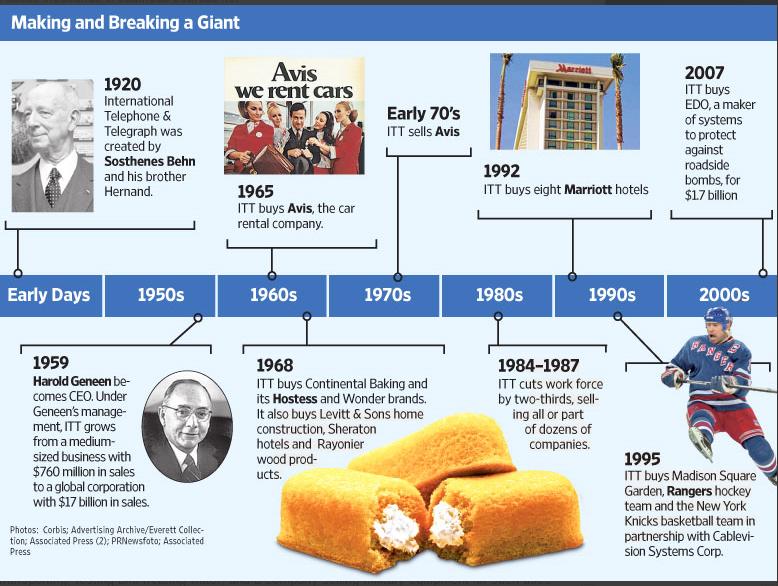 The Wall Street Journal’s article of 13 January contains a nice graphic on the firm’s history, including a picture of Harold Geneen, the quintessential “management by the numbers” CEO (click to enlarge). It also includes ruminations on the conglomerate form more generally, about which I have a continuing research interest. Yale’s Jeffrey Sonnenfeld says conglomerates represented “an unholy mix of opportunistic investment bankers, misguided consultants and the vanities of CEOs.” A companion article puts it this way: “Conglomerates blossomed five decades ago, when favorable interest rates made it relatively easy to boost revenue and stock prices with serial acquisitions. But they fell out of favor when the stock increases slowed and investors began to question whether promised efficiencies would materialize.”
But this is not quite right. In fact, the research literature finds little evidence that conglomerate growth was fueled mainly by cheap credit and rising stock prices. (more…)
Transaction Cost Regulation
| Peter Klein |
At last year’s ISNIE conference in Stirling Pablo Spiller gave an excellent presidential address on “Transaction Cost Regulation,” the application of transaction cost economics to regulatory issues. The text of the address has now been released as an NBER Working Paper with the same name:
This paper discusses the fundamental underpinnings and some implications of transaction cost regulation (TCR), a framework to analyze the interaction between governments and investors fundamentally, but not exclusively, in utility industries. TCR sees regulation as the governance structure of these interactions, and thus, as in standard transaction cost economics, it places emphasis in understanding the nature of the hazards inherent to these interactions. The emphasis on transactional hazards requires a microanalytical perspective, where performance assessment is undertaken within the realm of possible institutional alternative. In that sense, politics becomes fundamental to understanding regulation as the governance of public / private interactions. The paper discusses two fundamental hazards and their organizational implications: governmental and third party opportunism. Both interact to make regulatory processes and outcomes more rigid, formalistic, and prone to conflict than envisioned by relational contracting.
You can see the slides from the ISNIE version here.
What an Arrow-Debreu Contract Might Look Like
| Peter Klein |
A visual reminder why real-world contracts are typically incomplete, giving rise to interesting problems of ex ante incentive alignment and ex post governance.
ISNIE Annual Conference, Stanford University, June 16–18
| Scott Masten |
The 15th Annual Conference of the International Society for New Institutional Economics will be held this year at Stanford University on June 16-18. The conference is being organized by President-Elect Barry Weingast, and my inside, not-yet-public information is that the conference will have two very interesting keynotes. The ISNIE website has the just-released Call for Papers.





 Organizations and Markets
Recent Comments