Hardware Matters
| Peter Klein |
 Joe Salerno’s post at Circle Bastiat, “There’s No Such Thing as a Free Cloud,” could have been an entry in our nothing new under the sun series. Joe highlights a recent HBR blog piece on the physical footprint and energy requirements of server farms, showing that success in the digital age depends, for some players, on access to tangible capital assets and energy. There are important implications:
The notion of a world without scarcity is thus usually propagated by leftist social theorists–but not always. There were some libertarian futurists around in the early 1970s. But lately many libertarians are among the vanguard of those who, dazzled by the marvels of the Digital Age, argue that many goods have become costlessly and, therefore, infinitely producible. Without government interference, they contend, humankind will be able to satisfy more and more of their wants using the resources freely available inside the Cloud.
Our Post-Scarcity libertarians should tell this to the owners of the 500,000 data centers, which contain the hundreds of millions of servers worldwide that constitute the real and indispensable infrastructure of the Cloud.
There are also the wires, cables, switches, cell towers, and client machines (PCs, smartphones, tablets, etc., not to mention smart refrigerators, cars with OnStar, thermostats, and more) that give us access to the cloud. To be sure, Moore’s law allows us to consume this hardware as never before. But software without hardware is like, hmmmm, peanut butter without jelly, Sonny without Cher, a Tim Burton movie without Johnny Depp. Notes Joe: “Once again, common sense observation of the real world reveals the ceaseless struggle of human actors to economize on the use of resources and vindicates the old and true economics of scarcity.”
SMS Career and Paper Development Workshop
| Peter Klein |
Join Laura Cardinal, Bill Schulze, Tomi Laamanen, Bruce Lamont, Gerry McNamara, Karen Schnatterly, and me for a research-focused senior PhD/junior faculty and paper development workshop at the 2012 Strategic Management Society meetings in Prague. Full details below the fold. (more…)
Entrepreneurship and the Auteur Theory
| Peter Klein |
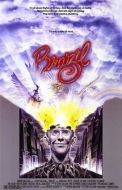 I’ve been reading Jack Mathews’ The Battle of Brazil: Terry Gilliam v. Universal Pictures in the Fight to the Final Cut, a fascinating — if absurdly one-sided — look at director Terry Gilliam’s struggle to get his 1985 film Brazil distributed in the US. Mathews tells the story as a noble crusade by a brilliant, iconoclastic, visionary filmmaker against the evil studio system, run by corporate toadies who care only about making money, even if it means destroying the artistic unity of the filmmaker’s creative vision. Gilliam had “final cut” rights for a version released in Europe, but his US distributor, Universal, demanded substantial edits, which Gilliam refused to make. Universal, led by Sid Sheinberg (who comes across heroically in documentaries about Steven Spielberg’s Jaws), was completely within its contractual rights to insist on these changes, but the result was a very different film that has been lampooned by critics. (The Sheinberg version was canned and an alternate Gilliam version eventually shown in the US after a long, ugly, public battle between Gilliam and the studio.)
It’s great reading for those interested in movies and the business of making movies. But there’s an interesting entrepreneurship angle as well. Most film critics, including author Mathews, accept the auteur theory of cinema, which sees movies as the highly personal products of a director’s creative vision. The studio approach, which treats moviemaking as a collaborative enterprise designed to make money, is anathema to the auteurs. The case is usually made with familiar anecdotes: 24-year-old Orson Welles had final control over Citizen Kane and created one of the medium’s great masterpieces, while RKO destroyed the follow-up Magnificent Ambersons (and all Welles’s subsequent films). The studios thought Star Wars would flop, and after George Lucas made his zillions he decided to finance and produce his subsequent films on his own, without studio interference — the dream of every auteur. American art-house darlings like Robert Altman, Peter Bogdonavich, Quentin Tarantino, Jim Jarmusch, etc. are always portrayed as fighting to keep Hollywood from turning their edgy, original films into bland, corporate drivel pitched at suburban soccer moms.
As Paul Cantor and others have explained, however, the auteur theory is bunk. Moviemaking is, in fact, a collaborative venture, and many of the best films are studio pictures created by large teams — the best example being Casablanca, which was essentially written by committee. Or, as Cantor puts it: “Just three words: Francis Ford Coppola.” (The Godfather films were studio pictures; virtually everything Coppola did since, with the partial exception of Apocalypse Now, has been a disaster.) And take George Lucas: Does anybody think the problem with the prequel trilogy was too many people standing around saying, “George, you can’t do that”?
Consider the parallels with entrepreneurship. (more…)
Handbook of Economic Organization
| Peter Klein |
Kudos to Anna Grandori for her edited volume, Handbook of Economic Organization: Integrating Economic and Organization Theory, currently making its way through the editorial process at Edward Elgar. Blurb:
The volume distinctively aims at integrating economic and organization theories for the explanation and design of economic organization. Economic organization is therefore intended both as an object of enquiry and as an emerging disciplinary field: not economics applied to organization as an object, but a forefront interdisciplinary field attracting researches and integrating insights from economics, organization theory, strategy and management, economic sociology, and cognitive psychology. The authors are distinguished scholars at their productive peak in those fields, sharing an in interest in an integrated and enlarged approach to economic organization. Each chapter not only addresses foundational issues and provides a state-of-art, but also offers original contributions and identifies key issues for future research.
Table of Contents is below the fold. You”ll find many of your favorite authors. (more…)
Italian Social Science: Generalized Low Quality?
| Nicolai Foss |
In conversations with Italian colleagues I have often been struck by the sad cynicism, sometimes even spite, with which they talk about Italian academic institutions. There is mention of “barons,” backstabbing, secret deals and networks, “the Roman approach,” the Illuminati and whatnot (OK, perhaps not that specific secret society) that hinder fully realizing the potential of Italian social science. To be sure, the situation cannot be entirely debilitating as there is quite serious research being conducted across a number of Italian universities (and as a frequent visitor to both Bocconi and Luiss Guido Carli I can testify to this). But, there is clearly a perception of rot among Italian academics themselves .
Here is a quite controversial 2009 paper, “L Words: The Curious Preference for Low Quality and Its Norms,” by famed rational choice sociologist, Diego Gambetta and philosopher Gloria Origgi. The paper begins thusly: “We have spent our academic careers abroad, Gloria in France and Diego in Britain. Over this long period of time each of us has had over a hundred professional dealings with our compatriots in Italy – academics, publishers, journals, newspapers, public and private institutions. It is not an exaggeration to say that 95% of the times something went wrong. Not catastrophically wrong, but wrong nonetheless.”
The reasons for “this cocktail of confusion, sloppiness and broken promises” that, allegedly, is Italian academia, can be located in a peculiar equilibrium, described as the “L world.” This is not, as one might think, a world described by the PD-game, but rather a situation in which both (all) parties agree on delivering high quality (H) and both (all) deliver low quality (L), and, as Gambetta and Origgi explain, (more…)
Ockham’s Razor
| Peter Klein |
 This looks like a mighty interesting conference:
Scientific theory choice is guided by judgments of simplicity, a bias frequently referred to as “Ockham’s Razor”. But what is simplicity and how, if at all, does it help science find the truth? Should we view simple theories as means for obtaining accurate predictions, as classical statisticians recommend? Or should we believe the theories themselves, as Bayesian methods seem to justify? The aim of this workshop is to re-examine the foundations of Ockham’s razor, with a firm focus on the connections, if any, between simplicity and truth.
The conference started yesterday; here’s a report on day 1 from Cosma Shalizi. Parsimony, for example, turns out to be more complicated than it appears; here is Shalizi on (recent University of Missouri visitor) Elliott Sober:
What he mostly addressed is when parsimony . . . ranks hypotheses in the same order as likelihood. . . . The conditions needed for parsimony and likelihood to agree are rather complicated and disjunctive, making parsimony seem like a mere short-cut or hack — if you think it should be matching likelihood. He was, however, clear in saying that he didn’t think hypotheses should always be evaluated in terms of likelihood alone. He ended by suggesting that “parsimony” or “simplicity” is probably many different things in many different areas of science (safe enough), and that when there is a legitimate preference for parsimony, it can be explained “reductively”, in terms of service to some more compelling goal than sheer simplicity.
Today’s Mini-Rant
| Peter Klein |
From my colleague John Howe. Here’s the news item:
MarketWatch (June 20, Orol), meanwhile, has learned that “regulatory observers urged policy makers on Wednesday to require companies to make road-show discussions available to the broader public.” Among them was Ann Sherman, associate professor of finance at DePaul University. She spoke at the Senate Banking Committee hearing that was devoted to whether the IPO process was working for ordinary investors and stated: “It is very important that we try to give everyone the same information.” Lise Buyer, founder of Class V Group LLC, a firm that guides IPO-bound companies, agreed with Sherman. She added that one way to improve the flow of information would be to require companies on a road show to hold a scheduled “Ask the Management” Q&A session via the Internet.
John asks:
Do people actually think we can level the information playing field? Not only is that naive (stupid), but it leads small/individual investors to the wrong conclusion — that they are not at a comparative disadvantage in the financial markets. They are, and they’re better off knowing it.
What Is a Firm?
| Peter Klein |
Some of you have heard me suggest — at least half seriously — that we ban the word “entrepreneurship” from scientific discourse. The word has so many definitions that its use often obfuscates rather than clarifies. (If you mean self-employment, better to say say “self-employment”; if you mean opportunity discovery, say “opportunity discovery”; and so on.)
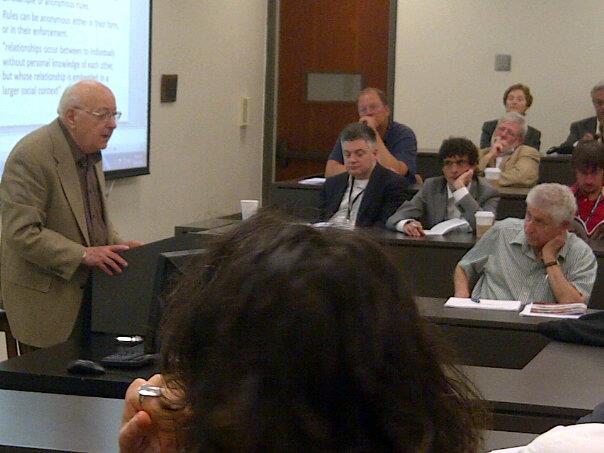
Yoram Barzel (right) listens to Harold Demsetz.
Harold Demsetz gave an interesting and entertaining presentation yesterday at ISNIE, in a session honoring Yoram Barzel on his 80th birthday. Demsetz’s remarks made me wonder if we should ban “firm” as well. Demsetz pointed out, quite rightly, that Coase (1937) defines the firm in terms of the employment relation. A one-person operation, in this definition, is not a firm, and vertical integration deals with the question of adding producers of intermediate products to the firm’s employment roll. Demsetz thinks independent contractors are firms, and hence it makes little sense to speak of “firm” and “market” as alternatives, as Coase does. (Oliver Williamson, during an earlier session, noted that Coase expressed more interest in intermediate product markets in his 1988 article than in “The Nature of the Firm.”)
For Knight, Williamson, Hart, and other notables, in contrast, the firm is defined not by the employment relationship, but by the ownership of alienable assets. In this approach, the question is who owns what, not who is employed by whom. (Dan Spulber offers yet another approach, defining the firm as nexus of transactions with objectives different from those of its owners.) Of course, even in the Knightian approach, to get from the one-person firm to the multi-person firm requires some theory about the relative transaction costs of employment versus independent contracting, a theory Nicolai and I try to provide in chapter 8 of our recent book, focusing on the conditions under which the entrepreneur can delegate judgment to subordinates.
So, what is a firm? Perhaps the better question is, What are the important research questions that can be answered when the firm is defined as X?
ISNIE 2012
 | Peter Klein |
The 16th annual meeting of the International Society for New Institutional Economics starts today at the USC Gould School of Law at the University of Southern California. President-Elect Lee Epstein has put together a very interesting program with the usual set of good papers and keynotes, including two special sessions in honor of Yoram Barzel on his 80th birthday. No live streaming, but the papers are available online, and I’ll pass along any good gossip to the O&M readership.
Elinor Ostrom (1933-2012)
| Peter Klein |
A guest post from former guest blogger Joe Mahoney, the Caterpillar Chair in Business and Director of Graduate Studies in the Department of Business Administration, University of Illinois:
As many readers of O&M know by now, Elinor Ostrom of Indiana University (born August 7, 1933) died of pancreatic cancer on Tuesday, June 12th at the age of 78. She shared the Nobel Prize in Economics in 2009 with Professor Oliver Williamson (UC-Berkeley). Elinor along with her husband Vincent Ostrom (now 93) founded Indiana University’s Workshop in Political Theory and Policy in the mid-1960s, in which she remained active until this Spring, only a couple of weeks before her hospitalization. She also donated most of her Nobel Prize money to the Workshop, as Elinor and Vincent had no children and few living relatives. Williamson said in a statement that Ostrom was “a great human being,” an inspiring teacher and colleague and accomplished social scientist. “She had a wonderful sense of joy about the importance of her work that she successfully communicated to others,” he said. A record five women won Nobel prizes in 2009, and Elinor Ostrom is the only woman to have been awarded the prize in Economics.
Elinor Ostrom, who was born and raised in Los Angeles as a child of the Great Depression, and received her education from undergraduate through Ph.D. at UCLA, contributed to our understanding of the evolution of institutions for collective action in common resource contexts such as forests, fisheries, oil fields, and grazing lands. She emphasized citizen involvement, the creativity of local communities, and cutting through sterile dichotomous classifications and ideological “solutions” that are glib and inaccurate. Ostrom states that “neither the State nor the market is uniformly successful in enabling individuals to sustain long-term, productive use of natural resources” (1990: 1). She emphasized the complementarities between public and private mechanisms for solving collective good problems (see Governing the Commons, Cambridge University Press, 1990.) Ostrom conducted field studies of the world’s fisheries, roamed with shepherds in Swiss pastures, and trudged around the Los Angeles water basin (during her dissertation work) to distill the essentials of harnessing cooperation. She writes in the preface to her 1990 book: “It is my conviction that knowledge accrues by the continual process of moving back and forth from empirical observation to serious efforts at theoretical formulation.” From this theoretically informed field case study method Elinor Ostrom concludes that instead of presuming that individuals sharing a common resource are “inevitably caught in a trap from which they cannot escape, . . . the capacity of individuals to extricate themselves from various types of dilemma situations varies from situation to situation” (1990: 14).
Ostrom championed unlocking the spirit of “public entrepreneurship” — a term she coined in her 1965 UCLA dissertation. Her spirit can live on within us, if we decide to “make it so.” Good years.
Collected Works of F. A. Hayek, Vol. 7: Business Cycles
| Nicolai Foss |
The University of Chicago Press has just published the seventh volume, “Business Cycles, Part I and II,” in their nineteen volumes Collected Works of F.A. Hayek project. The two books contain most of Hayek’s well-known interwar work on the business cycle, particularly his more methodological Monetary Theory and the Trade Cycle (originally published in 1928) and, of course, Prices and Production, in addition to a number of essays on, as they were called, “industrial fluctuations.” The two parts of Volume 7 both have excellent 40+ pages introductions penned by Hansjoerg Klausinger who may well be the scholar in the world with the deepest knowledge of Hayek’s contributions to business cycle theory and who does a superb job in terms of discussing Hayek’s work through the lens of modern economics.
Annoying Summertime Pursuit Numero Uno: Writing Tenure Letters
| Nicolai Foss |
OK, it is June and high season for tenure letter requests. I have written tons of these letters within the last decade or so, and I confess that I find this activity increasingly annoying and the tenure letter institution increasingly hard to fathom. Deans will write me, saying that I have “been identified” (well, yes, in the sense that I was on someone’s shortlist, and you just picked me) as an “expert” (hmmm) in “X” (X may be strategy, organization theory, HRM, knowledge management, entrepreneurship — even organizational behavior, but not yet, alas, sociology), and I have “three weeks” to write up my letter (and I have nothing else to do in June?) for “Dr. Doe” (who didn’t bother to ask me whether I would write such a letter).
I once brought up the issue of compensation for at least one day of intense work effort with a dean, but that was not well received. However, at least for us Euro professors the “what’s in it for me” question is quite real. Euro schools typically don’t use the tenure letter institution (INSEAD and LBS do, but they are “Americanized” schools), and we get zero credit for this service. (Euro schools tend to pay for comparable services, BTW). Still, when I bring up these issues, righteous types will say things like “”Nicolai, citizenship isn’t tit-for-tat” or lecture me on “generalized reciprocity.” However, the argument that ultimately made me continue writing these letters, rather than turning requests down, was that apparently people are harmed by someone’s refusal to write the letter.
So, I do it. But I reserve the right to bitch and whine. And speculate on the rationale of this institution. What is really its purpose? Anyone can produce a list of half a dozen people (close colleagues, former advisors, friends …) and get them to write nice letters. What kind of objective assessment is produced by some dean picking people from such a list? Is this empty ritual? Or, is there some underlying efficiency rationale?
Interview with Gary Becker on Rational Choice
| Peter Klein |
The latest issue of the Erasmus Journal for Philosophy and Economics features an interview with Gary Becker on rational choice. I am not a Chicagoite positivist, but I sympathize with Gary’s overall take on the behavioral revolution: Meh.
Interviewer: Following the crisis, many economists and methodologists have argued that more realistic behavioral underpinnings of economic theory would have made forecasts more accurate. Do you think that one of the things the recent crisis has shown us is that people just do not behave rationally? Or did the crisis rather show exactly the opposite—that people did in fact react to incentives and that the consequences of introducing new financial instruments were just not foreseeable?
Becker: I think it is mainly the latter. There were incentives, both on the borrower and on the lender side, that these subprime loans would be made available at the lowest interest rates; and there was pressure from the government to do so; and probably those involved did not understand the financial instruments. Now, is it that we have to change our theories radically with respect to their behavioral structure or even switch to a new behavioral framework? There is very little evidence that would support such a move.
A later remark supports my argument that “disequilibrium analysis” is not the defining characteristics of the Austrian school:
I have read some of the literature on the critique of equilibrium, not so much by philosophers but by the Austrian school of economics, and I could just never make sense out of it, because I do not see what they are substituting for it. Even Friedrich Hayek, who is listed as one of the top Austrians, if you read his analysis, you see that he is using equilibrium analysis.
Alien, Deconstructed
| Peter Klein |
We haven’t raised the pomo periscope for a while, so here goes. I’m a big fan of the original Alien film and, like Ridley Scott fans around the world, am eagerly awaiting the prequellish Prometheus. Until seeing Tom Shone’s piece in Slate, however, I had no idea the Alien franchise had inspired so much pseudo-academic pomobabble:
We’ve had Alien as feminist allegory (“Woman: The Other Alien in Alien,” Women Worldwalkers: New Dimensions of Science Fiction and Fantasy, 1985), Alien as mothering fable (“Mommie Dearest: Aliens, Rosemary’s Baby, and Mothering,” Journal of Popular Culture, 1990), Alien as abortion parable (“Voices of Sexual Distortion: Rape, Birth, and Self-Annihilation Metaphors in the Aliens Trilogy,” Quarterly Journal of Speech, 1995). Even Jones the cat got his own diagram, courtesy of James H. Kavenagh’s essay “Son of a Bitch: Feminism, Humanism, and Science in Alien” (October, No. 13, 1980), which sought to align the alien attack on humans with an Althusserian-Marxist takedown of humanism in general:
“The founding term in the film is human (S). … The anti-human (-S), is, of course, the alien, and the not-human (̅S̅) is Ash, the robot. The cat, then functions in the slot of the not-anti-human (-̅S̅), an indispensable role in this drama.”

I am totally using Kavenagh’s title in a future academic article.
Lewin on Austrian Capital Theory
| Peter Klein |
A very nice overview of “Austrian” capital theory and its relevance for the current economic crisis from former guest blogger Peter Lewin.
With the resurgence of Keynesian economic policy as a response to the current crisis, echoes of past debates are being heard — in particular the debate from the 1930s between John Maynard Keynes and Friedrich Hayek. . . . Hayek pointed out that capital investment does not simply add to production in a general way but rather is embodied in concrete capital items. That is, the productive capital of the economy is not simply an amorphous “stock” of generalized production power; it is an intricate structure of specific interrelated complementary components. Stimulating spending and investment, then, amounts to stimulating specific sections and components of this intricate structure.
See also the recent SO!APbox essay by Rajshree Agarwal, Jay Barney, Nicolai, and me, “Heterogeneous Resources and the Financial Crisis: Implications of Strategic Management Theory.”
7th São Paulo Workshop on Institutions and Organizations
| Peter Klein |
The next São Paulo Research Workshop on Institutions and Organizations is 1-2 October 2012. Proposals are due 15 June, so hurry! The keynote speakers are not yet announced but they’ve had, ahem, some good ones before, so expectations are high. Click the link above for details.
“Give Me Money!”
| Peter Klein |
I’ve received quite a few emails from various academic organizations asking me to help defeat the Flake Amendment, which would eliminate National Science Foundation funding for political science research. The American Political Science Association is all over this, even publishing a virtual special issue of APSR highlighting NSF-funded research results.
Ironically, none of the arguments I’ve seen for preserving public funding of social science research makes an argument consistent with, well, social-science research. All take the form: “Government funding has supported the following important research findings, which have had the following social benefits.” This argument receives three Fs for research design. First, there is no counterfactual. The point isn’t whether government-funded research result X is good, but whether it’s better than Y, the research result that would have obtained in the absence of government funding. Government funding doesn’t simply increase the quantity of research, it shapes the direction of research. How do we know NSF-funded work isn’t crowding out even more valuable work?
Second, there is no attempt at causal inference. Where are the natural experiments, the randomized controlled trials, the valid instruments? There is evidence that a main effect of government funding of hard science is to increase the wages of scientists, not the quality or quantity of research. Even if NSF funds good political science research, how do we know the funding is the cause, not the consequence, of the research?
Third, there is no cost-benefit analysis. The lobbying statements simply list purported benefits. Well, sure, the government could give me hundreds of millions of dollars and I’d do some good with it too. Would those benefits exceed the costs? “Political science research has wide-spread effects beyond specific projects,” say the APSA’s talking points. Maybe so, but what about the effects of those goods and services that would have been produced with the taxpayer dollars that went to NSF? Has nobody at the Monkey Cage read Bastiat?
Put differently, I’m certain the APSR would desk-reject an empirical paper with the logical structure of this argument for funding!
My advice to social scientists seeking government funding is to start by acting like social scientists, not K Streeters.
Organizing Entrepreneurial Judgment: Kindle Edition Now Available
| Peter Klein |
Here’s the link — and the price is right, just $16.50!
According to the latest sales figures, we’re up to #1,070,026 on Amazon. So close to the top spot! Incidentally, my sole-authored Capitalist and the Entrepreneur is just behind at #1,210,245, suggesting that the market places only a small value on the marginal Foss contribution. That’s the correct inference, right?
More Coase
| Peter Klein |
Russ Roberts interviews Coase on EconTalk. Familiar stuff, but it’s great to hear Coase talk about it at age 101. Some highlights:
Roberts: “[I]t’s hard to measure transactions costs; it’s hard to quantify the theory. Is that correct or is it irrelevant.” Coase: “It’s very relevant. But the state of economics is such that people don’t try to measure these things, to study them, and so people can engage in discussions and explanations without any real knowledge of what happens in the real world.”
Roberts: “What was your reaction to [game theory] and its influence on the study of the firm?” Coase: “I think the influence was wholly bad, because people developed high theoretical approaches instead of approaches based on what actually happens.”
Roberts: “[D]id you have contact with Keynes and Hayek, two great economists of that era in England?” Coase: “Yes. I was very friendly with Hayek. I liked him, and he liked me. But we didn’t have great contact. He tended to deal with these big questions, and I’m always interested in how the actual system operates. Therefore, in much smaller matters than Hayek.” Roberts: “And how about Keynes? Did you know Keynes?” Coase: “I can tell you– I was helping when Britain was trying to get a loan from the United States immediately after the war, and I was talking to one of Keynes’s assistants. And Keynes came in the room and walked over to us and the man I was talking to us said, ‘This is Coase, who is helping us with the statistics. I don’t think you know him.’ And Keynes said, ‘No, I don’t.’ And walked off. And that’s my life with Keynes. “





 Organizations and Markets
Recent Comments