Reminder: “Alternative Investments” Proposals due 15 June
| Peter Klein |
Reminder: Proposals for the Managerial and Decision Economics special issue on “Effects of Alternative Investments on Entrepreneurship, Innovation, and Growth” are due 15 June 2012. Don Siegel, Nick Wilson, Mike Wright, and I are editing the special issue and organizing a paper-development conference 29 October 2012 at the SUNY Global Center in Manhattan. Click the link above or go here for further details. We look forward to your submissions!
Vertical (Dis)integration and Technological Change
| Dick Langlois |
One of my longest-running interests has been the relationship between economic change, including technological change, and the boundaries of the firm. In broad strokes, my story is this: when markets are thin and market-supporting institutions weak, technological change, especially systemic change, leads to increased vertical integration, since in such an environment centralized ownership and control may reduce “dynamic” transaction costs; but when markets are thick and market-supporting institutions well developed, technological change leads to vertical disintegration, since in that environment the benefits of specialization and the division of labor outweigh the (now relatively smaller) transaction costs of contracting. This latter scenario is what I called the Vanishing Hand. I recently ran across a new working paper by Ann Bartel, Saul Lach, and Nachum Sicherman, called “Technological Change and the Make-or-Buy Decision,” that supports the Vanishing Hand idea empirically. Here is the abstract.
A central decision faced by firms is whether to make intermediate components internally or to buy them from specialized producers. We argue that firms producing products for which rapid technological change is characteristic will benefit from outsourcing to avoid the risk of not recouping their sunk cost investments when new production technologies appear. This risk is exacerbated when firms produce for low volume internal use, and is mitigated for those firms which sell to larger markets. Hence, products characterized by higher rates of technological change will be more likely to be produced by mass specialized firms to which other firms outsource production. Using a 1990-2002 panel dataset on Spanish firms and an exogenous proxy for technological change, we provide causal evidence that technological change increases the likelihood of outsourcing.
The Spanish dataset is based on questionnaires about outsourcing activities in various mechanical industries. The exogenous proxy is number of patents granted in the U. S. in each industry. So, basically, Spanish firms in industries in which there are a lot of American patents tend to outsource more ceteris paribus than Spanish firms in industries with fewer American patents. Although I always like empirical evidence that supports my own arguments, I also like to play the devil’s advocate. The incomplete-contracts literature (which for me is Coase and Knight as much as Hart and Moore) reminds us that it is harder to write contracts when knowledge is tacit and inchoate. Could it thus be that number of patents is a proxy for the importance of explicit versus tacit knowledge in the industry, and it is the prevalence of the explicit, rather than technological change per se, that makes contracting less costly? My money is still on the Vanishing Hand story.
Why Do Firms Differ?
| Peter Klein |
This year marks the thirtieth anniversary of two major contributions to strategy and organization, Nelson and Winter’s Evolutionary Theory of Economic Change and Lippman and Rumelt’s “Uncertain Imitability: An Analysis of Interfirm Differences in Efficiency under Competition.” Both tried to explain inter-firm performance differences without reference to market power or random shocks. Interestingly, as Ruff Coff points out, both were aimed at economists, but had little impact there, instead becoming foundational contributions to the emerging strategy field. Here’s a concise summary of Lippman and Rumelt from Peter Zemsky:
Lippman and Rumelt (1982), in the first formal theoretical paper inspired by the distinctive concerns of the strategy literature, demonstrate how superior performance can arise without assumptions of imperfect competition and market power, which are the defining features of the IO approach. In their model there are a large number of potential entrants that can pay a fixed cost to enter an industry. The key assumption is that there is imperfect imitability so that each entrant’s cost function is determined by an independent draw from a known distribution. In equilibrium, firms with bad draws exit and the remaining firms on average must have abnormal returns even when in the case where the firms are all small and have no market power. Ex ante however expected profits from entry are zero. The paper remains an outstanding example of high quality theorizing in strategy. Barney (1986) in his paper on strategic factor markets applies the same reasoning in his verbal argument that from an economics perspective superior performance must be the result of luck.
L&$ also explain the background and context of their article in a new video.
Kirzner’s theory of entrepreneurship is another example of a contribution intended to change the conversation in economics — by shifting attention from equilibrium states to adjustment processes — that seems to have little impact upon its intended audience, while becoming hugely influential in a different field (entrepreneurship).

IT and Higher Ed
| Peter Klein |
 Joshua Gans’s Forbes piece on Stanford’s online game theory course brought up a larger point about higher education. I’ve been involved in various online, distance, web-based educational activities for many years. When designing an online course, the typical professor imagines each element of a traditional course, then creates a virtual equivalent. I.e., paper syllabus = html syllabus; books, articles, handouts = pdf files; classroom lecture = webcast lecture; office hours = chat session; pen-and-paper exams = online exams; and so on. The elements are exactly the same as before; only the method of delivery has changed.
This is almost certainly the wrong way to leverage the information technology revolution. The pedagogy is exactly the same. But isn’t this just what we would expect of entrenched incumbents? The record companies didn’t create iTunes. The online New York Times is pretty much like the paper New York Times; it took Google and Flipboard and other innovators to revolutionize the newsreading business.  As we’ve noted before, isomorphism and stasis is exactly what we would expect from a protected cartel — disruptive innovation, in the Christensen sense, will almost certainly come from outside. (Hopefully after Yours Truly is comfortably retired.)
With the Pols
| Peter Klein |
Two years ago I was in D.C. on Hayek-Klein day and found myself on an elevator with Ben Bernanke, upon which I persuaded him to sing me a few bars of Happy Birthday. True story. This year I was in D.C. again, this time to give an organizational economist’s perspective on the Federal Reserve System to the House Financial Services Committee’s Subcommittee on Domestic Monetary Policy and Technology. You can read my written testimony here and see the oral remarks at C-SPAN which has archived the event.
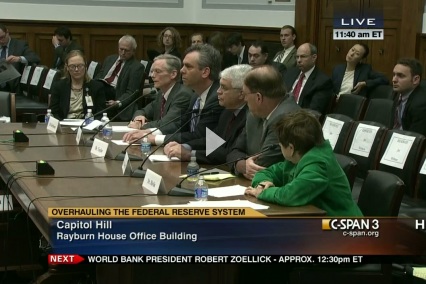
That’s Jeff Herbener to my right and John Taylor to my left, with Jamie Galbraith by Taylor. The one on the end is not Yoda, but Alice Rivlin.
Because the hearing was televised, I can truthfully say, “I’m not a macroeconomist, but I play one on TV.”
Darden Entrepreneurship and Innovation Research Conference
| Peter Klein |
The Darden Entrepreneurship and Innovation Research Conference is now underway in Charlottesville, Virginia. Keynote and roundtable sessions will be streamed on the conference website.
Crowdsourcing in Academia
| Peter Klein |
It’s called “fractional scholarship.”
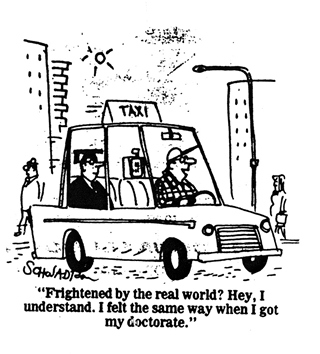
American universities produce far more Ph.D’s than there are faculty positions for them to fill, say the report’s authors, Samuel Arbesman, senior scholar at the Kauffman Foundation, and Jon Wilkins, founder of the Ronin Institute. Thus, the traditional academic path may not be an option for newly minted Ph.D.s. Other post-graduate scientists may eschew academia for careers in positions that don’t take direct advantage of the skills they acquired in graduate school.
Consequently, “America has a glut of talented, highly educated, underemployed individuals who wish to and are quite capable of effectively pursuing scholarship, but are unable to do so,” said Arbesman. “Ideally, groups of these individuals would come together to identify, define and tackle the questions that offer the greatest potential for important scientific results and economic growth.”
Given the level of relationship-specific investment many research projects require, this isn’t likely to work without some kinds of long-term commitments. But the model may be effective for other projects. And it beats the alternative.
The Bizarro World of Professor Sen
| Peter Klein |
Here is another of those head-scratchers, this one from Amartya Sen, about how neoclassical economics is partly responsible for the financial crisis because neoclassical economists believe that markets work “perfectly”:
Since the crisis broke out the economics profession in general and mainstream economics in particular have been severely criticised. Do you think this is justified?
The criticism of mainstream economics is justified to a limited extent. It is certainly true that the focus of attention in mainstream economics has tended to be on assuming the market to be working perfectly and there being no need for regulation. However, while this view has been a very dominant part of mainstream economics, you have to bear in mind that mainstream economics is not all centered around one unified theme. I don’t think all of mainstream economics should be held responsible.
Do you think that neoclassical macro economists should bear the brunt of the blame?
This would be an oversimplification. Neoclassical economics has many different paths. There are mainstream neoclassical economists who have been very critical of the complete reliance on the markets.
I’ve been around neoclassical economists since my undergraduate days and I can’t think of a single neoclassical economist who says that markets work “perfectly” and favoring “complete reliance on the markets.” David Friedman comes to mind, but even his arguments for anarchism are not based on the belief that markets are somehow “perfect,” but that they are less imperfect than regulation. The truth, of course, is that virtually all neoclassical economists favor a substantial amount of economic regulation — government production of law and order, government control of the monetary system, competition policy, and other government actions to combat purported market failures.
Statements like Sen’s make sense only as a rhetorical ploy to fool the reader. If the mainstream thinks, say, that government should control 25% of the economy, and you think government should control 75%, you describe the mainstream as “extremists” who believe in “no government,” thus making your position seem like a reasonable middle ground. Krugman of course employs the same rhetorical strategy. Sen is obviously too intelligent to mean what he says literally, so I can only assume mendacity. Am I missing something?
Part-time Work and Discursive Resistance and Foucault and Stuff
| Lasse Lien |
I both challenge and reify this:
Contributing to a Foucauldian perspective on ‘discursive resistance’, this paper theorizes how part-time workers struggle to construct a valid position in the rhetorical interplay between norm-strengthening arguments and norm-contesting counter-arguments. It is thereby suggested that both the reproductive and the subversive forces of resistance may very well coexist within the everyday manoeuvres of world-making. The analysis of these rhetorical interplays in 21 interviews shows how arguments and counter-arguments produce full-time work as the dominant discourse versus part-time work as a legitimate alternative to it. Analysing in detail the effects of four rhetorical interplays, this study shows that, while two of them leave unchallenged the basic assumptions of the dominant full-time discourse and hence tend instead to reify the dominant discourse, two other interplays succeed in contesting the dominant discourse and establishing part-time work as a valid alternative. The authors argue that the two competing dynamics of challenging and reifying the dominant are not mutually exclusive, but do in fact coexist.
Nentwich, J. and Hoyer, P. (2012), “Part-time Work as Practising Resistance: The Power of Counter-arguments.” British Journal of Management, forthcoming.
Explosive Economists
| Peter Klein |
I’ve always liked the actor John Lithgow, not only because of his smarmy yet likeable weirdness (keep your comments to yourselves, please), but also because he’s married to an economist, the UCLA economic historian Mary Yeager. (The late Fred Bateman told me that when he and Yeager were just starting out, no one in their professional circles could understand why she was hanging out with this struggling actor who was obviously never going to make it big.)
So I was amused by a profile in Thursday’s WSJ about Lithgow’s role in an upcoming Broadway play about cold-war journalist Joseph Alsop. Reporter: “You portray Joe Alsop as an explosive man. Did you model him on someone from your own life?” Lithgow: “I’ve known mercurial people who emotionally completely turn on a dime, and they’re very exciting people. My wife is a little like that.”
OK, most economists are not exciting, but I’ve known plenty of mercurial and explosive ones.
Birger Wernerfelt Receives Honorary Doctorate from CBS
| Nicolai Foss |
Wernerfelt, a key originator of the resource-based view of strategy (here) who has made numerous important contributions to the economics of organization, marketing, and other fields, received the degree at a ceremony at the Copenhagen Business School yesterday (another recipient of the honorary doctoral degree was Deirdre McCloskey). I motivated the degree with the following remarks: (more…)
No Best Practice for Best Practice
| Lasse Lien |
An important selling point for the consulting industry is that consultants can presumably help a firm identify and implement “best practice.” Surely the consulting industry is an important channel for disseminating knowledge of better ways of doing things, but identifying what constitutes best practice for a given firm in a given situation is no trivial task, and even if the best practice could be identified, transferring it will be a significant challenge.
This begs the question of whether there is a best practice for identification and transfer of best practices, and whether the consulting industry has identified and adopted such a practice. According to this paper Benjamin Wellstein and Alfred Kieser, the consulting industry in Germany is nowhere near a best practice for best practice. This goes for for both inter- and intra-industry transfer. I’ll bet my hat that this finding holds everywhere.
Well, I guess as long as the consulting industry keeps finding better practices for transferring better practices, we shouldn’t be too disappointed that there is no best practice for best practice. (HT: E.S. Knudsen)
Time to Say Goodbye, but Not Really
| Peter Lewin |
After a most enjoyable and productive tour as a guest blogger on this site (at least for me), the time has come to say goodbye.
I do so at an auspicious moment, having just received my copy of Organizing Entrepreneurial Judgment. This book brings together important work by two of the hosts of this site in a very accessible format that promises to spread their message to many who have yet to hear it. To understand the firm one must understand entrepreneurship and vice versa. We live in a dynamic world in which individual judgments concerning the value of resources and the path of future events play a key role and organizational structures develop to give traction to those judgments. For an unrepentant Austrian subjectivist like me it is all very exciting. I look forward to observing further developments as an observer and casual participant on this blog, and elsewhere.
I would like to warmly thank the hosts of this blog Dick, Nicolai, Lasse, and Peter for extending to me the invitation to participate and look forward to ongoing productive associations with all of them.
Paradigm Shift
| Peter Klein |
 Did you know this year is the semicentennial of Kuhn’s Structure of Scientific Revolutions? David Kaiser offers some reflections at Nature.
At the heart of Kuhn’s account stood the tricky notion of the paradigm. British philosopher Margaret Masterman famously isolated 21 distinct ways in which Kuhn used the slippery term throughout his slim volume. Even Kuhn himself came to realize that he had saddled the word with too much baggage: in later essays, he separated his intended meanings into two clusters. One sense referred to a scientific community’s reigning theories and methods. The second meaning, which Kuhn argued was both more original and more important, referred to exemplars or model problems, the worked examples on which students and young scientists cut their teeth. As Kuhn appreciated from his own physics training, scientists learned by immersive apprenticeship; they had to hone what Hungarian chemist and philosopher of science Michael Polanyi had called “tacit knowledge” by working through large collections of exemplars rather than by memorizing explicit rules or theorems. More than most scholars of his era, Kuhn taught historians and philosophers to view science as practice rather than syllogism.
Kuhn did not, to my knowledge, say much about the social sciences, though in a later essay he described them in somewhat unflattering terms:
[T]here are many fields — I shall call them proto-sciences — in which practice does not generate testable conclusions but which nonetheless resemble ph9ilosophy and the arts rather than the established sciences in their developmental patters. I think, for example, of fields like chemistry and electricity before the mid-eighteenth century, of the study of heredity and phylogeny before the mid-nineteenth, or many of the social sciences today. In those fields, . . . though they satisfy [Popper’s] demarcation criterion, incessant criticism and continual striving for a fresh start as primary forces, and need to be. No more than in philosophy and the arts, however, do they result in clear-cut progress.
Murray Rothbard took an explicitly Kuhnian approach to his history of economic thought, agreeing with Kuhn that there is no linear, upward progression and condemning what he called the “Whig theory” of intellectual history.
Get Off My Lawn
| Peter Klein |
The boys from orgtheory.net were parking in our maintenance lot, so we had to put up signs. (Spotted in Champaign, IL.)

Qantum + Politics = Ψ(Fun)
| Lasse Lien |
O&M is nonpartisan, but this description of Mitt Romney as the first quantum politician is IMHO so funny that it would be downright irresponsible to ignore it.
After describing how other candidates operate under Newtonian principles, where a candidate’s position on an issue remains constant until acted upon by some outside force, David Javerbaum goes on to describe how things are very different in the quantum Romneality (excerpt):
Complementarity. In much the same way that light is both a particle and a wave, Mitt Romney is both a moderate and a conservative, depending on the situation. It is not that he is one or the other; it is not that he is one and then the other. He is both at the same time.
Probability. Mitt Romney’s political viewpoints can be expressed only in terms of likelihood, not certainty. While some views are obviously far less likely than others, no view can be thought of as absolutely impossible. Thus, for instance, there is at any given moment a nonzero chance that Mitt Romney supports child slavery.
Uncertainty. Frustrating as it may be, the rules of quantum campaigning dictate that no human being can ever simultaneously know both what Mitt Romney’s current position is and where that position will be at some future date. This is known as the “uncertainty principle.”
Entanglement. It doesn’t matter whether it’s a proton, neutron or Mormon: the act of observing cannot be separated from the outcome of the observation. By asking Mitt Romney how he feels about an issue, you unavoidably affect how he feels about it. More precisely, Mitt Romney will feel every possible way about an issue until the moment he is asked about it, at which point the many feelings decohere into the single answer most likely to please the asker.
Noncausality. The Romney campaign often violates, and even reverses, the law of cause and effect. For example, ordinarily the cause of getting the most votes leads to the effect of being considered the most electable candidate. But in the case of Mitt Romney, the cause of being considered the most electable candidate actually produces the effect of getting the most votes.
Duality. Many conservatives believe the existence of Mitt Romney allows for the possibility of the spontaneous creation of an “anti-Romney” that leaps into existence and annihilates Mitt Romney. (However, the science behind this is somewhat suspect, as it is financed by Rick Santorum, for whom science itself is suspect.)
What does all this bode for the general election? By this point it won’t surprise you to learn the answer is, “We don’t know.” Because according to the latest theories, the “Mitt Romney” who seems poised to be the Republican nominee is but one of countless Mitt Romneys, each occupying his own cosmos, each supporting a different platform, each being compared to a different beloved children’s toy but all of them equally real, all of them equally valid and all of them running for president at the same time, in their own alternative Romnealities, somewhere in the vast Romniverse.
David Javerbaum (NYT March 31).
HT: Svein T. Johansen
A Curious Case of Vertical Integration
| Peter Klein |
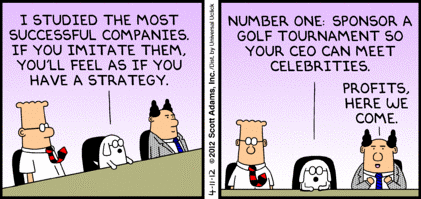
The WSJ reports that Delta Airlines wants to acquire a Pennsylvania oil refinery. The reporters, quoting the ubiquitous “people familiar with the situation,” says that Delta “could save between $20 and $25 a barrel on some of its jet-fuel costs by acquiring the refinery, a big advantage as industry costs now approach $140 a barrel, up 11% so far this year.” But how? No particular economies of integration are mentioned in the article (apparently the WSJ doesn’t consider this an important point). Jet fuel is a standardized commodity, so asset specificity isn’t an issue. Organizational capabilities don’t seem to be relevant. Market power? Price discrimination? I don’t see it. In short, I can’t imagine where these cost savings would come from. Any ideas?
Stylish Academic Writing
| Peter Klein |
Helen Sword’s recent WSJ piece — “Yes, Even Professors Can Write Stylishly” — takes me back to an early O&M entry on academic writing. Sword offers some great pairwise comparisons:
Stodgy: The human capacity to synthesize linguistic complexity is exemplified by the grammatical phenomenon of verb irregularity.
Stylish: “This book tries to illuminate the nature of language and mind by choosing a single phenomenon and examining it from every angle imaginable. That phenomenon is regular and irregular verbs, the bane of every language student.” (Steven Pinker)
and
Stodgy: A significant variability in nutrient-gathering behaviors has been observed in various insect species.
Stylish: “Insects suck, chew, parasitize, bore, store, and even cultivate their foods to a highly sophisticated degree of specialization.” (Richard Leschen and Thomas Buckley)
Plenty more are in her new book, Stylish Academic Writing. As I noted in the earlier post, economics and management scholarship has been blessed with some terrific prose stylists, but plenty of awful ones too.





 Organizations and Markets
Recent Comments