The Performative Effects of Social Constructionist Professors in Business Schools
| Nicolai Foss |
Many European business schools praise disciplinary diversity. Some style themselves as “business universities,” rather than “traditional” business schools. Such schools may have a substantial contingent of faculty from the humanities, including historians, literary theorists, and philosophers, as well as sociologists and political scientists. The probability of such faculty subscribing to social constructionism is high. Typically, this perspective is taught to the students in courses on communication, whether intercultural or not, the theory of science, cross-cultural management, and so on. It is pretty much everywhere.
Those in sociology who stress “reflexivity” and “performativity” tell us that our theorizing, as mediated through teaching, influences the objects of theorizing. What may be the performative effect of social constructionist professors? My hypothesis is that the students they teach will end up acting like Hayek’s “constructivist rationalists” on the level of society, that is, managers who believe everything in organizations is malleable, and may therefore do substantial damage to the organizations they manage. The Wiki on social constructionism provides a neat summary of Ian Hacking’s celebrated critique of social constructionism:
Ian Hacking, having examined a wide range of books and articles with titles of the form “The social construction of X” or “Constructing X”, argues that when something is said to be “socially constructed”, this is shorthand for at least the following two claims:
(0) In the present state of affairs, X is taken for granted; X appears to be inevitable.
(1) X need not have existed, or need not be at all as it is. X, or X as it is at present, is not determined by the nature of things; it is not inevitable.
Hacking adds that the following claims are also often, though not always, implied by the use of the phrase “social construction”:
(2) X is quite bad as it is.
(3) We would be much better off if X were done away with, or at least radically transformed.
If this is foundational for you as a manager, you will likely have little respect for what has evolved inside an organization, because “it is not inevitable.” You will be unimpressed by efficiency arguments from economics and functionalist arguments from sociology that explain the presence of a given feature of an organization. Your urge is to change the organization erratically according to your whims, and nourish ongoing turmoil. Psychological/implicit contracts suffer. Negative implications for productivity and firm-level performance follow.
Another Field Experiment
| Lasse Lien |
As previously pointed out, field experiments are rare. Here is another. This one is on the quality of decision making. I guess the authors’ finding that men are more consistent (i.e. rational) decision makers than women will raise an eyebrow or two. I don’t know about other male O&M readers, but I am definitely taking home a copy to show my wife.
Who Is (More) Rational?
Syngjoo Choi, Shachar Kariv, Wieland Müller, and Dan SilvermanyRevealed preference theory offers a criterion for decision-making quality: if decisions are high quality then there exists a utility function that the choices maximize. We conduct a large-scale field experiment that enables us to test subjects’ choices for consistency with utility maximization and to combine the experimental data with a wide range of individual socioeconomic information for the subjects. There is considerable heterogeneity in subjects’ consistency scores: high-income and high-education subjects display greater levels of consistency than low-income and low-education subjects, men are more consistent than women, and young subjects are more consistent than older subjects. We also find that consistency with utility maximization is strongly related to wealth: a standard deviation increase in the consistency score is associated with 15-19 percent more wealth. This result conditions on socioeconomic variables including current income, education, and family structure, and is little changed when we add controls for past income, risk tolerance and the results of a standard personality test used by psychologists.
WSJ on Conglomerates
| Peter Klein |
Industrial conglomerate ITT announced in January a split into three more focused companies, one concentrated in hotels and gaming, one in education (technical training centers), and a slimmed-down ITT Corporation containing the remaining manufacturing businesses. This is the second major restructuring for ITT, once the poster child of the conglomerate movement of the 1960s and early 1970s.
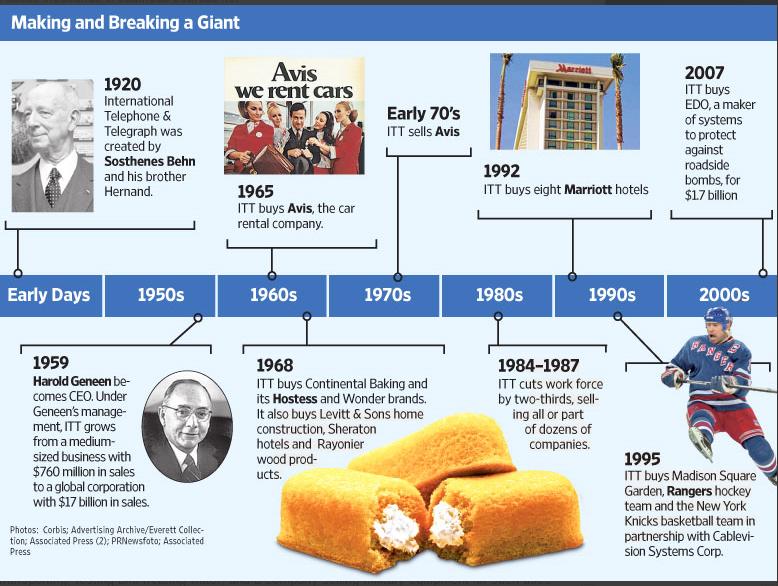 The Wall Street Journal’s article of 13 January contains a nice graphic on the firm’s history, including a picture of Harold Geneen, the quintessential “management by the numbers” CEO (click to enlarge). It also includes ruminations on the conglomerate form more generally, about which I have a continuing research interest. Yale’s Jeffrey Sonnenfeld says conglomerates represented “an unholy mix of opportunistic investment bankers, misguided consultants and the vanities of CEOs.” A companion article puts it this way: “Conglomerates blossomed five decades ago, when favorable interest rates made it relatively easy to boost revenue and stock prices with serial acquisitions. But they fell out of favor when the stock increases slowed and investors began to question whether promised efficiencies would materialize.”
But this is not quite right. In fact, the research literature finds little evidence that conglomerate growth was fueled mainly by cheap credit and rising stock prices. (more…)
John Nye on the New Institutional Economics and Economic Development
| Peter Klein |
The always-thoughtful and interesting John Nye, speaking last December on the New Institutional Economics and economic development.
BTW, for your convenience, a copy of the hard-to-find 1989 Nabli and Nugent paper, “The New Institutional Economics and Its Applicability to Development,” is available here.
Sociologists on IRBs
| Peter Klein |
According to sociologists Carol A. Heimer and JuLeigh Petty (via Zachary), the basic problem is that IRBs “substitute bureaucratic ethics for professional ethics.”
Much of the literature on human subject regulation asserts that Institutional Review Boards (IRBs) have failed at the task of regulating human subjects research. These critiques of IRB law can be grouped into three loose categories: critiques of IRB law as law, critiques of IRBs as regulation, and critiques of IRBs as a system of norm creation. Moving beyond critique, we rethink the literature on IRBs drawing on the tools and scholarship of the social sciences. In particular, we examine human subjects regulation as an insufficient remedy to inequalities between weak and powerful actors, as a site of professional claims- and career-making, and as an occasion for institutionalization. Finally, distinguishing between the regulation of science and the regulation of ethics, we observe that the latter is far more difficult because ethics are contextual and subject to social construction. For these reasons, IRBs often substitute bureaucratic ethics for professional ethics.
They raise several interesting points, and to show my appreciation I’ll refrain from attaching the pomo periscope tag.
Too Cool to Update …
| Nicolai Foss |
We generally think of setting up a webpage (or a blog or a CV) as great fun, and maintaining it as less fun. But not maintaining your webpage (in terms of design and content) may be a signalling device. For example,
- “I am so big that the minor details since 2001 are really best left to my biographers.”
- “I remain the master of 1994-style animated GIFs.”
- “Please — I am a mathematical economist, not a mere web designer.”
And your examples?
Snow Days
| Dick Langlois |
The University canceled classes yesterday and today because of the snow, for the third and fourth times already this semester. I had to email my large lecture class with rearranged assignments. Apparently, some of my colleagues were even more upset at this than I was. (If it’s not obvious: Jay Hickey is the functionary in Human Resources who sends out the emails canceling classes.)
Three New Review Papers
| Nicolai Foss |
Although they are in general not highly regarded, I love writing review papers. Writing such a paper is an excellent opportunity to revisit classic papers. Sometimes you get a new idea while reflecting on the current research frontier. They are great for establishing research contacts, for although review papers may not be cited a lot, they are read a lot. And they can usually be put quickly together. Here are three new review papers/chapters written over the last month or so:
- “Entrepreneurship in the Context of the Resource-Based Theory of the Firm.” Written for Kevin Mole and Monder Ram, eds., Perspectives in Entrepreneurship (Palgrave).
- “The Emerging Strategic Entrepreneurship Field.” Written with my PhD student Jacob Lyngsie for Daniel Hjorth, ed., Handbook of Organisational Entrepreneurship (Elgar).
- “Entrepreneurship and the Economics of the Firm.” Written with Peter G. Klein and Peter’s PhD student Per L. Bylund for the above-mentioned Hjorth volume.
Pomo Periscope XXI: Trashing Sociology
| Nicolai Foss |
The boys over at orgtheory.net think that our Pomo Periscope series is “lame” and are upset that we ”routinely [trash] these people” (meaning Foucault et al.). Which is what you would expect, as the PP “routinely” pokes fun at sociologists. However, if you want real, heavy-hitting sociology-trashing, rather than the fundamentally kind-hearted approach of the PP, take a close look at Russell Jacoby’s review of Erik Olin Wright’s Envisioning Real Utopias.
Transaction Cost Regulation
| Peter Klein |
At last year’s ISNIE conference in Stirling Pablo Spiller gave an excellent presidential address on “Transaction Cost Regulation,” the application of transaction cost economics to regulatory issues. The text of the address has now been released as an NBER Working Paper with the same name:
This paper discusses the fundamental underpinnings and some implications of transaction cost regulation (TCR), a framework to analyze the interaction between governments and investors fundamentally, but not exclusively, in utility industries. TCR sees regulation as the governance structure of these interactions, and thus, as in standard transaction cost economics, it places emphasis in understanding the nature of the hazards inherent to these interactions. The emphasis on transactional hazards requires a microanalytical perspective, where performance assessment is undertaken within the realm of possible institutional alternative. In that sense, politics becomes fundamental to understanding regulation as the governance of public / private interactions. The paper discusses two fundamental hazards and their organizational implications: governmental and third party opportunism. Both interact to make regulatory processes and outcomes more rigid, formalistic, and prone to conflict than envisioned by relational contracting.
You can see the slides from the ISNIE version here.
What an Arrow-Debreu Contract Might Look Like
| Peter Klein |
A visual reminder why real-world contracts are typically incomplete, giving rise to interesting problems of ex ante incentive alignment and ex post governance.
Scientific Misconduct in Management Research
| Nicolai Foss |
Fraudulent behavior in research is the ultimate academic gossip. It is hardly surprising that our post on Thomas Basbøll’s claim that management theory heavyweight Karl Weick has engaged in plagiarism (here) was one of O&M’s most popular posts in 2010. One of my own papers was once directly copied. All that was changed was the front page. In one of those strange coincidences, the journal editor asked my co-author to review the paper. The plagiarist was a consultant, not an academic, so it is possible that the case had no consequences for him.
How prevalent is scientific misconduct in management research? And how strongly should we care? After all, what gets published in the management journals does not have the same direct impact as what gets published in the medicine journals, or what the UN’s Intergovernmental Climate Panel utters. While management research may not cure cancer, it likely has considerable impact on resource allocation, and therefore on what is available for curing cancer. Moreover, there are strong externalities: A reputation for “bad science” in one field or discipline may easily spill over to other fields and disciplines. Hence, misconduct should be regarded with as severely in management research as in other fields and disciplines.
With respect to the incidence of fraudulent research behavior, rather little is known. While fraud in, particularly, medicine tends to draw major headlines in the press, I cannot recall anything similar in the case of management research. It seems unlikely that management researchers should be significantly more honest than researchers in medicine, so our lack of knowledge in this seems troublesome. In “Management Science on the Credibility Bubble: Cardinal Sins and Various Misdemeanors,” recently published in the Academy of Management Learning and Education, Arthur G. Bedeian, Shannon G. Taylor, and Alan N. Miller present evidence that research misconduct is quite a prevalent phenomenon. Briefly, they collected data from faculty in 104 PhD-granting management departments in the US. Questions identified “eleven different types of questionable research conduct, including data fabrication, data falsification, plagiarism, inappropriately accepting or assigning authorship credit, and publishing the same data or results in two or more publications.”
Some of Bedeian et al.’s examples of “questionable research conduct” seem somewhat open to interpretation and questioning (e.g., “developing ‘ins’ with journal editors” — in fact, the initiative for such “ins” often emerge from the editor side; “published the same data or results in two or more publications” — presumably, there is nothing necessarily wrong with publishing “the same data … in two or more publications”), and the procedure of asking faculty to indicate their “knowledge of faculty engaging in” research misconduct is questionable, as different faculty may relate to the same episode of research misconduct (they acknowledge this problem). Still, the numbers are quite striking. More than 70% reports knowledge of cases of not giving due credit to originators of ideas (i.e., plagiarism). Even more report knowledge of data manipulation, although only (?) 27% report knowledge of outright data fabrication.
Entrepreneurship Nobel to Steven Klepper
| Nicolai Foss |
The Global Award for Entrepreneurship Research may not quite be the real thing, but it is Swedish, highly prestiguous, and 100k Euro is still quite a bit of money. The Prize is administered and financed by the Research Institute of Industrial Economics, the Swedish Foundation for Small Business Research, and the Swedish Agency for Economic and Regional Growth. Earlier recipients include Joshn Lerner, David Audretsch, Scott Shane, William Baumol, and Israel Kirzner.
O&M congratulates the Prize Committee for an excellent choice and CMU Professor Steven Klepper for receiving the Prize. Klepper’s work is rigorous, yet highly realistic and relevant. It takes process, heterogeneity, and entrepreneurship seriously, and demonstrates that such research is capable of being published in the very best economics journals. Here is the Committe’s motivation for the choice of Klepper:
Steven Klepper has made significant contributions to our understanding of the role of new firm entry in innovation and economic growth. His work is theoretical and integrative, firmly rooted in empirical observation of historical innovative processes, focusing on explaining “empirical regularities.” Klepper’s work integrates elements of traditional neoclassical models with evolutionary theory, bridging some of the gaps between neoclassical and evolutionary theory and between entrepreneurship research and mainstream economics.
In looking at the evolution of industries, Klepper explores regularities in the time paths of entry of new producers, exit of incumbent firms, industry output and price, and the rate of product and process innovation. To explain these regularities, he develops theories that feature differences in firm capabilities and the advantages of large firms in appropriating the returns from their innovative efforts. The theories are also used to explain differences in firms’ innovative efforts, the composition of their innovative effort and their innovative success.
His work is founded on systematic longitudinal empirical analyses requiring massive, detailed, and painstaking collections and analyses of historical data on firm entry, exit, size, location, distribution networks, and technological choices. The focus is on the function of new firms in industrial growth as well as the background and heritage of new entrants, particularly as reflected in spinoffs from existing firms.
The Confusing “Business Model” Construct
| Nicolai Foss |
The discourse of both practicing managers and management scholars abounds with concepts and jargon that sound fine, and surely refer to something real and important, but are used in a hopelessly imprecise manner and have all sorts of different, often conflicting, meaning attached to them. Examples of yesteryear include “value creation,” “competitive advantage,” and “value proposition” — “yesteryear”, because reasonable clarity has gradually been achieved with respect to their meaning.
Another example, where lack of clarity unfortunately persists, is that of “business models” — which refers to, for example, “bricks and clicks business models” (which is mainly about integrating online and offline presence), “collective business models” (which is mainly about pooling resources across firms), “cutting out the middleman” (which is, well, you guessed it), “franchising” (which is a particular contractual arrangement for handling distribution), “freemium” (offering free basic services and expensive premium services” etc., etc. (examples are from the wiki on the subject). So, business models are about internet distribution, the contractual form of distribution, resource sharing, cutting out middlemen, differentiation policies, etc. It is not clear what unites all this, except, perhaps, a basic concern with the consumer/customer side of value creation and appropriation (and even that doesn’t hold for all conceptions). Moreover, some argue that building a business model is subordinate to formulating a strategy, while others (e.g., Teece) argue that strategies are on a lower level than business models.
Obviously, attempts to reduce all this confusion are highly laudauble. Two recent such attempts deserve mention here. One is an excellent paper, “The Business Model: Theoretical Roots, Recent Developments, and Future Research,” by Christoph Zott, Raphael Amit, and Lorenzo Massa. Among other things they argue that the business model is a meaningful unit of analysis, and should be understood as a firm-centric, yet boundary-spanning activity system supported by a logic of value creation and appropriation. The second attempt is a special issue of Long Range Planning on the subject, with contributions from such luminaries as David Teece, Raphael Amit, Rita McGrath, Muhammad Yunus, Yves Doz, Michael Tushman and many others. I have only read the Teece paper, but look forward to reading the rest. Teece (in “Business Models, Business Strategy, and Innovation”) begins by arguing the “concept of a business model lacks theoretical grounding in economics or in business studies,” goes on to offer his own definition, supplies several examples, discusses the conceptual differences between business models and business strategies and ends by linking the business model constructs to his earlier work on how the organization of the innovation process influences the appropriation of value from innovation. Like so many articles in LRP, this paper will be excellent for the classroom.
Academic Discourse – Math Edition
| Lasse Lien |
(01-27) 05:04 PST San Fernando, Calif. (AP) —
A California university professor has been charged with peeing on a colleague’s campus office door.
Prosecutors charged 43-year-old Tihomir Petrov, a math professor at California State University, Northridge, with two misdemeanor counts of urinating in a public place. Arraignment is scheduled Thursday in Los Angeles County Superior Court in San Fernando.
Investigators say a dispute between Petrov and another math professor was the motive.
The Los Angeles Times says Petrov was captured on videotape urinating on the door of another professor’s office on the San Fernando Valley campus. School officials had rigged the camera after discovering puddles of what they thought was urine at the professor’s door.
In Defense of Big Words
| Peter Klein |
A cardinal rule of clear communication is never to use a long, obscure word or phrase when a shorter, more common one will do. Orwell thought this was of Brobdingnagian importance — sorry, a big deal — and Hemingway famously rebutted Faulkner’s critique of his writing style by pitying
Poor Faulkner. Does he really think big emotions come from big words? He thinks I don’t know the ten-dollar words. I know them all right. But there are older and simpler and better words, and those are the ones I use.
Mencken, referring to the Danish linguist Otto Jespersen, says “[t]he prevalence of very short words in English, and the syntactial law which enables it to dispense with the definite article in many constructions . . . are further marks of vigor and clarity.” And of course we can all name scholars, even whole fields and genres, marked by particularly murky and obscure prose. (Question: Does academic jargon reform pass the remediableness criterion? LOL.)
However, according to a group of MIT linguists, as reported in Nature (via Azra Raza), big words often contain more information than their shorter counterparts, and word choice is mostly a function of information content:
For many years, linguists have tended to believe that the length of a word was associated with how often it was used, and that short words are used more frequently than long ones. This association was first proposed in the 1930s by the Harvard linguist George Kingsley Zipf.
Zipf believed that the relationship between word length and frequency of use stemmed from an impulse to minimize the time and effort needed for speaking and writing, as it means we use more short words than long ones. But Steven Piantadosi and colleagues at the Massachusetts Institute of Technology in Cambridge say that, to convey a given amount of information, it is more efficient to shorten the least informative — and therefore the most predictable — words, rather than the most frequent ones. . . .
But after analyzing word use in 11 different European languages, Piantadosi and colleagues found that word length was more closely correlated with their information content than with how often they are used.
Managing Innovation
| Peter Klein |
My old classmate Hank Chesbrough offers some thoughts on managing innovation in HBR’s Conversation Blog. Previous decades brought us systems analysis, PERT, TQM, supply chain management, and open innovation. What’s next? Hank’s predictions:
First, management innovation will become more collaborative. Opening up the innovation process will not stop with accessing external ideas and sharing internal ideas. Rather, it will evolve into a more iterative, interactive process across the boundaries of companies, as communities of interested participants work together to create new innovations. . . .
Second, business model innovation will become as important as technological innovation. . . . Third, we will need to master the art and science of innovating in services-led economies. Most of what we know about managing innovation comes from the study of products and technologies. Yet the world’s top advanced economies today derive most of their GDP from services rather than products or agriculture.
Kirznerian versus Knightian Entrepreneurs in Film
| Peter Klein |
Kirzner’s entrepreneur is a pure discoverer who owns no capital. Knight’s entrepreneur is an uncertainty-bearing, resource owner with skin in the game. So who do you think is the real entrepreneur, Jerry Lundegaard or Wade Gustafson?
Bonus: my favorite scene from Miller’s Crossing, useful to illustrate the differences between action (emphasized by Knight) and cognition (emphasized by Kirzner): (more…)
My New Favorite Journal
| Peter Klein |
It’s the Journal of Universal Rejection (HT: Joshua Gans). From the journal’s website:
The founding principle of the Journal of Universal Rejection (JofUR) is rejection. Universal rejection. That is to say, all submissions, regardless of quality, will be rejected. Despite that apparent drawback, here are a number of reasons you may choose to submit to the JofUR:
- You can send your manuscript here without suffering waves of anxiety regarding the eventual fate of your submission.
- You know with 100% certainty that it will not be accepted for publication.
- There are no page-fees.
- You may claim to have submitted to the most prestigious journal (judged by acceptance rate).
- The JofUR is one-of-a-kind. Merely submitting work to it may be considered a badge of honor.
- You retain complete rights to your work, and are free to resubmit to other journals even before our review process is complete.
- Decisions are often (though not always) rendered within hours of submission.
If I submit a paper titled “The Ubiquity of Knightian Uncertainty,” would that constitute a performative contradiction?
Finally — a Field Experiment!
| Lasse Lien |
Field experiments represent a killer combination of a causal design and external validity — the best of both the classical (laboratory) experiment and the natural experiment. Unfortunately, field experiments in strategy, management, organizational economics, etc. are often prohibitively costly, morally questionable, or both. But sometimes a field experiment is feasible, and when it is, it tends to stand out as particularly interesting.
This paper illustrates this point quite well, IMHO. The paper is a field experiment on the not entirely trivial question: Does Management Matter?





 Organizations and Markets
Recent Comments