Tirole
| Peter Klein |
As a second-year economics PhD student I took the field sequence in industrial organization. The primary text in the fall course was Jean Tirole’s Theory of Industrial Organization, then just a year old. I found it a difficult book — a detailed overview of the “new,” game-theoretic IO, featuring straightforward explanations and numerous insights and useful observations but shot through with brash, unsubstantiated assumptions and written in an extremely terse, almost smug style that rubbed me the wrong way. After all, game theory was supposed to add transparency and “rigor” to the analysis, bringing to light the hidden assumptions of the old-fashioned, verbal models, but Tirole combined math and ad hoc verbal asides in equal measure. (Sample statement: “The Coase theorem (1960) asserts that an optimal allocation of resources can always be achieved through market forces, irrespective of the legal liability assignment, if information is perfect and transactions are costless.” And then: “We conclude that the Coase theorem is unlikely to apply here and that selective government intervention may be desirable.”) Well, that’s the way formal theorists write and, if you know the code and read wisely, you can gain insight into how these economists think about things. Is it the best way to learn about real markets and real competition? Tirole takes it as self-evident that MIT-style theory is a huge advance over the earlier IO literature, which he characterizes as “the old oral tradition of behavioral stories.” He does not, to my knowledge, deal with the “new learning” of the 1960s and 1970s, associated mainly with Chicago economists (but also Austrian and public choice economists) that emphasized informational and incentive problems of regulators as well as firms.
Tirole is one of the most important economists in modern theoretical IO, public economics, regulation, and corporate finance, and it’s no surprise that the Nobel committee honored him with today’s prize. The Nobel PR team struggled to summarize his contributions for the nonspecialist reader (settling on the silly phrase that his work shows how to “tame” big firms) but you can find decent summaries in the usual places (e.g., WSJ, NYT, Economist) and sympathetic, even hagiographic treatments in the blogosphere (Cowen, Gans). By all accounts Tirole is a nice guy and an excellent teacher, as well as the first French economics laureate since Maurice Allais, so bully for him.
I do think Tirole-style IO is an improvement over the old structure-conduct-performance paradigm, which focused on simple correlations, rather than causal explanations and eschewed comparative institutional analysis, modeling regulators as omniscient, benevolent dictators. The newer approach starts with agency theory and information theory — e.g., modeling regulators as imperfectly informed principals and regulated firms as agents whose actions might differ from those preferred by their principals — and thus draws attention to underlying mechanisms, differences in incentives and information, dynamic interaction, and so on. However, the newer approach ultimately rests on the old market structure / market power analysis in which monopoly is defined as the short-term ability to set price above marginal cost, consumer welfare is measured as the area under the static demand curve, and so on. It’s neoclassical monopoly and competition theory on steroids, and hence side-steps the interesting objections raised by the Austrians and UCLA price theorists. In other words, the new IO focuses on more complex interactions while still eschewing comparative institutional analysis and modeling regulators as benevolent, albeit imperfectly informed, “social planners.”
As a student I found Tirole’s analysis extremely abstract, with little attention to how these theories might work in practice. Even Tirole’s later book with Jean-Jacques Laffont, A Theory of Incentives in Procurement and Regulation, is not very applied. But evidently Tirole has played a large personal and professional role in training and advising European regulatory bodies, so his work seems to have had a substantial impact on policy. (See, however, Sam Peltzman’s unflattering review of the 1989 Handbook of Industrial Organization, which complains that game-theoretic IO seems more about solving clever puzzles than understanding real markets.)
SBA Loans Reduce Economic Growth
| Peter Klein |
That’s the conclusion of a new NBER paper by Andy Young, Matthew Higgins, Don Lacombe, and Briana Sell, “The Direct and Indirect Effects of Small Business Administration Lending on Growth: Evidence from U.S. County-Level Data” (ungated version here). “We find evidence that a county’s SBA lending per capita is associated with direct negative effects on its income growth. We also find evidence of indirect negative effects on the growth rates of neighboring counties. Overall, a 10% increase in SBA loans per capita is associated with a cumulative decrease in income growth rates of about 2%.” As the authors point out, SBA loans represent funds that also have alternative uses, and SBA-sponsored clients may not be the most worthy recipients (in terms of generating economic growth).
The results are largely robust and, perhaps more importantly, we never find any evidence of positive growth effects associated with SBA lending. Even when the estimated effects are statistically insignificant, the point estimates are always negative. Our findings suggest that SBA lending to small businesses comes at the cost of loans that would have otherwise been made to more profitable and/or innovative firms. Furthermore, SBA lending in a given county results in negative spillover effects on income growth in neighboring counties. Given the popularity of pro-small business policies, our findings should give reason for policymakers and their constituents to reevaluate their priors.
More Skepticism of Behavioral Social Science
| Peter Klein |
 Here at O&M we have been somewhat skeptical of the behavioral social science literature. Sure, in laboratory experiments, people often behave in ways inconsistent with “rational” behavior (as defined by neoclassical economics). Yes, people seem to use various rules-of-thumb in making complex decisions. And yet, it’s not clear that the huge literature on such biases and heuristics tells us much we don’t already know.
An interesting essay by Steven Poole argues the behavioralists’ claims are overstated, mainly by relying on a narrow, superficial notion of rationality as the benchmark case. Contemporary psychology suggests that people interpret the questions posed in laboratory experiments in a nuanced, contextual manner in which their seemingly “irrational” answers are actually reasonable.
There are many other good reasons to give ‘wrong’ answers to questions that are designed to reveal cognitive biases. The cognitive psychologist Jonathan St B T Evans was one of the first to propose a ‘dual-process’ picture of reasoning in the 1980s, but he resists talk of ‘System 1’ and ‘System 2’ as though they are entirely discrete, and argues against the automatic inference from bias to irrationality. . . . In general, Evans concludes that a ‘strictly logical’ answer will be less ‘adaptive to everyday needs’ for most people in many such cases of deductive reasoning. ‘A related finding,’ he continues, ‘is that, even though people may be told to assume the premises of arguments are true, they are reluctant to draw conclusions if they personally do not believe the premises. In real life, of course, it makes perfect sense to base your reasoning only on information that you believe to be true.’ In any contest between what ‘makes perfect sense’ in normal life and what is defined as ‘rational’ by economists or logicians, you might think it rational, according to a more generous meaning of that term, to prefer the former. Evans concludes: ‘It is far from clear that such biases should be regarded as evidence of irrationality.’
Poole also argues strongly against the liberal-paternalist “nudges” advocated by Cass Sunstein and Richard Thaler, noting that “there is something troubling about the way in which [nudging] is able to marginalise political discussion.” Moreover, “nudge politics is at odds with public reason itself: its viability depends precisely on the public not overcoming their biases.” Poole concludes:
[T]here is less reason than many think to doubt humans’ ability to be reasonable. The dissenting critiques of the cognitive-bias literature argue that people are not, in fact, as individually irrational as the present cultural climate assumes. And proponents of debiasing argue that we can each become more rational with practice. But even if we each acted as irrationally as often as the most pessimistic picture implies, that would be no cause to flatten democratic deliberation into the weighted engineering of consumer choices, as nudge politics seeks to do. On the contrary, public reason is our best hope for survival. Even a reasoned argument to the effect that human rationality is fatally compromised is itself an exercise in rationality. Albeit rather a perverse, and – we might suppose – ultimately self-defeating one.
Worth a read. Even climate-change skepticism gets a nod, in a form consistent with some reflections here.
SMS Special Conference, “From Local Voids to Local Goods: Can Institutions Promote Competitive Advantage?”
| Peter Klein |
Please consider submitting a proposal to the upcoming SMS Special Conference in Santiago, Chile, 19-21 March 2015, on the theme “From Local Voids to Local Goods: Can Institutions Promote Competitive Advantage?” Here’s the description:
A recent stream of strategy research has examined how institutional voids pose fundamental challenges for industrial development in emerging markets, which bring detrimental effects to the competitiveness of local firms. Yet, in many countries, policymakers, to various degrees and levels, have adopted a rather positive agenda, to try and foster local firms through the provision of public resources, such as investments in infrastructure, specialized industrial policies, as well as knowledge-generation systems. Concomitantly, firms themselves have pursued collective synergies that individual firms alone would be able to attain. In sum, strategies embedded in the local environment may promote rather than limit competitive advantage. To advance this discussion, we are gathering a group of established scholars and practitioners in Santiago, one of the most modern Latin American cities. Chile is also well known for its distinctive institutional reforms, which promote a thriving business climate. The Conference will thus offer a unique opportunity to discuss how firms and institutions interact to spur entrepreneurship and development.
I am chairing the track on “Institutions and Local Entrepreneurship,” and looking for papers dealing broadly with the relationships among legal, political, and social institutions, entrepreneurship (broadly defined), public policy, and economic performance. I would love to see submissions from O&Mers. The submission deadline (extended abstract, not full paper) is 15 October 2014, just around the corner. Let me know if you have any questions.
“Why Managers Still Matter”
| Nicolai Foss |
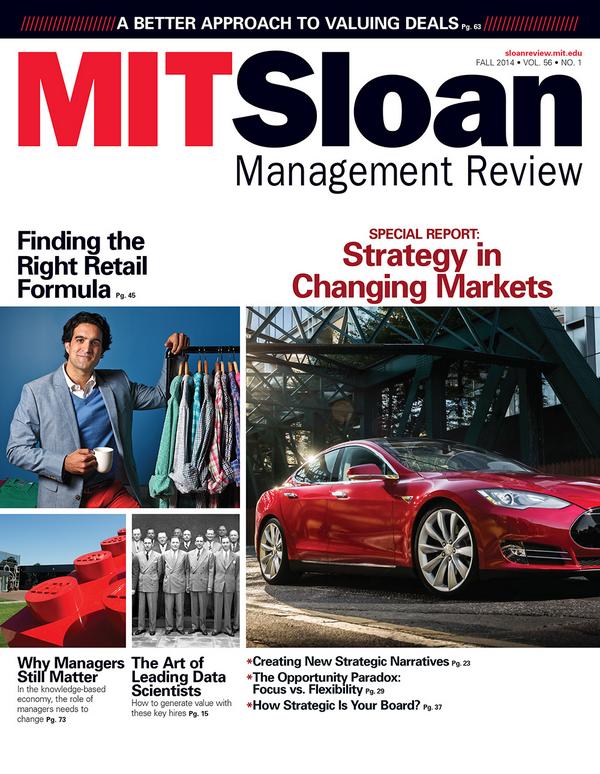 Here is a recent MIT Sloan Management Review piece by Peter and me, “Why Managers Still Matter.” We pick up on a number of themes of our 2012 book Organizing Entrepreneurial Judgment. A brief excerpt:
“Wikifying” the modern business has become a call to arms for some management scholars and pundits. As Tim Kastelle, a leading scholar on innovation management at the University of Queensland Business School in Australia, wrote: “It’s time to start reimagining management. Making everyone a chief is a good place to start.”
Companies, some of which operate in very traditional market sectors, have been crowing for years about their systems for “managing without managers” and how market forces and well-designed incentives can help decentralize management and motivate employees to take the initiative. . . .
From our perspective, the view that executive authority is increasingly passé is wrong. Indeed, we have found that it is essential in situations where (1) decisions are time-sensitive; (2) key knowledge is concentrated within the management team; and (3) there is need for internal coordination. . . . Such conditions are hallmarks of our networked, knowledge-intensive and hypercompetitive economy.
Academics and Social Media
| Peter Klein |
At this week’s Strategic Management Conference in Madrid I participated in an interesting session on Media Innovations, along with Will Mitchell and Wiley’s Caroline McCarley. My remarks focused on academics and their use of social media. How (if at all) can professors use blogs, videos, wikis, and other social media products to disseminate their research, to improve their teaching, and even to discover new ideas? Are social media and “serious” activities like research and class preparation substitutes or complements? Should untenured faculty avoid such distractions?
I began my remarks — where else? — with Kim Kardashian. Biologist Neil Hall made a bit of a splash a few months back by introducing the Kardashian Index, basically the ratio of an academic researcher’s Twitter followers to citations in peer-reviewed journals. (For a rough approximation, just divide Twitter followers by Google Scholar cites.) Someone with a very high K-index, the story goes, has a large popular following, but hasn’t made any important scientific contributions — in other words, like Kim, famous for being famous.
Science published a rejoinder suggesting that the K-index gets it wrong by implying, incorrectly, that popular and scholarly influence are inversely related. Indeed, among the top 20 natural scientists, by Twitter followers, are some scientific lightweights like Neil deGrasse Tyson (2.4 million Twitter followers and 151 citations), but also serious thinkers like Tim Berners-Lee (179,000 followers and 51,204 cites) and Steven Pinker (142,000 and 49,933). I haven’t run the numbers for economists and management scholars but I think you’ll find the same general pattern. E.g., among the biggies on the LDRLB Top Professors on Twitter list you find a mix of practitioner-oriented writers with modest academic influence (Bill George, Richard Florida, Stew Friedman, Gary Hamel) and scholars with huge citation counts (Mike Porter, Clay Christensen, Adam Grant).
I went on to emphasize (as usual) that, for the most part, these issues are nothing new. Scholars and thinkers throughout history have used whatever media are available to disseminate their ideas to wider audiences. In the 17th-19th centuries there were pamphlets, handbills, newspapers, and lecture halls; in the 20th century radio, magazines, TV, and other outlets. Classical economists like John Stuart Mill published anti-slavery tracts; the Verein für Socialpolitik took positions on important social issues of the day; the American Economic Association was founded to combat lassiez-faire; C. S. Lewis gave his famous wartime radio lectures; Paul Samuelson and Milton Friedman dueled in the pages of Newsweek, and Friedman took to the airwaves for the PBS series “Free to Choose.” So academic bloggers, Tweeters, Facebookers, YouTubers, LinkedInners, and Instagrammers are following in a grand tradition. Of course, what’s new today is the scale; without a contract for a newspaper column or TV show, any of us can set up shop, and have the potential to reach a very wide audience. (more…)
The WINIR Greenwich Conference
| Dick Langlois |
 I write on the flight back from the inaugural conference of the World Interdisciplinary Network for Institutional Research (WINIR), which met on the Prime Meridian these last few days. The conference was a great success, not only for its wonderful location in the Old Royal Naval College astride the Cutty Sark but also for the overall quality of the organization and the presentations.
As I have mentioned before, WINIR was created to encourage institutional research from a wide range of perspectives and disciplines. The annual conference institutionalizes this (you might say) by having keynote speakers from five different disciplines. The political scientist was Kathleen Thelen from MIT, one of my fellow editors on the Journal of Institutional Economics; the legal scholar was Katharina Pistor from Columbia; and the sociologist was Geoffrey Ingham from Cambridge, who made some interesting observations about Chinese institutions in the context of the “great divergence” debate in economic history. Serious and well-known scholars all. The economist was Timur Kuran, who updated us on his fascinating work on the economics of the pre-nineteenth-century Islamic waqf. But the most interesting – or at any rate most surprising – keynote was the philosopher Barry Smith from Buffalo, whom some of you may have heard of for his early work on the philosophy of Austrian economics. Smith’s talk was about “ontology,” which in my ignorance I had expected to be an hour of head-breaking essentialism. It turns out that “ontology” now means the practice of classification – giving things the right names and putting them in the right boxes. As much computer science as philosophy, it seemed to me. The main applications are in databases and sciences more generally, including things like Department of Defense databases and Human Genome data. Smith is a world-leading practitioner of this kind of ontology, having founded something called the National Center for Ontological Research. (I must confess that the first thing that popped into my mind when I heard this title was the High-Energy Magic Building at Terry Pratchett’s Unseen University.) Basically, ontology appears to be about modularization and standardization, something quite fitting to talk about in the shadow of the Royal Greenwich Observatory. I discovered that Smith was unaware of the modularity literature, so I plan to send him some references.
Many of the parallel sessions were also of high quality. I could attend only a fraction of them (what with sneaking out to visit the longitude exhibit at the National Maritime Museum). But let me plug a couple of papers by my friends. Giampaolo Garzarelli and Lyndal Keeton modeled “internal exit” in pre-colonial Southern Africa, the fissioning off of subtribal groups to found new polities. (I was impressed with the quality of that entire session.) As I was chairing a competing session later, I missed Roger Koppl and Caryn Devin talking about their paper “Against Design,” written with Stuart Kauffman and Teppo Felin. A version of that collaboration will appear in JOIE as a target article with solicited comments. (more…)
SMS Teaching Workshop: Impact of New Technologies on Teaching and Higher Education
| Peter Klein |
Along with  Gonçalo Pacheco de Almeida I am chairing the Competitive Strategy Interest Group Teaching Workshop at the upcoming Strategic Management Society conference in Madrid. The workshop is Saturday, 20 September 2014, 1:00-4:00pm at the main conference venue, the NH Eurobuilding, Paris Room. Our theme is “The Impact of New Technologies on Teaching and Higher Education” and we have an all-star lineup featuring Bharat Anand (Harvard), Peter Zemsky (INSEAD), Michael Leiblein (Ohio State), Michael Lenox (University of Virginia), Frank Rothaermel (Georgia Tech), Vivek Goel (Chief Academic Strategist at Coursera), and Andrea Martin (President of IBM Academy of Technology).
Background: The higher-education industry is abuzz with talk about MOOCs, distance learning, computer-based instruction, and other pedagogical innovations. Many of you are already using online exercises and assessments, simulations, and other activities in the classroom. How are these innovations best incorporated into the business curriculum, at the BBA, MBA, EMBA, and PhD levels? What can business scholars, say about the impact of these technologies on higher education more generally? Are they sustaining or disruptive innovations, and what do they imply for the structure of the business school, and the university itself?
The plan for this session is to discuss how leading companies and business schools are (a) driving innovation in the Higher Education teaching space, (b) thinking about the business model of virtual education (MOOCs, social learning, etc.), and (c) testing some of the assumptions behind globalization in the education industry.
The full schedule is below the fold. Additional information about the workshop, and the SMS itself, is available at the conference website.
If you’re coming to SMS this year, please plan to join us for the workshop. Pre-registration is encouraged but not required. If you’re planning to attend, please let us know by sending an email to csig.teaching2014@gmail.com. Feel free to email Gonçalo or myself at the same address with questions or comments. (more…)
Entrepreneurship and the Established Firm: A Call to Arms
| Nicolai Foss |
Frequent readers of this blog will know that we (well, some more than others [ahem]) tend to obsess about the proper conceptualization of entrepreneurship, such as whether “opportunity” is a useful construct in the context of entrepreneurship research, and whether this, heavily expanding, research field is best off by thinking of entrepreneurship in terms of “opportunity discovery.” In this brief essay, just published in Strategic Organization, Dr. Jacob Lyngsie (Dept of Strategic Management and Globalization, Copenahgen Business School) and I discuss how the emphasis on opportunity discovery in the literature is accompanied by a neglect of entrepreneurship in the established firm and a tendency to think of entrepreneurs as individuals (rather than teams) (similar themes are discussed in the recent Foss and Klein volume, Organizing Entrepreneurial Judgment). We call for a research effort that systematically deal with how entrepreneurial established firms organize a division of entrepreneurial labor, and on how administrative machinery can be deployed inside firms to foster the motivation, opportunity and ability that drive entrepreneurial behaviors.
Theories of the Firm
| Peter Klein |
At the recent Academy of Management conference in Philadelphia I was pleased to participate in a pre-conference workshop organized by Paul Drnevich, Larry Tribble, and David Croson, “Theories and Their Words: A Cross-Academy Discussion of Perspectives on Value Creation and Capture.” From the blurb:
In this workshop a panel of senior and emerging scholars provides a forum to examine and discuss the roles and implications of several prominent management theories and their differing terminology for creating and capturing value. Our distinguished panelists will provide an overview of the value implications of several well-known foundational theories of the existence and purpose of business organizations: Transaction Cost Economics (TCE), Property Rights Theory (PRT), the Capabilities and Resource-based View (RBV), and Industrial Organization (IO), discuss challenges often encountered in efforts to integrate these theories and their terminology, and explore commonalities and intersections across these perspectives that may yield opportunities for future research. We provide perspectives from the distinguished scholars as a means of clarifying how each theory explains the core concepts of value creation and value capture, without which a sustainable business cannot exist. We then offer a discussion of points of commonality and integration of the theories around value creation and value capture with an open forum Q&A session with the presenters regarding directions for future research. We conclude with round-table breakout discussions, each led by a senior scholar and focused on a specific aspect of the theory they presented for more detailed discussion of future research in that theoretical stream.
The presentations from the workshop are online here. You may find them interesting for for research and for teaching. My own presentation on strategy and transaction cost economics covered the basics of TCE and asked if TCE is really a theory of strategy (short answer: no and yes).
Update: Mike Ryall’s presentation is viewable here.
Debating Microfoundations, Euro-style
| Nicolai Foss |
As readers of this blog will know, probably to a nauseating extent, microfoundations have been central in much (macro) management theory over the last decade. Several articles, special issues, and conferences have been dedicated to microfoundations, most recently a Strategic Management Society Special Conference at the Copenhagen Business School. Some, uhm, highlyspirited exchanges have taken place (e.g., AoM 2013), with proponents of those foundations being accused of economics imperalism and whatnot, and critics of microfoundations receiving push-back for endorsing defunct Durkheimian collectivism (an obviously justified criticism). Here is recent civilized exchange on the subject between Professor Rodolphe Durand, HEC Paris, and myself. Complete with heavy Euro accents of different origins.
History Lesson: 200 Years of Management, uhm, Thought
| Nicolai Foss |
OK, surely you have come across those timelines featuring the great economists, á la Aristotle-the Spanish Scholastics–William Petty-Cantillon-Smith-Ricardo-Say-Menger-Wicksteed-Marshall-Mises-Hayek-Boettke-Langlois-Klein-etc. Here is a similar timeline with the Greats of management theory, 1800-2000 (Lien seems to be missing, however). Many of the names of those management types are clickable, taking you to e.g. their wikis. Fun brush-up, and may be good for students.
Evaluating New Ideas: Looking Across and Looking Beyond
| Nicolai Foss |
Those of us who have experience with research councils and other funding bodies with expert evaluations of the submitted research are familiar wilth folklore, such as “When evaluating economists routinely smash non-economics projects,” “sociologists are a total incrowd and will not tolerate any application of rational choice method, serious econometrics or common sense,” etc. Of course, this is part of the various conspiracy theories about how, notably, economists seek to establish intellectual hegemony.
However, the folklore may be wrong. In a new paper, “Looking Across and Looking Beyond the Knowledge Frontier: Intellectual Distance and Resource Allocation in Science,” Kevin Boudreau, Eva Guinan, Karim Lakhani and Christoph Riedl look at the grant proposal process at a major research university and show that evaluators tend to treat proposals more harshly the closer they were to their own areas of expertise. However, evaluators also treat highly novel proposals negatively. Taking issues of ecological and external validity into account, there are obvious implications for the understanding of the nature of the exploitation/exploration tradeoff: There may indeed be a bias against exploring in the domains of highly novel ideas (as predicted by the literature), but the harsh evaluation of new, but well understood ideas may mean that there is a domain of relatively novel and less well understood ideas within which firms will explore.
Making Money from Behavioral Social Science?
| Peter Klein |
Longtime readers of this blog expect skepticism about behavioral social science. One of my issues is the assumed, but unexplored, assumption that private actors and market institutions cannot deal with behavioral anomalies, and therefore government intervention is necessary to make people act “rationally.” But if we can really improve health outcomes by putting the chocolate cake behind the carrot sticks in the display case, why wouldn’t profit-seeking entrepreneurs exploit this fact? Consumers pay substantial price premiums for organic produce, grass-fed meats, and other healthy products, even when the purported health benefits are long-term and uncertain. Wouldn’t some patronize the behavioral-economics-influenced grocer? “Our shelves are arranged to encourage healthy food choices.” Add earth tones, hipster music, an onsite juice bar, and the place will make as much money as your local Whole Foods.
To be a little less flippant: consider adverse selection theory. Many people misread Akerlof’s famous paper as a call for government regulation of used-car markets (or, worse, as a demonstration that used-car markets can’t exist). In fact, as Akerlof states plainly in the original piece, his theory explains the existence of private assurance mechanisms such as warranties, third-party certification, quality signalling, and the like.
A recent Forbes piece puts it this way: How do you make money by helping mitigate behavioral anomalies? Cognitive biases “have been accepted into the mainstream of economics and pop culture, particularly since the recent publication of popular books such as Richard Thaler and Cass Sunstein’s Nudge, Dan Ariely’s Predictably Irrational, and Daniel Kahneman’s Thinking, Fast and Slow. Even so, relatively few companies have attempted to use behavioral economics to try to change people’s behavior around overeating, smoking, or other bad habits many are desperate to break.” The focus is on the diet company StickK, which takes advantage of loss aversion (pun intended) to help people achieve weight and other goals.
StickK is a cool site, and I hope it is successful. But, if behavioral theory is so powerful and general, why aren’t more entrepreneurs taking advantage of it?
Microeconomics of Central Banking
| Peter Klein |
I have a chapter in a new book edited by David Howden and Joseph Salerno, The Fed at One Hundred: A Critical View on the Federal Reserve System (New York: Springer, 2014). My chapter is called “Information, Incentives, and Organization: The Microeconomics of Central Banking,” and builds upon themes discussed many times on this blog, such as Fed independence. Here is a SSRN version of the chapter. The book comes out next month but you can pre-order at the Amazon link above.
The Use of History in Management Research and Education
| Peter Klein |
Another book recommendation, also courtesy of EH.Net. The book is Organizations in Time: History, Theory, Methods (Oxford University Press, 2014), edited by Marcelo Bucheli and R. Daniel Wadhwani. (Bucheli is author of an excellent book on the United Fruit Company.) Organizations in Time is about of the use of history in management research and education. Perhaps surprisingly, the field of business history is not usually part of the business school curriculum. In the US at least, business historians are typically affiliated with history or economics departments, not management departments or other parts of the business school. EH.Net reviewer Andrew Smith notes the following:
Until the 1960s, economic history and business history had an important place in business school teaching and research. Many management scholars then decided to emulate research models developed in the hard sciences, which led to history becoming marginal in most business schools. History lost respect among positivistic management academics because historians made few broad theoretical claims, rarely discussed their research methodologies, and did not explicitly identify their independent and dependent variables. Historians in management schools became, effectively, disciplinary guests in their institutions.
The period from 2008 to the present has witnessed a revival of interest in history on the part of consumers of economic knowledge in a variety of academic disciplines, not to mention society as a whole. . . . It is now widely recognized that there needs to be more history in business school research and teaching. However, as Marcelo Bucheli and Dan Wadhwani note in the introductory essay, this apparent consensus obscures a lack of clarity about what a “historic turn” would, in practice, involve (p. 5).
This volume argues that the historic turn cannot simply be about going to the historical record to gather data points for the testing of various social-scientific theories, which is what scholars such as Reinhart and Rogoff do. Rather than being yet another device for allowing the quantitative social sciences to colonize the past, the historic turn should involve the adoption of historical methods by other management school academics. At the very least, people in the field of organization studies should borrow more tools from the historian’s toolkit.
Read the book (or at least the review) to learn more about these tools and approaches, which involve psychology, embeddedness, path dependence, and other concepts familiar to O&M readers.
Competition in Early Telephone Networks
| Peter Klein |
 As with other technologies involving network effects, the early telephone industry featured competing, geographically overlapping networks. Robert MacDougall provides a fascinating history of this period in The People’s Network: The Political Economy of the Telephone in the Gilded Age (University of Pennsylvania Press, 2013). From the book blurb:
In the decades around 1900, ordinary citizens—farmers, doctors, small-town entrepreneurs—established tens of thousands of independent telephone systems, stringing their own wires to bring this new technology to the people. Managed by opportunists and idealists alike, these small businesses were motivated not only by profit but also by the promise of open communication as a weapon against monopoly capital and for protection of regional autonomy. As the Bell empire grew, independents fought fiercely to retain control of their local networks and companies—a struggle with an emerging corporate giant that has been almost entirely forgotten.
David Hochfelder wrote a thoughtful review which appeared today on EH.Net. As Hochfelder points out, the history of the telephone is not just about technology and market structure, but broader social themes as well:
At one level, this is a story about industrial competition. At a deeper level, it reveals competing visions of an important technology, the social role that it ought to play. MacDougall shows that the Bell System and the Independents envisioned the telephone in far different ways. Bell, especially under Theodore Vail, president of AT&T between 1907 and 1919, sought to build a unified telecommunications network that spanned the United States. Bell Canada espoused a different vision, that the telephone ought to remain an expensive urban medium primarily used for business purposes. Both Bell systems shared the ideology that the telephone industry ought to be controlled by centralized, national corporations. On the other hand, the Independents described the Bell System as a grasping octopus that wanted a stranglehold over the nation’s communications. The Independents offered instead a vision of the telephone as a people’s network that enhanced local ties and preserved community autonomy. In the United States, MacDougall claims that the Independents’ vision for the telephone “descended from a civic understanding of communication that went back to the American Revolution,” that “free and open communications were a basic ingredient of democracy” (p. 5). On a more mundane level, the Independents encouraged social uses of the telephone — like gossiping and banjo-playing — that the Bell System actively discouraged at the time.
Westgren on Entrepreneurial Opportunities
| Peter Klein |
 My colleague Randy Westgren has two thoughtful posts on entrepreneurial opportunities (1, 2). Randy shares my unease with the construct of opportunity, which began as a metaphor introduced by Israel Kirzner, only to be reified by entrepreneurship scholars looking for a central organizing construct. My own view is that the concept of opportunity is redundant at best, misleading at worst. Randy expresses the same idea: “If the opportunity is so important to the entrepreneurial process, why are there so many mediating actions and decisions between the existence and the outcomes? How much of the outcomes does the existence of the opportunity explain?” He goes on to propose some useful taxonomies for making sense of the literature. More to come.
Foss and Klein Interview on Entrepreneurial Judgment
| Peter Klein |
Nicolai and I are interviewed by Angel Martin for the Spanish-language site sintetia. An English-language version is here. We wax eloquent on entrepreneurship theory, research, teaching, policy, and more. Personally, I think I sound more profound in Spanish, but that’s probably because I can’t read Spanish.
More Pioneers of Entrepreneurship Research
| Peter Klein |
Besides the essay on Mark Casson discussed below, the Strategic Entrepreneurship Journal has released forthcoming profiles of Ian MacMillan (by Rita McGrath), Arnold Cooper (by Tim Folta), and Steve Klepper (by Rajshree Agarwal and Serguey Braguinsky), as part of its series on “Research Pioneers.”





 Organizations and Markets
Recent Comments