Upcoming Workshops, Seminars, and Events
| Peter Klein |
Some upcoming events of interest to O&M readers:
- “Research and Policy Change Inspired by Ronald Coase,” 27-28 March 2015, Washington DC
- Berkeley-Paris Organizational Economics Workshop, 10-11 April 2015, Paris
- BHC/EBHA Workshop Historical Approaches to Entrepreneurship Theory & Research, 24 June 2015, Miami FL
- TILEC Economic Governance Workshop, “Economic Governance and Social Preferences,” 3-4 September 2015, Tilburg
Benefits of Academic Blogging
| Peter Klein |
I sometimes worry that the blog format is being displaced by Facebook, Twitter, and similar platforms, but Patrick Dunleavy from the LSE Impact of Social Science Blog remains a fan of academic blogs, particularly focused group blogs like, ahem, O&M. Patrick argues that blogging (supported by academic tweeting) is “quick to do in real time”; “communicates bottom-line results and ‘take aways’ in clear language, yet with due regard to methods issues and quality of evidence”; helps “create multi-disciplinary understanding and the joining-up of previously siloed knowledge”; “creates a vastly enlarged foundation for the development of ‘bridging’ academics, with real inter-disciplinary competences”; and “can also support in a novel and stimulating way the traditional role of a university as an agent of ‘local integration’ across multiple disciplines.”
Patrick also usefully distinguishes between solo blogs, collaborative or group blogs (like O&M), and multi-author blogs (professionally edited and produced, purely academic). O&M is partly academic, partly personal, but we have largely the same objectives as those outlined in Patrick’s post.
See also our recent discussion of academics and social media.
(HT: REW)
Two Large-Sample Empirical Papers on Strategy and Organization
| Peter Klein |
Bryan Hong, Lorenz Kueng, and Mu-Jeung Yang have two new NBER papers on strategy and organization using a seven-year panel of about 5,500 Canadian firms. The papers exploit the Workplace and Employee Survey administered annually by Statistics Canada. The data, the authors’ approach, and the results should be very interesting to O&M readers. Here are the links to the NBER versions; there may be ungated versions as well.
Business Strategy and the Management of Firms
NBER Working Paper No. 20846, January 2015Business strategy can be defined as a firm’s plan to generate economic profits based on lower cost, better quality, or new products. The analysis of business strategy is thus at the intersection of market competition and a firm’s efforts to secure persistently superior performance via investments in better management and organization. We empirically analyze the interaction of firms’ business strategies and their managerial practices using a unique, detailed dataset on business strategy, internal firm organization, performance and innovation, which is representative of the entire Canadian economy. Our empirical results show that measures of business strategy are strongly correlated with firm performance, both in the cross-section and over time, and even after controlling for unobserved profit shocks exploiting intermediates utilization. Results are particularly striking for innovation, as firms with some priority in business strategies are significantly more likely to innovate than firms without any strategic priority. Furthermore, our analysis highlights that the relationship between strategy and management is driven by two key organizational trade-offs: employee initiative vs. coordination as well as exploration of novel business opportunities vs. exploitation of existing profit sources.
Estimating Management Practice Complementarity between Decentralization and Performance Pay
NBER Working Paper No. 20845, January 2015The existence of complementarity across management practices has been proposed as one potential explanation for the persistence of firm-level productivity differences. However, thus far no conclusive population-level tests of the complementary joint adoption of management practices have been conducted. Using unique detailed data on internal organization, occupational composition, and firm performance for a nationally representative sample of firms in the Canadian economy, we exploit regional variation in income tax progression as an instrument for the adoption of performance pay. We find systematic evidence for the complementarity of performance pay and decentralization of decision-making from principals to employees. Furthermore, in response to the adoption of performance pay, we find a concentration of decision-making at the level of managerial employees, as opposed to a general movement towards more decentralization throughout the organization. Finally, we find that adoption of performance pay is related to other types of organizational restructuring, such as greater use of outsourcing, Total Quality Management, re-engineering, and a reduction in the number of layers in the hierarchy.
Henry G. Manne (1928-2015)
| Peter Klein |
 Very sorry to report the passing of Henry Manne yesterday at the age of 86. Manne made seminal contributions to the literatures in corporate governance, securities regulation, higher education, and many other subjects. Here are past O&M posts on Manne and his contributions. I tried several times to get him to guest blog on O&M but couldn’t pull it off.
I got to know him fairly well in the last few years and he was a charming companion and correspondent — clever, witty, erudite, and a great social and cultural critic, especially of the strange world of academia, where he plied his trade for five decades but always as a slight outsider.
Here are tributes and commentaries from David Henderson, Jane Shaw, Don Boudreaux, and me. We’ll share more in the coming days.
Team Science and the Creative Genius
| Peter Klein |
 We’ve addressed the widely held, but largely mistaken, view of creative artists and entrepreneurs as auteurs, isolated and misunderstood, fighting the establishment and bucking the conventional wisdom. In the more typical case, the creative genius is part of a collaborative team and takes full advantage of the division of labor. After all, is our ability to cooperate through voluntary exchange, in line with comparative advantage, that distinguishes us from the animals.
Christian Caryl’s New Yorker review of The Imitation Game makes a similar point about Alan Turing. The film’s portrayal of Turing (played by Benedict Cumberbatch) “conforms to the familiar stereotype of the otherworldly nerd: he’s the kind of guy who doesn’t even understand an invitation to lunch. This places him at odds not only with the other codebreakers in his unit, but also, equally predictably, positions him as a natural rebel.” In fact, Turing was funny and could be quite charming, and got along well with his colleagues and supervisors.
As Caryl points out, these distortions
point to a much broader and deeply regrettable pattern. [Director] Tyldum and [writer] Moore are determined to suggest maximum dramatic tension between their tragic outsider and a blinkered society. (“You will never understand the importance of what I am creating here,” [Turing] wails when Denniston’s minions try to destroy his machine.) But this not only fatally miscasts Turing as a character—it also completely destroys any coherent telling of what he and his colleagues were trying to do.
In reality, Turing was an entirely willing participant in a collective enterprise that featured a host of other outstanding intellects who happily coexisted to extraordinary effect. The actual Denniston, for example, was an experienced cryptanalyst and was among those who, in 1939, debriefed the three Polish experts who had already spent years figuring out how to attack the Enigma, the state-of-the-art cipher machine the German military used for virtually all of their communications. It was their work that provided the template for the machines Turing would later create to revolutionize the British signals intelligence effort. So Turing and his colleagues were encouraged in their work by a military leadership that actually had a pretty sound understanding of cryptological principles and operational security. . . .
The movie version, in short, represents a bizarre departure from the historical record. In fact, Bletchley Park—and not only Turing’s legendary Hut 8—was doing productive work from the very beginning of the war. Within a few years its motley assortment of codebreakers, linguists, stenographers, and communications experts were operating on a near-industrial scale. By the end of the war there were some 9,000 people working on the project, processing thousands of intercepts per day.
The rebel outsider makes for good storytelling, but in most human endeavors, including science, art, and entrepreneurship, it is well-organized groups, not auteurs, who make the biggest breakthroughs.
Top Posts of 2014
| Peter Klein |
It’s been another fine year for O&M, with over 100,000 unique visitors from Albania to Zimbabwe and about every country in-between. Our pageviews are down from 2006, the year we started this blog, but nowadays many people read our posts through Facebook or other syndication and sharing sites, so our actual reach is much larger.
Here are the most viewed posts written in the last year:
- Tirole
- What are “Transaction Costs” Anyway?
- Notes on Inequality
- Gary Becker: A Personal Appreciation
- It’s the Economics that Got Small
- Rich Makadok on Formal Modeling and Firm Strategy
- The Piketty Code
- Gary S. Becker, 1930-2014
- Is Human Capital Theory Compatible with the Strategy Literature?
- Cheating and Public Service
- The Soft Underbelly of Business Model Innovation
- More Skepticism of Behavioral Social Science
- Theories of the Firm
- The Theory of Mind in Agency Theory
- Academics and Social Media
- The New Empirical Economics of Management
Thanks to our readers and commentators for a great 2014. We are looking forward to 2015!
More on Strategy and Game Theory
| Peter Klein |
 Recent posts on strategy and game theory (here and here) generated quite a lot of discussion here and on social media. Avinash Dixit offers more grist for the mill in his December 2014 Journal of Economic Literature essay on Lawrence Freedman’s Strategy: A History (Oxford, 2013). (An ungated version is here.) Dixit’s essay contrasts the economist’s and the historian’s view of strategy — “strategy” being game theory for the former, a broader, interpretive, interdisciplinary exercise for the latter — but the discussion is highly relevant for strategic management. The management literature has traditionally taken a wide, flexible view of “strategy,” closer to the historian’s sense than the economist’s, though that is rapidly changing as game theory becomes more widespread in strategic management research and teaching.
Here’s an excerpt from Dixit’s opening, which gives you the flavor:
[Freedman] heads the preface with a memorable quote from Mike Tyson: “Everyone has a plan till they get punched in the mouth.” Later he quotes another fighter, the legendary German Field Marshal Helmuth Karl Bernhard Graf von Moltke: “no plan survived contact with the enemy” (p. 104). The game theorist will respond: “Those plans are not strategies. They are incomplete. They fail to specify any action at the node of the game tree where you get punched in the mouth or meet the enemy army, or in the ensuing subgame.” It would be extreme stupidity, or arrogance tantamount to stupidity, for a boxer not to recognize the possibility of getting punched in the mouth. And although avoiding battle may be an important aspect of military strategy in many situations (see pp. 47–9), every plan should include a provision for action if or when battle commences. Tyson, or Freedman, will probably counter that even if the boxer starts with a complete plan that specifies the action for this contingency, the punch will make him forget the plan and react hot-headedly. Modern game theorists exposed to behavioral ideas will admit some truth in this, and agree that the boxer’s System 2 calculations are likely to fly out of the ring when the punch lands and System 1 instincts will take over. But they will add that that makes it all the more important for the boxer to strategize better in advance—to take actions before getting punched, either to reduce the risk, or to arrange matters in such a way that the anger and instinct (or the prospects of such reactions) are put to more effective use, as with the strategy of brinkmanship. More generally, “the art of creating power” often entails strategic moves like commitments, threats and promises that game theorists have analyzed following Thomas Schelling (1960). And Freedman’s picture of “strategy as a System 2 process engaged in a tussle with System 1 thinking” (p. 605) looks remarkably like Schelling’s (1984, ch. 3) “intimate contest for self-command.”
I have a twofold purpose in constructing the above exchange. One is to highlight the difference between the perspectives of economists and historians in thinking about the same situation. The second is to argue that each has something to learn from the other, and a fuller understanding can result from their dialog. The two perspectives share a lot of middle ground, and have useful complementarities.
The thoughtful essay is well worth reading in its entirety.
The Paper the World Needs Right Now
| Lasse Lien |
I strongly think this paper is both timely and useful.

Behavioral Contract Theory
| Peter Klein |
The December 2014 issue of the Journal of Economic Literature contains a nice review article on “Behavioral Contract Theory” by Botond Köszegi. Abstract below, ungated version here.
This review provides a critical survey of psychology-and-economics (“behavioral-economics”) research in contract theory. First, I introduce the theories of individual decision making most frequently used in behavioral contract theory, and formally illustrate some of their implications in contracting settings. Second, I provide a more comprehensive (but informal) survey of the psychology-and-economics work on classical contract-theoretic topics: moral hazard, screening, mechanism design, and incomplete contracts. I also summarize research on a new topic spawned by psychology and economics, exploitative contracting, that studies contracts designed primarily to take advantage of agent mistakes.
The Medieval Enlightenment in Economic Thought
| Dick Langlois |
Attending academic presentations as a spectator – a pure consumer – can be great fun. On November 20, I drove up to Boston for one day of a wonderful conference, put together by the Business History program at Harvard Business School, on the History of Law and Business Enterprise (which probably merited its own separate blog post). This is an area that I am starting to get interested in. The conference was in many ways a showcase for the GHLR perspective on the history of corporate organization – the acronym referring to the work of Timothy Guinnane, Naomi Lamoreaux, Ron Harris, and Jean-Laurent Rosenthal, all of whom were there. The conference took place across the street from Harvard Stadium on the weekend of the Harvard-Yale game. Harvard won the football game (alas), but the conference was a Yale rout.
And last week I attended a presentation here at UConn that was even more vicarious fun. Our Humanities Institute invited Joel Kaye from Barnard to talk about his new book, A History of Balance, 1250-1375: The Emergence of a New Model of Equilibrium and Its Impact on Thought, which has just appeared from Cambridge. I was the token economist in the audience, even though two of his chapters are about economics. His argument is that medieval scholastic thought changed radically over this period, and produced by its end a different and arguably more sophisticated model of how the economic world works. This “new” model is not the standard Aristotelian version we are normally told about but was in fact something far closer to the views of the Scottish Enlightenment. (Needless to say, his telling of this was far more nuanced.) In addition to Nicole Oresme, whom I had heard of, he relies heavily on the work of Peter John Olivi, an earlier Franciscan theologian, whom I had never heard of. In Kaye’s telling, Olivi came close to something like the idea of the invisible hand. I took a quick look at standard history-of-thought texts, and nobody mentions Olivi at all – except Murray Rothbard, who credits him with discovering the subjective theory of value.
This is really a story about the Enlightenment of the High Middle Ages, which took place among academic clerics in an age of population growth, (extensive) economic growth, and urbanization. As Kaye apparently argues in an earlier book, these academics were constantly confronted with the market – especially in the thriving city of Paris – and were well versed in market practice; indeed, this knowledge of the market and money contributed to advances in physical and biological as well as social sciences. The medieval academic Enlightenment went into decline after the Black Death in the early fourteenth century. The resulting dislocations and the swing in relative prices – in favor of peasants and against landholders, including importantly the Church – reduced the centrality and authority of academic thought, even as they spurred institutional changes that would set the stage for growth in the early modern period. Population in Europe did not return to its pre-plague levels until the sixteenth or seventeenth century, and economic thought took just as long to recover. (I know this is whiggish, but I can’t help it.)
There was perhaps one connection between the two events. At HBS, Ron Harris talked about his ongoing research on the earliest history of the corporate form in the East and the West. Here the commenda contract is the centerpiece. That is presumably what schoolmen like Olivi called by the Latin term societas, which was not, however, the same institution as the societas publicanus of ancient Rome.
On Classifying Academic Research
| Peter Klein |
Should academic work be classified primarily by discipline, or by problem? Within disciplines, do we start with theory versus application, micro versus macro, historical versus contemporary, or something else? Of course, there may be no single “optimal” classification scheme, but how we think about organizing research in our field says something about how we view the nature, contributions, and problems in the field.
There’s a very interesting discussion of this subject in the History of Economics Playground blog, focusing on the evolution of the Journal of Economic Literature codes used by economists (parts 1, 2, and 3). I particularly liked Beatrice Cherrier’s analysis of the AEA’s decision to drop “theory” as a separate category. The Machlup–Hutchison–Rothbard exchange helps establish the context.
[T]he seemingly administrative task of devising new categories threw AEA officials, in particular AER editor Bernard Haley and former AER interim editor Fritz Machlup, into heated debates over the nature and relationships of theoretical and empirical work.
Machlup campaigned for a separate “Abstract Economic Theory” top category. At the time of the revision, he was engaged in methodological work, striving to find a third way between Terence Hutchison’s “ultraempiricism,” and the “extreme a priorism” of his former mentor, Ludwig Von Mises (see Blaug, ch.4). He believed it was possible to differentiate between “fundamental (heuristic) hypotheses, which are not independently testable,” and “specific (factual) assumptions, which are supposed to correspond to observed facts or conditions.” The former was found in Keynes’s General Theory, and the latter in his Treatise on Money, Machlup explained. He thus proposed that empirical analysis be classified independently, under two categories: “Quantitative Research Techniques” and “Social Accounting, Measurements, and Numerical Hypotheses” (e.g., census data, expenditure surveys, input-output matrices, etc.). On the contrary, Haley wanted every category to cover the theoretical and empirical work related to a given subject matter. In his view, separating them was impossible, even meaningless: “Is there any theory that is not abstract? And, for that matter, is there any economic theory worth its salt that is not applied,” he teased Machlup. Also, he wanted to avoid the idea that “class 1 is theory, the rest are applied … How about monetary theory, international trade theory, business cycle theory?” He accordingly designed the top category to encompass price theory, but also statistical demand analysis, as well as “both theoretical and empirical studies of, e.g., the consumption function [and] economic growth models of the Harrod-Domar variety,” among other subjects. He eschewed any “theory” heading, which he replaced with titles such as “Price system; National Income Analysis.” His scheme eventually prevailed, but “theory” was reinstated in the title of the contentious category.
An Information Flow Diagram from 1922
| Peter Klein |
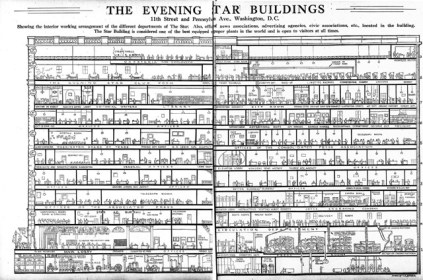
We’ve featured some cool vintage diagrams before, such as the New York and Erie Railroad organizational chart and the diagrams of the Mundaneum. Here’s an information flow diagram from 1922, represented as a cutaway view of the Washington Star newspaper offices. As Jason Kottke notes, it provides “a fascinating view of how information flowed through a newspaper company in the 1920s. Raw materials in the form of electricity, water, telegraph messages, paper, and employees enter the building and finished newspapers leave out the back.”
We Won a Book Award
| Nicolai Foss |
It doesn’t seem to have made its way to the Austrian blogs, but Peter and I just won the Society for the Development of Austrian Economics/Foundation of Economic Education Award for Best Book in Austrian Economics. Specifically, we received the Award for Organizing Entrepreneurial Judgment: A New Approach to the Firm. (Here is Peter and me presenting the book back in 2012). In addition, the book has picked up some cites and has sold quite well. Thus, we can hardly claim that it “fell still-born from the press.” Yet, it could be more influential and could sell better. You know what to do.
PhD Strategy Syllabi
| Peter Klein |
Russ Coff has assembled an impressive list of syllabi and reading lists for PhD courses in strategy, innovation, research methods, and related subjects. Feel free to send him additional suggestions. Many useful references here for faculty and students teaching or taking these courses, and for anybody wishing to learn more about classic and contemporary literature in strategic management research.
It’s the Economics that Got Small
| Peter Klein |
Joe Gillis: You’re Norma Desmond. You used to be in silent pictures. You used to be big.
Norma Desmond: I *am* big. It’s the *pictures* that got small.
— Sunset Boulevard (1950)
John List gave the keynote address at this weekend’s Southern Economic Association annual meeting. List is a pioneer in the use by economists of field experiments or randomized controlled trials, and his talk summarized some of his recent work and offered some general reflections on the field. It was a good talk, lively and engaging, and the crowd gave him a very enthusiastic response.
List opened and closed his talk with a well-known quote from Paul Samuelson’s textbook (e.g., this version from the 1985 edition, coauthored with William Nordhaus): “Economists . . . cannot perform the controlled experiments of chemists and biologists because they cannot easily control other important factors.” While professing appropriate respect for the achievements of Samuelson and Nordhaus, List shared the quote mainly to ridicule it. The rise of behavioral and experimental economics over the last few decades — in particular, the recent literature on field experiments or RCTs — shows that economists can and do perform experiments. Moreover, List argues, field experiments are even better than using laboratories, or conventional econometric methods with instrumental variables, propensity score matching, differences-in-differences, etc., because random assignment can do the identification. With a large enough sample, and careful experimental design, the researcher can identify causal relationships by comparing the effects of various interventions on treatment and control groups in the field, in a natural setting, not an artificial or simulated one.
While I enjoyed List’s talk, I became increasingly frustrated as it progressed, and found myself — I can’t believe I’m writing these words — defending Samuelson and Nordhaus. Of course, not only neoclassical economists, but nearly all economists, especially the Austrians, have denied explicitly that economics is an experimental science. “History can neither prove nor disprove any general statement in the manner in which the natural sciences accept or reject a hypothesis on the ground of laboratory experiments,” writes Mises (Human Action, p. 31). “Neither experimental verification nor experimental falsification of a general proposition are possible in this field.” The reason, Mises argues, is that history consists of non-repeatable events. “There are in [the social sciences] no such things as experimentally established facts. All experience in this field is, as must be repeated again and again, historical experience, that is, experience of complex phenomena” (Epistemological Problems of Economics, p. 69). To trace out relationships among such complex phenomena requires deductive theory.
Does experimental economics disprove this contention? Not really. List summarized two strands of his own work. The first deals with school achievement. List and his colleagues have partnered with a suburban Chicago school district to perform a series of randomized controlled trials on teacher and student performance. In one set of experiments, teachers were given various monetary incentives if their students improved their scores on standardized tests. The experiments revealed strong evidence for loss aversion: offering teachers year-end cash bonuses if their students improved had little effect on test scores, but giving teachers cash up front, and making them return it at the end of the year if their students did not improve, had a huge effect. Likewise, giving students $20 before a test, with the understanding that they have to give the money back if they don’t do well, leads to large improvements in test scores. Another set of randomized trials showed that responses to charitable fundraising letters are strongly impacted by the structure of the “ask.”
To be sure, this is interesting stuff, and school achievement and fundraising effectiveness are important social problems. But I found myself asking, again and again, where’s the economics? The proposed mechanisms involve a little psychology, and some basic economic intuition along the lines of “people respond to incentives.” But that’s about it. I couldn’t see anything in these design and execution of these experiments that would require a PhD in economics, or sociology, or psychology, or even a basic college economics course. From the perspective of economic theory, the problems seem pretty trivial. I suspect that Samuelson and Nordhaus had in mind the “big questions” of economics and social science: Is capitalism better than socialism? What causes business cycles? Is there a tradeoff between inflation and unemployment? What is the case for free trade? Should we go back to the gold standard? Why do nations to go war? It’s not clear to me how field experiments can shed light on these kinds of problems. Sure, we can use randomized controlled trials to find out why some people prefer red to blue, or what affects their self-reported happiness, or why we eat junk food instead of vegetables. But do you really need to invest 5-7 years getting a PhD in economics to do this sort of work? Is this the most valuable use of the best and brightest in the field?
My guess is that Samuelson and Nordhaus would reply to List: “We are big. It’s the economics that got small.”
See also: Identification versus Importance
Bottom-up Approaches to Economic Development
| Peter Klein |
Via Michael Strong, a thoughtful review and critique of Western-style economic development programs and their focus on one-size-fits-all, “big idea” approaches. Writing in the New Republic, Michael Hobbs takes on not only Bono and Jeff Sachs and USAID and the usual suspects, but even the randomized-controlled-trials crowd, or “randomistas,” like Duflo and Banerjee. Instead of searching for the big idea, thinking that “once we identify the correct one, we can simply unfurl it on the entire developing world like a picnic blanket,” we should support local, incremental, experimental, attempts to improve social and economic well being — a Hayekian bottom-up approach.
We all understand that every ecosystem, each forest floor or coral reef, is the result of millions of interactions between its constituent parts, a balance of all the aggregated adaptations of plants and animals to their climate and each other. Adding a non-native species, or removing one that has always been there, changes these relationships in ways that are too intertwined and complicated to predict. . . .
[I]nternational development is just such an invasive species. Why Dertu doesn’t have a vaccination clinic, why Kenyan schoolkids can’t read, it’s a combination of culture, politics, history, laws, infrastructure, individuals—all of a society’s component parts, their harmony and their discord, working as one organism. Introducing something foreign into that system—millions in donor cash, dozens of trained personnel and equipment, U.N. Land Rovers—causes it to adapt in ways you can’t predict.
Opportunity Discovery or Judgment? Fargo Edition
| Peter Klein |
In the opportunity-discovery perspective, profits result from the discovery and exploitation of disequilibrium “gaps” in the market. To earn profits an entrepreneur needs superior foresight or perception, but not risk capital or other productive assets. Capital is freely available from capitalists, who supply funds as requested by entrepreneurs but otherwise play a relatively minor, passive role. Residual decision and control rights are second-order phenomena, because the essence of entrepreneurship is alertness, not investing resources under uncertainty.
By contrast, the judgment-based view places capital, ownership, and uncertainty front and center. The essence of entrepreneurship is not ideation or imagination or creativity, but the constant combining and recombining of productive assets under uncertainty, in pursuit of profits. The entrepreneur is thus also a capitalist, and the capitalist is an entrepreneur. We can even imagine the alert individual — the entrepreneur of discovery theory — as a sort of consultant, bringing ideas to the entrepreneur-capitalist, who decides whether or not to act.
A scene from Fargo nicely illustrates the distinction. Protagonist Jerry Lundegaard thinks he’s found (“discovered”) a sure-fire profit opportunity; he just needs capital, which he hopes to get from his wealthy father-in-law Wade. Jerry sees himself as running the show and earning the profits. Wade, however, has other ideas — he thinks he’s making the investment and, if it pays off, pocketing the profits, paying Jerry a finder’s fee for bringing him the idea.
So, I ask you, who is the entrepreneur, Jerry or Wade?
Two Interesting NBER Papers
| Peter Klein |
A couple of recent NBER papers of interest to O&Mers, one from Doug Irwin, another from Luis Garicano and Esteban Rossi-Hansberg:
Adam Smith’s “Tolerable Administration of Justice” and the Wealth of Nations
Douglas A. Irwin
NBER Working Paper No. 20636, October 2014In the Wealth of Nations, Adam Smith argues that a country’s national income depends on its labor productivity, which in turn hinges on the division of labor. But why are some countries able to take advantage of the division of labor and become rich, while others fail to do so and remain poor? Smith’s answer, in an important but neglected theme of his work, is the security of property rights that enable individuals to “secure the fruits of their own labor” and allow the division of labor to occur. Countries that can establish a “tolerable administration of justice” to secure property rights and allow investment and exchange to take place will see economic progress take place. Smith’s emphasis on a country’s “institutions” in determining its relative income has been supported by recent empirical work on economic development.
Knowledge-based Hierarchies: Using Organizations to Understand the Economy
Luis Garicano, Esteban Rossi-Hansberg
NBER Working Paper No. 20607, October 2014We argue that incorporating the decision of how to organize the acquisition, use, and communication of knowledge into economic models is essential to understand a wide variety of economic phenomena. We survey the literature that has used knowledge-based hierarchies to study issues like the evolution of wage inequality, the growth and productivity of firms, economic development, the gains from international trade, as well as offshoring and the formation of international production teams, among many others. We also review the nascent empirical literature that has, so far, confirmed the importance of organizational decisions and many of its more salient implications.
Update: See also Irwin’s article in Monday’s WSJ: “The Ultimate Global Antipoverty Program.”
HOPE Launch Event
| Nicolai Foss |
This Wednesday, 22 October 2014, is the Launch event for the CBS research program I co-direct with Anders Sørensen, “Human Capital, Organization Design, and Corporate Performance” (HOPE). The program includes Ed Lazear, Kathryn Shaw, Ben Campbell, and David Ross. HOPE is about organizational structure and productivity:
Many of the European economies suffer from sluggish productivity growth. Firms matter strongly to economic growth. However, the understanding of firm performance has many gaps — particularly concerning the role for performance of human resources, organizational design, and their interaction.
The scientific ambition of HOPE is to address these gaps based on an interdisciplinary approach, intensively cooperating with some of the world’s leading researchers in the fields that inform this proposal, and by making use of the state-of-the-art econometric methods, and high-quality register and survey data. HOPE will enter a still sparsely populated but highly important field, and will place CBS centrally in the international discussion of the causes of firm performance, such as firm-level productivity.
HOPE is a joint venture between Department of Strategic Management and Globalization, and Department of Economics at Copenhagen Business School
Hope you can join us!
Rich Makadok on Formal Modeling and Firm Strategy
[A guest post from Rich Makadok, lifted from the comments section of the Tirole post below.]
Peter invited me to reply to [Warren Miller’s] comment, so I’ll try to offer a defense of formal economic modeling.
In answering Peter’s invitation, I’m at a bit of a disadvantage because I am definitely NOT an IO economist (perhaps because I actually CAN relax). Rather, I’m a strategy guy — far more interested in studying the private welfare of firms than the public welfare of economies (plus, it pays better and is more fun). So, I am in a much better position to comment on the benefits that the game-theoretic toolbox is currently starting to bring to the strategy field than on the benefits that it has brought to the economics discipline over the last four decades (i.e., since Akerlof’s 1970 Lemons paper really jump-started the trend).
Peter writes, “game theory was supposed to add transparency and ‘rigor’ to the analysis.” I have heard this argument many times (e.g., Adner et al, 2009 AMR), and I think it is a red herring, or at least a side show. Yes, formal modeling does add transparency and rigor, but that’s not its main benefit. If the only benefit of formal modeling were simply about improving transparency and rigor then I suspect that it would never have achieved much influence at all. Formal modeling, like any research tool or method, is best judged according to the degree of insight — not the degree of precision — that it brings to the field.
I can’t think of any empirical researcher who has gained fame merely by finding techniques to reduce the amount of noise in the estimate of a regression parameter that has already been the subject of other previous studies. Only if that improved estimation technique generates results that are dramatically different from previous results (or from expected results) would the improved precision of the estimate matter much — i.e., only if the improved precision led to a valuable new insight. In that case, it would really be the insight that mattered, not the precision. The impact of empirical work is proportionate to its degree of new insight, not to its degree of precision. The excruciatingly unsophisticated empirical methods in Ned Bowman’s highly influential “Risk-Return Paradox” and “Risk-Seeking by Troubled Firms” papers provide a great example of this point.
The same general principle is true of theoretical work as well. I can’t think of any formal modeler who has gained fame merely by sharpening the precision of an existing verbal theory. Such minor contributions, if they get published at all, are barely noticed and quickly forgotten. A formal model only has real impact when it generates some valuable new insight. As with empirics, the insight is what really matters, not the precision. (more…)





 Organizations and Markets
Recent Comments